


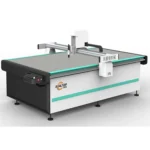
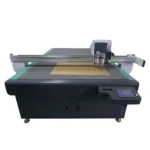
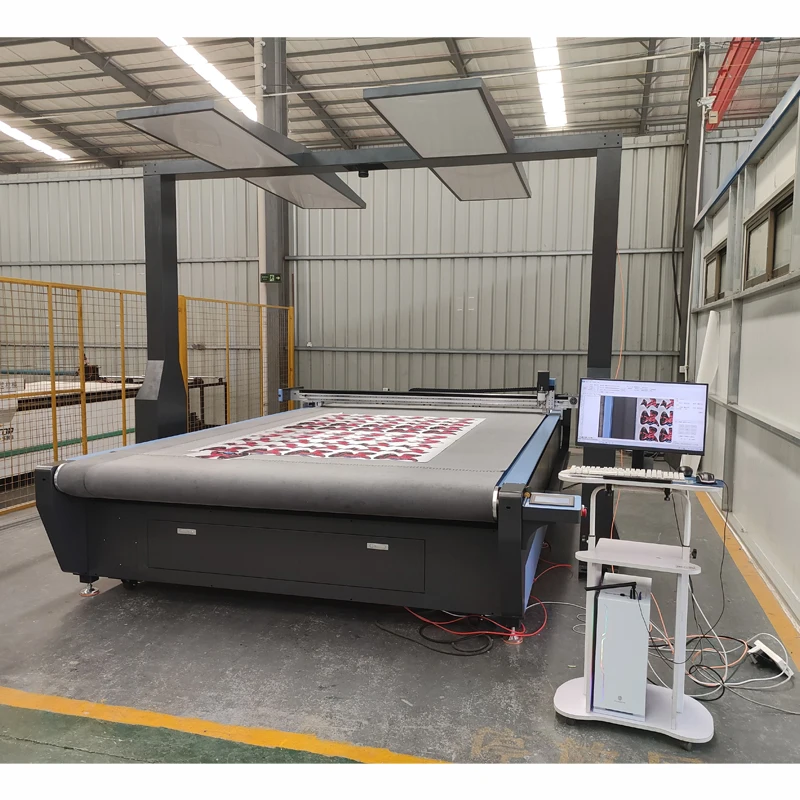
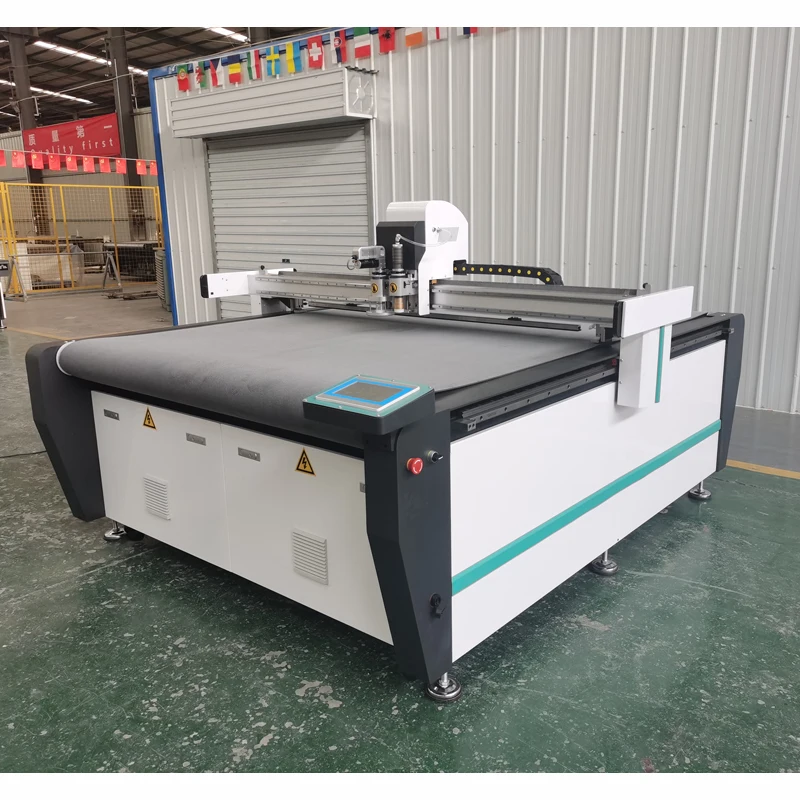
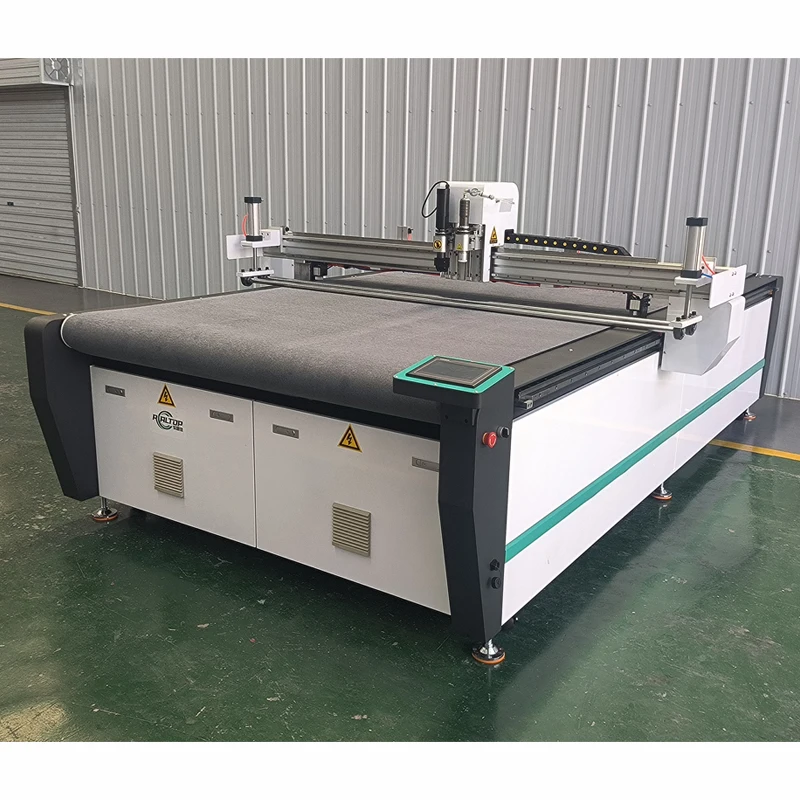
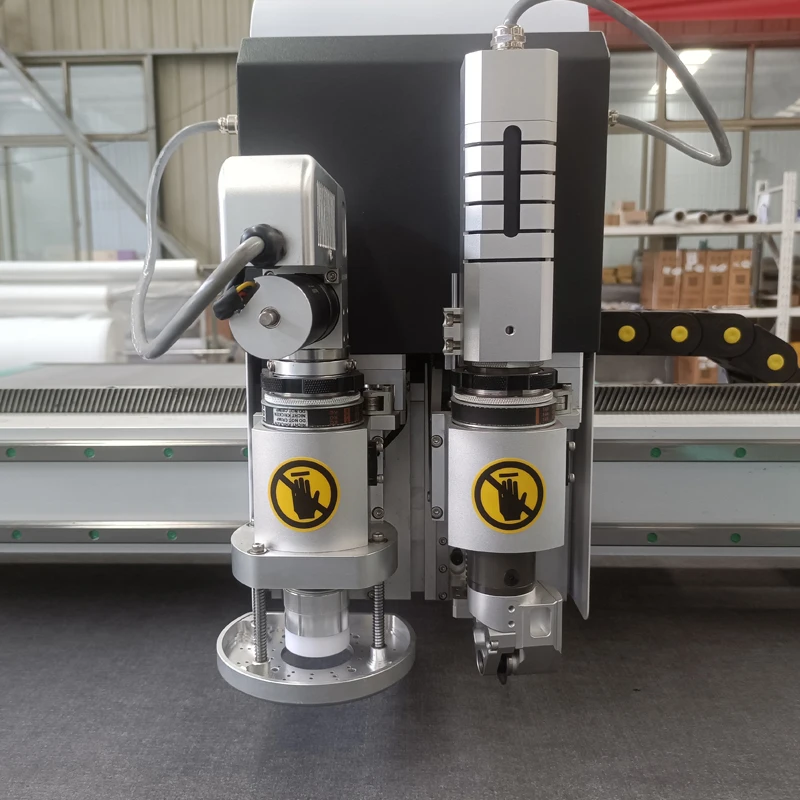
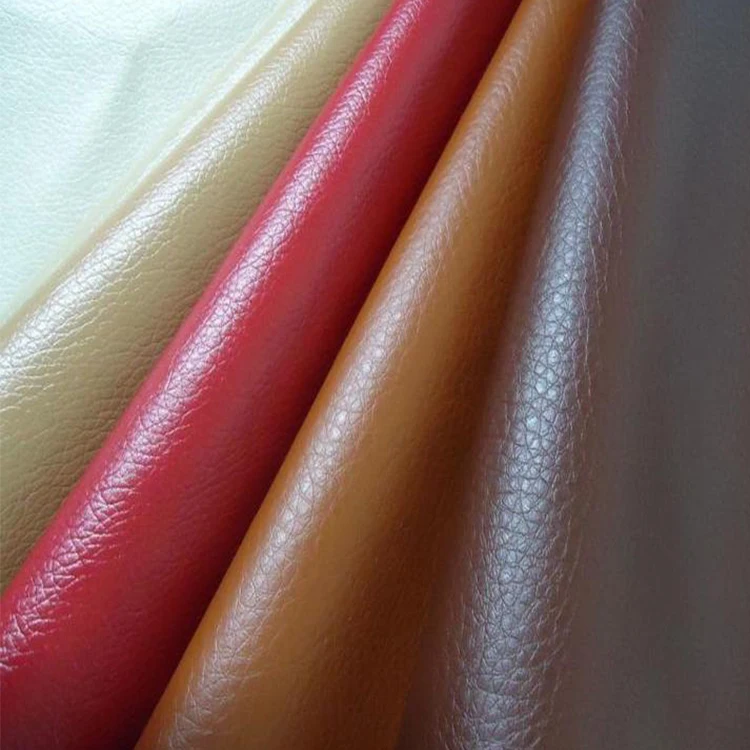
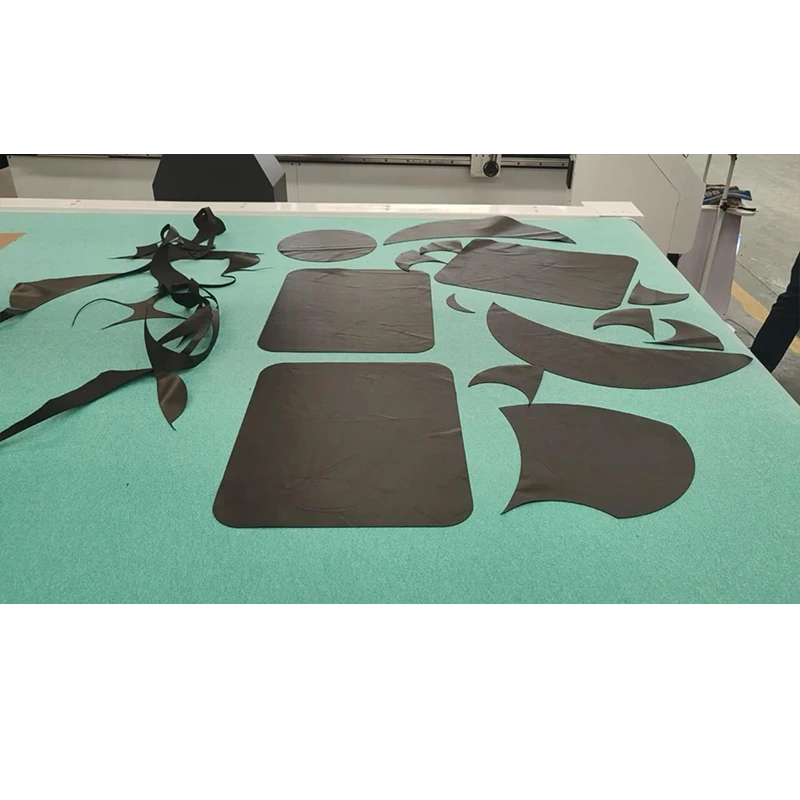

Verified Cutting Yield — panoramic CCD vision tested on your printed stock to extract contours and nest irregular leather outlines before the order is confirmed, not after the machine arrives.
Technical Specifications
| Parameter | Value |
|---|---|
| Product Type | CNC Oscillating Knife Cutting Machine |
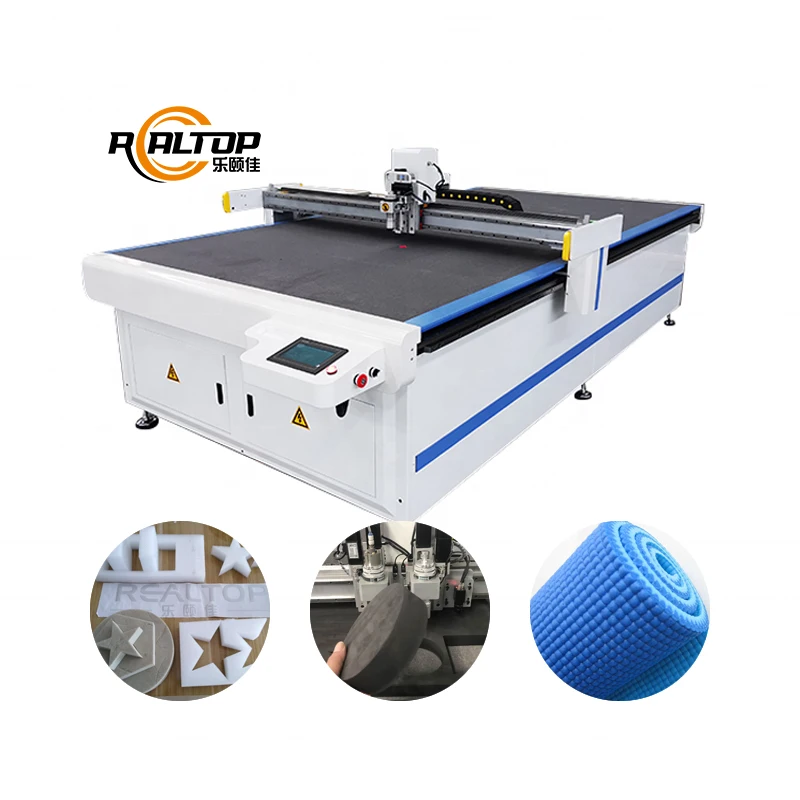
| Working Area | 1600×2500 mm |
| Machine Size | 3450×2300×1250 mm |
| Rated Power | 9 kW |
| Voltage | 380V ±10% |
| Cutting Thickness | 20 mm – 80 mm (basis not stated in source — confirm material type and density) |
| Translational Velocity | 800–1200 mm/s |
| Repeated Accuracy | ≤0.1 mm |
| Transmission System | Delta servo motor, Taiwan Hiwin linear guide, synchronous belt, ball screw |
| Tool Head Options | Swiss imported oscillating knife (full/half cut, cursor); pneumatic knife, high-power vibrating knife, circular knife, V-cutting knife, drag knife, creasing wheel, dotted line knife, punching, brush |
| Vision System | Small CCD camera mark-point positioning, panoramic camera recognition, projection positioning (optional) |
| Vacuum Table | Aluminum alloy vacuum adsorption, 7.5 kW vacuum pump |
| Feeding System | Automatic pulling and receiving, Germany imported conveyor belt |
| Safety Device | Infrared sensors |
| Software & File Formats | HP-GL compatible; pattern cutting software for carton, automotive foot pad/seat cover, garment fabric; language customizable |
Application Suitability
| Application | Material or Output |
|---|---|
| Garment and footwear batch cutting | Multi-layer fabric, textile, non-woven fabric with CCD-traced printed patterns |
| Automotive interior trim production | Leather, PU, EVA, composite materials cut to contoured shapes |
| Packaging and carton sample making | Corrugated cardboard, cardboard, plastic box — creasing, slot milling and full/half cutting |
| Sealing gasket fabrication | Rubber, PTFE, ETFE, fiberglass, gasket material |
| Soft furnishings and floor coverings | Carpet, sponge, foam board, XPE, PVC, PP, PE |
| Bags, luggage and shoe material processing | Leather, shoe material, luggage material, film, sticker |
Why Printed Contour Recognition Fails at Line Speed — and What to Verify Before You Commit
A panoramic CCD system must track your specific printed registration marks at full production speed, verified on your own stock before the purchase order is signed.
When a production manager invests in a CNC oscillating knife cutting machine production line turnkey setup, the assumption is that the vision system will handle any printed fabric or leather hide without manual intervention. In practice, camera resolution, lighting angle and mark contrast vary widely across printing processes, and a system that reads marks perfectly on one substrate can lose tracking entirely on another [NEED_CITE: vision system calibration standards for industrial cutting]. I have seen garment factories stop mid-run because the camera could not distinguish faded ink marks on dark polyester blends — the exact material they run eighty percent of the time. The fix is not a software patch after delivery; it is a sample cutting test on your actual printed stock, documenting mark recognition reliability at the translational velocities your workflow demands.
Contour Extraction and Nesting for Irregular Hides
Leather and natural hides present irregular outlines and internal flaws that defeat standard rectangular nesting. The panoramic camera recognition system scans each hide, maps the usable area and identifies defects before the cutting path is generated. This means the nesting algorithm works within the actual hide boundary rather than assuming a clean rectangle, placing pattern pieces around scars, thin spots and edge irregularities. For automotive seat cover producers and luxury leather goods manufacturers, this directly translates to fewer rejected panels and less wasted material per hide processed.
Multi-Tool Workflows in a Single Cycle
A carton sample maker needs creasing, slot milling and full-depth cutting on the same sheet without manual tool changes. The tool head configuration on this CNC oscillating knife cutting machine production line turnkey platform allows a creasing wheel, drag knife and oscillating knife to operate within a single file and cycle [NEED_CITE: multi-tool CNC cutting workflow standards]. The HP-GL compatible software accepts geometry from standard packaging design packages, so the production manager does not need to rebuild artwork in unfamiliar proprietary software. This matters when sample turnaround time is measured in hours, not days.
How Drive Components Define Edge Consistency
The repeated accuracy specification of ≤0.1 mm rests on the Taiwan Hiwin linear guide and Delta servo motor combination. In oscillating knife cutting, the blade vibrates at high frequency while the gantry moves at up to 1200 mm/s — any play in the linear guide or servo lag shows up immediately as waviness on the cut edge, particularly visible on thick foam and dense gasket material. A synchronous belt and ball screw transmission ensures the cutting head maintains position fidelity through direction changes, which is where cheaper drive systems typically lose registration. For long production runs cutting hundreds of identical automotive interior panels, this repeatability determines whether the fiftieth panel matches the first.
The Cost of Underspecified Vacuum Zoning
A 7.5 kW vacuum pump provides substantial holding force across the 1600×2500 mm aluminum alloy table, but the zoning configuration determines whether that force reaches small parts. When cutting sticker sheets or narrow gasket strips, an unzoned table pulls air through the open areas around the parts, losing suction exactly where it is needed most [NEED_CITE: vacuum table zoning requirements for small part cutting]. The result is material lift at high translational velocity, producing dimensional errors and ragged edges on pieces that are too small to bridge the vacuum zones. Before ordering, the vacuum table zoning must be specified for the smallest part in your production mix.
Matching Configuration to Your Production Floor
Every cutting installation starts with a material assessment — the thickness, density and surface finish of what you actually run, not a generic test sample. The tool head selection follows from that assessment: oscillating knife for thick foam and composite stock, drag knife for thin film and sticker material, creasing wheel for carton folding lines. The feeding system integrates automatic pulling and receiving with a Germany imported conveyor belt, connecting upstream printing or spreading equipment to the cutting table and downstream sorting stations. Voltage is confirmed at 380V ±10% before production, and the control language is set to the operator’s preference — English, Russian, Italian, Chinese or other languages on request — so the machine arrives ready to run rather than requiring days of interface translation.
Documentation and Verification
- Sample cutting report on your specific material thickness, density and edge quality requirement before order confirmation
- Tool head and vacuum table zoning list matched to your stated material type and smallest part dimension
- Software licence and file format compatibility note confirming import from your existing nesting workflow
- Factory test record documenting voltage, plug type and control language verified before crating
- Electrical schematic with circuit diagram for your local maintenance team
Installation, Commissioning and Support
- Foundation requires level concrete floor supporting 3450×2300×1250 mm machine footprint with clearance for conveyor feeding system
- Dedicated 380V ±10% circuit rated for 9 kW cutting system plus 7.5 kW vacuum pump startup surge
- Gantry and tool head assembly completed on-site with linear guide alignment verified against ≤0.1 mm repeatability specification
- First-run parameter setting on your material with oscillating frequency, blade depth and vacuum zoning adjusted per test results
- Operator training covering HP-GL file import, CCD camera calibration and multi-tool head changeover procedures
- Spare parts list covering Swiss oscillating knife blades, conveyor belt segments and infrared sensor units
What Your Inquiry Should Include
To specify a cutting configuration that runs from day one, provide the material type, thickness range and whether the surface is printed, laminated or bare. Include the smallest and largest part dimensions in your typical nest, along with your daily volume target so the feeding and receiving system can be matched to upstream throughput. State your local voltage, frequency and plug standard, plus the control interface language your operators need.
Frequently Asked Questions
Q: How is the stated cutting thickness range verified for my material?
A: The 20 mm to 80 mm range depends entirely on material density and structure — cutting 80 mm open-cell foam is fundamentally different from cutting 20 mm dense rubber gasket stock. We run a sample cutting test on your actual material, documenting blade type, oscillation frequency, edge quality and cycle time. The results form part of the order specification so there are no surprises when the machine is commissioned on your floor.
Q: Can the CCD system reliably track my printed marks at full production speed?
A: Mark tracking depends on ink contrast, substrate color and mark geometry — variables that differ across printing processes. Before confirmation, we test the panoramic camera on your printed stock at production translational velocity, recording recognition rate and any missed marks. If the system requires lighting or exposure adjustment for your specific print, that configuration is documented and shipped with the machine.
Q: Is the vacuum table zoned for small parts, and how is lift prevented?
A: The 7.5 kW vacuum pump delivers holding force across the aluminum alloy table, but zoning determines whether suction reaches small pieces. We specify the zone layout based on the smallest part in your production mix, ensuring adequate vacuum coverage. During the factory test, we cut your smallest parts at maximum speed and measure dimensional accuracy to confirm the zoning is sufficient.
Q: Which file formats and nesting systems does the software accept?
A: The control system accepts HP-GL compatible files and includes pattern cutting design software configured for carton, automotive interior and garment applications. We confirm compatibility with your existing nesting workflow before order — if your design team exports from a specific CAD package, we test the file import and cutting path generation during the sample phase.
Q: How does the auto-feeding system integrate with upstream and downstream equipment?
A: The automatic pulling and receiving system uses a Germany imported conveyor belt synchronized to the cutting cycle. We match the feeding speed to your upstream printing or spreading output and downstream sorting capacity, confirming throughput balance during specification. The conveyor height, belt width and receiving table configuration are set to your line layout before shipment.





商品评价
Clear filtersThere are no reviews yet.