




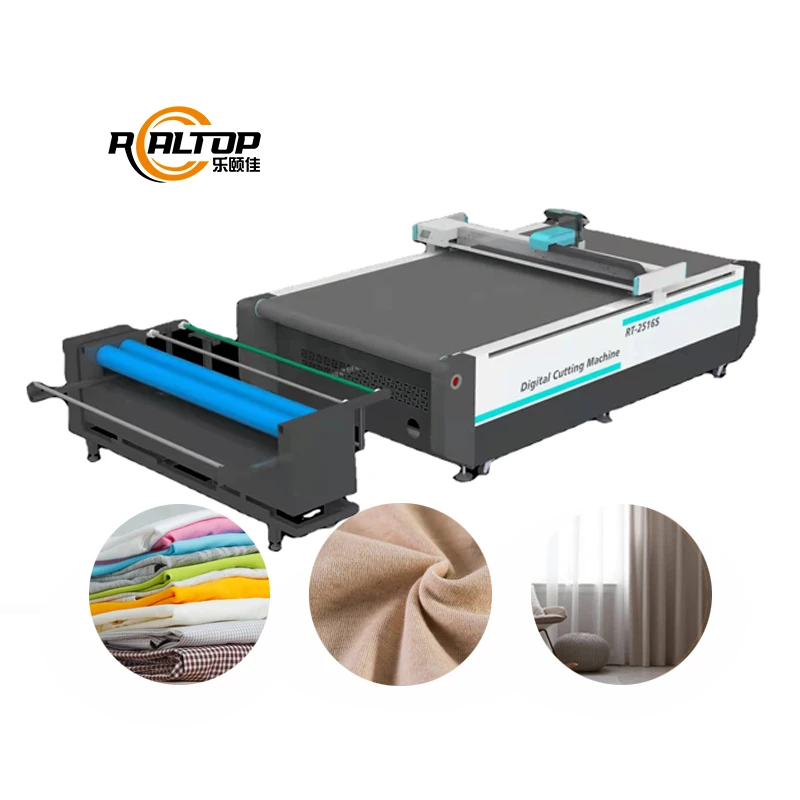

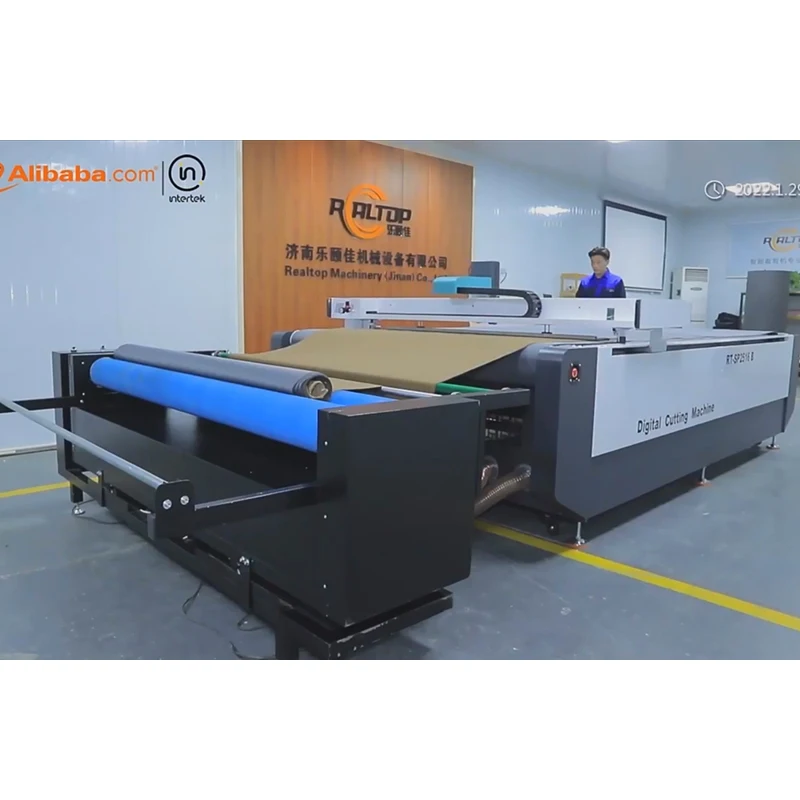


Tool head matched to fabric behavior — oscillating knife selected per elastic recovery and stretch weight, confirmed on buyer’s own roll before any configuration is locked.
Technical Specifications
| Parameter | Value |
|---|---|
| Model | RT-D2516 / RT-S2516 |
| Product Type | CNC Oscillating Knife Cutting Machine with Auto Spreading and Stacking |
| Working Area | 1600 × 2500 mm |
| Machine Size | 3450 × 2300 × 1250 mm |
| Rated Power | 9 kW |
| Voltage | 380V ±10% (50/60 Hz to be confirmed with buyer) |
| Translational Velocity | 800–1200 mm/s |
| Cutting Thickness | 20–80 mm (varies by material density — confirm on buyer fabric) |
| Repeated Accuracy | ≤0.1 mm |
| Vacuum Pump | 7.5 kW, integrated aviation aluminum shell with built-in silencer |
| Transmission | Digital servo motor (Delta or Panasonic optional, IP67), Taiwan Hiwin linear guide, synchronous belt, ball screw |
| Visual Positioning | Small CCD camera mark point, panoramic camera recognition, projection positioning |
| Vacuum Table | Magnesium-aluminum alloy with fluorocarbon PVDF powder spraying, anodic and hard oxidation treatment |
| Conveyor Belt | Germany imported, with auto feeding |
| Frame | Thick-walled seamless steel, high-temperature tempering, CNC machining center finishing |
| Software Language | English, Russian, Italian, Chinese (additional languages customizable) |
| Safety | Infrared induction blocking, beam anti-collision sensors, emergency stop with in-situ resume |
Application Suitability
| Application | Material or Output |
|---|---|
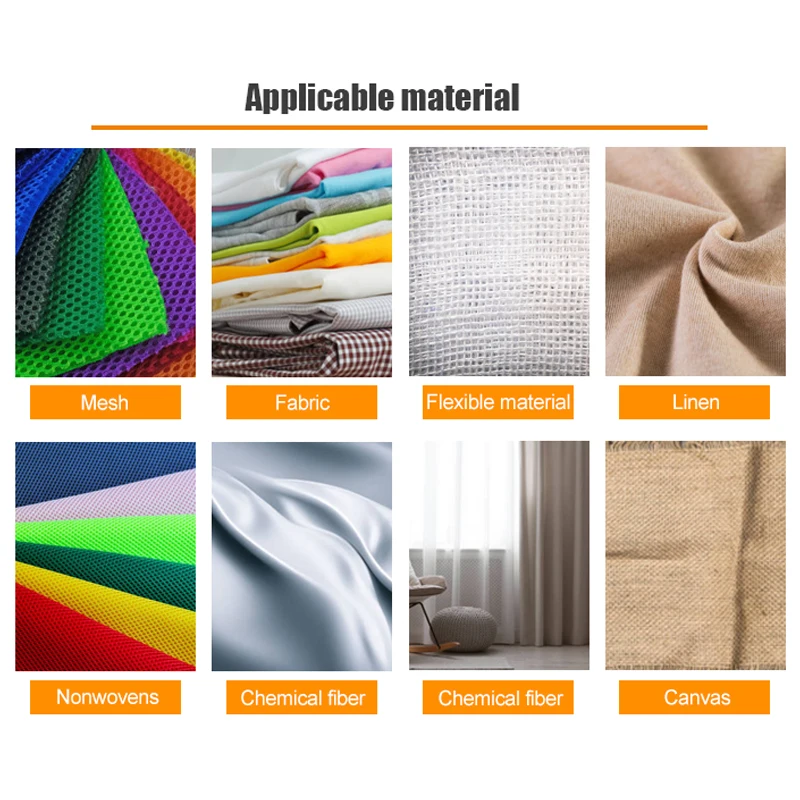
| Garment and activewear cutting | Elastic fabric, stretch knit, spandex blends for sportswear, underwear, swimwear |
| Automotive interior trimming | Seat cover fabrics, headliner textiles, door panel soft trim with contour nesting |
| Soft furnishing and carpet production | Large-format upholstery fabric, non-woven carpet, rug backing materials |
| Footwear and luggage manufacturing | Shoe upper material, synthetic leather, PU and EVA foam layers |
| Industrial gasket and sealing | Sponge, rubber sheet, PTFE, ETFE cut to profile |
| Packaging sample and graphic arts | Corrugated cardboard, sticker film, PVC sheet, foam board |
Why "Working Area" Alone Fails on Stretch Fabric
The cutting table only matters if the vacuum, tool head and spreading tension are all set for the exact fabric weight and elastic recovery you run.
I spent four days on-site at an automotive interior plant because the spreading line was spec’d on table size and rated speed, but nobody checked how high-elastic composite fabric behaves under standard tension settings. The material bunched, skewed and fed off-grain before it even reached the knife. With elastic fabric, the problem shows up as ragged edges, shifted contour cuts and pieces that spring back out of tolerance the moment vacuum releases. A CNC oscillating knife cutting machine for fabric production must be validated on the buyer’s actual roll stock — not on a reference sample of standard sponge [NEED_CITE: material behavior differences between standard test media and production elastic fabric].
Spreading Tension and Knife Selection for Elastic Recovery
Elastic fabric stores tension the moment it leaves the roll. If the auto feeding system pulls too hard, the material stretches going under the knife and then relaxes after the cut, leaving pieces that are smaller than the pattern. The RT-D2516/RT-S2516 feeds from the roll through a Germany-imported conveyor belt with adjustable tension control, allowing the operator to match feed force to the fabric’s stretch modulus. The Swiss-imported oscillating knife head runs in full-cut and half-cut modes, and the vibration frequency is matched to the material density so the blade passes through without dragging or pulling the weave.
Vacuum Zoning That Holds Small Pieces at Line Speed
A 1600 × 2500 mm table area means nothing if small cut pieces lift off the surface when the knife exits the cut. The magnesium-aluminum alloy vacuum table on this system uses multi-zone adsorption, so only the active cutting area pulls suction. The fluorocarbon PVDF surface treatment and anodic oxidation increase holding force without requiring a larger pump. The 7.5 kW vacuum fan runs in an integrated aviation aluminum shell with built-in silencer sponge, keeping noise down on the production floor while maintaining consistent negative pressure across the active zone [NEED_CITE: vacuum adsorption requirements for lightweight cut parts on high-speed knife tables].
Reading Specs for Actual Production Results
The 800–1200 mm/s translational velocity defines how fast the head moves between cuts, but actual throughput depends on nesting density, cut complexity and the number of tool changes per sheet. The ≤0.1 mm repeated accuracy matters most when cutting interlocking pattern pieces where even a fraction of a millimeter drift accumulates across a full lay. The IP67-rated digital servo motors (Delta or Panasonic options) keep positioning stable in environments where fabric dust and fiber debris settle on the drive components. The thick-walled seamless steel frame, finished on a CNC machining center after high-temperature tempering, resists deflection under the lateral forces that an oscillating knife generates when cutting dense composite stacks.
What Happens When the Tool Head Doesn’t Match the Material
I have seen producers run high-density foam on a drag knife setup because the order was placed on working area alone. The result was crushed edges, delaminated layers and parts that had to be trimmed by hand before they could go to the sewing line. When CCD contour recognition is promised but the camera cannot track printed registration marks on stretch fabric at production speed, every nested piece drifts off-contour. Wrong vacuum zoning leaves small pattern pieces floating mid-cut, and the knife drags them across the table surface. These failures do not show up in the brochure [NEED_CITE: common tool head and material mismatch failures in digital cutting operations].
Why This Configuration Approach Works
In-house design covers both knife cutting and the upstream spreading system, so the feeding tension and cutting parameters are developed together rather than bolted on as afterthoughts. Every tool head and table zone is specified against the buyer’s actual fabric weight, stretch behavior and smallest piece dimension. CCD camera positioning and panoramic vision are confirmed against the buyer’s printed contour files before the order goes to production. Software compatibility — including HP-GL format import and nesting workflow — is verified against the buyer’s existing pattern-making system. Sample cutting runs on the buyer’s own roll material before any configuration is finalized.
Documentation & Verification
- Machine specification sheet with confirmed working area, voltage and frequency for your facility
- Electrical schematic with 380V ±10% supply requirements and dedicated circuit load
- Tool head and vacuum table zoning plan matched to your smallest cut piece dimension
- Sample cutting report on your elastic fabric including edge quality and elastic recovery measurements
- Software license and HP-GL file format compatibility note for your nesting workflow
- Factory test record documenting repeated accuracy and vacuum holding performance before dispatch
Installation, Commissioning & Support
- Foundation must support the 3450 × 2300 mm footprint plus roll stand and stacking area clearance
- Dedicated 380V ±10% circuit required for 9 kW machine load plus 7.5 kW vacuum pump
- Machine ships fully assembled; conveyor belt, spreading unit and stacking station aligned on arrival
- First-run commissioning includes spreading tension calibration on your specific elastic fabric weight
- Operator training covers tool head swap, vacuum zone activation and CCD mark point registration
- Spare parts list includes Swiss knife blades, conveyor belt sections and vacuum filter elements
- Daily maintenance covers rail lubrication on Taiwan Hiwin guides and vacuum pump silencer inspection
Before You Request a Quote
Send us the fabric type, weight per square meter, stretch percentage and roll width you run in production. We also need your typical nesting pattern, the smallest piece dimension in your marker, your daily cut volume target and the voltage and frequency at your facility. If you can ship a roll sample to our workshop, we will run a full spreading, cutting and stacking test and send back the sample pieces with a parameter report before you commit to an order.
Frequently Asked Questions
Q: How is cutting thickness verified for elastic fabric before I place an order?
A: We run a sample cut on your actual roll material, testing the full range of thicknesses you produce. The report documents edge quality, elastic recovery after cut and stacking alignment. We only finalize the tool head and knife frequency recommendation after these results are reviewed with you, not from a generic material chart.
Q: How does vacuum table zoning prevent small pieces from lifting during cutting?
A: The magnesium-aluminum alloy table is divided into independent suction zones. We configure the zone map based on your smallest piece dimension and nesting layout. Only the active cutting zone pulls vacuum, concentrating holding force where the knife is working and preventing lightweight cut parts from drifting at high translational speed.
Q: What spreading tension settings are used for different elastic fabric weights?
A: Tension is calibrated during commissioning using your specific roll stock. The auto feeding system adjusts pull force to match the fabric’s stretch modulus, preventing over-extension that causes pieces to shrink back after cutting. We document the tension parameters for each fabric type you run so operators can recall them by material code.
Q: How does the CCD positioning system handle stretch distortion on printed fabric?
A: The panoramic camera and small CCD mark point system work together to read registration marks on pre-printed elastic panels. During sample testing, we verify tracking accuracy at production speed with your actual printed material, accounting for the stretch distortion that shifts contour lines relative to the printed image.
Q: What is the workflow from roll loading to stacked cut pieces?
A: The operator loads the fabric roll onto the spreading unit. The system feeds, spreads and advances the material onto the vacuum conveyor. The oscillating knife cuts the nested pattern, and cut pieces move to the stacking station. Throughput depends on your nesting density and cut complexity, which we calculate during the sample cutting phase.





商品评价
Clear filtersThere are no reviews yet.