




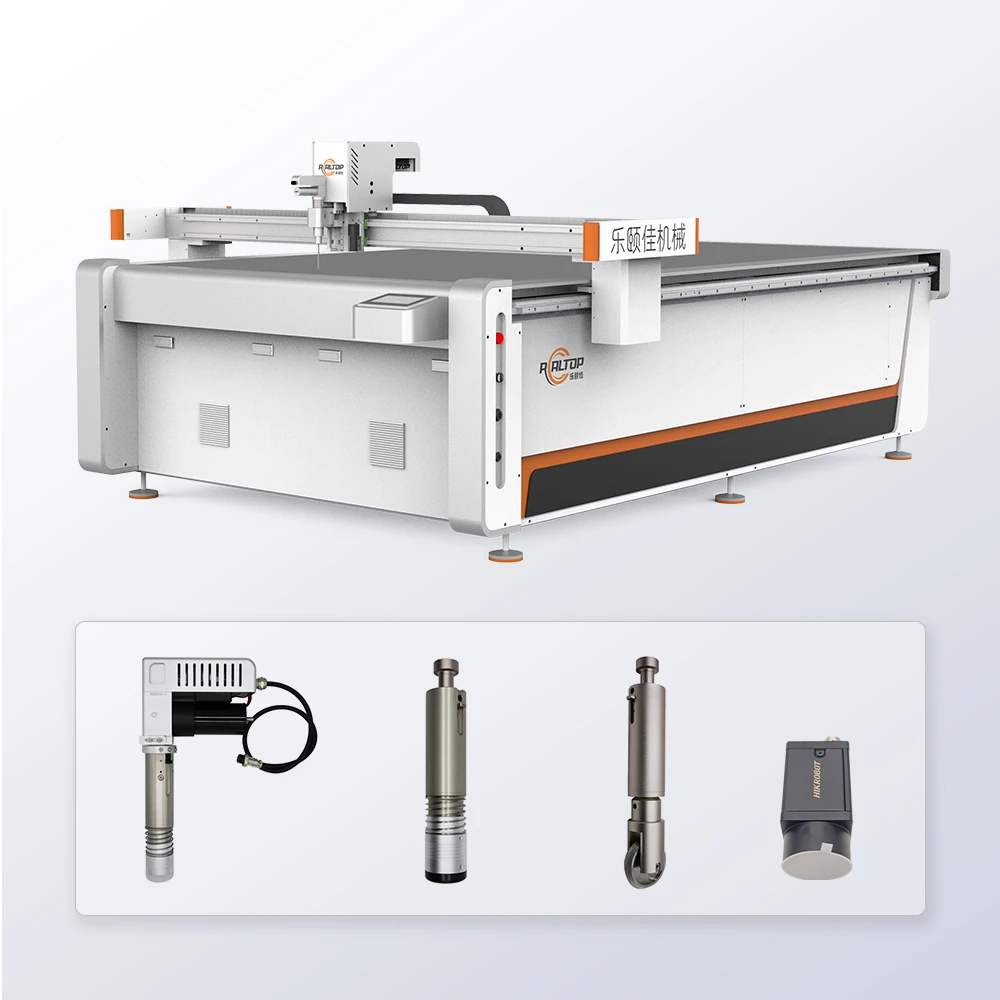
Tool head matched to material — We specify oscillating, drag, or circular knife options based on your fabric weight, composite layers, and daily cutting volume, not just the machine’s working area.
Technical Specifications
| Parameter | Value |
|---|---|
| Model | RT-D2516 / RT-S2516 |
| Product Type | CNC Oscillating Knife Cutting Machine |
| Working Area | 1600 × 2500 mm |
| Machine Dimensions | 3450 × 2300 × 1250 mm |
| Rated Power | 9 kW |
| Voltage | 380V ±10% (frequency to be confirmed for export market) |
| Drive System | Digital servo motor (Delta or Panasonic), linear guide, synchronous belt, imported ball screw |
| Translational Velocity | 800 – 2000 mm/s |
| Cutting Speed | 200 – 800 mm/s (basis not stated in source — confirm material / thickness) |
| Cutting Thickness | ≤100 mm (varies with material density and tool head selection) |
| Repeatability | ≤0.1 mm |
| Table Configuration | Flat working table or auto-feeding conveyor table |
| Tool Head Options | Oscillating knife, pneumatic knife, high-power vibrating knife, circular knife, V-cutting knife, drag knife, creasing wheel, dotted line knife, punching tool, brush |
| Visual Positioning | Small CCD mark-point camera, panoramic camera recognition, projection positioning |
| Vacuum Table Surface | Magnesium-aluminum alloy, PVDF powder spraying, anodic and hard oxidation |
| Vacuum Pump | 7.5 kW, integrated aviation aluminum shell, built-in silencer sponge |
| Compatible File Formats | PLT, DXF, AI, HP-GL compatible |
| Control Interface | Touch screen, multi-language (English, Russian, Italian, Chinese; customizable) |
Application Suitability
| Application | Material or Output |
|---|---|
| Garment and Footwear Production | Multi-layer woven fabric, non-woven textile, and shoe upper materials for apparel and footwear |
| Automotive Interior Fabrication | Leather, sponge composite, PU, EVA, and rubber for floor mats and seating components |
| Packaging and Carton Sample Making | Corrugated cardboard, gray board, and folding carton stock with creasing and cut lines |
| Soft Furnishings and Upholstery | Curtain fabric, furniture upholstery textile, and carpet |
| Gasket and Sealing Fabrication | PTFE, ETFE, rubber, and composite sealing materials |
What "Up to 100 mm Thickness" Leaves Out About Fabric Cutting
A cutting depth rating means nothing until you test the exact composite stack you run in production.
Buyers often see a 100 mm maximum thickness on a spec sheet and assume the machine will slice cleanly through any material up to that depth. I once watched a buyer commit to a cloth cutting setup based solely on the working area and rated thickness, only to discover that a dense, three-layer automotive floor mat composite required extended cycle times and multiple tool head adjustments to achieve a clean cut on the bottom layer [NEED_CITE: material density impact on oscillating knife penetration]. The cutting speed range of 200–800 mm/s is not a flat guarantee; it depends entirely on what you are cutting and how many layers are in the lay-up.
Matching Knife Type to Your Specific Textile or Composite
The RT-D2516 and RT-S2516 support a wide range of interchangeable tool heads, but selecting the correct one is a production decision, not a catalog checkbox. A high-power oscillating knife handles thick woven fabric and sponge composites cleanly, while a drag knife works well for vinyl and sticker films used in graphic production. For carton sample making, a creasing wheel paired with a cutting knife produces fold-ready packaging prototypes in a single pass. Getting this wrong means ragged edges on garment textiles or crushed foam in automotive interior components.
Contour Cutting with Camera Positioning at Line Speed
When your fabric has printed graphics or registration marks, the CNC oscillating knife cutting machine production line relies on CCD or panoramic camera systems to track those marks during continuous cutting. This matters for automotive interior panels and garment pieces where the cut path must follow a printed contour. The panoramic recognition option covers the full working area, while the small CCD mark-point camera targets specific reference marks. Both require clear mark printing and consistent lighting to maintain accuracy at production throughput.
Reading the Specs That Actually Determine Output
The 1600 × 2500 mm working area determines your maximum sheet lay-up, but the real throughput depends on how the vacuum table zoning holds your specific fabric during cutting. The 7.5 kW vacuum pump with magnesium-aluminum alloy platform provides uniform suction, yet narrow strips and intricate shapes on lightweight non-woven textile can still lift if the vacuum zones are not configured for small-part retention [NEED_CITE: vacuum zoning requirements for lightweight fabric cutting]. The digital servo drive with imported ball screw delivers ≤0.1 mm repeatability, which is critical for nesting software to minimize fabric waste across multi-layer lay-ups. The 9 kW rated power accounts for the full system load, so your facility electrical plan needs to accommodate this alongside the vacuum pump’s dedicated draw.
The Hidden Cost of Specifying a Cloth Cutter by Working Area Alone
When a buyer specifies a machine by table size without confirming tool head selection, vacuum zone layout, and conveyor or flat table configuration, the result is usually a machine that runs but cannot hold cycle time on the buyer’s actual material. A flat table may suit batch cutting of thick leather hides, while an auto-feeding conveyor table is necessary for continuous roll-to-cut workflow on garment fabric. If the vacuum zoning is not matched to the part geometry you produce most often, operators spend time repositioning material between cuts [NEED_CITE: production downtime from vacuum lift on small fabric parts]. These issues surface after the machine arrives, when reconfiguration costs are highest.
Why Buyers Source This Cutting Table From Our Jinan Facility
Our design team configures each RT-D2516 or RT-S2516 around the buyer’s actual material sample, not a generic catalog spec. We run sample cutting on your fabric, leather, or composite before the order is finalized, documenting edge quality, achievable cutting depth, and realistic cycle time. The in-house production covers both knife and table assembly, so tool head selection, vacuum zoning, and conveyor configuration are built into the machine rather than added as aftermarket modifications. Software file format compatibility with your existing PLT, DXF, or AI workflow is confirmed before shipment, and the control language is set to your operator’s requirement.
Documentation & Verification
- Sample cutting report on your fabric or composite with edge quality photographs
- Tool head and vacuum zone configuration list matched to your material type
- Electrical schematic confirming 380V ±10% compatibility with your facility supply
- Software licence and PLT, DXF, AI file format compatibility verification note
- Factory test record documenting cutting repeatability on your specified lay-up
- Operation and maintenance manual in your selected control language
Installation, Commissioning & Support
- Verify 380V ±10% dedicated circuit capacity for 9 kW system plus 7.5 kW vacuum pump
- Confirm floor space of at least 4000 × 3000 mm for machine access and material staging
- Level the 3450 × 2300 × 1250 mm frame on a flat concrete substrate before assembly
- Commission auto-feeding conveyor tension and vacuum zone activation for your sheet format
- Train operators on touch screen nesting workflow and CCD camera mark-point calibration
- Stock replacement oscillating knife blades and vacuum pump silencer sponge as first-order spares
Before You Send an Inquiry
Tell us what you are actually cutting: the material type, the number of layers in a typical lay-up, and the sheet or roll dimensions you receive from your supplier. Share your daily production volume and the file formats your design team currently outputs. We will use this to recommend the tool head, table configuration, and camera positioning option that fits your workflow.
Frequently Asked Questions
Q: How do I choose between an oscillating knife and a drag knife for my fabric?
A: Oscillating knives suit thick woven fabric, sponge, and multi-layer composites where a vibrating blade produces a clean edge through the full stack. Drag knives work for thin vinyl, sticker film, and single-layer materials where the blade follows the cut path without oscillation. We test both on your material sample before recommending a tool head configuration.
Q: Can the CCD camera track printed marks on a continuously feeding conveyor?
A: Yes, the panoramic camera recognition option is designed for continuous auto-feeding workflows. It reads registration marks on printed fabric as the conveyor advances material through the cutting zone. Mark clarity, contrast, and consistent overhead lighting are required for reliable tracking at production speed.
Q: How does vacuum table zoning prevent small fabric parts from lifting?
A: The magnesium-aluminum alloy vacuum table is divided into selectable zones. For intricate shapes and narrow strips, you activate only the zones directly under the cutting path, concentrating suction on small parts. This prevents lightweight non-woven and woven textiles from shifting during high-speed knife travel.
Q: Will the software accept my existing DXF and AI cutting files?
A: The control system imports PLT, DXF, and AI formats natively. Before order confirmation, we verify that your specific file structure and nesting workflow integrate with the machine’s instruction system. If your production planning software outputs a non-standard format, we test compatibility during the sample cutting stage.


商品评价
Clear filtersThere are no reviews yet.