




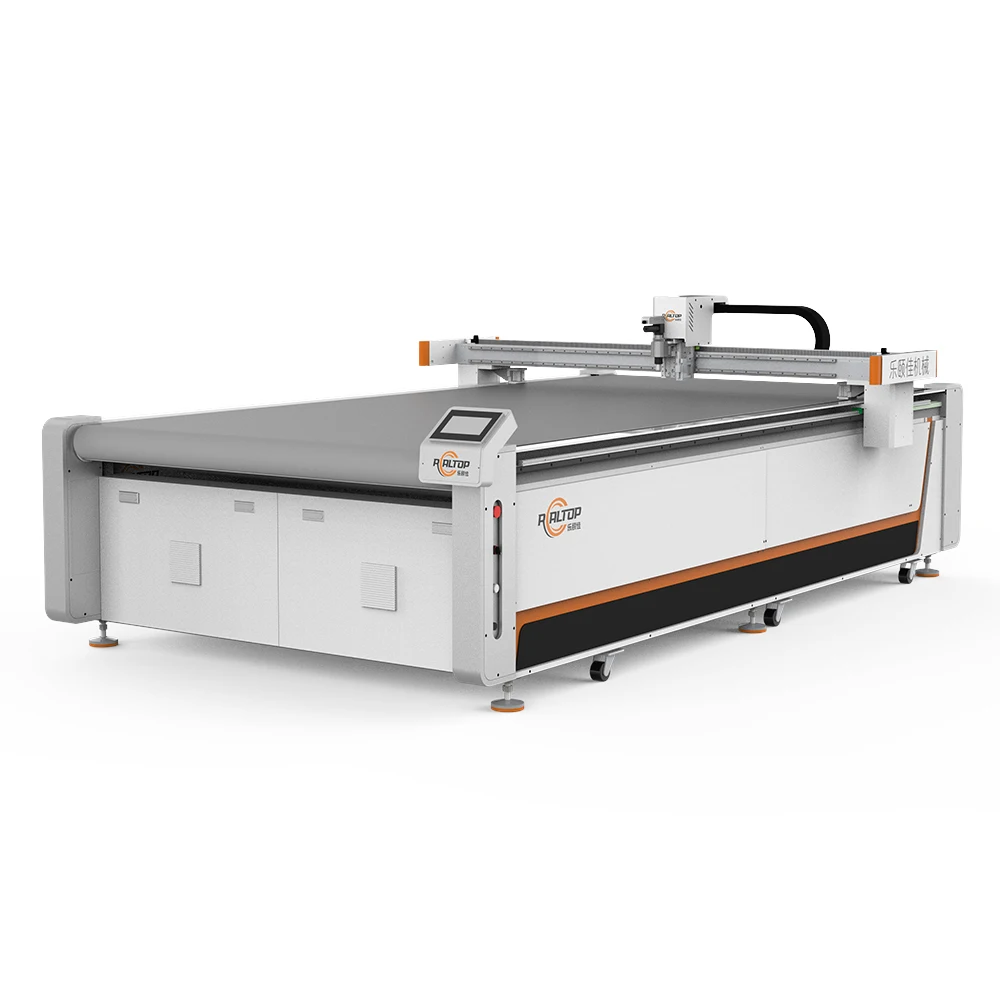
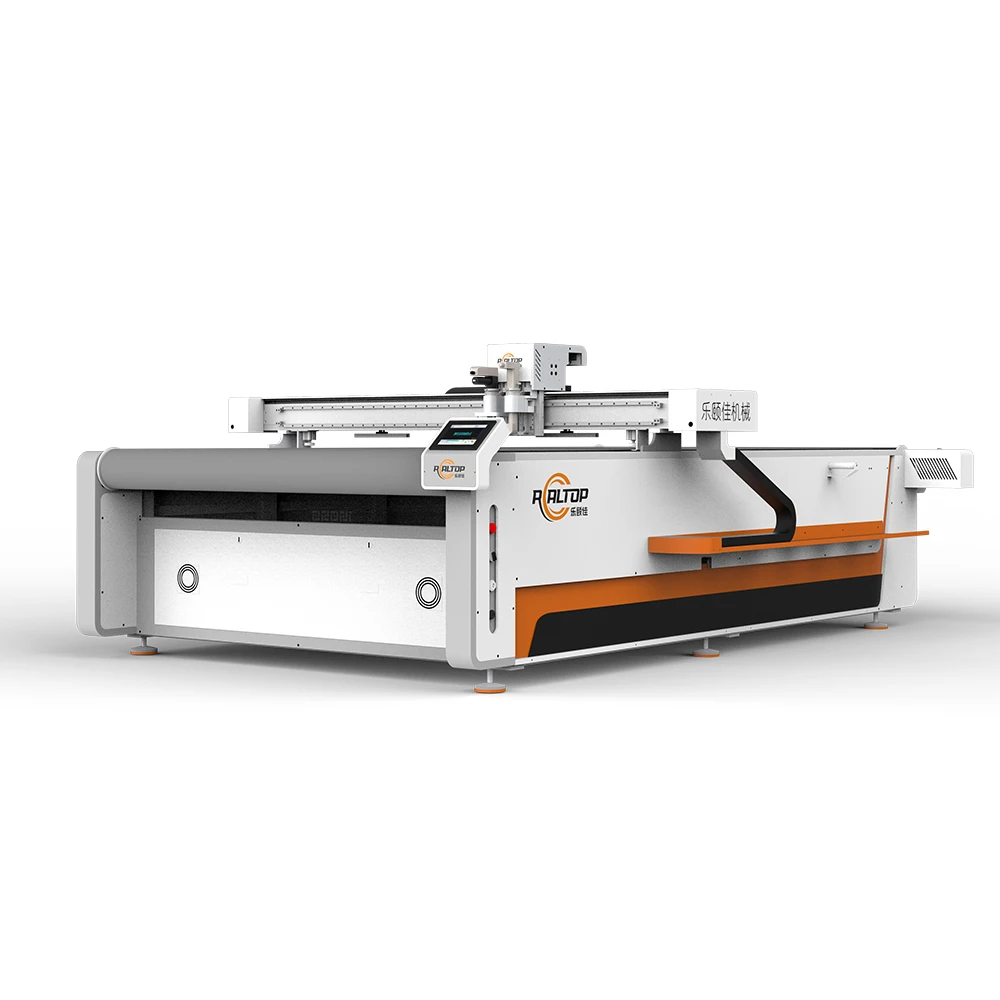
Vacuum Zoning Tuned for Nested Parts — the RT-D2516/RT-S2516 table divides its 1600×2500mm honeycomb platform into selectable zones, so a small sticker sheet and a full corrugated blank each receive adequate hold-down without manual taping.
Technical Specifications
| Parameter | Value |
|---|---|
| Model | RT-D2516 / RT-S2516 |
| Working Area | 1600 × 2500 mm |
| Machine Footprint | 3450 × 2300 × 1250 mm |
| Rated Power | 9 kW (cutting head and motion) |
| Vacuum Pump | 7.5 kW |
| Table Surface | Aluminum alloy honeycomb with multi-zone vacuum adsorption |
| Tool Head | Swiss imported oscillating knife — full cut, half cut, cursor location |
| Translational Velocity | 800–1200 mm/s (rapid traverse, no-load) |
| Cutting Speed | 200–800 mm/s (basis not stated in source — confirm material type, flute, and density) |
| Cutting Thickness | Up to 100 mm depending on material density and tooling |
| Repeatability | ≤ 0.1 mm |
| Transmission | Digital servo motor (Taiwan Delta), Hiwin linear guide, synchronous belt and ball screw |
| Instruction Format | HP-GL compatible |
| Voltage | 380V ± 10% / 50 Hz |
| Machine Frame | Welded thick-walled square seamless steel, high-temperature stress relieved |
| Safety | Infrared perimeter sensors and emergency stop |
| Nesting Software | Professional carton nesting package — included, language customizable |
Application Suitability
| Application | Material or Output |
|---|---|
| Corrugated carton sample making | Single, double, and E-flute board up to the machine’s thickness limit |
| Short-run packaging production | Kraft liner, white-top liner, coated folding carton stock |
| Sticker and label contour cutting | Self-adhesive vinyl, paper labels, reflective sheeting with printed marks |
| Display and signage blanks | Honeycomb paper board, corrugated PP, foam board |
| Flexible material conversion | Leather, sponge composite, PVC soft sheet, silicone gasket, rubber |
Why a Machine’s Stated Speed Means Nothing Without Your Board Grade
Cutting speed is a function of flute profile, moisture content, and liner weight — not a fixed dial on the control panel.
I have watched packaging sample rooms buy a machine rated at a headline speed, then spend weeks discovering that their local E-flute at 8% moisture cuts cleanly at half that figure, while a B-flute from a different mill tears the liner at the same setting [NEED_CITE: corrugated board flute profiles and machinability differences]. A CNC knife cutting machine for packaging and carton production must be validated on the exact board grade, moisture range, and flute type that will run through it daily. The only reliable way to lock in throughput expectations is a sample cutting test on your own stock before the purchase order is signed.
Vacuum Hold-Down That Follows the Cut Path
The aluminum honeycomb table on this machine is not a single suction surface. Zones can be activated or closed off to match the blank footprint, so a small die-cut sticker layout receives concentrated vacuum while a full-sheet carton blank spreads the load across the entire 1600 × 2500 mm area. This matters on corrugated board because the fluted core acts as a series of tiny air channels; uneven suction leaves edges lifting into the knife path, producing ragged tails on cut lines and crushed flute walls at the entry point.
Multifunctional Head: Cut, Crease, and Mark in One Pass
The Swiss-imported oscillating knife head delivers full-depth through-cuts, while the same tool station supports half-cut scoring and cursor-based positioning. For a packaging sample maker, this means a single file can drive the crease lines for a tuck-end carton, the perimeter cut, and a registration mark — all without a manual tool change mid-job. Crease depth is adjustable so that folding carton stock receives a clean score without piercing the opposite liner, keeping the blank structurally sound for downstream folding and gluing operations.
Frame Rigidity and Its Effect on Crease Straightness
The welded thick-walled steel frame undergoes high-temperature stress relief before machining. In oscillating knife cutting, the tool head generates lateral vibration forces at every stroke; a frame that still carries residual welding stress will gradually shift, pulling crease lines out of square with the cut perimeter. Over a production run of several hundred carton blanks, that drift compounds into mismatched panels that refuse to fold flat. Stress-relieved frames maintain dimensional repeatability within the stated ≤ 0.1 mm tolerance across long shifts [NEED_CITE: stress relief treatment effects on welded steel machine frames].
Drive Train Selection for Repeatability
The Taiwan Delta digital servo motors paired with Hiwin linear guides and ball screws form a closed-loop motion system. On corrugated board, where the knife must penetrate a compressible fluted core before hitting the dense bottom liner, the servo must react instantly to changing cutting forces to prevent the blade from dragging or overshooting at corners. The synchronous belt and ball screw combination eliminates the backlash common in rack-and-pinion setups, which is why tight internal features like glue-tab slots and ventilation cutouts stay dimensionally accurate from the first blank to the last.
The Cost of Skipping Zone Validation
Buyers who spec a flatbed cutter on working area alone often discover too late that the vacuum zoning cannot grip their smallest sticker layout. The result is material lift during the oscillating pass, producing nicked edges and forcing operators to tape every sheet to the table by hand — a step that negates the speed advantage of CNC automation entirely [NEED_CITE: vacuum hold-down requirements for small-format digital cutting]. Asking for a zone map and running a small-part sample on your sticker stock before order eliminates this failure mode.
Why Source From This Production Line
The in-house design team covers both oscillating knife and laser technologies, so a buyer processing corrugated board today and acrylic signage tomorrow can match the cutting method to the material rather than forcing one process to do both. Tool head and table configurations are specified per material and production volume, not pulled from a standard list. CCD camera positioning for printed contour work is validated on your own artwork before shipment. Software file-format compatibility — including your existing nesting workflow — is confirmed during the quotation stage. Voltage, control language, and plug type are locked in before the machine enters the assembly bay, and a sample cutting report on your actual material accompanies the documentation package.
Documentation & Verification
- Machine specification sheet listing every tool head option and table zone configuration
- Electrical schematic with confirmed voltage, frequency, and plug type for your facility
- Sample cutting report produced on your corrugated board grade and sticker stock
- Factory test record showing repeatability measurement across the full 1600 × 2500 mm travel
- Software licence key with file format compatibility note matching your design workflow
- Packing photographs taken on the assembly floor before crate closure
Installation, Commissioning & Support
- Foundation must be level within 2 mm across the 3450 × 2300 mm machine footprint to prevent frame twist
- Dedicated 380V ± 10% three-phase circuit with capacity for 9 kW cutting load plus 7.5 kW vacuum pump
- Machine ships in modular assemblies; the honeycomb table sections are joined and leveled on site
- First-power commissioning includes vacuum zone mapping and servo tuning for your material density
- Operator training covers crease-depth calibration, nesting software import, and tool change procedure
- Spare oscillating blades, vacuum cup seals, and drive belt included in the initial parts kit
- Recommended maintenance: linear guide lubrication every 40 operating hours, vacuum filter check weekly
What We Need to Quote Your Line Correctly
Send the exact corrugated flute type, liner weight, and typical sheet dimensions you run most often, along with the sticker or label stock if that is part of your mix. Confirm your facility voltage and frequency, the control language your operators need, and whether your existing nesting files are in DXF, PLT, or a proprietary format. If daily volume targets matter, tell us the blank count and the shift length so we can run a sample test that mirrors real production conditions.
Frequently Asked Questions
Q: How is cutting speed validated for my specific corrugated board?
A: We run a sample cutting test on your exact board grade, flute type, and moisture level, then record the sustainable feed rate and edge quality. That test result — not a catalog figure — becomes the basis for throughput expectations in the quotation.
Q: What tool head configuration should I choose for a mix of carton and sticker jobs?
A: The oscillating knife handles corrugated board and thick foam, while a drag knife or tangential head suits thin vinyl stickers. We specify the combination based on your material list and confirm it during the sample test before order.
Q: Can the CCD camera track my printed registration marks at production speed?
A: Contour tracking performance depends on mark contrast, size, and board surface reflectivity. We photograph your printed sheet, run a CCD capture test at the target feed rate, and include the tracking report in the documentation package.
Q: How do I know the vacuum zones are adequate for my smallest carton blank?
A: Provide the dimensions of your smallest production part. We map the active zone layout against that footprint, run a hold-down test, and confirm whether standard zoning is sufficient or a custom zone plate is needed.
Q: What utility and space requirements should I plan before delivery?
A: The machine requires a level floor across 3450 × 2300 mm, a 380V three-phase supply rated for the combined 16.5 kW load, and extraction for cardboard dust. We provide a site preparation drawing showing clearances for material loading and maintenance access.





商品评价
Clear filtersThere are no reviews yet.