


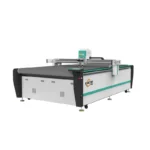
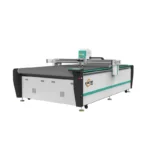
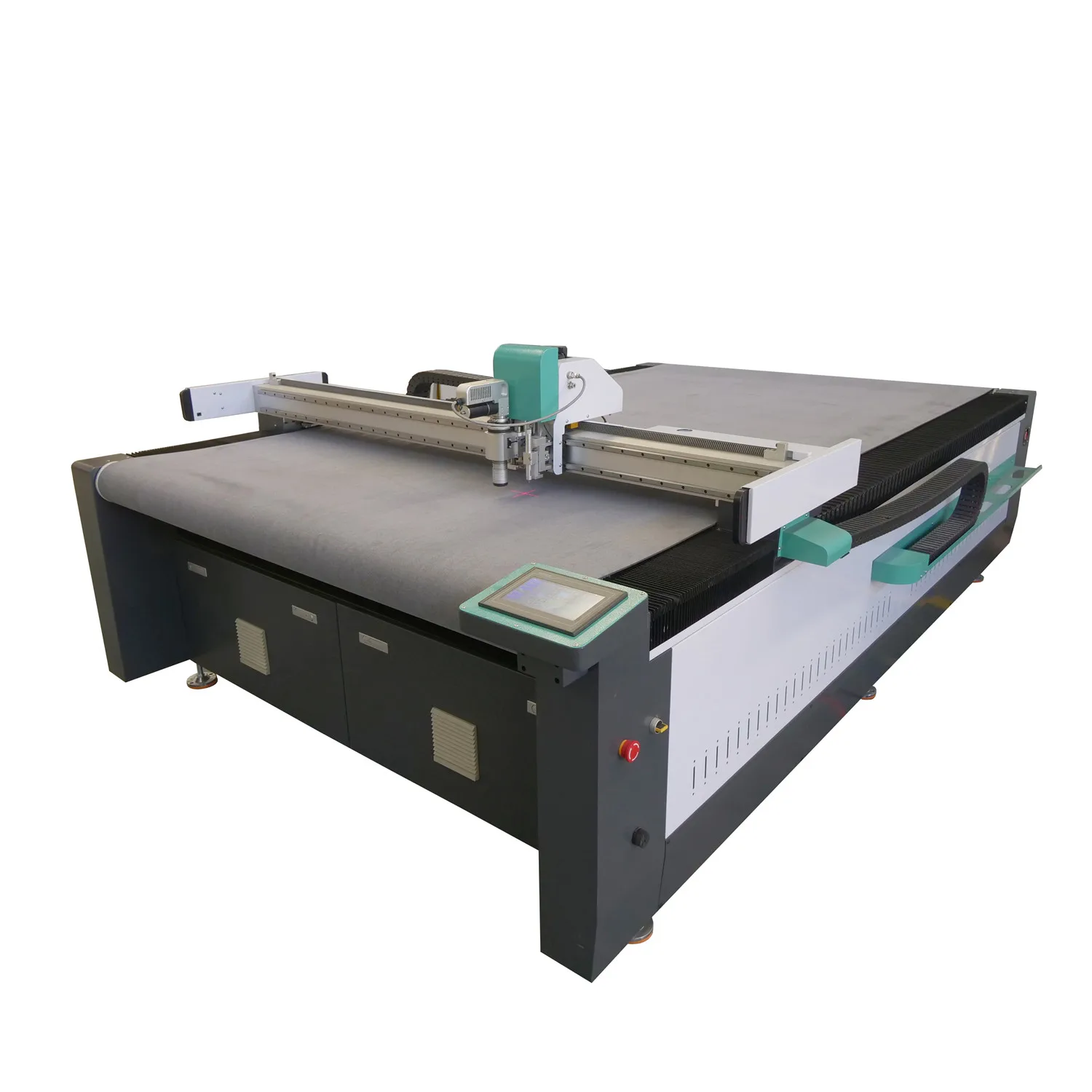
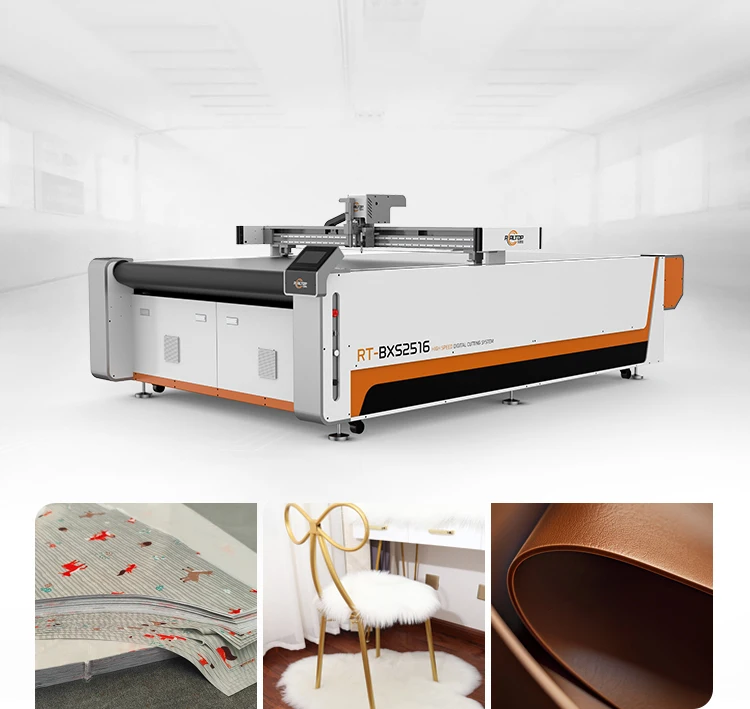
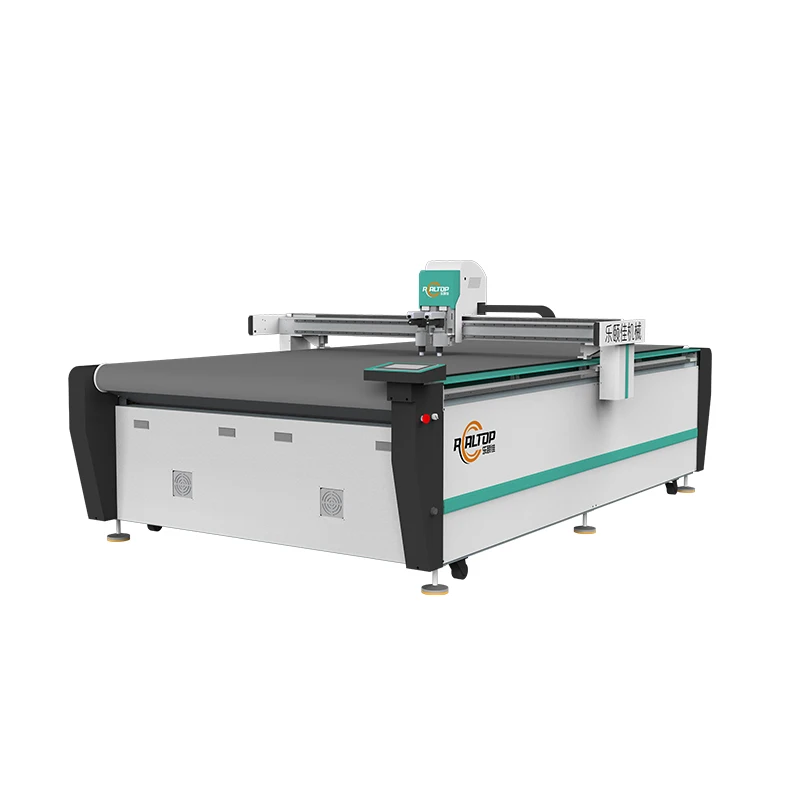
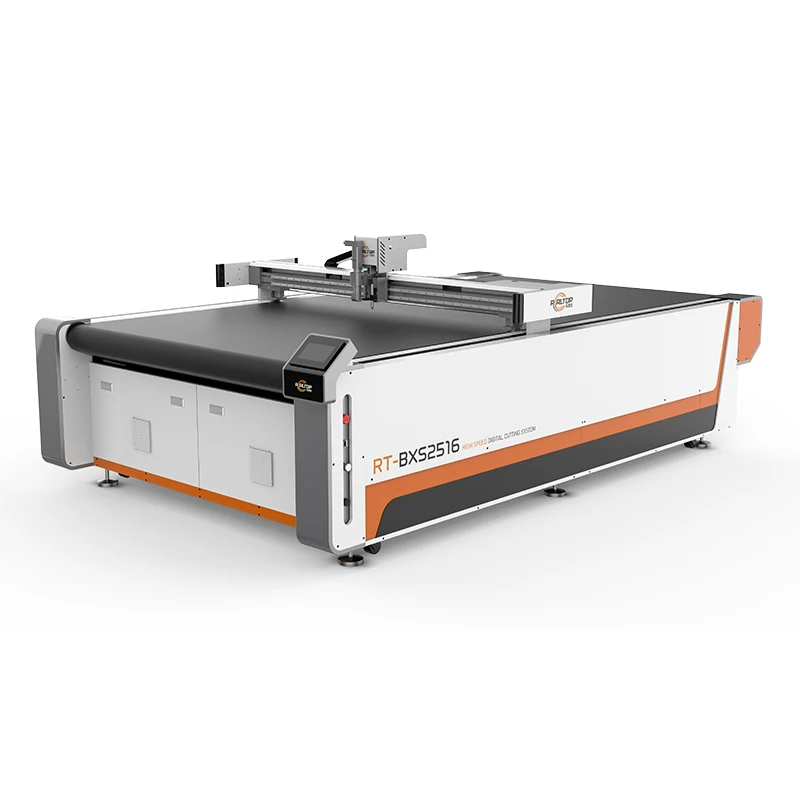
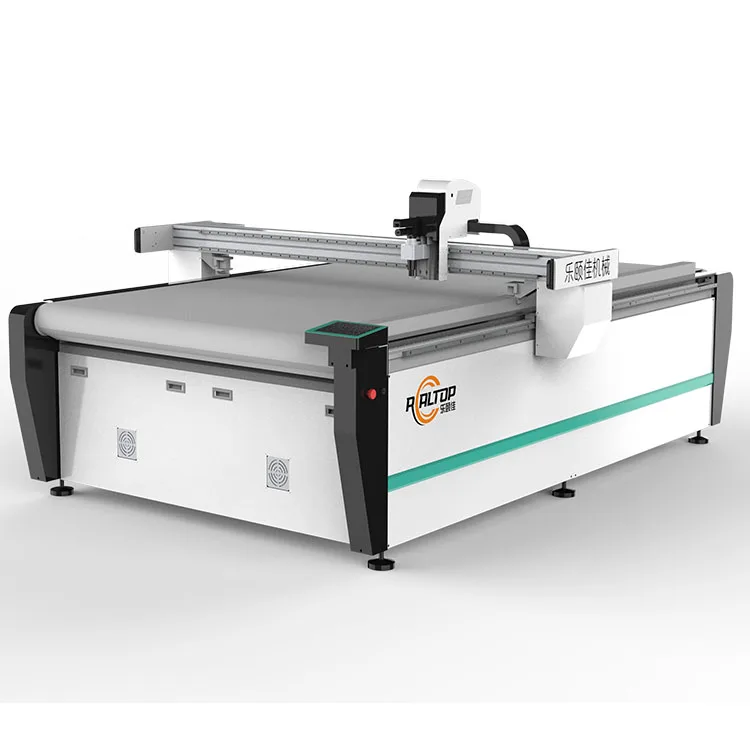
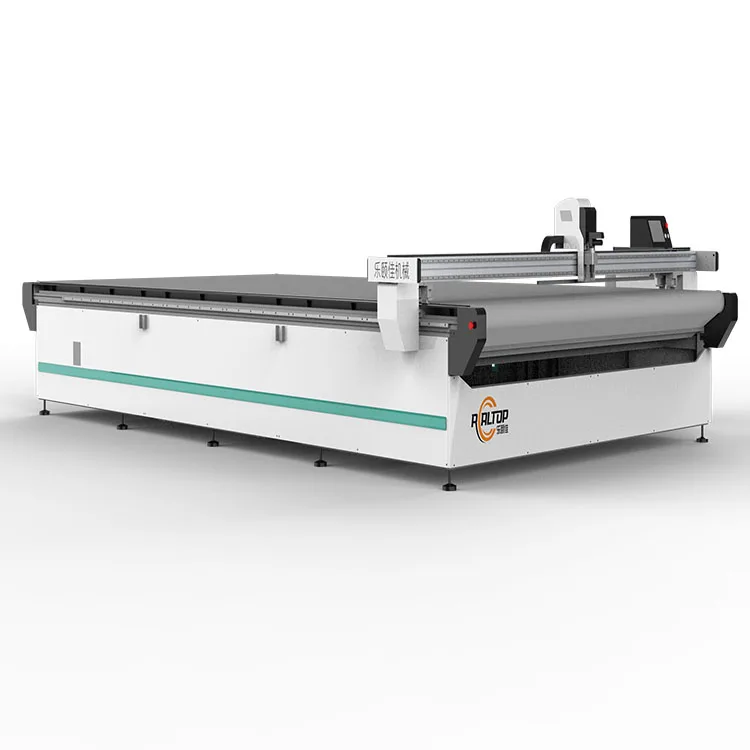

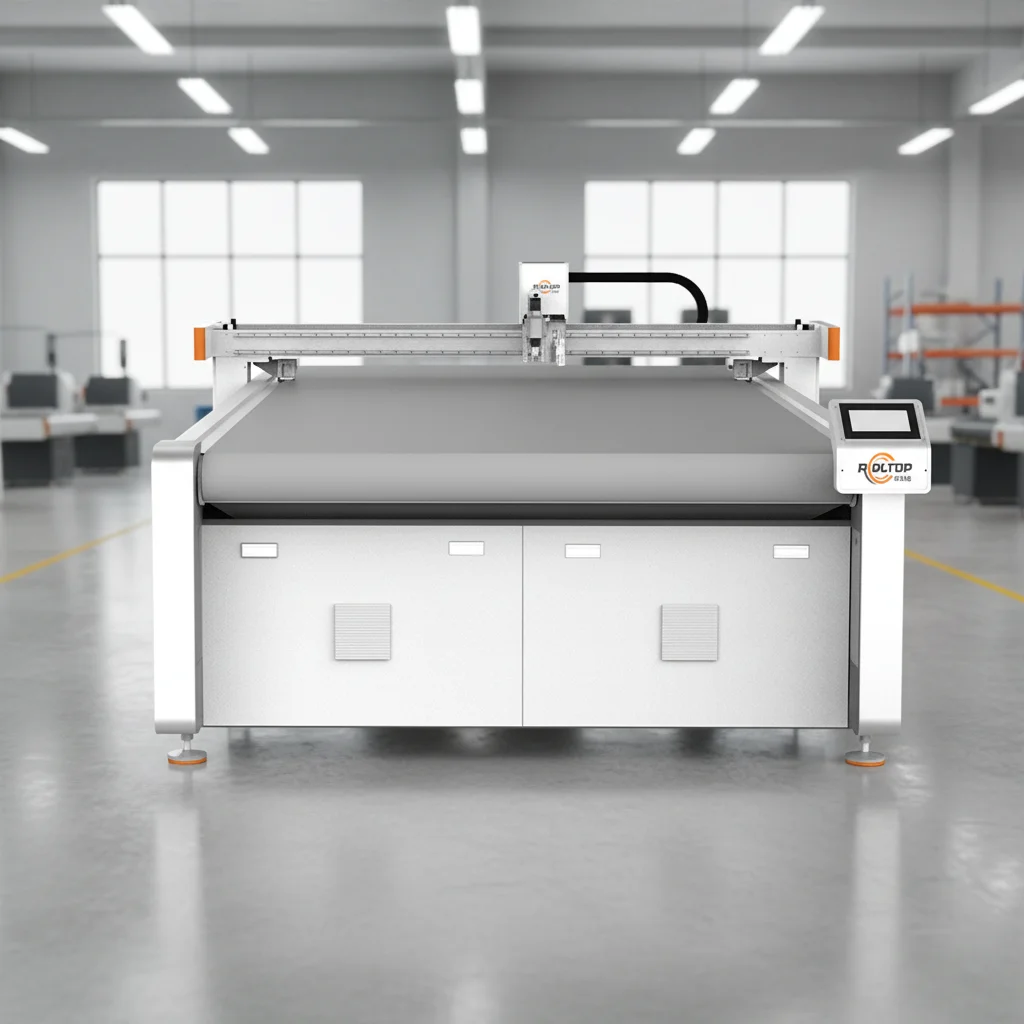
Production-matched vacuum zoning — small garment pattern pieces tend to lift on a single-zone table at cutting speed, so this flatbed is configured with split-box adsorption matched to your actual nest layout rather than sold on working area alone.
Technical Specifications
| Parameter | Value |
|---|---|
| Product Type | CNC Oscillating Knife Cutting Machine |
| Model | RT-D2516 / RT-S2516 |
| Working Area | 1600 × 2500 mm |
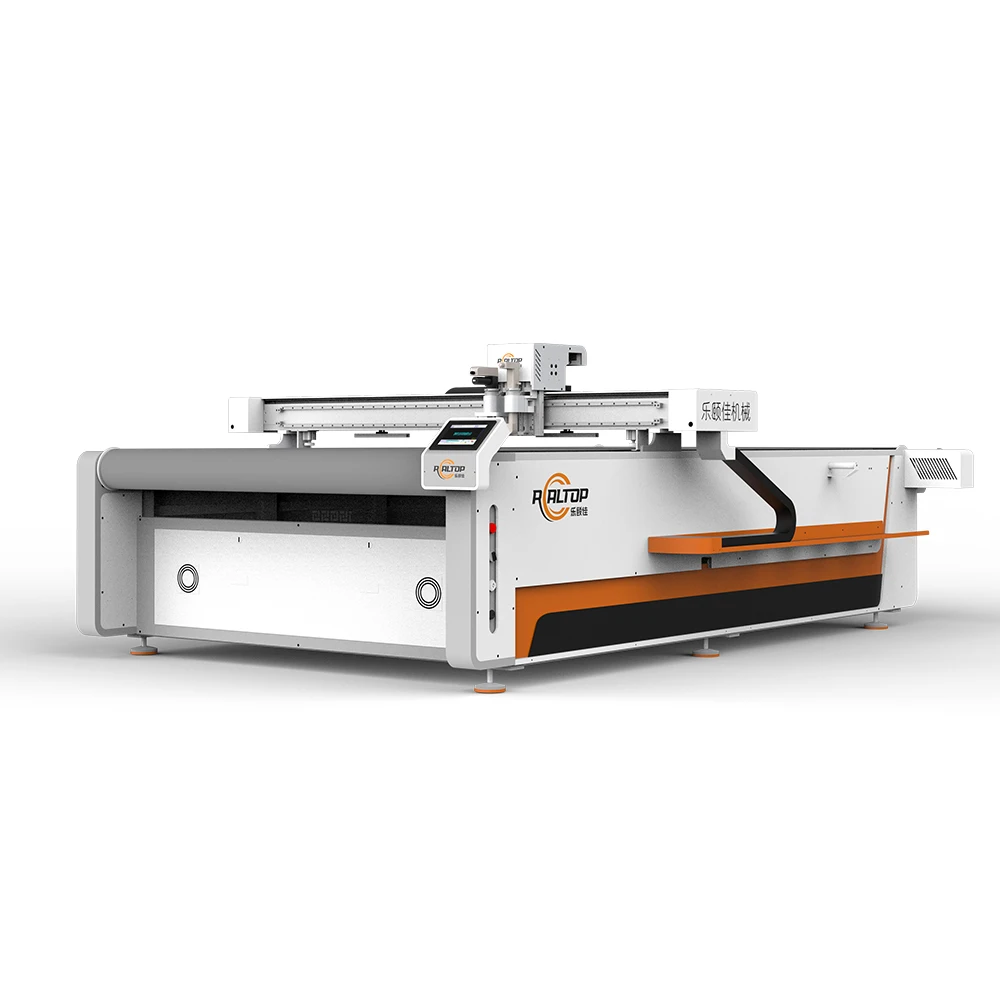
| Machine Size | 3450 × 2300 × 1250 mm |
| Rated Power | 9 kW |
| Voltage | 380V ±10% |
| Cutting Speed (translational) | 800–2000 mm/s |
| Cutting Speed (material processing) | 200–800 mm/s (depends on material type and ply count) |
| Repeated Accuracy | ≤0.1 mm |
| Cutting Thickness | Up to 100 mm (varies with material density and layer count) |
| Table Type | Flat working table / Auto-feeding table (options) |
| Vacuum Pump | 7.5 kW |
| Transmission System | Digital servo motor, linear guide, synchronous belt, ball screw |
| Servo Motor | Delta (optional Panasonic or Japanese brand) |
| Guide Rail | Taiwan Hiwin |
| Conveyor Belt | German imported |
| Tool Head | Swiss imported oscillating knife (full-cut, half-cut, cursor location); optional pneumatic knife, high-power vibrating knife, circular knife, V-cutting knife, drag knife, creasing wheel, dotted line knife, punching, brush |
| Visual Positioning | Small CCD camera mark-point positioning, panoramic camera recognition, projection positioning |
| Control System | CNC with touch screen panel |
| Language Options | English, Russian, Italian, Chinese (custom available) |
| File Formats | PLT, DXF, AI (HP-GL compatible) |
| Safety Devices | Infrared sensor stop, beam anti-collision, emergency stop with in-situ resume |
| Vacuum Table Surface | Magnesium-aluminum alloy, PVDF powder spraying, anodic oxidation, hard oxidation |
| Air Box Platform | Integrated box adsorption (split box option available) |
| Assembly State | Fully assembled |
| Certification | CE |
Application Suitability
| Application | Material or Output |
|---|---|
| Garment and footwear production | Multi-ply cotton, polyester, technical textile, non-woven fabric, PU leather |
| Automotive interior trimming | Seat cover fabric, headliner textile, carpet, composite foam laminate |
| Luggage and bag manufacturing | Nylon, canvas, PVC-coated textile, synthetic leather, composite reinforcement |
| Soft furnishing and upholstery | Heavy woven fabric, velvet, foam-backed textile, curtain material |
| Sports and outdoor gear | Ripstop nylon, neoprene, XPE foam, laminated membrane textile |
| Composite and gasket fabrication | PTFE, ETFE, rubber sheet, fiberglass cloth, sealing material |
Why "1600 × 2500 mm Working Area" Is Not Enough to Specify a CNC Oscillating Knife Cutting Machine Production Line Fabric Textile
A cutting table specified only on footprint regularly underperforms the day it meets real pattern nesting.
I have walked into garment factories in Southeast Asia where a newly installed flatbed was rated for the correct bed size yet could not hold small sleeve panels flat during high-speed traversal. The fabric lifted at the trailing edge, the oscillating knife dragged, and the operator spent hours reducing feed rate to compensate. The root cause was a single-zone vacuum table pulling uniformly across the entire surface, leaving marginal suction at the edges where nested pieces are most concentrated. This CNC oscillating knife cutting machine production line fabric textile setup addresses that with a split-box adsorption platform and magnesium-aluminum alloy surface treated with hard oxidation, configured around the buyer’s actual nesting density [NEED_CITE: vacuum zoning principles for flatbed digital cutting systems].
Matching Tool Heads to Fabric Weight and Ply Count
A Swiss imported oscillating knife with full-cut and half-cut functions is the default configuration, but the tool head selection matters far more than the blade brand. Single-layer contour cutting on printed polyester calls for a different stroke amplitude and oscillation frequency than bulk cutting through 40 plies of cotton jersey. The multifunctional head accepts pneumatic knife, circular knife, V-cutting knife, drag knife, and creasing wheel inserts, each chosen against the material specification rather than bundled as standard. When a buyer in Jakarta switched from woven lining fabric to a coated high-elastic composite, the oscillating knife produced frayed edges until the tool head was reconfigured and the vacuum zoning adjusted for the new material density.
CCD Vision and Production-Speed Contour Tracking
Printed contour work on textile demands that the vision system tracks registration marks without slowing the conveyor feed. This CNC oscillating knife cutting machine production line fabric textile configuration offers small CCD camera mark-point positioning alongside panoramic camera recognition and projection positioning. The CCD locates printed fiducials on each lay, compensating for fabric stretch and skew introduced during spreading. Panoramic recognition covers the full working area in a single pass, which matters when pattern pieces are printed edge-to-edge on sublimated polyester and the margin between adjacent nests is narrow [NEED_CITE: CCD contour recognition accuracy standards in textile cutting].
What the Specs Actually Mean on the Production Floor
The 9 kW rated power drives a 7.5 kW vacuum pump alongside the Delta servo motors and oscillating knife head simultaneously. This matters because vacuum suction drops when the pump is undersized relative to table area, and fabric lift appears first on lightweight materials with large surface area per piece. The Taiwan Hiwin linear guide and ball screw transmission deliver the ≤0.1 mm repeated accuracy, which becomes critical when contour-cutting printed textile where even a 0.5 mm drift makes the finished panel visually off-register. Cutting speed ranges from 200 to 800 mm/s depending on material — that spread exists because a single-ply film cuts at the upper range while multi-layer sponge or PU foam requires the lower end to maintain edge quality. The auto-feeding option with a German imported conveyor belt supports roll-to-sheet workflow, eliminating the manual lay-up step for high-volume operations.
The Hidden Cost of Skipping Configuration Verification
A buyer who specifies a CNC oscillating knife cutting machine production line fabric textile on working area and price alone typically discovers the gap during the first production week. Wrong tool head selection produces ragged edges on coated fabric or crushed foam on soft composites. Insufficient vacuum zoning causes small pattern pieces to shift, generating scrap that accumulates across shifts. Unconfirmed voltage or control language forces the operator to work with an interface they cannot read, increasing setup errors [NEED_CITE: electrical specification mismatches in imported CNC equipment]. Software incompatibility with the buyer’s existing nesting file format adds a manual conversion step that erodes the throughput the machine was purchased to deliver.
Why This Machine Is Built Around Your Material, Not a Brochure Spec
In-house design covering both knife and laser cutting means the cutting method is matched to the material rather than forced into one technology. Tool head and table configuration are specified per material type and production volume, not sold as a fixed package. CCD camera positioning is verified on printed textile samples before the order is confirmed. Software compatibility with PLT, DXF, and AI formats is checked against the buyer’s existing nesting workflow. Voltage, control language, and plug type are locked before production begins, not discovered at uncrating. Sample cutting on the buyer’s own fabric at production ply count runs before commitment, so edge quality and throughput are confirmed on the actual material [NEED_CITE: pre-shipment sample testing protocols for CNC cutting equipment].
Documentation & Verification
- Machine specification sheet listing configured tool heads and vacuum zone map for your nesting layout
- Electrical schematic with voltage, frequency, and plug type confirmed for destination country
- Sample cutting report on your fabric at production ply count with edge quality photographs
- Factory test record showing repeated accuracy and cutting speed on specified material
- Software license and file format compatibility note confirming PLT, DXF, AI import
- Operation and maintenance manual with tool change procedures for each configured head
Installation, Commissioning & Support
- Fully assembled delivery at 3450 × 2300 × 1250 mm requires clear floor path and level concrete pad
- Dedicated 380V ±10% circuit with separate breaker for 9 kW rated load plus 7.5 kW vacuum pump
- First-run parameter calibration on your fabric type, adjusting oscillation frequency and vacuum zone pressure
- Operator training on touch screen CNC panel in confirmed language covering tool head changeover and CCD alignment
- Spare parts list identifying Swiss knife blades, conveyor belt segments, and vacuum seal consumables
- Routine maintenance schedule for Hiwin guide rail lubrication and vacuum platform surface inspection
What to Include With Your Inquiry
Specify the fabric types, weight range, and maximum ply count you plan to cut. Confirm your daily volume target and whether roll-fed or sheet-fed workflow applies. Provide your local voltage and frequency so the electrical package is matched before production.
Frequently Asked Questions
Q: How is the cutting thickness and ply count verified before shipment on my specific fabric?
A: A sample cutting test runs on your supplied material at the exact ply count you will use in production. The report documents edge quality, cutting speed achieved, and tool head configuration. This test confirms whether the oscillating knife, pneumatic knife, or alternative head delivers the clean edge your finished product requires before the machine leaves the factory.
Q: Which tool head configuration matches single-layer contour cutting versus multi-layer bulk cutting?
A: Single-layer contour work on printed textile typically uses the Swiss oscillating knife at higher frequency with CCD mark-point tracking. Multi-layer bulk cutting through heavy fabric or foam requires a high-power vibrating knife or pneumatic knife at lower oscillation frequency to maintain edge integrity across the full stack depth. The tool head list is confirmed against your material before order.
Q: Does the CCD vision system track printed marks accurately at full production feed speed?
A: The small CCD camera locates fiducial marks on each fabric lay, and the panoramic camera covers the full working area for printed contour recognition. Tracking accuracy is verified during the sample cutting test at the feed speed matched to your material, so contour alignment is confirmed under actual production conditions rather than at reduced demonstration speed.
Q: How is the vacuum table zoned for small garment pattern pieces that tend to lift?
A: The split-box adsorption platform divides the magnesium-aluminum alloy surface into independent vacuum zones. Zones under active cutting areas receive full suction from the 7.5 kW pump, while unused areas are isolated. This configuration is mapped to your typical nesting layout so that small pieces at the table edges hold flat during high-speed traversal.
Q: What voltage, control language, and software format are confirmed before production begins?
A: The electrical schematic is built around your local voltage and frequency, with plug type specified for the destination country. The CNC touch screen panel is loaded with your chosen language from available options. File format compatibility with PLT, DXF, and AI is tested against a sample nesting file from your existing workflow to confirm seamless import before the machine enters production.





商品评价
Clear filtersThere are no reviews yet.