




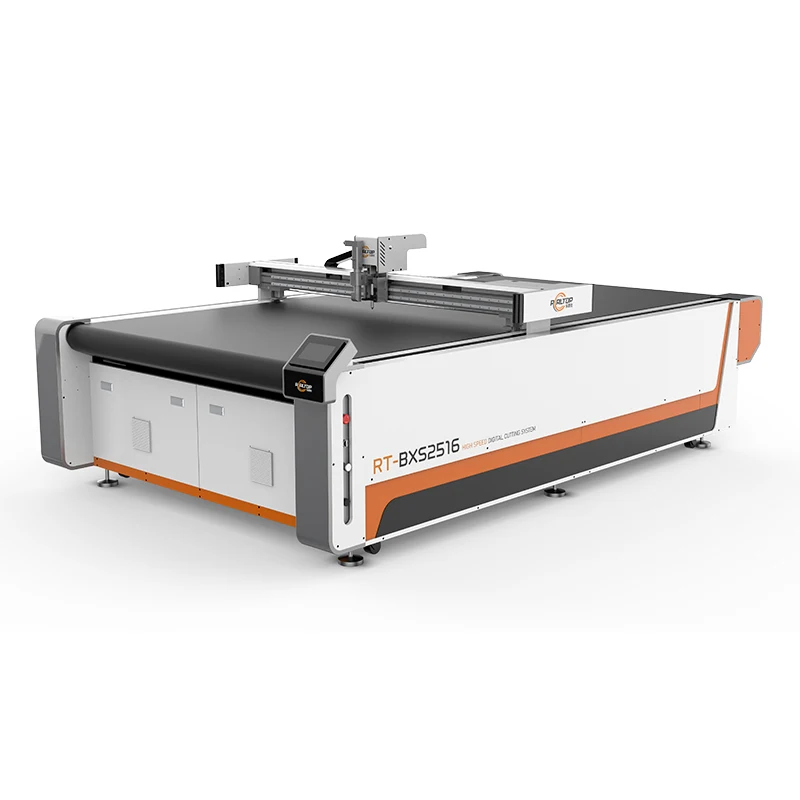
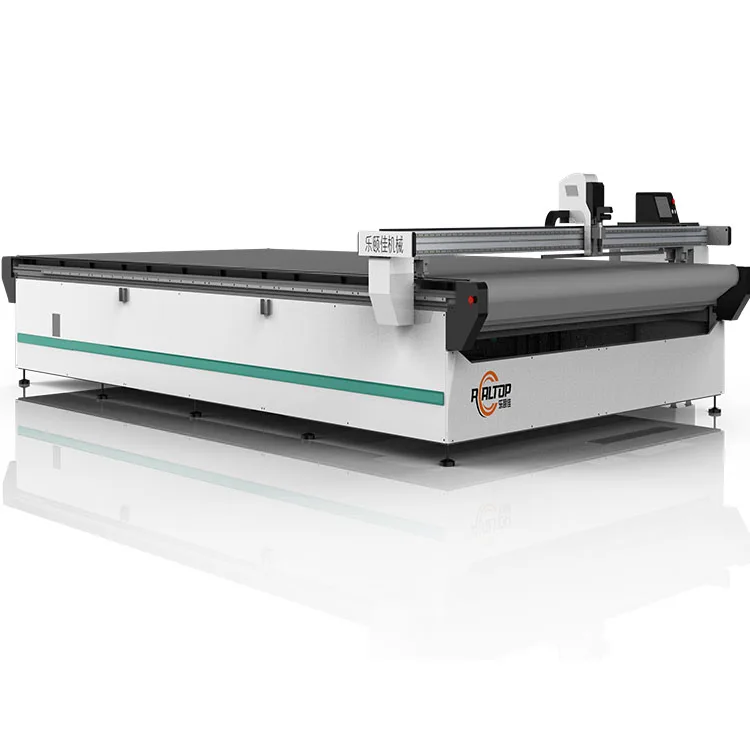
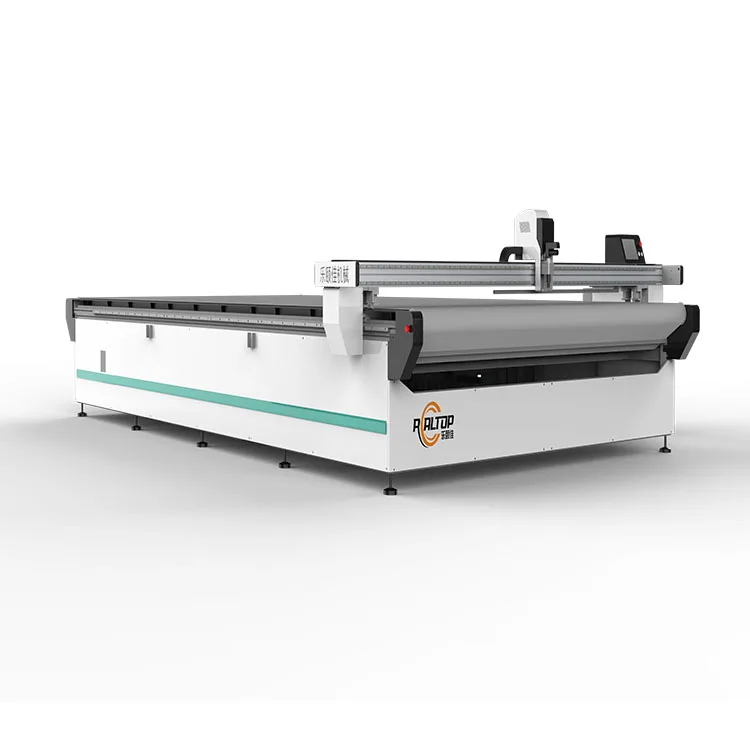
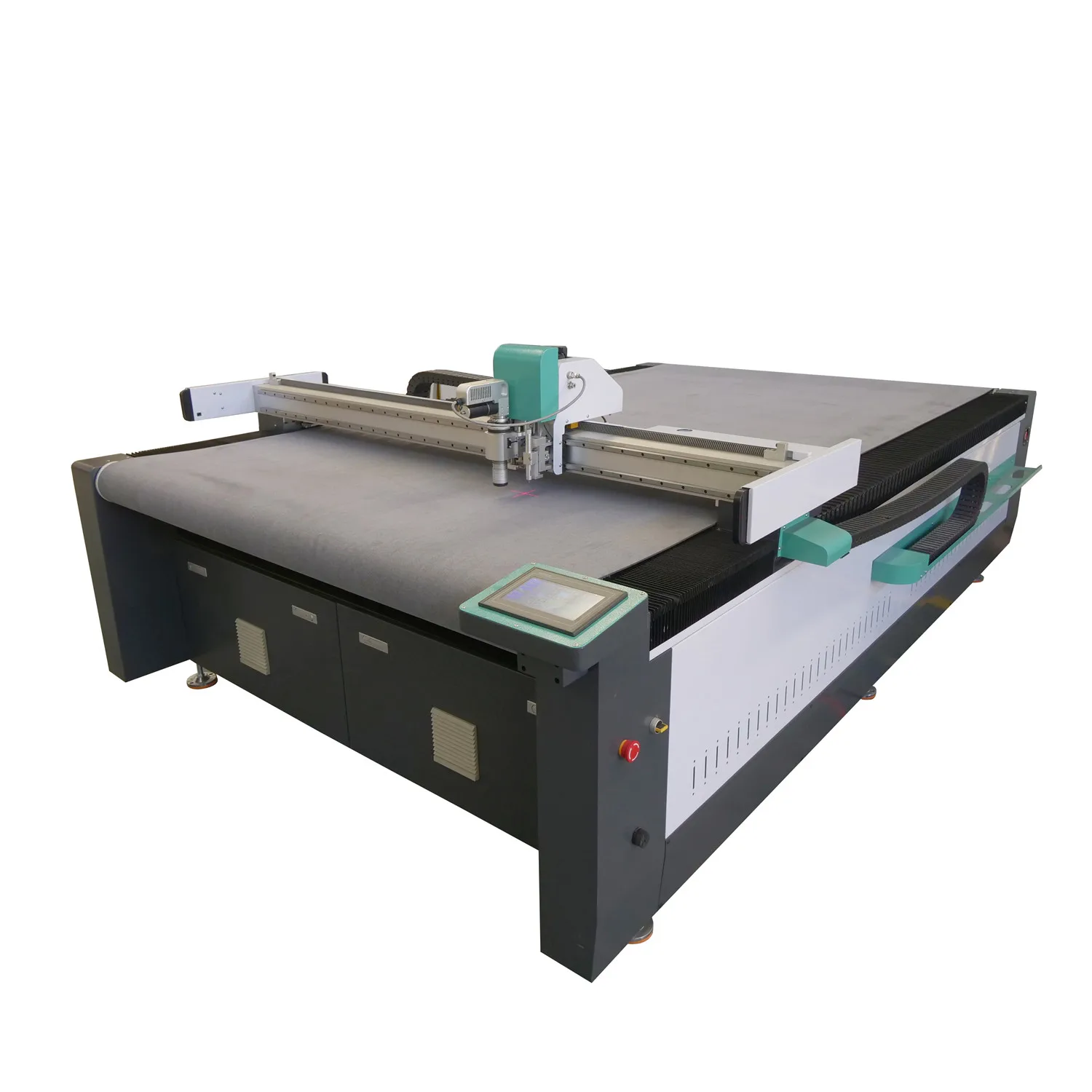


Production-Ready Textile Cutting — Tool head and vacuum zoning configured against your fabric stack height and daily yardage before order confirmation, not after delivery
Technical Specifications
| Parameter | Value |
|---|---|
| Model | RT-D2516 / RT-S2516 |
| Product Type | CNC Oscillating Knife Cutting Machine |
| Working Area | 1600 × 2500 mm |
| Machine Footprint | 3450 × 2300 × 1250 mm |
| Rated Power | 9 kW |
| Cutting Thickness Capacity | ≤100 mm (varies with material type and density — basis to be confirmed) |
| Cutting Speed Range | 200–800 mm/s (depends on material and layer count — basis to be confirmed) |
| Translational Velocity | 800–2000 mm/s |
| Repeated Accuracy | ≤0.1 mm |
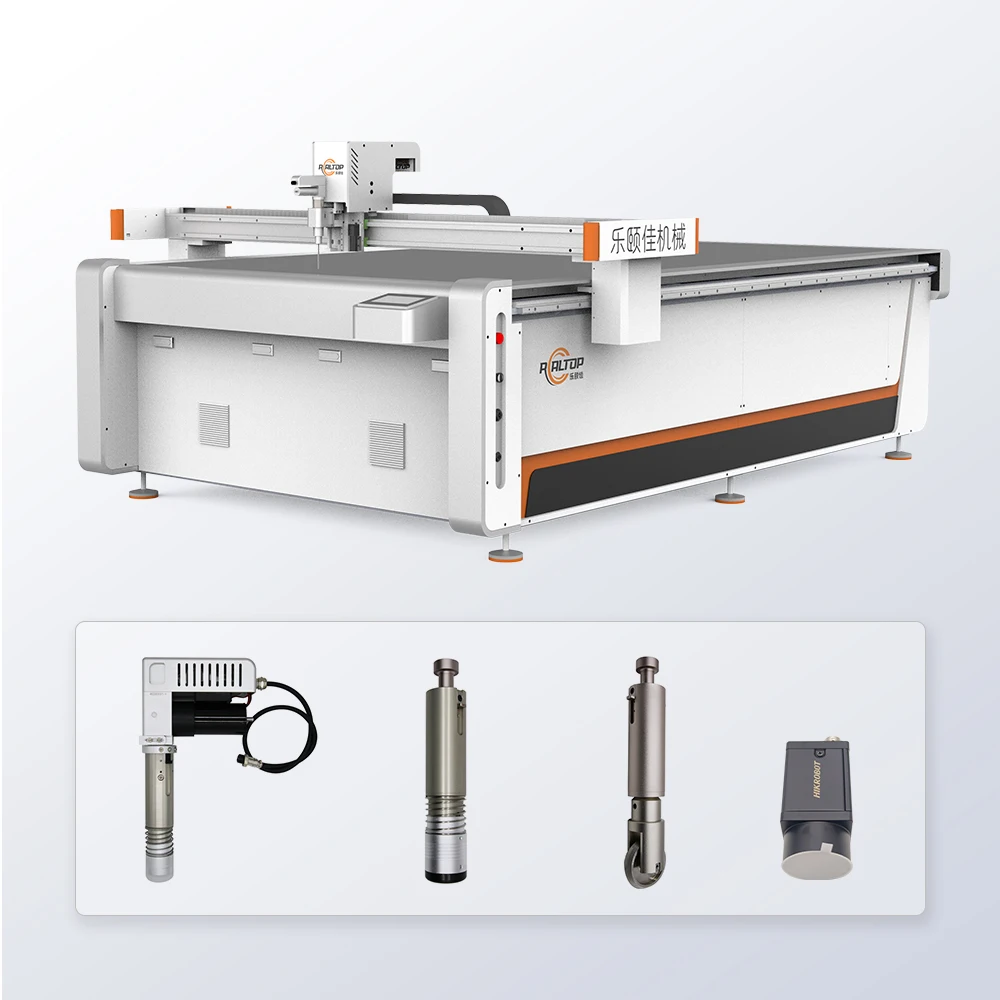
| Multifunctional Tool Head | Swiss-imported knife; options include oscillating knife, pneumatic knife, high-power vibrating knife, circular knife, V-cutting knife, drag knife, creasing wheel, dotted-line knife, punching, brush |
| Servo Motor | Delta or Panasonic (configurable) |
| Transmission System | Digital servo motor, linear guide, synchronous belt, ball screw |
| Linear Guide | Taiwan Hiwin rail |
| Vacuum Table | Magnesium-aluminum alloy, fluorocarbon PVDF powder spraying, anodic oxidation, hard oxidation |
| Vacuum Pump | 7.5 kW, integrated aviation aluminum shell with built-in silencer sponge |
| Conveyor Belt | Germany-imported |
| Visual Positioning Options | Small CCD camera mark-point positioning, panoramic camera recognition, projection positioning |
| Control Panel | Touch screen, multiple languages |
| Software Compatibility | Auto typesetting; supports PLT, DXF, AI formats |
| Voltage | 380V ± 10% |
| Instruction Format | HP-GL compatible |
| Frame Construction | Thick-walled seamless steel structure, high-temperature tempering, CNC machining center finished |
| Safety Devices | Infrared sensors, anti-collision, emergency stop |
| Working Table Options | Flat working table, auto-feeding table |
Application Suitability
| Application | Material or Output |
|---|---|
| Garment pattern cutting | Single and multi-layer fabric stacks, fur, woven and knit textiles |
| Automotive interior trimming | Leather hides, synthetic leather, carpet, composite sound-deadening materials |
| Soft furnishing production | Sofa fabrics, curtain panels, upholstery foam laminates |
| Footwear component cutting | Shoe upper materials, insole board, synthetic leather, EVA foam |
| Bag and luggage manufacturing | Nylon, canvas, PU leather, reinforced composite panels |
| Sports and outdoor goods | Neoprene, technical textiles, coated fabrics |
| Sealing and gasket fabrication | Non-woven fabric, PTFE, ETFE, rubber sheet |
| Advertising and print finishing | Printed vinyl, banner material, sticker films |
Why "200–800 mm/s" Tells You Almost Nothing Without Your Fabric in Hand
The speed number on a spec sheet only becomes real once your specific fabric type, layer count, and pattern geometry are on the table.
A cutting speed that works for a single layer of woven cotton at 800 mm/s may produce fused edges or skipped cuts on a 30-layer stack of technical nylon. I once visited a workshop where the operator had dialed the speed down to a crawl because the oscillating knife was dragging through a multi-layer foam laminate — the machine could not be blamed, but the wrong tool head and blade profile had been fitted for that material. This is why sample cutting on your actual roll goods is non-negotiable before any CNC Oscillating Knife Cutting Machine production line is committed to build. [NEED_CITE: material-specific cutting speed validation in textile manufacturing]
How the Swiss-Imported Tool Head Adapts to Textile Variability
The multifunctional cutting head accepts a Swiss-imported knife blade and supports vibration full cutting, half cutting, and cursor location within a single tool station. For garment manufacturers running nested pattern pieces from knit and woven fabrics, this means the same head can score a crease line on one piece and perform a full through-cut on the next without a manual tool change. Oscillating knife, pneumatic knife, circular knife, and drag knife options are all available on this platform, letting you match the blade action to the fiber structure rather than forcing every material through a single cutting method. The CNC Oscillating Knife Cutting Machine production line specification locks the tool head choice after your sample material has been tested.
CCD Camera Positioning for Printed Contour Work at Line Speed
When your fabric arrives pre-printed with registration marks, the visual positioning system becomes the difference between accurate contour cutting and costly material waste. This platform offers three vision options: a small CCD camera for mark-point positioning, a panoramic camera for broader recognition fields, and projection positioning for manual alignment verification. For signage producers cutting printed vinyl or garment makers working with sublimated panels, the panoramic camera recognition maintains tracking at production speed where a basic sensor would lose the mark. [NEED_CITE: CCD contour recognition accuracy standards in digital cutting]
Reading the Specs That Actually Determine Your Daily Output
The 7.5 kW vacuum pump paired with the magnesium-aluminum alloy table is the combination that holds your material flat during cutting. On a 1600 × 2500 mm bed, vacuum zoning determines whether a small pattern piece near the edge stays pinned or lifts into the knife path — inadequate zoning causes ragged cuts and forces the operator to re-nest layouts to avoid the table perimeter. The Taiwan Hiwin linear guide and ball screw transmission maintain the ≤0.1 mm repeated accuracy across the full working area, which matters when you are cutting interlocking pattern pieces where a half-millimeter drift accumulates into misaligned seams downstream. The Delta or Panasonic servo motor choice affects long-term positioning consistency under continuous multi-shift operation.
The Cost of Skipping the Configuration Conversation
A buyer who specifies a CNC Oscillating Knife Cutting Machine production line based on working area alone often discovers the problem weeks after installation. The vacuum table may not have enough independent zones to hold small garment pieces, causing lift and wasted material. The wrong blade profile may crush foam layers instead of shearing them cleanly. The software may not accept the nesting files the buyer already uses in their workflow, forcing a manual conversion step that erodes any throughput gain. These are not machine defects — they are specification gaps that could have been caught during the sample cutting and configuration review stage. [NEED_CITE: common specification mismatches in CNC cutting equipment procurement]
What You Actually Get When You Source From This Line
In-house design covers both knife and laser cutting processes, so your material is matched to the correct method rather than forced into whichever machine happens to be in stock. Every tool head and table configuration is specified per your material type and production volume before the build begins. CCD camera positioning is confirmed against your printed mark style, not assumed. Software compatibility with PLT, DXF, and AI formats is verified against your existing nesting workflow before order confirmation. Sample cutting on your own roll goods produces a physical report you can inspect — edge quality, layer integrity, contour accuracy — before you commit to the full CNC Oscillating Knife Cutting Machine production line build. [NEED_CITE: sample-based equipment validation practice in industrial cutting]
Documentation & Verification
- Machine specification sheet listing confirmed tool head and vacuum table configuration for your material
- Electrical schematic and voltage confirmation matching your facility power supply
- Sample cutting report produced on your fabric with edge quality and accuracy measurements
- Software license and file format compatibility note confirming PLT, DXF, AI workflow integration
- Factory test record demonstrating cutting performance on your submitted material before dispatch
- Operation and maintenance manual in your specified control language
Installation, Commissioning & Support
- 3450 × 2300 × 1250 mm machine footprint requires level concrete floor with clearance for auto-feeding table extension
- 380V ± 10% three-phase supply with dedicated circuit for the 9 kW rated power draw and 7.5 kW vacuum pump
- Thick-walled steel frame ships as a single assembly; linear guides and servo motors require on-site alignment verification
- First-run parameter setting covers blade oscillation frequency, vacuum zone mapping, and CCD camera calibration for your mark style
- Spare blade inventory, presser wheel sets, and vacuum belt segments sized to your daily cutting volume at order stage
- Touch screen control panel configured in your specified language before shipment with on-site operator training
What We Need to Specify Your Line Correctly
Send your primary fabric type with thickness range, typical layer count per cut, and maximum sheet or roll width. Include your current nesting software name and the file formats you export daily. State your facility voltage and frequency, preferred control panel language, and whether your workflow requires flat-table or auto-feeding configuration. If your material carries printed registration marks, provide a sample panel so we can verify CCD recognition before quoting the CNC Oscillating Knife Cutting Machine production line.
Frequently Asked Questions
Q: How do you verify cutting speed for my specific fabric type and layer count?
A: We run sample cuts on your submitted material across the thickness and layer range you specify. The cutting speed, blade profile, and oscillation frequency are recorded in a test report showing edge quality and dimensional accuracy. The confirmed parameters become part of your machine configuration before production begins.
Q: Which CCD camera option matches my printed mark recognition needs?
A: It depends on your mark size, contrast, and spacing. The small CCD camera suits high-contrast marks on individual pieces. The panoramic camera handles broader recognition fields for nested printed panels. We test your actual printed sample to confirm which system maintains tracking accuracy at your target production speed.
Q: How is software compatibility with my nesting workflow confirmed before order?
A: We request a sample nesting file in your native format — PLT, DXF, or AI — and run it through our auto typesetting software to verify import, toolpath generation, and output accuracy. The compatibility result is documented in writing and included with your order confirmation package.
Q: What vacuum table zoning do I need for small garment pattern pieces?
A: Small pieces near the table perimeter require independent vacuum zones to prevent material lift during cutting. We map your typical pattern layout against the available zone configuration on the 1600 × 2500 mm bed and specify the zoning arrangement that holds your smallest piece geometry securely at full cutting speed.
Q: Can I review sample cutting results on my material before the machine ships?
A: Yes. Your submitted fabric is cut using the exact tool head, blade, and vacuum configuration specified for your order. The sample cutting report documents edge quality, layer separation integrity, and dimensional accuracy. You review and approve these results before the machine enters final assembly and dispatch.





商品评价
Clear filtersThere are no reviews yet.