


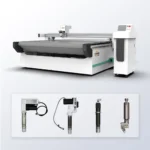
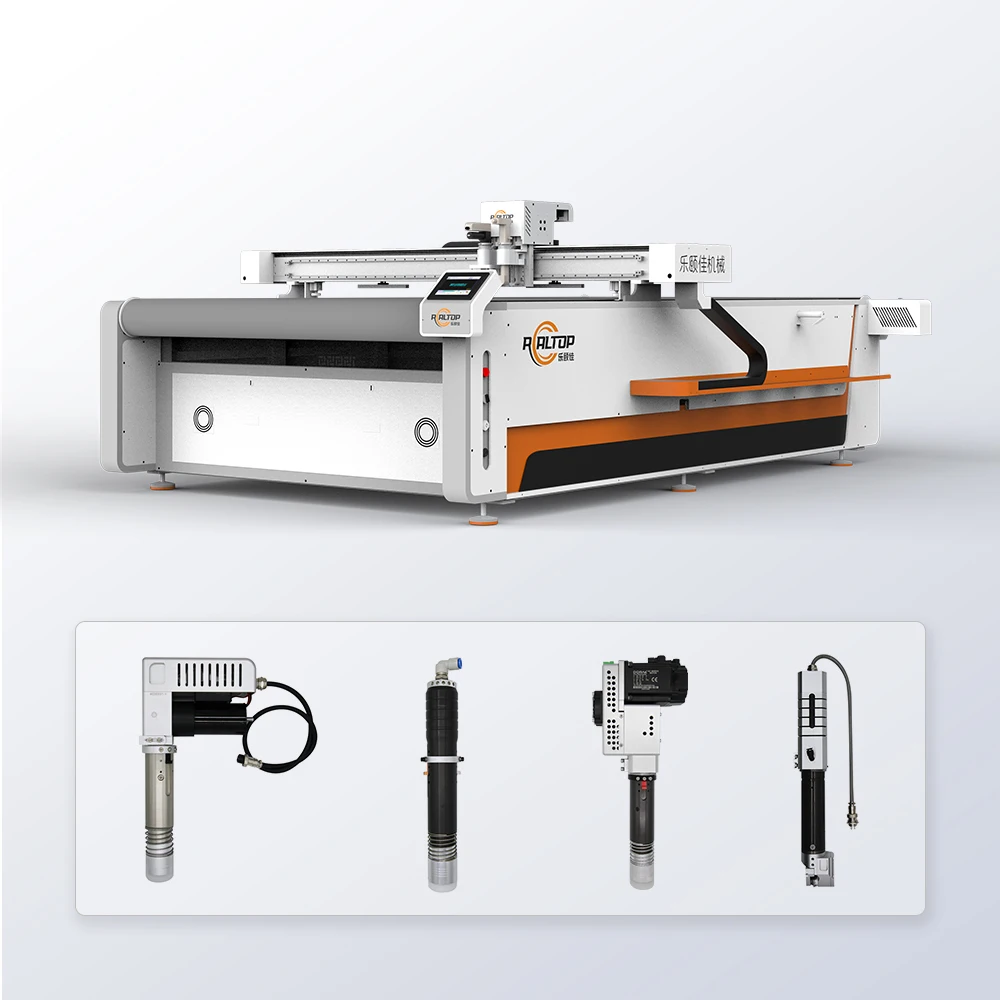


Tool Head Matched to Fabric Weight — We configure oscillating, pneumatic or high-power vibrating knife heads based on the exact fabric stack and layer count you send us for sample cutting.
Technical Specifications
| Parameter | Value |
|---|---|
| Product Type | CNC Oscillating Knife Fabric Cutting Machine |
| Model | RT-D2516 / RT-S2516 |
| Working Area | 1600 × 2500 mm |
| Overall Dimensions | 3450 × 2300 × 1250 mm |
| Rated Power | 9 kW |
| Voltage | 380V ±10% |
| Fixed Model | Flat working table / Auto feeding table |
| Multifunctional Head | Swiss imported knife with vibration full cutting, vibration half cutting, cursor location |
| Safety Device | Infrared sensors, anti-collision, emergency stop |
| Translational Velocity | 800–2000 mm/s |
| Cutting Speed | 200–800 mm/s (varies with cutting material) |
| Cutting Thickness | ≤100 mm (varies with material) |
| Repeatability | ≤0.1 mm |
| Transmission System | Digital servo motor, linear guide, synchronous belt, ball screw |
| Servo Motor Options | Delta or Panasonic (IP67 waterproof, vibration suppression) |
| Vacuum Table | Magnesium-aluminum alloy, PVDF powder spraying, anodic and hard oxidation |
| Vacuum Pump | 7.5 kW, aviation aluminum shell, built-in silencer sponge (noise reduction 35%) |
| Conveyor Belt | Germany imported |
| Linear Guide | Taiwan Hiwin rail |
| Software | Auto typesetting, supports PLT, DXF, AI formats |
| Visual Positioning Options | Small CCD camera mark point, panoramic camera recognition, projection positioning |
| Tool Head Options | Oscillating knife, pneumatic knife, high-power vibrating knife, circular knife, V cutting knife, drag knife, creasing wheel, dotted line knife, punching, brush |
| Language Options | English, Russian, Italian, Chinese (special languages customizable) |
Application Suitability
| Application | Material or Output |
|---|---|
| Shirt and garment cutting | Woven cotton, polyester blends, single-ply to multi-layer stacks |
| Uniform and workwear production | Heavy canvas, denim, flame-retardant textile stacks |
| Sofa and soft furnishing | Upholstery fabric, velvet, chenille, composite backing |
| Automotive interiors | Seat cover textiles, headliner fabric, synthetic leather |
| Footwear uppers and linings | Leather, PU, mesh, foam-backed textile |
| Carpet and floor mats | Tufted carpet, woven mats, foam underlay |
| Bags and luggage | Nylon, ballistic weave, canvas, coated synthetics |
Why Ragged Edges Appear at Full Production Speed
The cutting speed you see in a brochure only holds true for a specific fabric weight and layer count.
When garment shops push a CNC shirt fabric cutting machine production line past its verified material envelope, the blade deflects inside the stack, producing frayed plies on the bottom layers. The top pieces look clean while the bottom ones need rework. I once watched a buyer in Lima run sixty plies of coated polyester on a machine configured for light shirting — the bottom ten layers were unusable. [NEED_CITE: effect of layer count on blade deflection in textile cutting]
Matching the Tool Head to Garment Fabric Type
The oscillating knife head handles most woven and knit shirting fabrics at single or low-ply counts, producing a clean edge without fusing. When production shifts to heavier workwear textiles or multi-layer stacks approaching the 100 mm thickness envelope, a high-power vibrating knife or pneumatic knife head becomes necessary. Switching between tool heads on this CNC shirt fabric cutting machine production line does not require a mechanical rebuild — the multifunctional carriage accepts each tool option as a swap, so a garment shop running both light poplin and heavy drill cloth can reconfigure between shifts.
Continuous Roll-to-Cut Workflow for Shirt Panels
The auto-feeding table with the Germany-imported conveyor belt pulls fabric directly from the roll, advancing it across the 1600 × 2500 mm working area in one continuous motion. The 7.5 kW vacuum pump holds the material flat through the magnesium-aluminum alloy table surface, preventing the fabric from lifting during high-speed traversing at up to 2000 mm/s translational velocity. [NEED_CITE: vacuum hold-down requirements for multi-layer textile cutting] This means a shirt manufacturer cutting dozens of size-graded panels from a single roll can maintain a steady feed without manual repositioning between nests.
What the Specs Mean on the Cutting Floor
The ≤0.1 mm repeatability figure matters directly when nesting shirt collars and cuffs where a half-millimeter drift across a long cut path causes mismatch at the sewing stage. Taiwan Hiwin linear guides and ball-screw transmission deliver that positional accuracy across the full 2500 mm stroke. The digital servo motors, available in Delta or Panasonic IP67-rated versions with vibration suppression, maintain torque at the 200–800 mm/s cutting speed range without stepping errors. Auto typesetting software accepting PLT, DXF and AI files lets the production team import nests directly from their existing CAD environment. CCD camera mark point positioning and panoramic camera recognition are available as options for shops cutting printed textiles where pattern alignment across panels is mandatory.
What Happens When the Configuration Is Wrong for Your Fabric
Specifying a machine only by working area size ignores the real variables: fabric weight per square meter, layer count, coating type and daily panel volume. A flat table without auto-feeding forces operators to manually advance each ply, slowing throughput and introducing alignment drift. A vacuum pump undersized for the table area loses grip on small cut pieces, allowing them to shift during the final pass and producing miscut panels. [NEED_CITE: common causes of material shift on CNC cutting tables] When the voltage at the buyer’s factory sits outside the 380V ±10% window, servo drives fault intermittently, halting mid-cut and wasting the nested fabric already on the table.
Why Buyers Source This Line Here
In-house design covers both knife and laser cutting technologies, so a garment manufacturer can match the cutting method to the textile rather than force one method across every fabric. Each tool head and table configuration is specified per material and production volume before the order is locked. CCD camera positioning for printed contour work is verified with the buyer’s actual printed fabric. Software compatibility is confirmed against the buyer’s nesting file format before production begins. Sample cutting runs on the buyer’s own material ship with a report showing edge quality and layer capacity, giving a factual basis for the decision.
Documentation & Verification
- Machine specification sheet listing every configured option against your order
- Electrical schematic with 380V ±10% confirmation matched to your factory supply
- Tool head and table configuration record showing selected knife type and vacuum zoning
- Sample cutting report on your garment fabric with edge and stack-depth results
- Software licence and file format compatibility note for PLT, DXF and AI imports
- Factory test record captured before crate closure and shipment
Installation, Commissioning & Support
- 9 kW rated power requires a dedicated three-phase circuit with confirmed 380V ±10% at the panel
- 3450 × 2300 mm footprint needs clear floor space with level concrete for the flat or auto-feeding table
- Machine ships fully assembled; positioning and utility connection are the primary on-site tasks
- First-run parameter setting calibrates cutting speed between 200–800 mm/s for your specific fabric
- Operator training covers tool head changeover, nesting software and CCD camera mark point alignment
- Spare parts list includes Swiss-imported blades, conveyor belt segments and vacuum pump filter elements
What to Send with Your Inquiry
Provide the fabric type, weight per square meter and maximum layer count you plan to cut daily. Include your standard shirt pattern files so the software team can verify PLT, DXF or AI import compatibility before quotation. Confirm the voltage and frequency at your facility and the control language your operators need on the interface.
Frequently Asked Questions
Q: How do I choose between the oscillating knife, pneumatic knife and high-power vibrating knife for my fabric?
A: The selection depends on fabric weight, coating presence and layer count. Light woven shirting at single or low ply typically runs on the oscillating knife. Heavier coated textiles and multi-layer stacks need the pneumatic or high-power vibrating knife to maintain clean edges through the full stack depth. We run sample cuts on your actual fabric to confirm the choice before the order is finalized.
Q: How is cutting speed verified against my specific shirt fabric?
A: Cutting speed in the 200–800 mm/s range varies with material density and layer count. We test your fabric at incrementally higher speeds and inspect edge quality on every ply, especially the bottom layers where blade deflection shows first. The verified speed is documented in the sample cutting report that accompanies your order.
Q: Can the auto-feeding conveyor integrate with my existing garment workflow?
A: The auto-feeding table pulls from standard fabric rolls and advances material across the 1600 × 2500 mm working area. Your production team loads roll stock at one end, and the conveyor paired with auto typesetting software nests panels continuously. The workflow fits shops already running CAD-based pattern grading and digital marker planning.
Q: What happens when we switch between shirt patterns and different fabric types?
A: Tool head swap and software nest reload are the two changeover steps. The multifunctional carriage accepts each knife option without a mechanical rebuild. Your operators load the new DXF or PLT nest file, adjust the cutting speed to the verified value for the new fabric, and resume production. Changeover time depends on operator familiarity rather than hardware constraints.
Q: How do we confirm software compatibility before placing the order?
A: Send your existing PLT, DXF or AI pattern files along with your inquiry. Our software team imports them into the auto typesetting system, generates a test nest, and sends you the compatibility note alongside the sample cutting report. Any conversion issue is resolved before the machine enters production.



商品评价
Clear filtersThere are no reviews yet.