





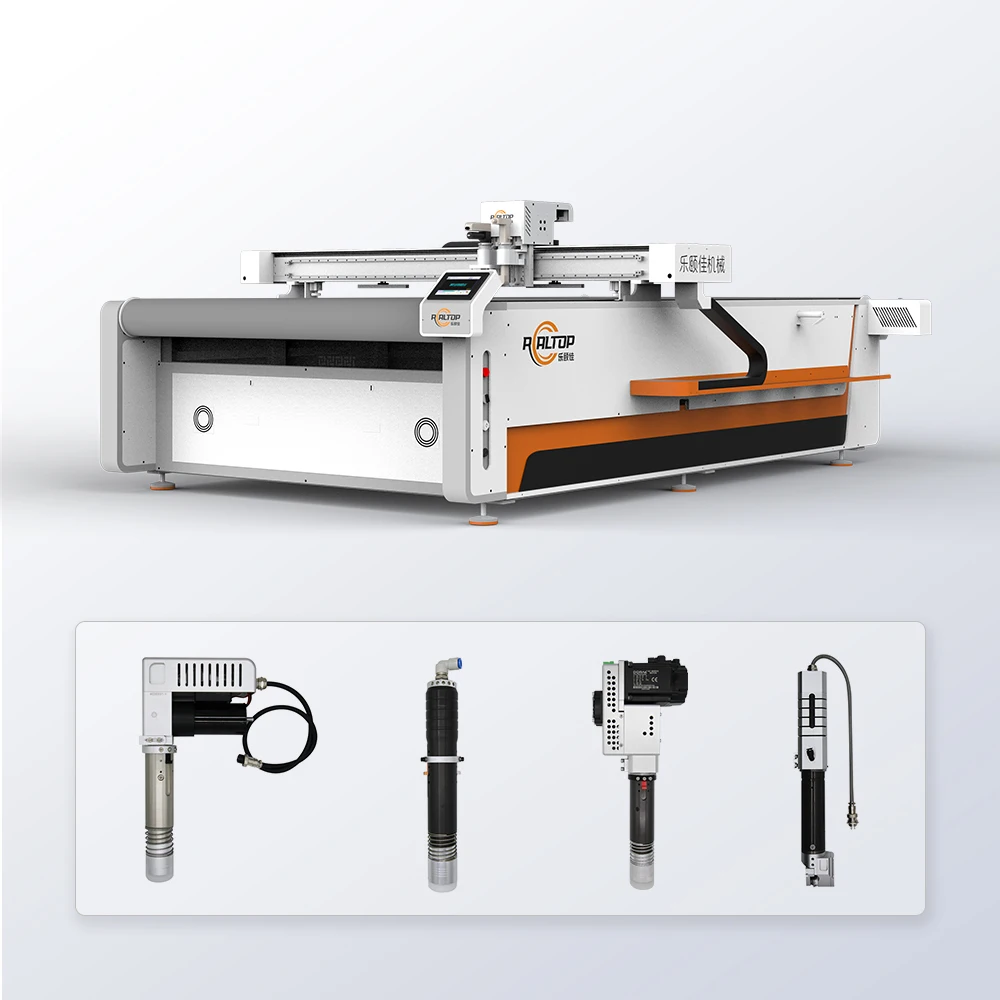
Material-matched cutting configuration — every cloth CNC cutting machine we ship carries a tool head and vacuum table zoning plan verified on the buyer’s actual fabric roll before the crate is nailed shut.
Technical Specifications
| Parameter | Value |
|---|---|
| Product Type | CNC Oscillating Knife Cutting Machine |
| Working Area | 1600 × 2500 mm |
| Tool Head Options | Oscillating knife, Driven rotary knife, Creasing wheel, Kiss cutting tool, Pneumatic knife, Milling tool, V groove knife |
| Cutting Speed Range | 0 – 2000 mm/s |
| Positioning Accuracy | ±0.1 mm |
| Vacuum Pump Power | 9 kW |
| Vacuum Table Type | Aluminum bellows vacuum table |
| Voltage Options | 110V / 220V / 380V |
| Compatible File Formats | PLT, DXF, AI, PDF |
| Control Interface | PLC control panel |
| Safety Devices | Infrared sensor, emergency stop |
| Software Languages | English, Russian, Italian, Chinese (additional on request) |
| Machine Dimensions | 3300 × 2100 × 1350 mm |
| Servo Drive Options | Panasonic, Delta, Dorna |
| Certification | CE |
Application Suitability
| Application | Material or Output |
|---|---|
| Apparel manufacturing | Suits, knitwear, lace, and complex fabrics requiring pattern-matching layouts |
| Automotive interiors | Seat fabrics, carpets, and PVC mats demanding burr-free edges |
| Home textiles | Sofa fabrics, curtains, and rugs processed in multi-layer stacks |
| Composite processing | Carbon fiber prepreg and aramid with cold cutting to avoid delamination |
| Footwear components | Leather, synthetic uppers, and insole board |
| Technical textiles | Filter media, geotextiles, and coated industrial fabrics |
What a Working Area Number Hides About Real Cutting Performance
A cloth CNC cutting machine production line specified only on table size often fails the moment the buyer loads a coated or layered fabric that behaves nothing like the standard test textile.
I walked into a garment factory in the Jinan area years ago where the owner had bought a flatbed cutter based purely on its 1600 × 2500 mm bed. The machine ran fine on plain woven cotton during the factory test. But his actual production was a coated polyester blend used for waterproof workwear. The oscillating knife head that sliced cotton cleanly dragged through the coating layer, fraying the edges and crushing the backing. Three rolls of material went to scrap before we swapped to a driven rotary knife and adjusted the vacuum zoning. The cloth CNC cutting machine production line was never wrong on paper — it was wrong for his material. [NEED_CITE: material-specific tooling selection for coated technical textiles]
This mismatch happens more often than buyers expect. The working area is the easiest number to compare across quotes, which is exactly why it dominates the conversation. But edge quality on a layered synthetic, vacuum hold-down on small pattern pieces, and blade oscillation frequency on dense weaves are the variables that actually determine whether a machine earns its keep on the shop floor.
How the Production Job Dictates the Tool Head
A suit jacket front panel cut from fine wool behaves entirely differently from a car seat cover cut from PVC-backed leather. The oscillating knife handles most woven and knit fabrics at production speed, producing clean edges through multi-layer stacks. But the moment you introduce a coated surface, a driven rotary knife often gives a cleaner result because it slices rather than punches through the material. For crease lines on packaging patterns or fold marks on structured garments, the creasing wheel mounts alongside the cutting tool so the same pass scores and cuts. The cloth CNC cutting machine production line configuration therefore starts with the material sample, not the brochure.
Why Multi-Layer Cutting Exposes Weak Vacuum Zoning
When a factory stacks thirty or forty plies of knit fabric to cut dozens of garment pieces in one pass, the vacuum table must hold every layer flat across the entire bed. The aluminum bellows design on this unit provides a seal that maintains suction even as the knife penetrates through the stack. But zoning matters just as much as total suction. A small pattern piece cut near the edge of the bed can lift if the vacuum zone underneath it is too large and sharing suction with empty table area. Proper zone segmentation keeps small parts locked down while the knife exits the cut. [NEED_CITE: vacuum table zoning principles for flatbed digital cutting systems]
Reading the Specifications Against Your Actual Work
The cutting speed range of 0 – 2000 mm/s defines the machine’s envelope, but actual throughput depends on material density, number of layers, and pattern complexity. A single ply of lightweight silk may run near the upper end, while a fifty-millimeter stack of dense upholstery foam requires a slower feed to maintain edge quality. The ±0.1 mm positioning accuracy keeps pattern-matching registrations tight across nested layouts, which matters when a plaid or stripe must align across multiple garment panels. File format compatibility with PLT, DXF, AI, and PDF means the machine accepts output from most pattern design and nesting software without requiring a format conversion step that could distort curves. The 9 kW vacuum pump is sized to support the full bed area, but the buyer should confirm that the zoning layout matches their typical piece size distribution. Servo drive selection across Panasonic, Delta, and Dorna allows the buyer to match their existing maintenance capability and local parts availability.
The Hidden Cost of Skipping the Sample Cut
A buyer who commits to a configuration without running their own material through the machine takes on all the risk. The standard factory test uses readily available test fabrics that may share nothing with the buyer’s production stock. Edge fraying that only appears on a specific coated textile, delamination that occurs only when the oscillation frequency hits a particular harmonic on a composite weave, or vacuum lift that surfaces only when cutting small pieces near the table boundary — these problems stay invisible until production begins. Once the machine is on the floor, reconfiguring tool heads and vacuum zones costs downtime and material waste that could have been avoided with a sample cutting report. [NEED_CITE: cost of unplanned production stoppages in garment manufacturing]
Why Buyers Source This Configuration Here
The in-house design team covers both knife cutting and laser cutting, so a buyer working with mixed materials — fabric on one line, acrylic templates on another — can match the cutting method to the material rather than forcing one technology to do everything. Tool head and table configurations are specified per material type and daily volume, not sold as a fixed package. The sample cutting protocol runs the buyer’s own fabric or composite through the machine before any order confirmation, generating a cutting report that documents edge quality, layer count, and speed settings. Software compatibility is confirmed against the buyer’s existing nesting workflow and file format before the order enters production. Voltage, plug type, and control panel language are locked down in writing before shipment, eliminating the arrival-day surprise of a machine that does not match the factory’s electrical supply.
Documentation & Verification
- Machine specification sheet listing the exact tool heads and vacuum zoning configured for your material
- Electrical schematic with your confirmed voltage, phase, and plug type noted on the drawing
- Sample cutting report produced on your fabric roll with edge quality photographs and speed parameters
- Factory test record documenting positioning accuracy verification across the full working area
- Software licence documentation with file format compatibility confirmed against your nesting system
- Spare parts list identifying consumables and wear parts specific to your selected tool head configuration
Installation, Commissioning & Support
- Floor space planning around the 3300 × 2100 × 1350 mm machine envelope including material feed and offload clearance
- Dedicated electrical circuit matching your confirmed voltage option with appropriate breaker sizing for the 9 kW vacuum pump
- Assembly of the heavy-duty frame and aluminum bellows vacuum table with flatness verification on your shop floor
- PLC control panel language set to your operator preference during commissioning with hands-on parameter tuning
- Tool head changeover training covering oscillating knife, rotary knife, and creasing wheel swaps for different production jobs
- Preventive maintenance schedule aligned to your daily cutting volume and material abrasiveness
What We Need to Quote the Right Configuration
Send us the material type, typical thickness, and whether you run single ply or multi-layer stacks. Tell us your daily cutting volume and the range of piece sizes in your nesting layouts. Specify your local voltage and frequency, the control language your operators need, and whether your existing nesting software outputs PLT, DXF, AI, or PDF. If you can ship a roll or sheet of your actual production material, we will run the sample cut and send you the report before any commitment.
Frequently Asked Questions
Q: How do we verify that the cutting speed matches our production volume?
A: We run a timed sample cut using your actual material at the layer count you specify, then calculate throughput based on your nesting pattern. This gives you a real-world figure tied to your product rather than a generic maximum speed claim that assumes a material you never cut.
Q: Which tool head works best for our specific fabric?
A: The answer depends on your material composition, coating, and whether you cut single or multi-layer. We test oscillating knife, driven rotary knife, and pneumatic knife options against your sample and document which produces the cleanest edge at your target speed before finalizing the configuration.
Q: Will small pattern pieces stay flat during cutting?
A: The aluminum bellows vacuum table is divided into zones that can be activated independently. We configure the zoning based on your typical piece size distribution so that small parts near the table edges receive sufficient hold-down without sharing suction with empty areas of the bed.
Q: Does the software accept our existing nesting files?
A: The system reads PLT, DXF, AI, and PDF formats. Before you order, we import a sample file from your nesting software and verify that curves, registration marks, and cut paths transfer correctly. Any incompatibility is resolved before the machine ships rather than discovered on your first production day.





商品评价
Clear filtersThere are no reviews yet.