




Tool Head Matched to Material — Every oscillating knife, drag knife, and creasing wheel option on this garment fabric CNC cutting machine production line is selected after sample cutting on the buyer’s actual roll goods, not assigned by default from a catalog page.
Technical Specifications
| Parameter | Value |
|---|---|
| Model | RT-D2516 / RT-S2516 |
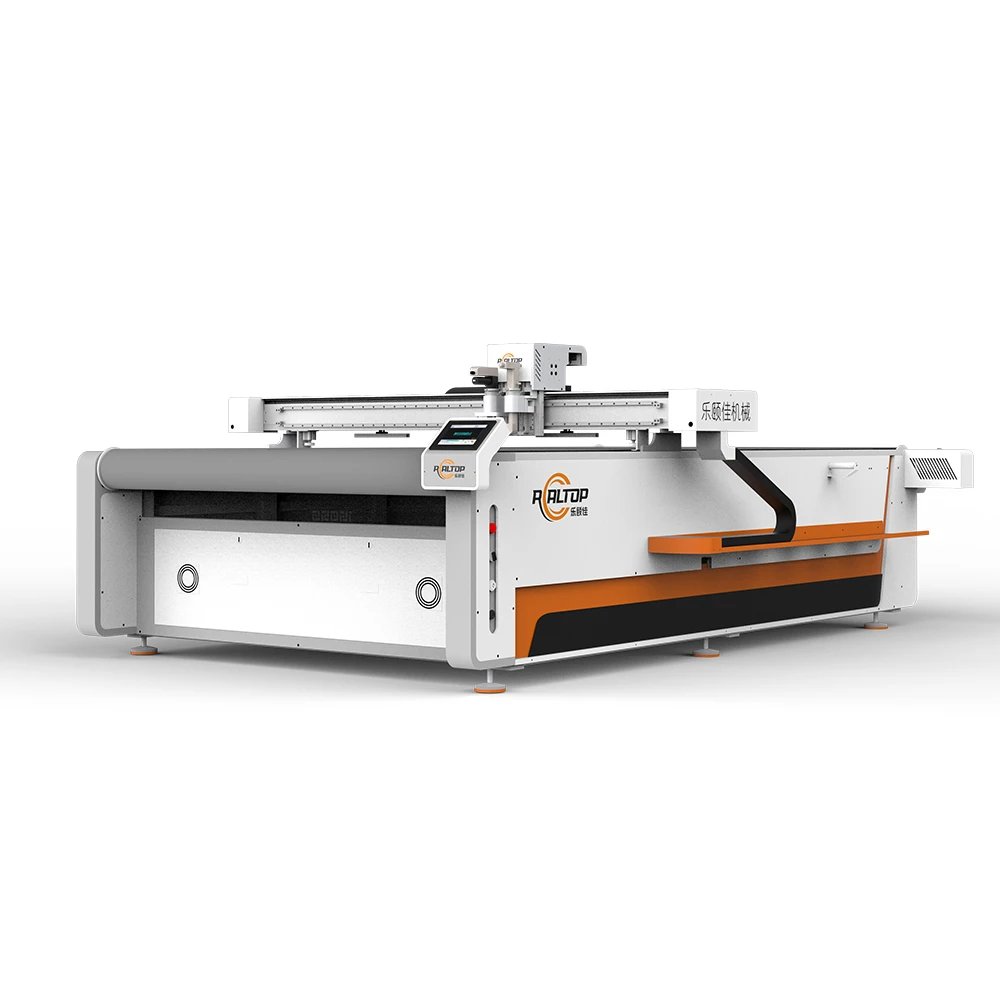
| Product Type | CNC Oscillating Knife Cutting Machine |
| Working Area | 1600 × 2500 mm |
| Overall Dimensions | 3450 × 2300 × 1250 mm |
| Rated Power | 9 kW |
| Voltage | 380V ±10% (50Hz/60Hz to confirm per destination market) |
| Table Type | Flat working table or auto-feeding conveyor table |
| Translational Velocity | 800 – 2000 mm/s |
| Cutting Speed | 200 – 800 mm/s (varies with fabric type and ply height) |
| Cutting Thickness | Up to 100 mm (depends on material density and lay-up) |
| Repeated Accuracy | ≤ 0.1 mm |
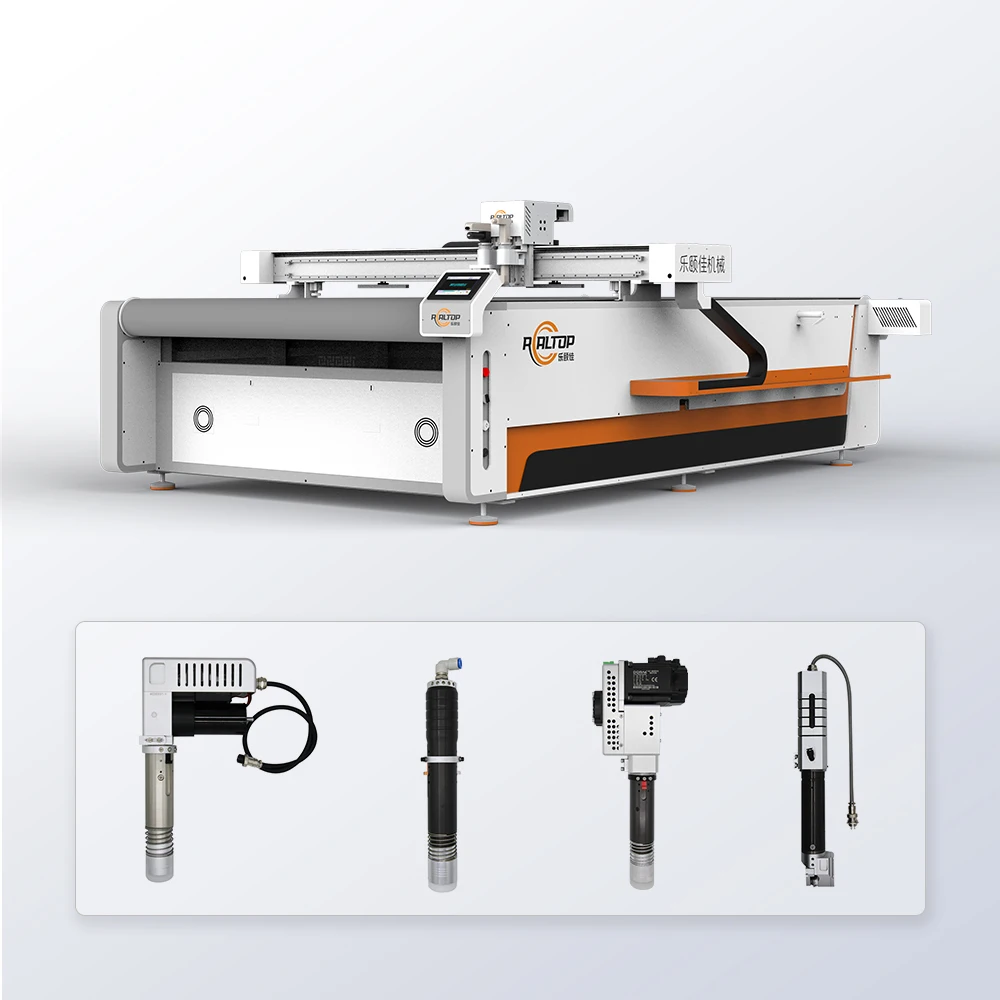
| Tool Head Options | Swiss imported oscillating knife, pneumatic knife, high-power vibrating knife, circular knife, V-cutting knife, drag knife, creasing wheel, dotted line knife, punching, brush |
| Visual Positioning | Small CCD camera mark-point positioning, panoramic camera recognition, projection positioning |
| Servo Motor | Delta or Panasonic (optional), IP67 rated |
| Transmission System | Digital servo motor, linear guide, synchronous belt, imported ball screw |
| Linear Guide | Taiwan Hiwin rail |
| Vacuum Table | Magnesium-aluminum alloy, PVDF powder sprayed, anodic and hard oxidation |
| Vacuum Pump | 7.5 kW |
| Conveyor Belt | Germany imported (on auto-feeding configuration) |
| Control Panel | Touch screen, multiple language support |
| Instruction System | HP-GL compatible format |
| Software | Auto nesting, supports PLT, DXF, AI file formats |
| Safety Devices | Infrared sensor stop, beam anti-collision, emergency stop with in-situ resume |
| Language Options | English, Russian, Italian, Chinese (custom languages available) |
Application Suitability
| Application | Material or Output |
|---|---|
| Garment and footwear production | Woven, knit, stretch fabrics in single and multi-layer lay-ups |
| Leather goods and luggage | Natural and synthetic leather, PU, PVC |
| Sofa and soft home furnishing | Upholstery textile, chenille, velvet, composite foam-backed fabric |
| Automotive interior | Laminated textile, headliner fabric, gasket material |
| Carpet and floor mat | Tufted and woven carpet, non-woven mat |
| Composite material processing | Sponge composite leather, EVA, XPE, PP, PE, PTFE, ETFE |
| Packaging and sample making | Corrugated cardboard, sticker, corrugated plastic |
| Advertising and printing | Vinyl, banner, printed fabric with contour marks |
Why Specifying Only the Working Area Sabotages Your Fabric Yield
A cutting table ordered solely on bed size frequently fails once production starts, because vacuum zoning was never matched to the small pattern pieces typical of garment cutting — and a garment fabric CNC cutting machine production line that cannot hold a sleeve panel flat will deliver ragged edges at high oscillating knife speed.
I have watched fabricators in the Pearl River Delta accept a standard flatbed after a quick test on cotton shirting, only to discover weeks later that their multi-layer coated technical fabric lifts off the table mid-cut. The blade chatters, the edge frays, and daily output drops noticeably. The root cause is almost always insufficient vacuum zoning combined with the wrong tool head frequency for the ply height. [NEED_CITE: vacuum hold-down requirements for multi-layer textile cutting]
Matching the Oscillating Knife to Your Lay-Up Height
The oscillating knife on this system comes in several configurations — standard Swiss-imported vibrating head, high-power vibrating knife, and pneumatic knife — each suited to a different fabric density and ply count. A single-layer silk requires a high-frequency, low-amplitude stroke to prevent drag distortion, while a 60-layer denim lay-up demands a longer stroke with higher downward force. Selecting the wrong combination produces either fused edges on synthetics or incomplete cuts on heavy canvas, both of which force rework downstream. The garment fabric CNC cutting machine production line is configured after sample cutting on your actual material so the correct head is locked in before the machine ships.
Vacuum Table Zoning and Small Pattern Piece Hold-Down
The magnesium-aluminum alloy vacuum table is built with multiple independent zones and a high-flatness machined surface. In garment production, pattern pieces range from large back panels to small collar stays, and each size interacts differently with airflow. A single-zone table pulls air through perforations far from the part, allowing lightweight pieces to shift during high-speed traversal. Zoned vacuum lets operators activate only the section beneath the active cut area, concentrating suction where it matters. This is the single largest factor separating a table that runs cleanly at 800 mm/s from one that forces the operator to slow down and nurse every contour. [NEED_CITE: vacuum zoning standards for CNC flatbed cutting tables]
Key Specifications That Directly Affect Daily Output
The 9 kW rated power drives both the oscillating knife head and the 7.5 kW vacuum pump simultaneously, so confirming your factory supply can sustain that draw on a dedicated circuit prevents mid-shift trips. The Taiwan Hiwin linear rails paired with an imported ball screw and Delta or Panasonic servo motors maintain ≤ 0.1 mm repeated accuracy across the full 1600 × 2500 mm bed — essential when cutting nested patterns where a drift of even half a millimeter accumulates across dozens of pieces. Translational velocity reaches 2000 mm/s between cuts while actual cutting speed stays within 200 – 800 mm/s depending on fabric resistance. The HP-GL compatible instruction system and nesting software accepting PLT, DXF, and AI files mean your existing marker files load without re-drawing, which avoids the silent time loss of re-programming every new style. [NEED_CITE: HP-GL and DXF compatibility in textile CAD workflows]
The Cost of Choosing the Wrong Configuration
When a buyer specifies a flat table but actually runs roll-to-roll knit fabric, every cut job starts with manual spreading and ends with manual collection — labor that an auto-feeding conveyor eliminates entirely. Conversely, ordering a conveyor table for rigid pre-cut leather hides wastes the belt mechanism and reduces usable cutting length. A CCD camera specified for printed contour work that cannot read registration marks at production speed forces operators to cut at half pace or abandon contour recognition entirely, negating the reason the camera was added. These mismatches surface only after installation, when returning the machine is no longer practical. [NEED_CITE: CNC cutting machine configuration mismatch case studies]
What Sets This Build Apart
The tool head and table configuration is specified per buyer material and daily volume rather than sold as a fixed package. In-house design covers both knife cutting and laser cutting technology, so if a buyer’s material profile shifts toward sealed-edge synthetics, the conversation can move to a CO2 laser without starting over with a new supplier. Software compatibility is confirmed before the order is placed — file format, nesting workflow, and language are verified against the buyer’s existing CAD environment. Every machine ships with a sample cutting report produced on the buyer’s own fabric at production speed, documenting edge quality and hold-down behavior. Voltage, plug type, and control language are confirmed before shipment, preventing the costly on-site rewiring that delays commissioning by days or weeks.
Documentation & Verification
- Machine specification sheet listing confirmed tool head and vacuum zone layout
- Electrical schematic with voltage and frequency verified against your factory supply
- Sample cutting report on your fabric at production speed before dispatch
- Software licence and file format compatibility note matching your nesting workflow
- Operation and maintenance manual in the operator’s working language
- Packing photographs showing table surface protection and crate bracing
Installation, Commissioning & Support
- 3450 × 2300 mm footprint requires a level concrete floor with clearance for conveyor feed and off-feed
- Dedicated 380V circuit sized for 9 kW machine plus 7.5 kW vacuum pump running concurrently
- Fully assembled delivery — table, gantry, and control cabinet arrive as one unit requiring utility hookup only
- First-run parameter tuning on your fabric to set oscillation frequency, vacuum zone, and feed rate
- Operator training on nesting software, tool head changeover, and emergency stop resume procedure
- Spare parts list covering oscillating knife blades, vacuum seals, and conveyor belt segments
Before You Request a Quote
To configure this garment fabric CNC cutting machine production line correctly, share your fabric type (woven, knit, coated, composite), typical ply height, maximum sheet or roll width, and daily cutting volume. Specify your factory voltage and frequency, preferred control language, and the CAD file formats your pattern department currently uses. If you are running printed fabric requiring contour recognition, send a sample print with registration marks so the CCD system can be tested before the order is finalized.
Frequently Asked Questions
Q: How do I choose between the standard oscillating knife and the high-power vibrating knife?
A: The choice depends on your fabric density and lay-up height. The standard Swiss-imported oscillating knife suits single-layer to moderate multi-layer wovens and knits. The high-power vibrating knife handles thicker composites, dense technical textiles, and high-ply denim lay-ups where greater downward force and stroke length are needed. Sample cutting on your material confirms the correct selection.
Q: How many vacuum zones does the table have, and why does zoning matter for garment pieces?
A: The magnesium-aluminum alloy table is divided into independently controllable zones. Small garment pieces like pocket flaps or collar stands only cover a fraction of the table surface, so activating all zones simultaneously dilutes suction. Zoning concentrates hold-down force directly under the cutting area, preventing lift and edge fraying at high traversal speeds.
Q: Can the CCD camera track printed marks on stretch fabric at full production speed?
A: The panoramic camera recognition and small CCD mark-point positioning systems are both available. Stretch fabric presents a tracking challenge because the material deforms under conveyor tension. We test your specific printed fabric at production cutting speed to confirm the camera reads registration marks reliably before the configuration is finalized and shipped.
Q: Does the nesting software work with my existing DXF and PLT marker files?
A: The software imports PLT, DXF, and AI file formats and supports auto typesetting. Before order confirmation, we run your actual marker files through the nesting module to verify import accuracy, piece count, and yield calculation. This prevents discovering incompatibility after the machine is installed in your production floor.
Q: Should I choose the flat table or the auto-feeding conveyor configuration?
A: The flat table suits pre-cut lay-ups, rigid hides, and short-run sample work where material is placed manually. The auto-feeding conveyor with Germany-imported belt is designed for roll-to-roll fabric production where continuous feeding and off-feeding increase throughput. Your production workflow and material format determine the correct choice.



商品评价
Clear filtersThere are no reviews yet.