




Precision Material Matching — Knife cutting method matched to genuine leather thickness and hide irregularity rather than forcing one tool across all materials, with configuration confirmed on the buyer’s own stock before order.
Technical Specifications
| Parameter | Value |
|---|---|
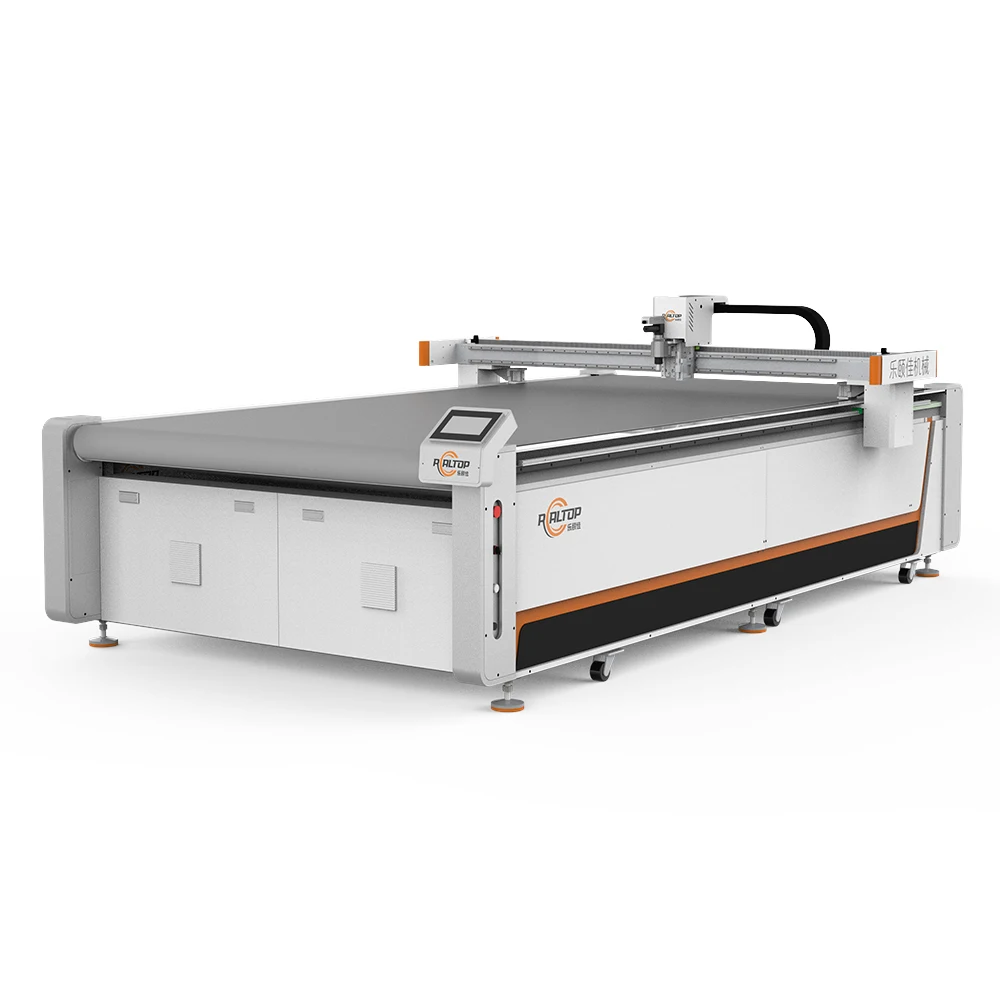
| Product Type | CNC Oscillating Knife Cutting Machine for Leather |
| Model | RT-D2516/RT-S2516 |
| Working Area | 1600×2500 mm |
| Machine Size | 3450×2300×1250 mm |
| Rated Power | 9 kW |
| Voltage | 380V±10% |
| Translational Velocity | 800–1200 mm/s |
| Cutting Thickness | 20–80 mm (varies by material density and layer count — basis to be confirmed) |
| Repeated Accuracy | ≤0.1 mm |
| Tool Head Options | Swiss imported oscillating knife (vibration full cutting, half cutting, cursor location); pneumatic knife, high-power vibrating knife, circular knife, V-cutting knife, drag knife, creasing wheel, dotted line knife, punching, brush available |
| Visual Positioning | Small CCD camera mark point positioning / panoramic camera recognition / projection positioning |
| Working Table | Magnesium-aluminum alloy vacuum adsorption table, PVDF powder sprayed, anodized and hard oxidized |
| Vacuum Pump | 7.5 kW, aviation aluminum shell with built-in silencer sponge |
| Transmission System | Digital servo motor (Delta or Panasonic optional, IP67), linear guide, synchronous belt, ball screw; Taiwan Hiwin rail |
| Instruction System | HP-GL compatible format |
| Safety Device | Infrared感应 blocking, anti-collision on both sides of beam, emergency stop with in-situ resume |
| Feeding | Auto feeding with Germany imported conveyor belt |
| Control Language Options | English, Russian, Italian, Chinese; special languages customizable |
| Certification | CE (declaration referenced; specific certificate number to be verified against manufacturer catalog) |
Application Suitability
| Application | Material or Output |
|---|---|
| Footwear upper cutting lines | Genuine and synthetic leather, composite leather at production scale |
| Bag and leather goods nesting | Irregular patterns across natural hides with flaw avoidance |
| Automotive interior trim | Soft leather and gasket materials on continuous conveyor workflow |
| Garment flexible material processing | Clothing textiles, sponge composite leather, PVC, soft glass, silicon, rubber |
| Shoe component production | Shoe upper and automotive interior leather components with contour accuracy |
Why the CCD Question Must Come Before the Quote
Natural hides do not arrive as clean rectangles, and a leather CNC cutting machine production line that cannot see the flaws will waste usable area on every single skin.
Running genuine leather through a system without defect-aware positioning means the operator is gambling that the nested pattern avoids scars, stretch marks, and brand stamps. On a busy shop floor processing hundreds of hides per day, that gamble turns into stacks of rejected cut pieces that still look perfect until quality control holds them up to the light. I have watched factories in Latin America accumulate half a workshop of wasted leather before realizing the machine they bought had no vision system at all, just a fixed cutting head following a blind file. The cost of that leather far exceeded what a panoramic camera recognition module would have added to the initial order [NEED_CITE: typical rejection rates in leather cutting without CCD guidance].
How CCD Recognition Handles Irregular Hide Geometry
A leather CNC cutting machine production line equipped with panoramic camera recognition scans each hide as it lands on the conveyor, mapping the irregular outline and internal defect zones before the knife head engages. The system routes the nesting algorithm around scars and thin spots that would produce weak edges on footwear uppers or bag panels. Without this step, operators manually inspect and reposition each hide, slowing the leather CNC cutting machine production line to a fraction of its mechanical speed.
Vacuum Zoning and Small-Part Hold-Down
The magnesium-aluminum alloy vacuum table with PVDF coating provides a flat, hard-oxidized surface that resists abrasion from repeated hide loading. Zoned suction is critical when cutting small leather components like strap tabs or buckle loops, where insufficient hold-down allows the oscillating knife to lift the material mid-stroke. The 7.5 kW vacuum pump with aviation aluminum housing and built-in silencer sponge maintains suction across zones without the noise levels that force operators to wear protection all shift [NEED_CITE: vacuum hold-down requirements for oscillating knife cutting on flexible materials].
Reading the Specs That Actually Matter for Leather
The Swiss imported oscillating knife head supports full-cut, half-cut, and cursor-location modes in a single pass, which matters when a footwear upper requires both through-cuts and scoring lines for folding. Translational velocity of 800–1200 mm/s defines how fast the head moves between cuts, but actual cutting speed depends on leather density, thickness, and nesting complexity — a figure the manufacturer should confirm on your specific material. Repeated accuracy of ≤0.1 mm ensures that mirrored pairs for left and right shoe upers register correctly during assembly. The HP-GL compatible instruction system accepts files from common CAD nesting software, but file format compatibility must be verified against the buyer’s existing workflow before the order is placed, not after the machine arrives.
The Hidden Cost of Skipping the Sample Cut
Committing to a leather CNC cutting machine production line without running your own hides through it first leaves too many variables unconfirmed. The cutting thickness range of 20–80 mm is material-dependent, and a dense veg-tanned leather at 3 mm may behave differently than a chrome-tanned split at the same thickness. Tool head selection — oscillating versus pneumatic versus high-power vibrating — determines edge quality and whether the cut seals or frays. I have seen buyers specify a working area based on their largest hide, then discover the vacuum zone layout cannot hold the small pieces that make up most of their actual production [NEED_CITE: importance of sample cutting validation before equipment purchase].
Why Sourcing This Line Through REALTOP
In-house design and production covering knife cutting means the configuration is matched to leather as a material category rather than adapted from a generic flatbed system. Tool head and table configuration is specified per hide format and daily volume, not quoted from a fixed catalog page. CCD camera positioning is confirmed as functional on the buyer’s printed contours and natural hide outlines before shipment. Software compatibility with the buyer’s existing nesting workflow is verified during the order stage. Voltage, plug type, and control language are locked in before production begins, so a machine shipping to Mexico arrives wired for local supply with the interface in Spanish if required.
Documentation & Verification
- Machine specification sheet confirming tool head, table size, and vacuum zone layout matched to your leather format
- Electrical schematic and voltage confirmation for your local supply before production starts
- Sample cutting report on your own leather type, thickness, and hide format
- Software licence and file format compatibility note for your existing CAD and nesting workflow
- Factory test record demonstrating cut accuracy and edge quality on your material before dispatch
- Operation and maintenance manual with spare parts list in your specified control language
Installation, Commissioning & Support
- 3450×2300×1250 mm footprint requires level concrete floor with clearance for conveyor feed and offload
- 9 kW rated power plus 7.5 kW vacuum pump requires dedicated circuit at confirmed voltage and frequency
- Machine arrives with auto-feeding conveyor and vacuum table assembled; beam and head require on-site mounting
- First-power commissioning includes vacuum zone calibration, CCD registration test, and servo tuning on your leather
- Operator training covers tool head changes between oscillating, pneumatic, and drag knife modes
- Spare parts list includes oscillating knife blades, vacuum seals, and conveyor belt sections
What to Prepare Before Requesting a Quote
Send the leather type, whether genuine or synthetic, along with the thickness range and whether you process full hides or pre-cut panels. Specify your daily volume in hides or cut pieces and your current nesting software so file format compatibility can be confirmed. Provide your workshop voltage and frequency, the control language your operators need, and whether your workflow requires auto-feeding from a roll or manual hide loading onto the conveyor.
Frequently Asked Questions
Q: How is cutting throughput verified for natural leather hides?
A: Translational velocity of 800–1200 mm/s defines head travel speed, but actual throughput depends on hide size, nesting density, leather thickness, and the number of contour-avoidance adjustments the CCD system must make per hide. The manufacturer should run your specific hides and report pieces per hour based on your actual nesting layout, not a generic benchmark.
Q: How does the CCD system handle irregular outlines and internal flaws?
A: Panoramic camera recognition scans the full hide on the conveyor, mapping the outer edge and internal defect zones such as scars or thin spots. The nesting software then places pattern pieces around these zones to maximize usable area. This happens at production speed without requiring the operator to manually mark or reposition each hide before cutting.
Q: What vacuum zone layout prevents small leather parts from lifting?
A: The magnesium-aluminum table is divided into suction zones that can be activated independently. Small pieces like buckle tabs or strap loops require localized hold-down directly beneath the cutting path. The zone configuration should be specified based on your smallest typical part size before the table is manufactured, not adjusted after delivery.
Q: How does the auto-feeding conveyor integrate with upstream and downstream?
A: The Germany imported conveyor belt feeds hides continuously onto the vacuum table, synchronized with the cutting cycle. Upstream, hides can be loaded manually or from a scanning station; downstream, cut pieces are offloaded manually or onto a sorting belt. Integration with existing conveyor heights and speeds is confirmed during the layout stage.
Q: Which software formats are supported and when is compatibility confirmed?
A: The HP-GL compatible instruction system accepts files from common CAD nesting platforms. Compatibility with the buyer’s specific software and file export settings is verified during the order confirmation stage, with a test file exchange before production begins, so there are no format surprises when the machine arrives on the shop floor.



商品评价
Clear filtersThere are no reviews yet.