




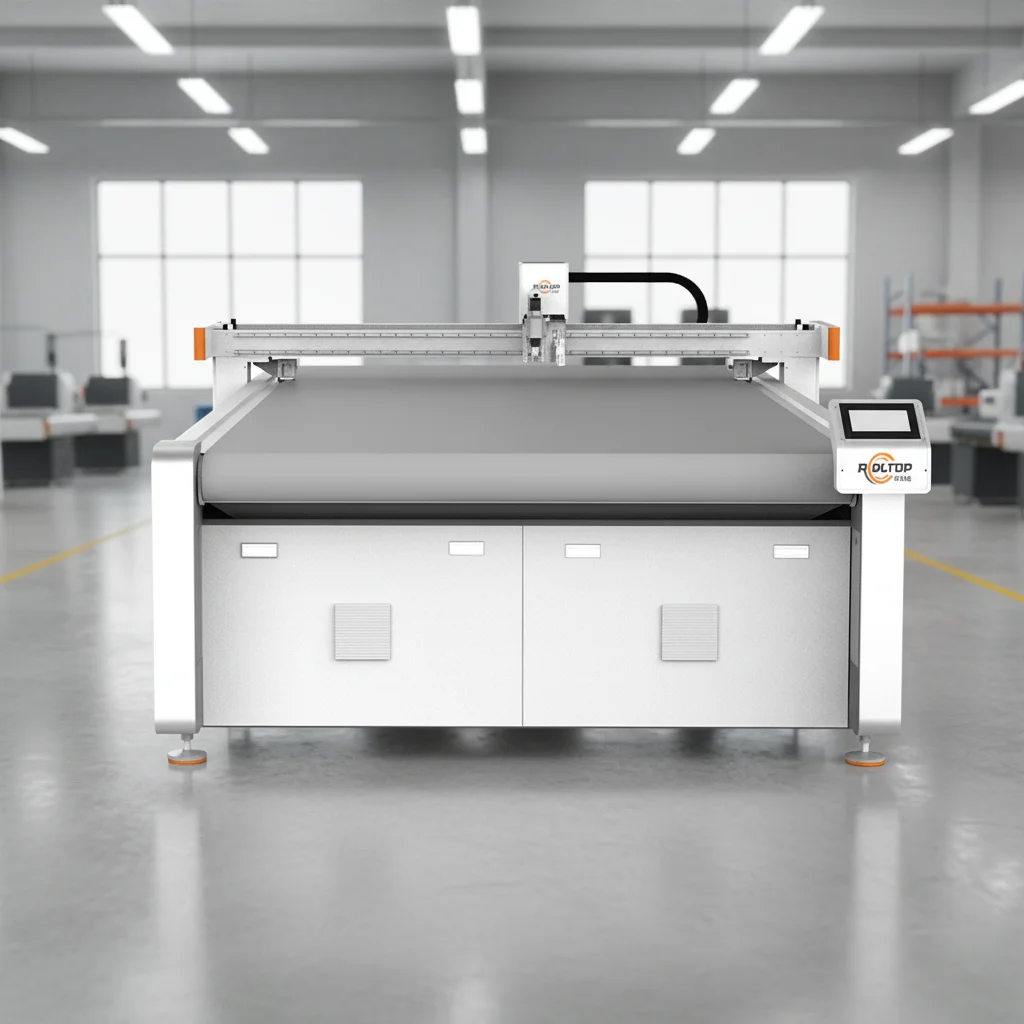
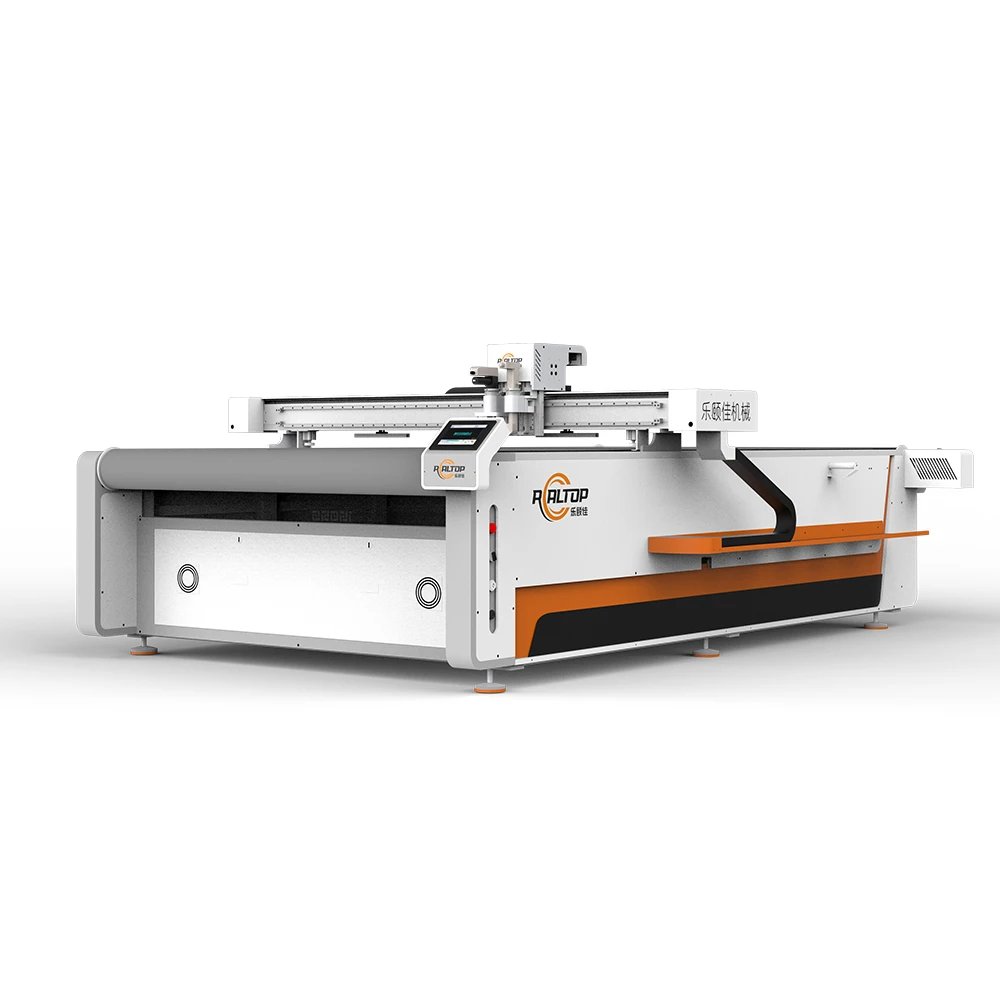
Custom knife and table configuration — this garment multi-layer CNC cutting machine pairs a Swiss oscillating head with a zoned vacuum bed so hold-down pressure follows the nesting layout, not just the table footprint.
Technical Specifications
| Parameter | Value |
|---|---|
| Model | RT-D2516/RT-S2516 |
| Product Type | Garment Multi-Layer CNC Oscillating Knife Cutting Machine |
| Working Area | 1600×2500mm |
| Overall Dimensions (L×W×H) | 3450×2300×1250mm |
| Rated Power | 9kW |
| Voltage | 380V±10% (frequency to be confirmed for destination market) |
| Vacuum Pump | 7.5kW |
| Tool Head | Swiss imported oscillating knife (full cutting, half cutting, cursor location) |
| Translational Speed | 800–1200mm/s |
| Cutting Speed | 200–800mm/s (basis not stated in source — confirm fabric type, layer count and thickness) |
| Repeatability | ≤0.1mm |
| Transmission System | Yaskawa digital servo motor, Taiwan Hiwin linear guide, synchronous belt, ball screw |
| Conveyor Belt | Germany imported |
| Instruction Format | HP-GL compatible |
| Safety Device | Infrared sensors |
| Assembly State | Fully assembled (verify against manufacturer catalog) |
| Table Type | Flat working table with vacuum and auto feeding |
Application Suitability
| Application | Material or Output |
|---|---|
| High-volume shirt and trouser cutting | Woven and knit fabric stacks at garment factory scale |
| Outerwear and technical apparel | Multi-layer coated textiles and soft-shell composites |
| Footwear upper and lining production | Synthetic leather, sponge-backed materials and PVC sheets |
| Contract cutting operations | Mixed batch runs across woven, knit and technical textiles |
| Automotive textile components | Soft glass, silicon rubber and composite fabric laminates |
Why Small Pattern Pieces Lift Off the Table Mid-Cut
Vacuum zoning must match the smallest nested part, not the full sheet area.
When a garment factory runs a nest full of collar stands, cuff pieces and pocket flaps, a flat vacuum field spread across the entire 1600×2500mm bed loses grip on individual small parts. The oscillating knife finishes its stroke, the fabric edge curls upward, and the next pass tears instead of cuts. I have seen multi-layer fabric stacks shift mid-run because the hold-down was specified for full-sheet blanks, not production nests. The result is ragged edges buried six layers deep where an operator cannot spot them until the bundle reaches the sewing line [NEED_CITE: vacuum hold-down requirements for nested small-part cutting].
A garment multi-layer CNC cutting machine configured for apparel production needs zone isolation that activates only under the area where parts are actually nested. Without that, the vacuum pump runs flat out while small pieces remain under-gripped — and the cutting speed figures on the spec sheet become irrelevant because the material is moving under the blade.
Oscillating Knife Behavior Across Fabric Compositions
The Swiss imported oscillating head on this system cycles between full-cut and half-cut modes, which matters when a single nest contains both a dense denim layer and a lightweight lining fabric. Full-cut mode drives the blade through the complete stack height with a high-frequency vertical stroke, parting woven and knit fibers cleanly. Half-cut mode reduces stroke depth for kiss-cutting applications where one layer must remain intact — common in fuse-bonded interlining work. The cursor location function lets the operator set a reference point after loading, so the cutting path aligns to the physical fabric edge rather than relying solely on the software origin.
Auto-Feeding Workflow for Continuous Layer Cutting
The 7.5kW vacuum pump paired with the Germany-imported conveyor belt establishes a continuous loop: cut one lay, advance the material, lay the next stack. For factories running shifts of six to twelve layers per spread, the auto-feeding table removes the manual drag-and-reposition cycle that typically interrupts multi-layer cutting. The conveyor tension and vacuum pull work together — if the vacuum zones are not balanced against belt speed, the fabric stack can bunch at the trailing edge or stretch at the leading edge, both of which throw off pattern dimensions [NEED_CITE: tension management in continuous fabric feeding systems].
Motion System and Cutting Accuracy on a 1600×2500mm Bed
The Yaskawa servo motors and Taiwan Hiwin linear guides maintain ≤0.1mm repeatability across the full working area. On a garment cutting table, repeatability determines whether notch marks align between the top and bottom layers of a twelve-layer spread. If the carriage deflects or the belt stretches unevenly across the long axis, notches drift — and a seam operator downstream discovers that the shoulder seam allowance is wider on one side. The synchronous belt and ball screw combination handles the directional changes that dense nesting layouts demand, where the head reverses constantly between closely spaced pattern pieces.
What Happens When the Tool Head Is Chosen by Catalogue Instead of Material
A drag knife works fine on single-layer vinyl. On a six-layer stack of sponge composite leather — the kind footwear uppers use — a drag knife crushes the foam core, leaves a smeared edge, and produces parts that will not accept stitching cleanly. I once traced a batch of rejected shoe uppers back to a machine that was specified by working area alone. The buyer chose the format they needed, then accepted whatever tool head came standard. The cutting speed listed on the plate never matched their material because the tool head was never matched to it [NEED_CITE: oscillating knife versus drag knife selection for layered composite materials]. An oscillating knife head, specified after a sample test on the actual fabric stack, eliminates this class of failure entirely.
Why Buyers Specify With Us
Both knife and laser cutting technologies are designed and produced in-house, so the cutting method is matched to the fabric rather than forced into one system. Every tool head and table configuration on the RT-D2516/RT-S2516 is specified per material type, stack height and daily volume — not picked from a default list. The HP-GL compatible instruction system accepts marker files directly from common nesting software, and compatibility is confirmed before the order is placed. Sample cutting runs on the buyer’s own fabric at the target layer count before commitment, so cutting speed and edge quality are verified on real production material, not a generic swatch.
Documentation & Verification
- Machine specification sheet confirming working area, tool head and vacuum pump rating
- Electrical schematic with voltage and frequency confirmation for the destination market
- Tool head and table configuration list matched to buyer’s fabric type and stack height
- Sample cutting report on buyer’s own material at target layer count before commitment
- Factory test record with photographs documenting full-table cutting accuracy
- Software licence and file format compatibility note for buyer’s nesting workflow
Installation, Commissioning & Support
- 3450×2300mm footprint requires level concrete floor with clearance for conveyor infeed and outfeed
- 9kW rated power plus 7.5kW vacuum pump demand dedicated circuit at confirmed 380V frequency
- Fully assembled delivery reduces on-site build time to utility connection and leveling
- First-run parameter setting covers vacuum zone mapping to the buyer’s typical nest layout
- Oscillating knife blade consumption rate and reorder schedule confirmed at commissioning
- Operator training covers HP-GL file import, cursor location setup and half-cut mode switching
What to Include With Your Inquiry
Provide the fabric type, typical layer count per spread and the maximum stack thickness your production runs require. Confirm the destination voltage, frequency and plug standard, along with the preferred control interface language. If you already run nesting or marker-making software, share the file format and version so we can verify HP-GL import compatibility before building the configuration.
Frequently Asked Questions
Q: How do you verify the stated 200–800mm/s cutting speed for my fabric?
A: The speed range depends on fabric composition, layer count and stack thickness. We run a sample cutting test on your actual material at your target layer count and document the achievable speed with acceptable edge quality. This sample report accompanies the quotation so the figure reflects your production conditions, not a generic benchmark.
Q: How does the vacuum table handle small garment pattern pieces like collars and cuffs?
A: The vacuum bed on this garment multi-layer CNC cutting machine for apparel production can be zoned so suction concentrates under the nested area rather than spread across the full 1600×2500mm surface. Zone configuration is matched to your typical nest layout during specification, preventing small parts from lifting during the knife stroke.
Q: Which nesting file formats does the control system accept?
A: The system supports HP-GL compatible instructions, which covers marker files exported from most standard garment nesting and CAD platforms. We confirm file format and version compatibility with your existing software before the order is finalized, and provide a compatibility note in the documentation package.
Q: What is the oscillating knife blade life on typical garment fabric stacks?
A: Blade consumption varies with fabric abrasiveness — woven denim wears blades faster than lightweight knit linings. We establish a baseline consumption rate during the sample cutting test on your material and include a spare parts list with reorder lead times so blade stock can be planned into your production schedule.
Q: Can the voltage, plug and control language be set for my country before shipment?
A: Voltage is configurable at 380V±10%, and the destination frequency must be confirmed for correct motor and pump setup. Plug type and control interface language are locked during the specification stage and verified on the electrical schematic before dispatch, matching the CE machinery directive requirements for industrial equipment [NEED_CITE: CE machinery directive requirements for industrial equipment].



商品评价
Clear filtersThere are no reviews yet.