



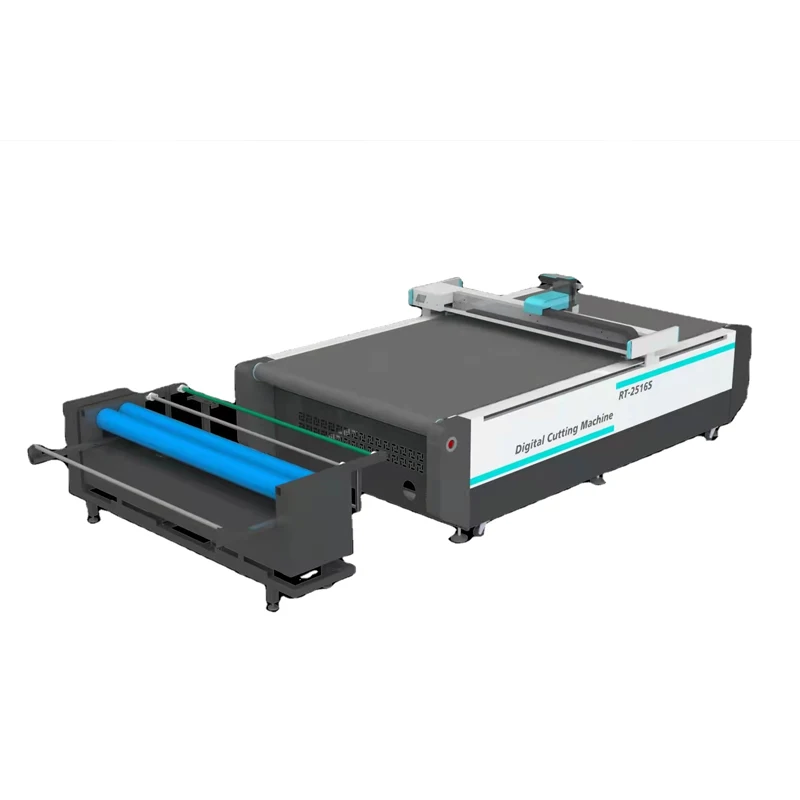

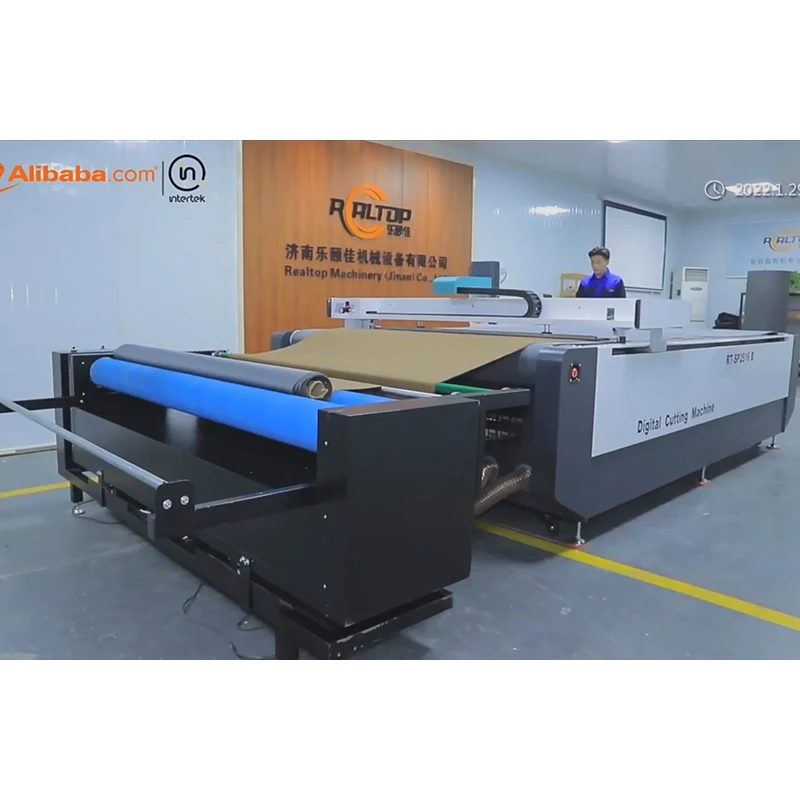
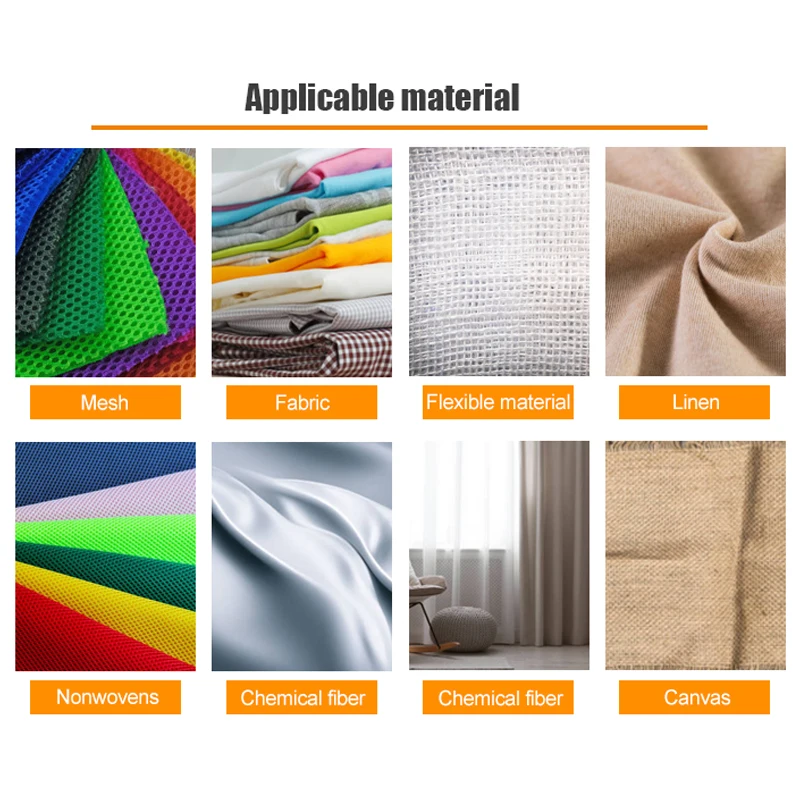

Integrated Flatbed Configuration — Every RT-D2516/RT-S2516 leaves the factory with tool head, vacuum zone map and conveyor speed matched to a sample of your actual fabric, not a generic textile assumption.
Technical Specifications
| Parameter | Value |
|---|---|
| Product Type | CNC Oscillating Knife Fabric Cutting Machine |
| Model | RT-D2516 / RT-S2516 |
| Working Area | 1600 × 2500 mm |
| Machine Size | 3450 × 2300 × 1250 mm |
| Rated Power | 9 kW |
| Voltage | 380V ±10% |
| Vacuum Pump | 7.5 kW |
| Table Type | Flat working table with zoned vacuum, high-density felt belt, German imported conveyor belt |
| Tool Head | Swiss imported oscillating knife with full-cut, half-cut and cursor location; modular holder for round knife and marking pen |
| Translational Velocity | 800–1200 mm/s |
| Cutting Thickness | ≤50 mm (varies by material density and layer count) |
| Repeated Accuracy | ≤0.1 mm |
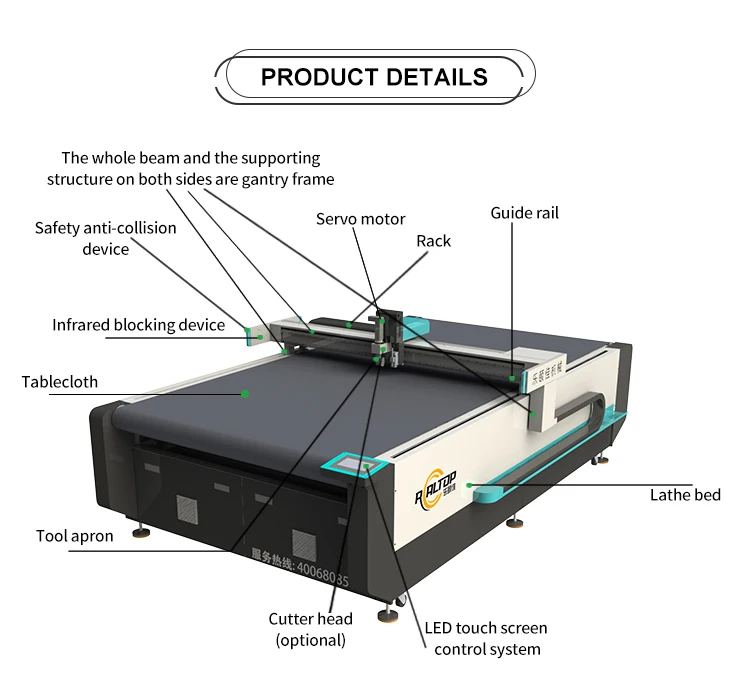
| Transmission System | Panasonic digital servo motor, Taiwan Hiwin linear guide, synchronous belt, ball screw, pinion and rack |
| Lathe Bed | Overall welding process, imported milling machine processed |
| Control Language Options | English, Russian, Italian, Chinese (special languages customizable) |
| Safety Device | Infrared sensors |
| Auto Feeding | Equipped with roll-fed conveyor |
| Instruction System | HP-GL compatible format |
Application Suitability
| Application | Material or Output |
|---|---|
| Zebra roller blind production | Coated polyester, woven blackout fabrics, solar screen textiles cut to blind panel length |
| Garment batch cutting | Cotton, polyester blends, technical textiles in single or multi-layer lays |
| Automotive interior trim | Sponge composite leather, non-woven headliner fabric, door panel textiles |
| Soft gasket fabrication | PVC sheets, silicone rubber, soft glass up to 50 mm depending on durometer |
| Leather goods | Genuine and synthetic leather for footwear, bags and upholstery panels |
Why Fabric Thickness Decides the Tool Head Before the Price Does
A fabric cutting line specified on working area alone will fail the moment actual material arrives on the table. I have stood in workshops where a machine bought for standard curtain sheers was suddenly expected to slice through triple-layer blackout cloth for zebra blinds. The oscillating knife stalled, the edge frayed, and an entire roll was written off before anyone reached for the manual. The CNC fabric cutting machine production line you evaluate on paper must be configured around the heaviest, most abrasive textile you intend to run, not the lightest sample shown at a trade fair [NEED_CITE: typical fabric density variation across blind and garment textiles].
When a buyer skips the material-to-toolhead conversation, two things happen. First, the knife oscillation frequency cannot shear through denser weaves cleanly, leaving fibres pulled rather than severed. Second, vacuum suction that holds a single layer flat will not grip stacked composite leather, so the material shifts mid-cut and dimensional tolerance collapses. Neither problem appears in the brochure. Both surface on day one of production.
Matching Oscillation Frequency to Textile Density
The Swiss imported knife head on the RT-D2516/RT-S2516 delivers vibration full-cutting, half-cutting and cursor location within a modular tool holder. For tightly woven blind fabrics, full oscillation amplitude shears fibres at every stroke, keeping the cut face clean. For knit jersey or single-layer garment textiles, the half-cut setting prevents over-penetration into the conveyor felt beneath. This swap is mechanical, not a software toggle, so the tool holder must be specified before the machine ships. A CNC fabric cutting machine production line configured this way avoids the common mistake of forcing one oscillation profile across every textile that crosses the table.
Vacuum Zoning That Actually Holds Small Blind Panels
The flatbed table uses an engineered internal wind structure paired with a 7.5 kW vacuum pump to distribute suction across independent zones. When a zebra blind panel is only 300 mm wide and 1500 mm long, opening every zone wastes suction and lets adjacent scrap lift into the knife path. Closing zones to match the panel footprint concentrates hold-down force exactly where the material sits [NEED_CITE: vacuum zone sizing principles for flatbed digital cutters]. The high-density felt conveyor belt maintains airflow continuity even under abrasive coated fabrics, so zoning remains effective throughout a multi-shift production day rather than degrading as the belt surface wears.
Reading the Specs That Matter on the Shop Floor
The Panasonic digital servo and pinion-and-rack drive maintain repeated accuracy of ≤0.1 mm across the 1600 × 2500 mm working area. In roller blind production, a blind panel that drifts by even half a millimetre from one piece to the next creates visible misalignment when panels hang side by side at the window. Taiwan Hiwin linear guides keep the carriage tracking true despite the lateral load imposed when the oscillating knife enters dense composite leather. The 9 kW rated power covers knife oscillation, servo travel and conveyor feed simultaneously; a lower rating would force the controller to throttle feed speed during thick-material cuts. HP-GL instruction format means nesting layouts generated in common textile software import directly, avoiding a re-draw step that introduces geometry errors. Together these parameters define whether the CNC fabric cutting machine production line maintains throughput across an eight-hour shift or begins to lag after the third roll [NEED_CITE: servo and rack alignment standards for CNC flatbed cutters].
The Cost of Skipping a Trial Cut on Your Own Material
When a buyer commits without sending actual fabric for sample cutting, three failures tend to surface within the first week. Coated blackout textiles delaminate because the knife frequency was set for uncoated polyester. Small garment pattern pieces lift off the felt belt because vacuum zones were left at a one-size default. Marking pen traces miss their targets because cursor location was never calibrated to the buyer’s print registration marks. Each issue stops the line, wastes material and erodes operator confidence in the equipment [NEED_CITE: material-specific trial cutting protocols for oscillating knife systems]. None of these are machine defects; they are configuration gaps that a pre-shipment sample run would have exposed.
Why Sourcing This Cutter From a Combined Knife and Laser House Matters
In-house design covers both oscillating knife and laser cutting, so the correct method is selected for the textile rather than forcing one technology across every fabric. Tool head and vacuum zone configuration are confirmed per material thickness and part geometry before the order is locked, not left to a default package. CCD camera positioning is available for printed contour work when blind fabrics carry registration marks. Voltage, plug type and control language are validated against the destination factory’s electrical standard before crating. Sample cutting on the buyer’s own roll stock runs before the machine ships, so edge quality is documented rather than assumed. The result is a CNC fabric cutting machine production line that arrives configured for your production floor, not a generic showroom demo.
Documentation & Verification
- Machine specification sheet listing confirmed tool head, vacuum zone map and conveyor type
- Electrical schematic with 380V ±10% wiring diagram and breaker sizing for 9 kW total load
- Sample cutting report on buyer-supplied fabric showing edge quality and dimensional accuracy
- HP-GL file format compatibility note matching buyer’s existing nesting software
- Spare parts list covering oscillating knife blades, felt belt segments and vacuum pump filters
Installation, Commissioning & Support
- Floor must be level within 2 mm across the 3450 × 2300 mm machine footprint to preserve rack alignment
- Dedicated 380V ±10% circuit with breaker rated for 9 kW plus 7.5 kW vacuum pump on separate line
- Machine ships partially assembled; lathe bed, electrical box and conveyor are bolted on site
- First-run calibration includes vacuum zone mapping to buyer’s typical panel sizes and nesting layouts
- Operator training covers knife head changeover, HP-GL file import and daily felt belt inspection
- Consumable spares kit includes Swiss knife blades and marking pen tips sized to first-year usage
What to Prepare Before Requesting a Quotation
Send the heaviest and lightest fabric you plan to cut, including any coated or composite constructions, along with target panel dimensions and daily roll count. Confirm the voltage and frequency at your facility, the control panel language your operators need, and whether your existing nesting software outputs HP-GL. If printed contour recognition is required, include a sample of the printed registration mark so the tool head and camera can be tested before the machine is built.
Frequently Asked Questions
Q: How is cutting thickness capacity verified for my specific blind or garment fabric?
A: A sample of your actual textile, including any coating or lamination, is run on the RT-D2516/RT-S2516 before order confirmation. The test records knife oscillation setting, cut edge quality and dimensional repeatability, and these results are attached to the quotation so capacity is documented for your material rather than quoted as a generic maximum.
Q: What vacuum zone configuration prevents small fabric parts from lifting during cutting?
A: The flatbed table divides suction into selectable zones matched to part footprint. For small garment panels or narrow blind strips, zones outside the part boundary are closed, concentrating the 7.5 kW pump’s suction where the material sits. The configuration is recorded during the trial cut and loaded into the machine controller before shipment.
Q: How do I confirm voltage, plug type and control language match my factory standard?
A: Voltage and frequency are verified against your facility’s supply at the quotation stage. Plug type follows the destination country standard, and control panel language is set to English, Russian, Italian, Chinese or a custom option. All three are listed on the electrical schematic before the machine enters production.
Q: Can the machine import my existing nesting workflow without re-formatting?
A: The controller accepts HP-GL compatible format, which covers most textile nesting software. A sample file from your current workflow is imported during the pre-shipment test to confirm geometry, layer naming and tool path assignment transfer correctly, eliminating re-draw work on the production floor.
Q: What does installation, training and first-year spare parts cover?
A: On-site assembly aligns the welded lathe bed and conveyor within level tolerance. Training covers knife head changeover, vacuum zone selection and HP-GL file handling. The spare parts kit includes oscillating knife blades, marking pen tips and felt belt segments sized for approximately twelve months of single-shift operation.



商品评价
Clear filtersThere are no reviews yet.