


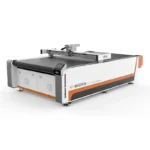

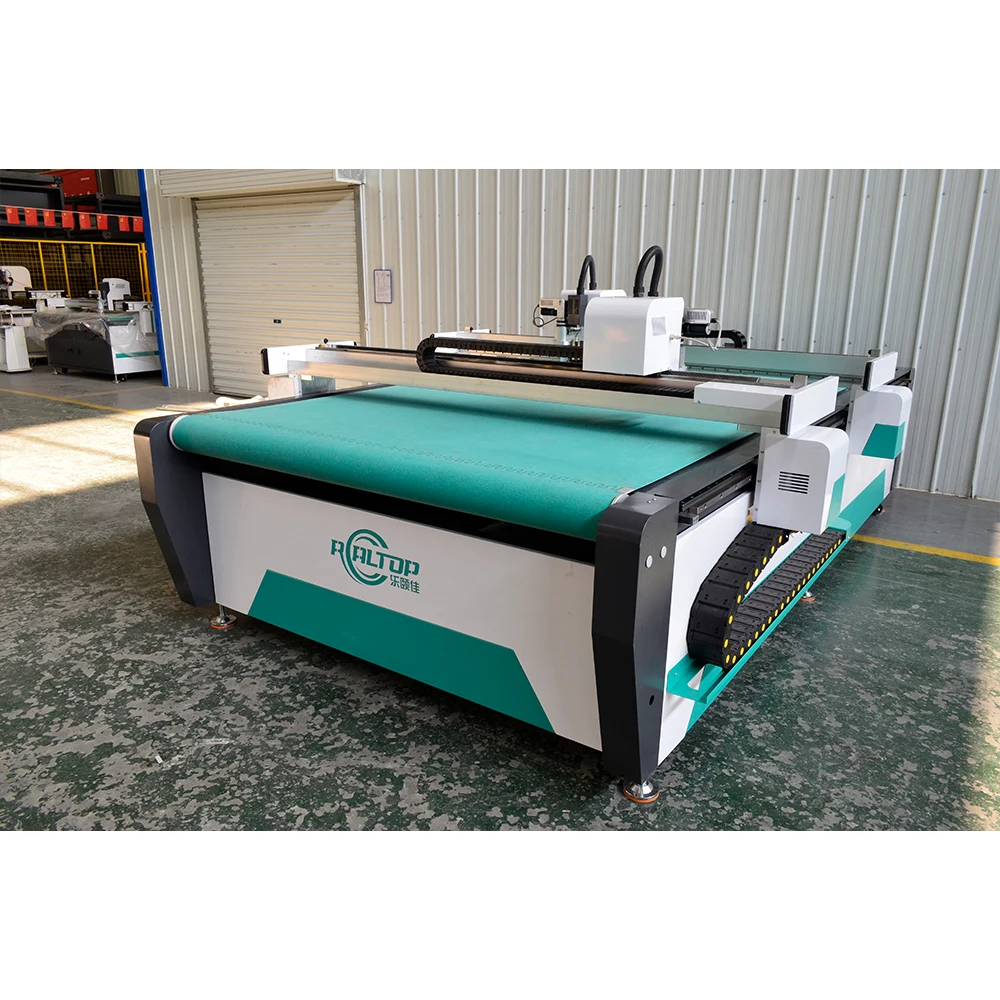
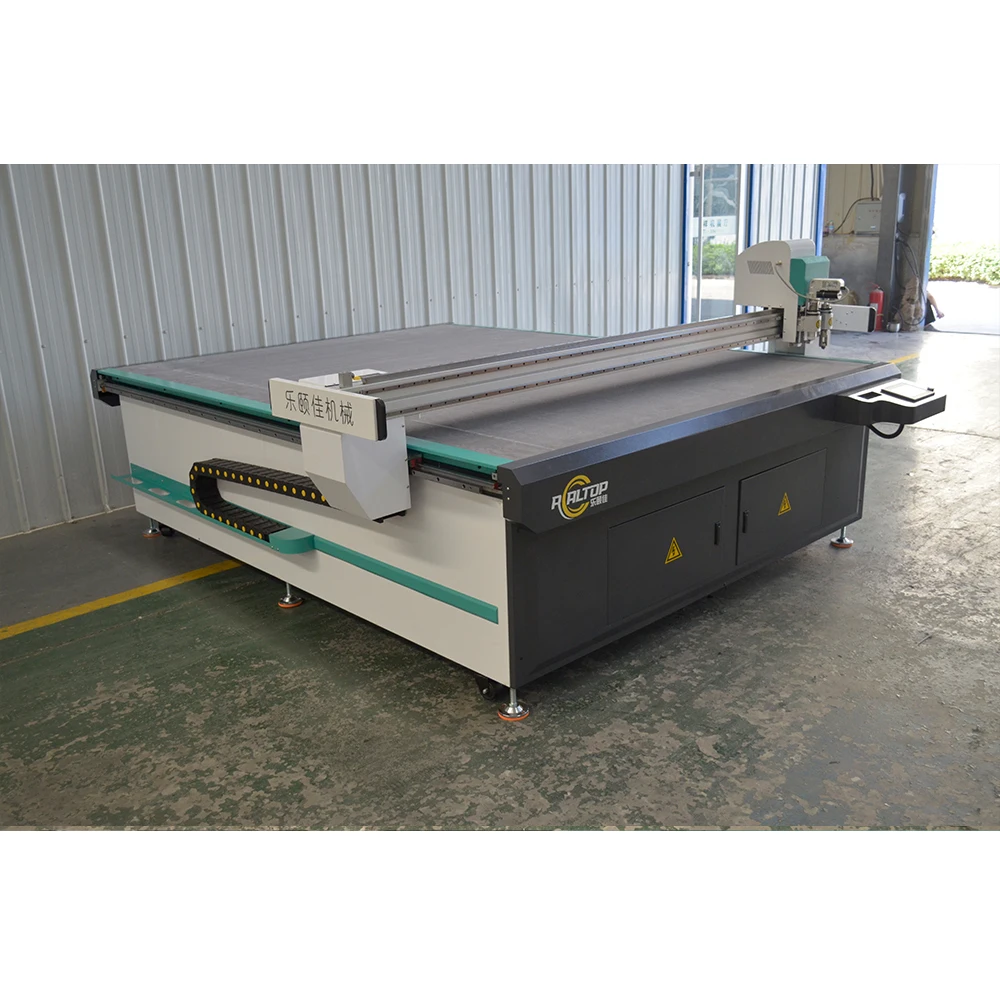
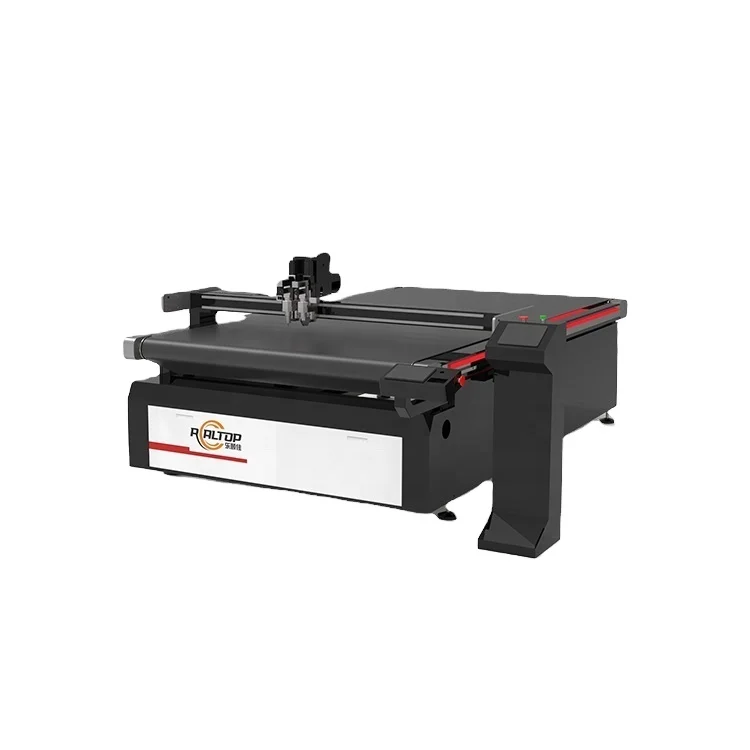
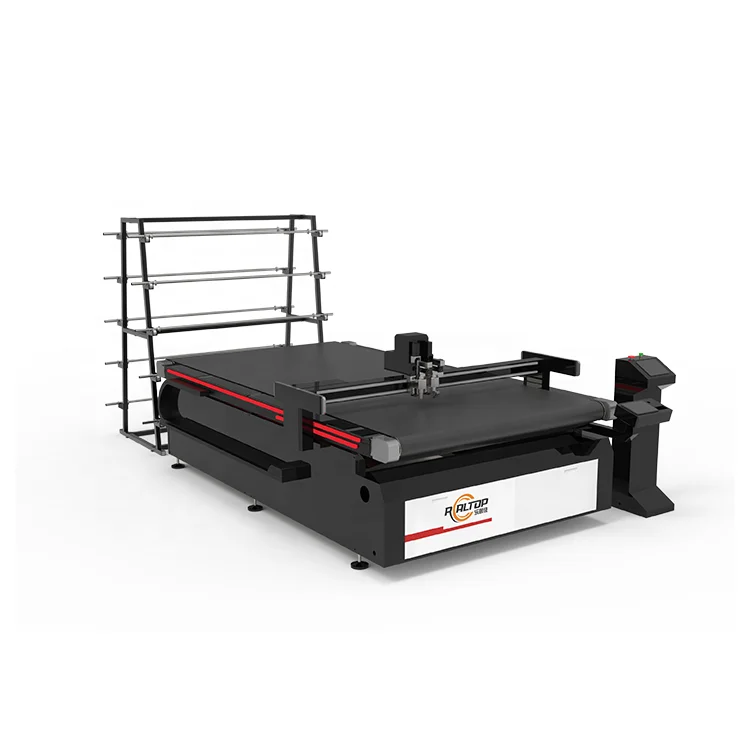
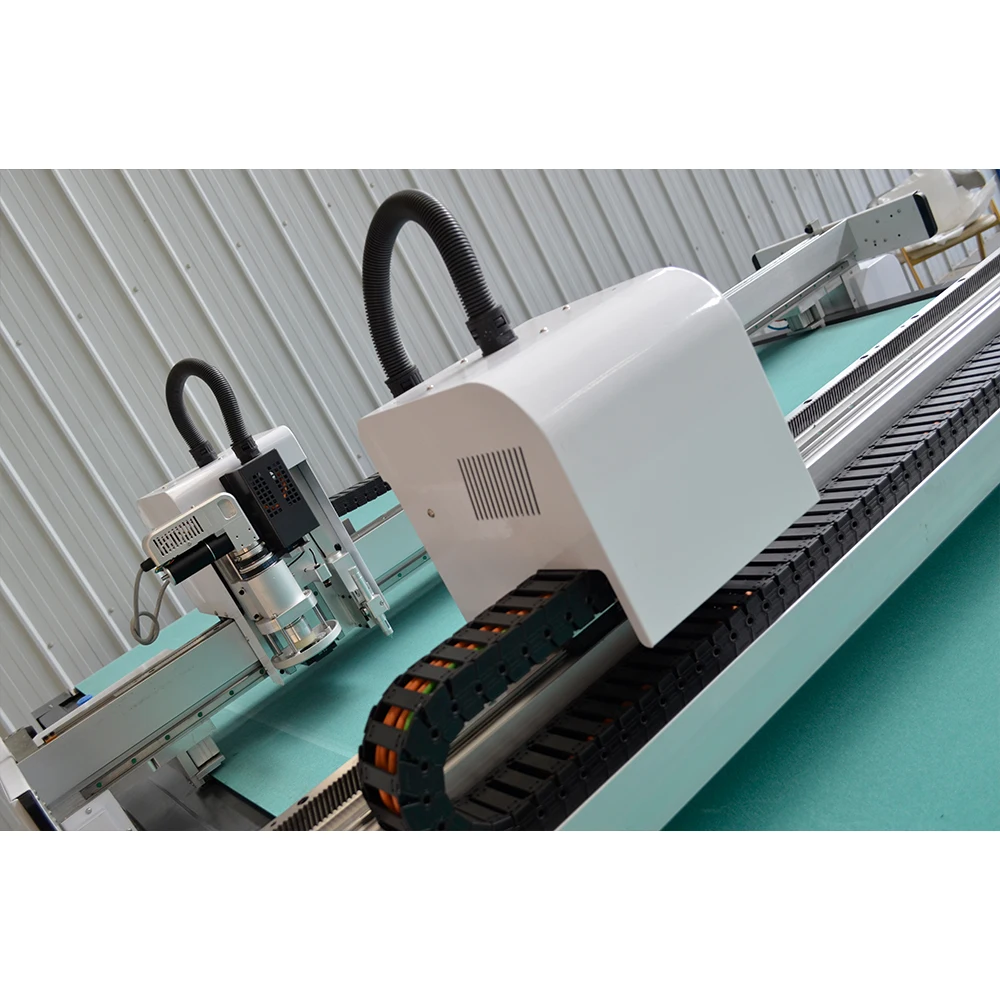
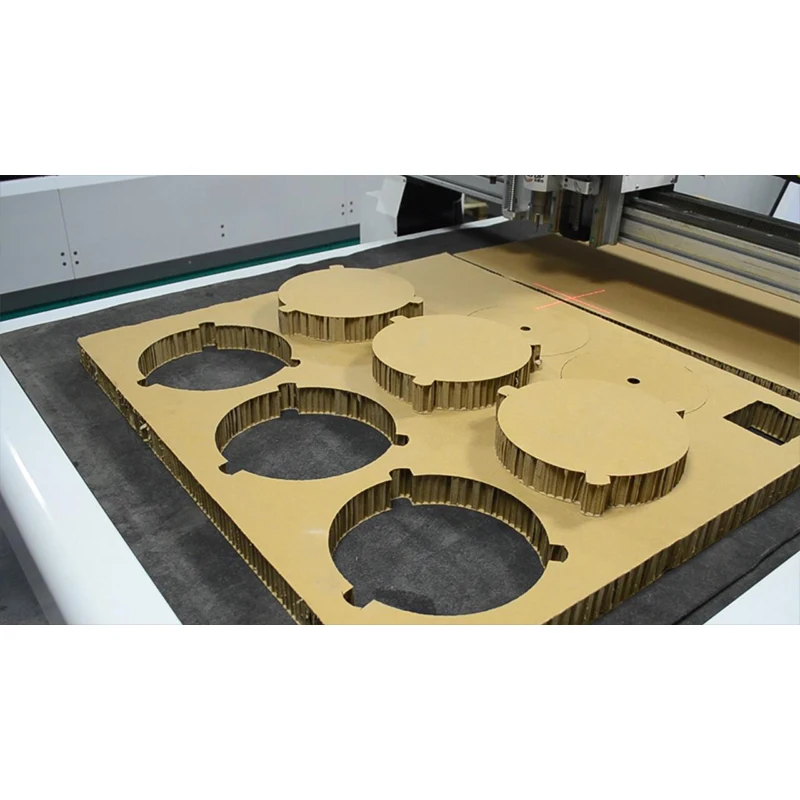

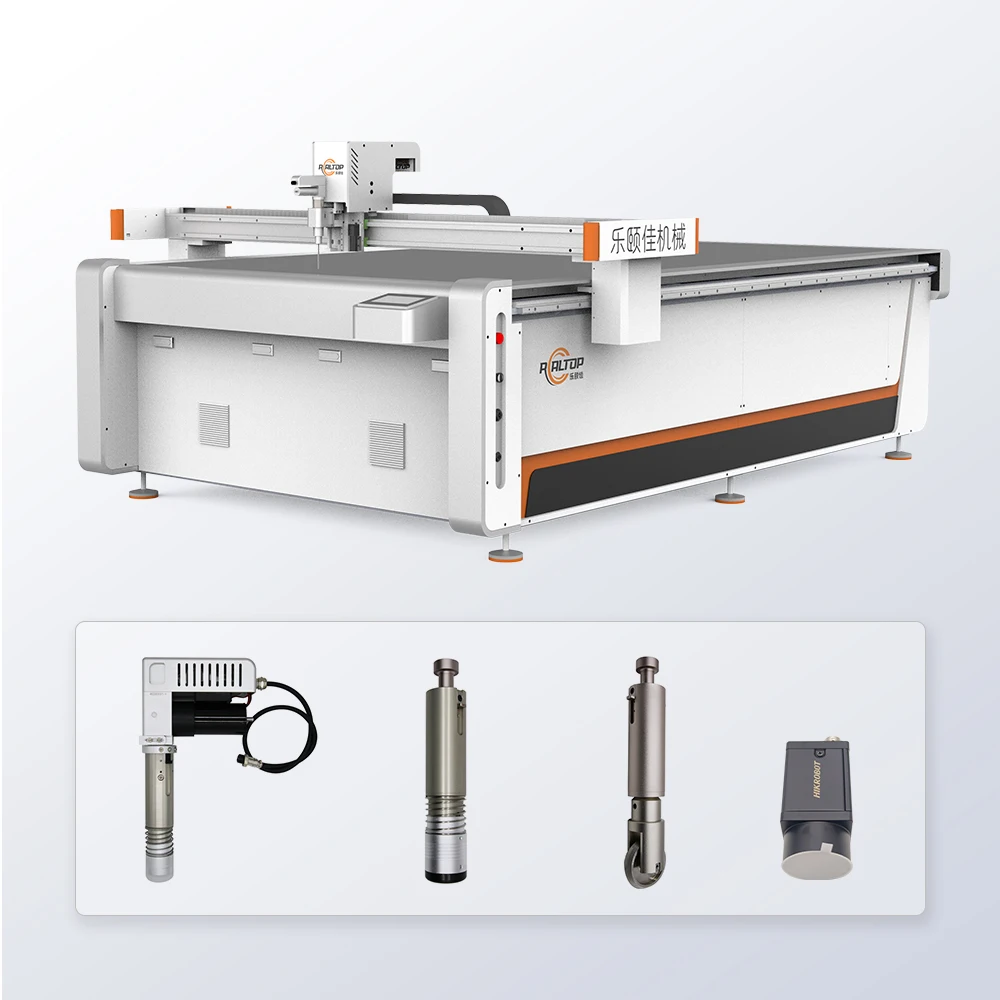
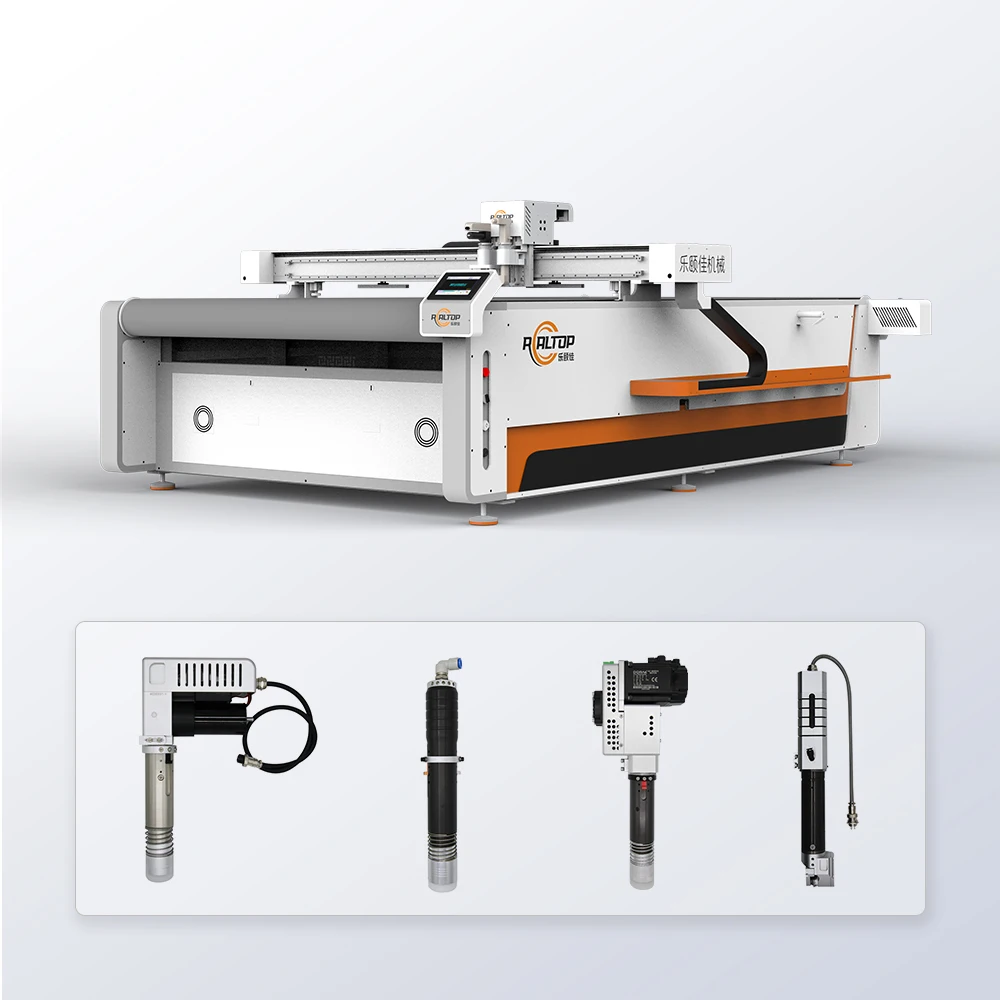
In-House Knife and Laser Design — RT-D2516/RT-S2516 oscillating knife system configured per material stack and daily volume, so garment and leather producers match the tool head to their actual stock rather than accept a generic setup.
Technical Specifications
| Parameter | Value |
|---|---|
| Product Type | CNC Oscillating Knife Cutting Machine |
| Model | RT-D2516/RT-S2516 |
| Working Area | 1600 × 2500 mm |
| Machine Size | 3450 × 2300 × 1250 mm |
| Rated Power | 9 kW |
| Table Type | Flat working table with auto-feeding conveyor |
| Tool Head | Swiss imported knife with vibration full cutting, half cutting, and cursor location |
| Safety Device | Infrared sensors |
| Translational Velocity | 800–1200 mm/s |
| Cutting Speed | 200–800 mm/s (according to different cutting materials) |
| Repeated Accuracy | ≤0.1 mm |
| Transmission System | Digital servo motor, linear guide, synchronous belt, imported ball screw |
| Servo Motor | Japanese Yaskawa |
| Rail | Taiwan Hiwin |
| Instruction System | HP-GL compatible format |
| Voltage | 380V ± 10% |
| Vacuum Pump | 7.5 kW |
| Conveyor Belt | Germany imported |
| Warranty | 12 months for whole machine |
| Standards | CE |
Application Suitability
| Application | Material or Output |
|---|---|
| Garment and footwear cutting | Multi-ply fabric, synthetic leather, textile composites |
| Leather goods manufacturing | Natural and bonded leather hides, PU leather sheets |
| Automotive interior production | Sponge composite leather, PVC door panel inserts |
| Soft gasket and seal fabrication | Rubber sheets, silicon pads, flexible composite gasket stock |
| Signage and soft display | PVC film, soft glass sheets, flexible banner material |
Why Cutting Depth on the Spec Sheet Is Not Enough
The CNC oscillating knife cutting machine for garment and leather production must be verified against the buyer’s actual material before commitment, not matched by working area alone.
A working area of 1600 × 2500 mm tells you nothing about whether the tool head can shear through a 15-layer fabric lay or a dense sponge composite without delaminating the bottom ply. I once specified an oscillating knife setup based on sample material the client provided, only to have the production run swap in a glass-fiber-reinforced composite that destroyed the blade within hours. The machine was perfectly capable, but the configuration was wrong for what was actually running across the table.
Thickness alone is a poor predictor. Density, fiber orientation, backing adhesion, and filler content all change how a blade behaves under oscillation. A machine quoted for "up to 30 mm cutting depth" may achieve that on open-cell foam but stall on bonded leather of the same thickness. [NEED_CITE: material density and fiber composition effects on oscillating knife tool life]
Oscillating Knife Behavior on Layered Fabric and Composite Leather
The Swiss imported knife head on this system delivers full-cut and half-cut vibration modes, which matters when a garment operation needs clean through-cuts on multi-ply lays but kiss-cuts on adhesive-backed pattern pieces in the same job. Full-cut oscillation drives the blade through the entire stack, while half-cut controls depth to score or perforate without cutting the carrier sheet below.
Cursor location function adds registration capability for aligning cuts to pre-printed marks, reducing setup time when switching between pattern pieces. The CNC oscillating knife cutting machine for garment and leather production handles the transition between heavy leather hides and lightweight lining fabric by adjusting stroke amplitude and frequency rather than requiring a physical tool change.
Vacuum Hold-Down and Continuous Material Feed
A 7.5 kW vacuum pump provides the suction necessary to hold flexible materials flat during cutting. Fabric and thin leather tend to lift at the edges when the oscillating knife exits a cut, especially on small pattern pieces where the vacuum zone extends beyond the material boundary. Zoning the table surface allows the operator to activate suction only under the area being cut, concentrating hold-down force where it is needed most.
The auto-feeding conveyor, built with a Germany-imported belt, enables continuous roll processing. The operator loads a fabric roll at the infeed, and the conveyor advances the material incrementally as each nesting layout completes. This eliminates manual repositioning for long production runs, which is where most time loss occurs in garment and leather cutting operations. [NEED_CITE: vacuum table zoning requirements for flexible material cutting]
What the Servo and Rail Combination Means for Pattern Accuracy
Repeated accuracy of ≤0.1 mm is achieved through Japanese Yaskawa digital servo motors paired with Taiwan Hiwin linear rails. In garment cutting, this tolerance matters most at pattern join points — collar-to-shoulder seams, pocket placements, and zipper openings where even a small deviation across dozens of plies produces mismatched pieces downstream.
The synchronous belt and imported ball screw transmission eliminates backlash during direction reversals, which occur constantly when the knife traces complex pattern outlines. On intricate leather hide nesting where pieces are placed close together to maximize yield, positional drift produces overlapping cuts and wasted material. The HP-GL compatible instruction system accepts standard nesting file formats, so pattern data transfers directly from the buyer’s existing CAD workflow without manual re-drawing.
When the Wrong Tool Head Costs More Than the Blade
Choosing an oscillating knife for a material that requires a drag knife or router bit produces ragged edges, crushed foam cores, and delaminated composite layers. The blade itself is the cheapest consumable in the process; the real cost shows up as rejected cut pieces, re-nesting wasted material, and production delays while the operator tries to compensate with slower feed rates.
A machine locked into a single tool head type forces the buyer to either accept compromised edge quality or outsource certain jobs entirely. I have seen leather operations running bonded hide through an oscillating knife that was set for natural leather, producing frayed edges that required secondary trimming. The production loss from misconfiguration typically exceeds the cost of a sample cut test by a wide margin. [NEED_CITE: tool head selection errors and downstream rework costs in flexible material cutting]
Why Buyers Source This System Here
In-house design covers both knife and laser cutting technologies, so the buyer selects the method that matches the material rather than forcing all jobs through one process. The RT-D2516/RT-S2516 sits within a range that includes CO2 and fiber laser options for the same buyer’s non-metal and metal work.
Tool head and table configuration are specified per material type and production volume before the order is placed. A high-volume garment operation cutting multi-ply fabric receives a different conveyor and vacuum zoning layout than a leather goods shop processing single hides.
Sample cutting on the buyer’s own material is conducted before commitment, confirming edge quality, achievable thickness, and cycle behavior under real conditions. Software compatibility is verified against the buyer’s existing nesting and pattern workflow. Voltage, plug type, and control language are confirmed and documented before shipment.
Documentation & Verification
- Machine specification sheet listing RT-D2516/RT-S2516 tool head options and table configuration
- Electrical schematic with 380V ± 10% wiring diagram and circuit protection details
- Sample cutting report on buyer’s leather, fabric, or composite material with edge quality photographs
- Factory test record documenting repeatability verification at ≤0.1 mm tolerance
- HP-GL software licence and file format compatibility confirmation note
- Spare parts list with Swiss knife blade and conveyor belt replacement specifications
Installation, Commissioning & Support
- Requires level concrete floor supporting 3450 × 2300 mm footprint plus material infeed clearance
- Dedicated 380V ± 10% three-phase circuit rated for 9 kW machine load plus 7.5 kW vacuum pump
- Arrives partially assembled; table frame, gantry, and auto-feeding conveyor bolted and aligned on site
- First-run commissioning includes Yaskawa servo parameter tuning and Hiwin rail preload adjustment
- Operator training covers HP-GL file import, nesting layout, vacuum zoning, and knife depth calibration
- Swiss knife blades, synchronous belts, and conveyor belt sections included as initial spare parts
What to Include in Your Inquiry
Provide the specific material types you cut, including thickness range, density, and whether materials are processed as single sheets or multi-ply lays. Confirm your local voltage standard, plug type, and preferred control interface language. If you use existing nesting or pattern software, share the file formats and a sample production file so compatibility can be verified before quotation.
Frequently Asked Questions
Q: How is cutting thickness verified against my specific material before order?
A: We run sample cuts on your actual leather, fabric, or composite material using the RT-D2516/RT-S2516 configured with the recommended tool head. A cutting report documents edge quality, maximum achievable thickness, and any delamination or fraying observed. You review and approve the results before the production machine is built to that configuration.
Q: Which tool head is selected for my material, and what edge quality does it produce?
A: The Swiss imported oscillating knife head is configured with full-cut or half-cut vibration depending on your material stack. Multi-ply fabric lays typically use full-cut for clean separation, while adhesive-backed pieces use half-cut to preserve the carrier sheet. The sample cutting report shows the actual edge finish you will receive in production.
Q: Is my existing nesting software and file format compatible with the control system?
A: The HP-GL compatible instruction system accepts standard vector file formats used in garment and leather nesting workflows. Before order confirmation, we test your sample production files to confirm import, toolpath generation, and cut sequence behavior. Any format conversion requirements are documented in the software compatibility note.
Q: How is vacuum table zoning configured for small pattern pieces to prevent lift?
A: The 7.5 kW vacuum system is divided into zones on the flat working table. For small pattern pieces, the operator activates only the zone directly beneath the cutting area, concentrating suction force. This prevents flexible materials like thin leather and lightweight fabric from lifting during knife exit on intricate cuts.
Q: What voltage, plug type, and control language are confirmed before shipment?
A: The standard configuration is 380V ± 10%, but voltage requirements are confirmed against your facility supply before production. Plug type and control interface language are specified during order confirmation and documented in the electrical schematic. All three items are verified during factory testing before the machine is packed for dispatch.




商品评价
Clear filtersThere are no reviews yet.