




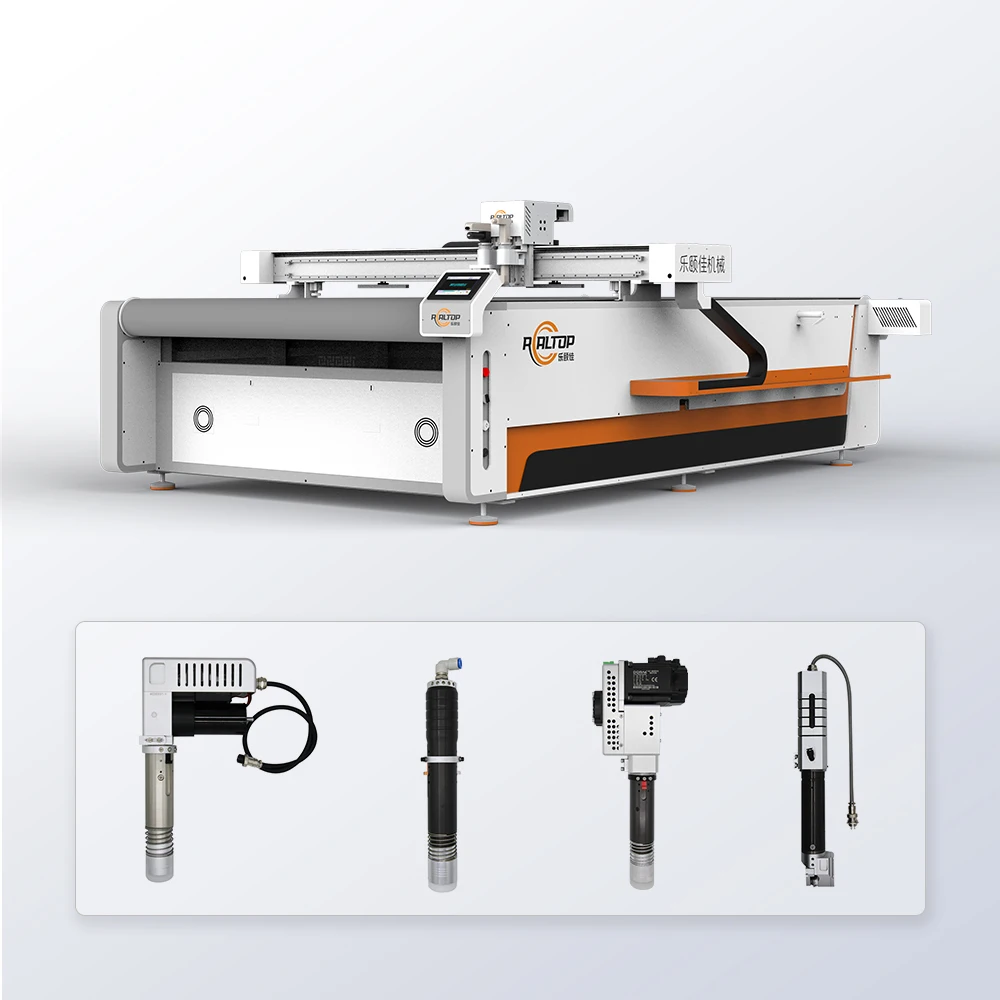


Zoned Vacuum Adsorption — we map your actual nesting layout before setting up the vacuum table zones, so small garment pieces stay flat instead of lifting mid-cut.
Technical Specifications
| Parameter | Value |
|---|---|
| Model | RT-D2516/RT-S2516 |
| Product Type | CNC Oscillating Knife Cutting Machine |
| Working Area | 1600 × 2500 mm |
| Machine Size | 3450 × 2300 × 1250 mm |
| Rated Power | 9 kW |
| Vacuum Pump | 7.5 kW |
| Table Type | Flat working table, auto feeding table |
| Multifunctional Head | Swiss imported knife (vibration full cutting, vibration half cutting, cursor location); options include oscillating knife, pneumatic knife, high-power vibrating knife, circular knife, V cutting knife, drag knife, creasing wheel, dotted line knife, punching, brush |
| Visual Positioning | Small CCD camera mark point positioning, panoramic camera recognition positioning, projection positioning |
| Safety Device | Infrared sensors, anti-collision, emergency stop |
| Translational Velocity | 800–2000 mm/s |
| Cutting Speed | 200–800 mm/s (varies with material) |
| Cutting Thickness | ≤100 mm (varies with material) |
| Repeated Accuracy | ≤0.1 mm |
| Transmission System | Digital servo motor, linear guide, synchronous belt, ball screw |
| Servo Motor | Delta (optional Japan Panasonic) |
| Guide Rail | Taiwan Hiwin |
| Conveyor Belt | Germany imported |
| Instruction System | HP-GL compatible format |
| Software | Auto typesetting, supports PLT, DXF, AI formats |
| Control Panel | Touch screen, multiple language supported |
| Voltage | 380V ±10% |
| Language Options | English, Russian, Italian, Chinese (special languages customizable) |
| Vacuum Table | Magnesium-aluminum alloy, fluorocarbon PVDF powder spraying, anodic oxidation, hard oxidation |
| Frame | Thick-walled seamless steel structure, high-temperature tempering, CNC machining center finished |
| Standards | CE declaration where applicable (source value — verify against manufacturer catalog) |
Application Suitability
| Application | Material or Output |
|---|---|
| Garment production line | Shirt fabric, clothing cloth, woven and knit textiles in single or multi-layer stacks |
| Footwear and luggage | Shoe material, PU, EVA, synthetic leather, luggage material |
| Soft home furnishing | Sofa fabric, carpet, non-woven fabric, floor mats |
| Automotive interior | Interior trim fabric, gasket material, composite panels |
| Sports and outdoor goods | Technical textiles, sponge, foam composites |
| Packaging and printing | Corrugated cardboard, sticker, film, graphic media |
Why File Format Compatibility Matters Before You Commit to a CNC Shirt Fabric Cutting Machine Production Line
Your nesting software already has a workflow — the machine must accept it, not replace it.
I have walked into garment factories where a brand-new cutting table sat idle because the nesting files from their existing CAD system would not open on the machine controller. The operator spent hours manually redrawing patterns that were already digitized. When you evaluate a CNC shirt fabric cutting machine production line, the first question should not be speed — it should be whether your PLT, DXF, and AI files import cleanly with layer and cut-line information intact. This unit supports auto typesetting and confirms file format compatibility before the order is placed [NEED_CITE: CAD file interoperability in garment manufacturing workflows].
Roll-to-Cut Workflow on the Auto Feeding Conveyor
Continuous fabric cutting demands a feeding system that keeps the roll aligned and tension consistent. The auto feeding table on this machine uses a Germany-imported conveyor belt paired with the 7.5 kW vacuum pump to hold fabric flat from the moment it unrolls through the cutting zone. For shirt fabric and clothing cloth, this means the operator loads the roll once, and the machine advances material automatically after each cutting cycle. The 1600 × 2500 mm working area accommodates most standard garment fabric widths without repositioning.
CCD Contour Recognition at Production Speed
Printed fabric requires the cutting path to follow the actual print, not just the file coordinates. The panoramic camera recognition system and small CCD mark point positioning work together to detect printed marks on the material surface and adjust the cutting path in real time. This is especially relevant for sublimation-printed sportswear and patterned shirt panels where print-to-cut registration drift causes rejected pieces. The projection positioning option adds a visual overlay so the operator can verify alignment before the knife engages.
How Core Parameters Translate on the Cutting Table
The Swiss imported oscillating knife handles full cutting, half cutting, and cursor location — three functions that cover most garment pattern requirements. Full cutting separates the piece; half cutting scores kiss-cut lines for fold marks or perforations; cursor location lets the operator manually position the knife for test cuts. The repeated accuracy of ≤0.1 mm ensures that nested pieces cut from the same file match each other, which is critical when left and right sleeve panels must be identical [NEED_CITE: tolerance requirements in garment pattern cutting].
The Delta servo motors (with Japan Panasonic as an option) drive the translational velocity up to 2000 mm/s and cutting speed up to 800 mm/s depending on the material. Thicker multi-layer stacks require slower cutting speeds to maintain edge quality, while single-layer woven fabrics can run at the upper range. The Taiwan Hiwin linear guides and ball screw transmission keep the knife path true across the full 2500 mm stroke length.
The thick-walled seamless steel frame, finished through high-temperature tempering and CNC machining center processing, resists deflection under continuous vacuum load. The magnesium-aluminum alloy vacuum table with fluorocarbon PVDF powder spraying provides a flat, corrosion-resistant surface that withstands years of fabric dust and adhesive residue.
What Happens When Vacuum Zoning Is Wrong for Your Pattern Pieces
Garment patterns include pieces of every size — large back panels next to small collar stays and cuff strips. If the vacuum table zones are set up for large pieces only, small pattern parts lose suction and lift during cutting, producing frayed edges or jamming the knife. I once spent an entire night at a factory re-mapping the vacuum zones after a batch of shirt panels was ruined because the small pieces kept curling up into the oscillating knife path. The zoned adsorption on this table must be matched to your actual nesting layout, not a generic default setting. Getting this wrong means material waste, not just slow production [NEED_CITE: vacuum hold-down requirements for small die-cut parts].
Why This Machine Fits Garment and Fabric Production
The tool head options — oscillating knife, pneumatic knife, circular knife, drag knife, V cutting knife — are selected based on your specific fabric type and layer count rather than a one-size-fits-all configuration. Woven shirt cloth typically runs well with the standard oscillating knife, while knit fabrics and stretch materials may need the pneumatic knife to prevent distortion at the cut edge.
Software compatibility is verified before order. If your factory runs a specific nesting CAD system, the file import and typesetting workflow are tested with your actual files. This prevents the situation where a machine arrives and cannot communicate with your existing digital workflow.
Voltage, plug type, and control panel language are confirmed for your destination market before shipment. The 380V ±10% system is standard, with language options including English, Russian, Italian, and Chinese, plus custom languages on request.
Sample cutting on your own fabric is conducted before you commit. You send the material, and the factory runs your nesting file, cuts the pieces, measures accuracy, and documents the results. You see the edge quality, the registration accuracy, and the cycle time on your exact material before signing off on the purchase.
The in-house design team covers both knife and laser cutting, so if a material is better suited to laser — such as synthetic fabrics that benefit from edge sealing — the recommendation is honest rather than forcing knife cutting on everything.
Documentation & Verification
- Machine specification sheet listing confirmed tool head and table configuration for your fabric type
- Electrical schematic with voltage and plug type verified for your facility
- Sample cutting report generated on your actual shirt fabric material before order confirmation
- Software licence documentation with PLT, DXF, AI file format compatibility note
- Factory test record documenting cutting accuracy and speed on your submitted material
- Operation and maintenance manual in your selected control language
Installation, Commissioning & Support
- Foundation must support the 3450 × 2300 mm footprint and 9 kW total power draw on a dedicated 380V circuit
- Machine ships with the frame and table assembled; conveyor and tool head calibrated on site
- Vacuum zone mapping configured to your nesting layout during commissioning, not left at factory defaults
- Touch screen control panel set to your language with operator training on file import and typesetting
- Spare parts list covers Swiss knife blades, conveyor belt segments, and vacuum seals
- Daily maintenance focuses on knife inspection, vacuum channel clearing, and guide rail lubrication
What to Include in Your Inquiry
To size the right configuration, share your primary fabric types with thickness and whether you cut single-layer or multi-layer stacks. Include a sample nesting file or your typical pattern layout so the vacuum zoning and tool head selection can be matched to your actual production. Specify your facility voltage and frequency, preferred control language, and whether roll feeding or flat sheet loading suits your workflow.
Frequently Asked Questions
Q: How do I choose the right tool head for my fabric thickness and layer count?
A: Single-layer woven shirt fabric typically runs on the standard oscillating knife. Multi-layer stacks or stretch knits often require the pneumatic knife or high-power vibrating knife to prevent edge distortion. We recommend a sample cut on your actual material so the tool head, cutting speed, and vacuum pressure are tuned to your specific stack height before the configuration is finalized.
Q: Can the CCD camera track printed marks at full cutting speed?
A: The panoramic camera recognition and small CCD mark point system detect registration marks on printed fabric and adjust the cutting path in real time. Tracking reliability depends on mark contrast, print quality, and fabric surface texture. We test recognition on your printed sample during the pre-order sample cutting to confirm it holds registration at your target speed.
Q: Will small garment pieces lift off the table during cutting?
A: Small pieces like collar stays or cuff strips can lift if vacuum zones are sized only for large panels. The magnesium-aluminum alloy table supports zoned adsorption that we map to your nesting layout during setup. Each zone is matched to the smallest piece in that area, ensuring adequate hold-down across the entire cutting field.
Q: Does the software work with my existing garment CAD system?
A: The system supports PLT, DXF, and AI formats with auto typesetting. Before order, we confirm compatibility by importing your actual production files and verifying that layer structure, cut lines, and drill marks transfer correctly. If your CAD exports a non-standard variant, we address the mapping before shipment rather than after installation.
Q: How does the auto feeding system handle roll fabric versus flat sheets?
A: The auto feeding conveyor advances roll fabric through the cutting zone after each cycle, enabling continuous operation without manual repositioning. For flat sheet or pre-cut panel work, the flat table configuration allows manual placement with full vacuum hold across the 1600 × 2500 mm area. The table type is selected based on your primary material format.



商品评价
Clear filtersThere are no reviews yet.