




Material-matched cutting configuration — every oscillating knife head and vacuum zone is validated against your actual foam density and sheet format before the machine leaves the Jinan factory floor.
Technical Specifications
| Parameter | Value |
|---|---|
| Product Type | CNC Oscillating Knife Cutting Machine |
| Working Area | 1600 × 2500 mm |
| Overall Dimensions (L×W×H) | 3450 × 2300 × 1250 mm |
| Rated Power | 9 kW |
| Voltage | 380V ±10% |
| Vacuum Pump Power | 7.5 kW |
| Tool Head | Swiss imported oscillating knife (vibration full cutting, vibration half cutting, cursor location) |
| Translational Velocity | 800–1200 mm/s |
| Cutting Thickness | 20–80 mm (basis not stated in source — confirm block format / material / thickness) |
| Repeatability | ≤0.1 mm |
| Transmission System | Digital servo motor, linear guide, synchronous belt, ball screw (Taiwan Hiwin rail) |
| Servo Motor Brand | Delta (optional Panasonic) |
| Vacuum Table | Magnesium-aluminum alloy, fluorocarbon PVDF powder spraying, anodic oxidation, hard oxidation |
| Safety Device | Infrared induction blocking, anti-collision, emergency stop |
| Control Language Options | English, Russian, Italian, Chinese (other languages customizable) |
| Instruction System | HP-GL compatible format |
| Conveyor Belt | Germany imported |
| Assembly State | Fully assembled |
| Standards | CE (declaration where applicable) |
Application Suitability
| Application | Material or Output |
|---|---|
| Automotive interior trim and gasket production | EVA, PU, XPE foam sheets and composite laminates |
| Packaging insert and carton sample making | Corrugated cardboard, foam board, sponge pads |
| Soft furnishing and sports goods manufacturing | PU foam, EVA, XPE, PVC in nested layouts |
| Carpet and floor mat cutting | Foam backing, sponge, rubber underlay |
| Sealing pad and gasket fabrication | PTFE, ETFE, rubber, composite gasket stock |
| Footwear and bag component cutting | Foam midsole sheets, leather, synthetic textile |
Why Cutting Depth Claims Fail When Density Changes
A CNC oscillating knife cutting machine for foam production line rated at a certain thickness on soft sponge will stall, crush, or leave ragged edges when that same head meets high-density EVA or cross-linked PE. The only way to confirm real cutting capacity is a timed sample run on your exact material at your target speed.
I have seen this play out firsthand. A customer in the automotive interior sector ordered a vibrating knife table after we ran trials on their initial samples. When production started, the actual foam stock was substantially denser than the test pieces, and the knife head could not push through cleanly. The edges came out with burrs and crushed zones, and an entire batch had to be scrapped before I flew on-site to reconfigure the tool head and pressure settings over several days. That is why I now insist on running every buyer’s production-grade material sample on the machine before signing off for shipment [NEED_CITE: material density variation in foam supply chains].
How Foam Density Dictates the Tool Head Choice
Soft open-cell sponge and rigid closed-cell EVA demand completely different oscillation frequencies and blade geometries. A Swiss imported oscillating knife head handles this range by offering full-cut and half-cut vibration modes plus cursor location, allowing the operator to switch between clean through-cuts on dense foam and kiss-cuts on laminated composites without changing hardware. Getting this selection right before the order prevents the crushed-edge failures that force production managers to slow the line or scrap parts.
Vacuum Zoning and Small-Part Stability at Speed
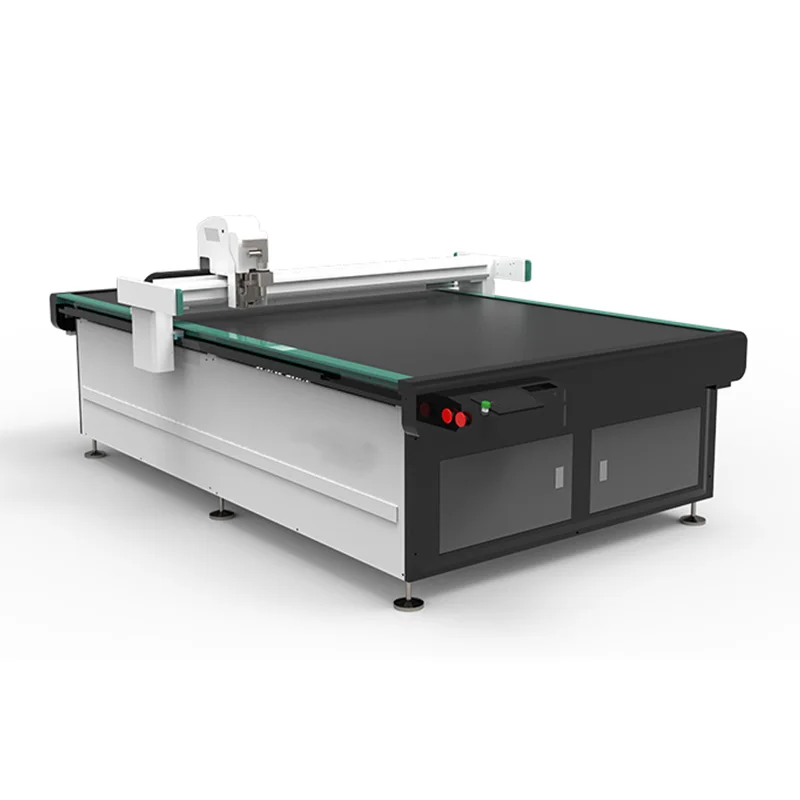
When you cut small gasket pieces or intricate automotive trim shapes from foam, the vacuum hold-down must keep each part flat even as the knife head travels at translational velocities up to 1200 mm/s. The magnesium-aluminum alloy table on this CNC oscillating knife cutting machine for foam production line uses zoned suction areas, so operators can concentrate holding force on the active cutting region. Without proper zoning, small foam parts lift off the bed mid-cut, producing dimensional errors and risking blade contact with the table surface [NEED_CITE: vacuum hold-down requirements for flexible material cutting].
Reading the Specs That Actually Matter on the Floor
The 9 kW rated power and 7.5 kW vacuum pump together define what this machine can sustain during an eight-hour shift. The Delta servo motors driving the Taiwan Hiwin linear rails keep repeatability within 0.1 mm, which matters when nesting dozens of gasket profiles across a 1600 × 2500 mm sheet — even a small positional drift compounds into material waste. The HP-GL compatible instruction system lets buyers feed nesting files directly from existing CAD workflows, avoiding the cost and learning curve of new software. And the Germany-imported conveyor belt supports continuous-feed layouts for high-volume operations, reducing the manual handling between cutting and the next production step.
The Cost of Skipping Material Validation
Choosing a machine based on working area alone is a common mistake that surfaces weeks after installation. When the foam thickness or density exceeds what the configured tool head can handle, the result is not just poor edge quality — it is increased blade wear, more frequent downtime for tool changes, and operators manually finishing edges that the machine was supposed to handle. I have watched production lines lose significant daily output because the vacuum table lacked sufficient zoning for the part mix being cut, causing small pieces to shift and forcing re-cuts [NEED_CITE: hidden costs of misconfigured CNC cutting equipment]. These problems do not show up in a brochure, but they dominate the first month of ownership if sample cutting is skipped.
Why Buyers Source This Equipment from Our Workshop
In-house design and production covers both knife and laser cutting technologies, so we match the cutting method to the material rather than pushing a single solution. Every tool head and table configuration is specified against the buyer’s material type, thickness and daily volume, not picked from a default list. CCD camera positioning is available for printed contour work where registration marks must be tracked at production speed. Software compatibility and file format support are confirmed before the order is placed, not discovered during commissioning. And the buyer’s own material is sample-cut and documented before any commitment is made, giving the purchasing team physical evidence rather than a data-sheet promise.
Documentation & Verification
- Machine specification sheet listing the configured tool head and table zoning for your foam type
- Electrical schematic with confirmed voltage and plug type for your facility
- Sample cutting report on your own foam material showing measured edge quality and cycle times
- Software licence and HP-GL file format compatibility note signed off before production
- Factory test record with photos documenting the machine running your specific job
- Spare parts list covering blades, belts and consumables sized for your production volume
Installation, Commissioning & Support
- The 3450 × 2300 mm footprint requires a level concrete floor with clearance for material infeed and conveyor outfeed
- A dedicated 380V ±10% circuit must be available to handle the combined 9 kW machine and 7.5 kW vacuum pump load
- Machine ships fully assembled, reducing on-site setup to power connection, vacuum hose routing and table leveling
- First-run commissioning includes parameter tuning for your specific foam density, thickness and nesting layout
- Operator training covers tool head changeover, vacuum zone selection and HP-GL file import procedures
- Wear items including oscillating knife blades and conveyor belt segments are identified with reorder intervals
What We Need to Configure Your Machine
To recommend the right tool head, vacuum zoning and conveyor setup, we need to know the foam types you cut — including density and whether the stock is open-cell, closed-cell or cross-linked — along with the maximum sheet dimensions and thickness range. Let us also know your local voltage standard, preferred control language and whether your current nesting software outputs HP-GL or requires a different format. If you send production-grade material samples, we will run them on the machine and provide a documented cutting report before you decide.
Frequently Asked Questions
Q: How is cutting thickness verified for my specific foam density and sheet format?
A: We cut your actual production material on the machine, testing across your full thickness range at target speed. A written report documents edge quality, cutting depth and cycle time for each material variant, so you see real results — not generic data-sheet claims — before committing to the order.
Q: Which tool head is recommended for foam versus composite, and why does edge quality differ?
A: The Swiss imported oscillating knife head offers full-cut and half-cut modes. Dense EVA and closed-cell foam typically require higher oscillation frequency with a stiffer blade, while softer sponge and composites use a different geometry to avoid crushing. Selecting the wrong mode produces burrs or delaminated edges.
Q: How does vacuum table zoning handle small foam parts that tend to lift?
A: The magnesium-aluminum alloy table divides into independent suction zones. Operators activate only the zones under the active cutting area, concentrating hold-down force where the knife head is working. This keeps small gasket and trim pieces flat without wasting vacuum capacity across unused table sections.
Q: Can the machine import my existing nesting software and file formats?
A: The HP-GL compatible instruction system accepts files from most mainstream nesting platforms. We confirm your specific software output format and run a test import during the sample cutting phase, so any conversion or compatibility issue is resolved before the machine ships.
Q: What does sample cutting on my material look like before I commit?
A: You send production-grade foam samples with your typical nesting layout. We configure the tool head and vacuum zones, run the job, and send you a report with photographs, measured edge quality, dimensional accuracy and cycle time data — all before you place the order.




商品评价
Clear filtersThere are no reviews yet.