




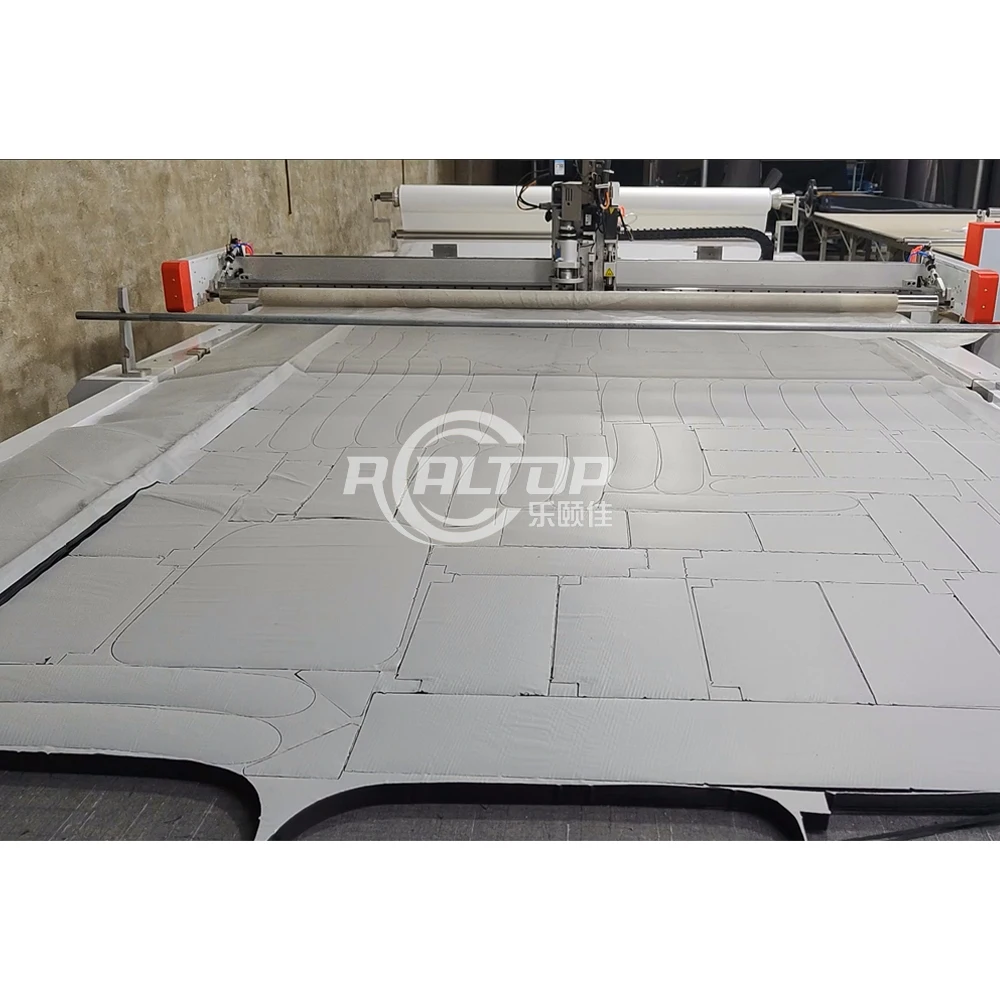
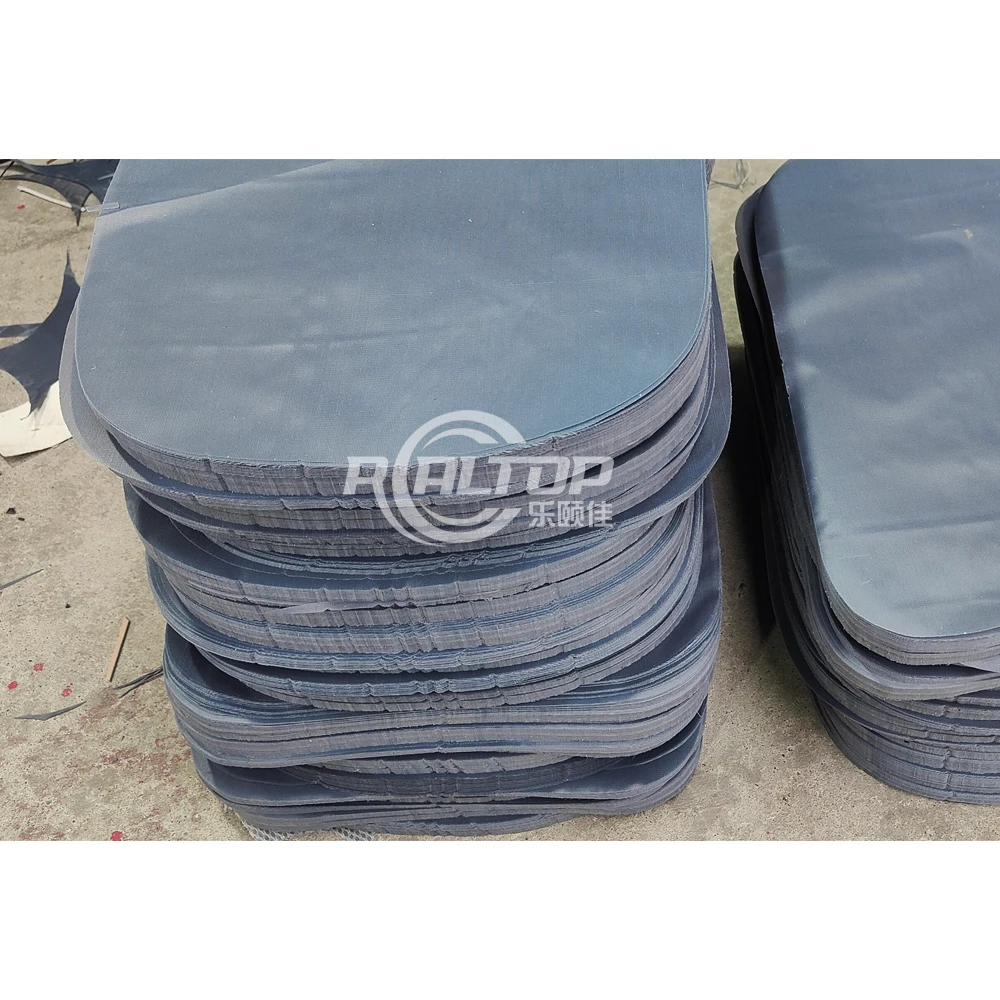
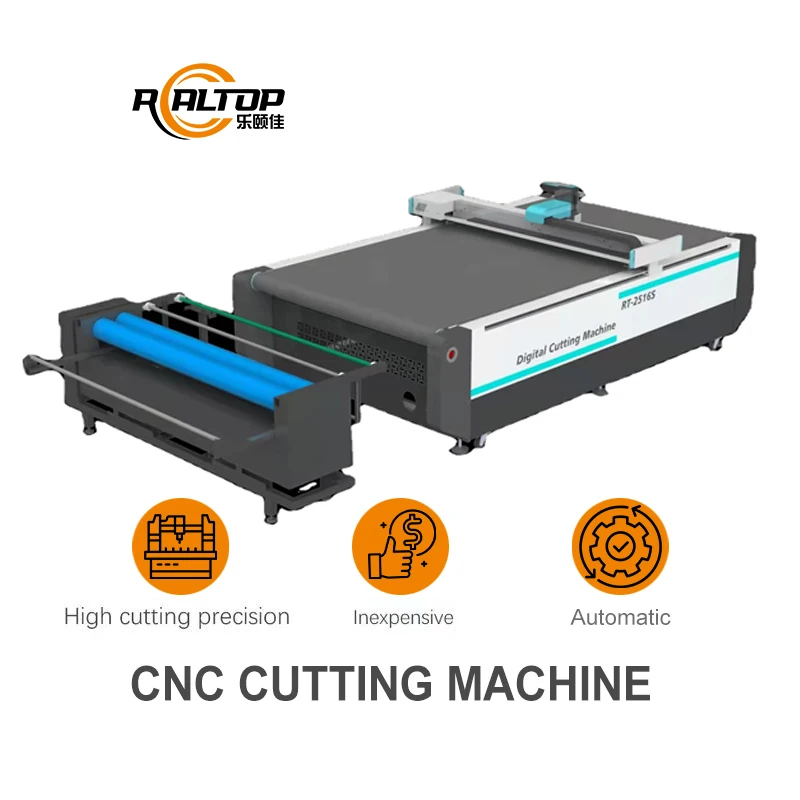
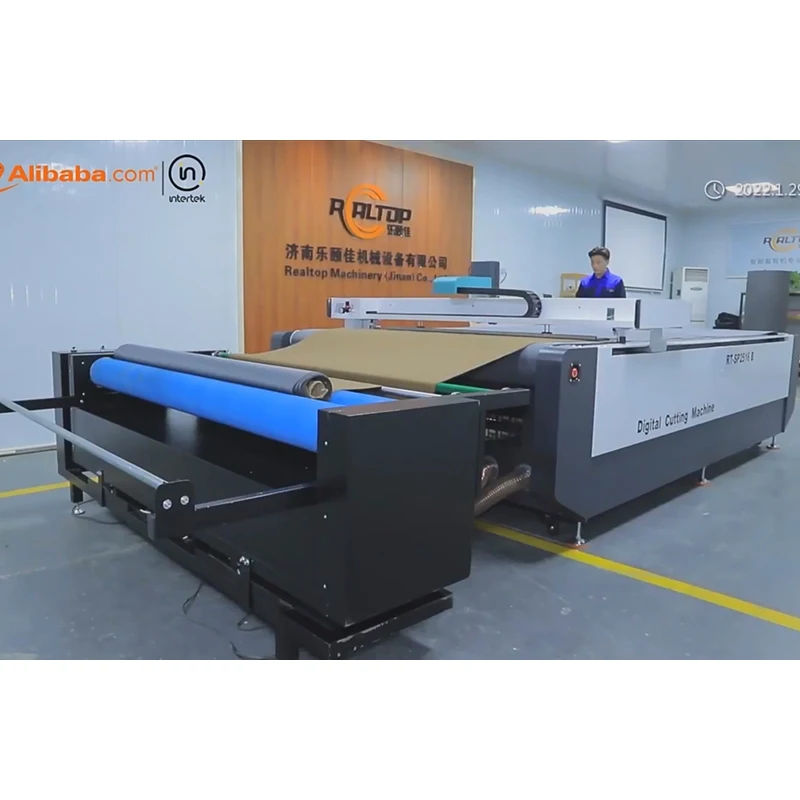

Zoned Vacuum Hold-Down — aviation aluminum countertop with inner wind channels delivers even suction across small garment pattern pieces during high-speed cutting runs.
Technical Specifications
| Parameter | Value |
|---|---|
| Product Type | CNC Oscillating Knife Cutting Machine |
| Model | RT-D2516/RT-S2516 |
| Working Area | 1600×2500 mm |
| Machine Size | 3450×2300×1250 mm |
| Rated Power | 9 kW |
| Voltage | 380V±10% |
| Table Surface | High-density felt on aviation aluminum countertop |
| Vacuum Pump | 7.5 kW with zoned suction |
| Multifunctional Head | Swiss imported knife with vibration full cut, half cut and cursor location |
| Translational Velocity | 800-1200 mm/s |
| Cutting Thickness | ≤50 mm (depending on material) |
| Repeated Accuracy | ≤0.1 mm |
| Transmission System | Digital servo motor, rack and pinion, Taiwan Hiwin linear guide |
| Auto Feeding | Germany imported conveyor belt with roll-to-sheet capability |
| Tool Holder | Modular design compatible with round knife, marking pen, auto feeder |
| Safety Device | Infrared sensors |
| Instruction System | HP-GL compatible format |
| Bed Structure | Overall welding with imported milling machine processing |
| Control Electrical Box | Fixed on fuselage with high-flexibility cables |
| Certification | CE |
Application Suitability
| Application | Material or Output |
|---|---|
| Garment pattern cutting | Multi-layer woven fabric, knit, high-elastic spandex blends with nesting |
| Footwear component cutting | Natural and synthetic leather, sponge composite leather |
| Automotive interior trimming | Sponge composite leather, foam-backed textiles, gasket materials |
| Signage and soft signage | PVC sheets, soft glass, textile banner material |
| Industrial gasket production | Silicon sheets, rubber compounds up to 50 mm depending on material density |
| Fashion and interior textiles | Upholstery fabric, curtain material, technical textiles on roll feed |
Why Vacuum Zoning Decides Whether Small Garment Pieces Stay Flat
A cutting machine rated on working area alone will fail the moment your nesting layout includes small collar or cuff pieces that lift under oscillating blade speed.
I watched a sportswear factory lose two full production days because their flatbed table had a single-zone vacuum that could not grip pattern pieces smaller than 200 mm across. The larger panels stayed put, but the small pieces fluttered at 1200 mm/s translational velocity, producing jagged edges and forcing operators to hand-hold material. [NEED_CITE: vacuum table zoning standards for flatbed cutting equipment] That kind of problem never shows up during a vendor demo with full-sheet cuts on standard cotton.
The RT-D2516/RT-S2516 addresses this through its aviation aluminum countertop with internal wind-channel structure, which distributes suction across independently managed zones rather than relying on a single plenum. When the nesting software places small garment pieces in one area and large front panels in another, the operator can adjust vacuum priority to the zones carrying the most intricate cuts.
Matching the Production Workflow from Roll to Finished Cut Piece
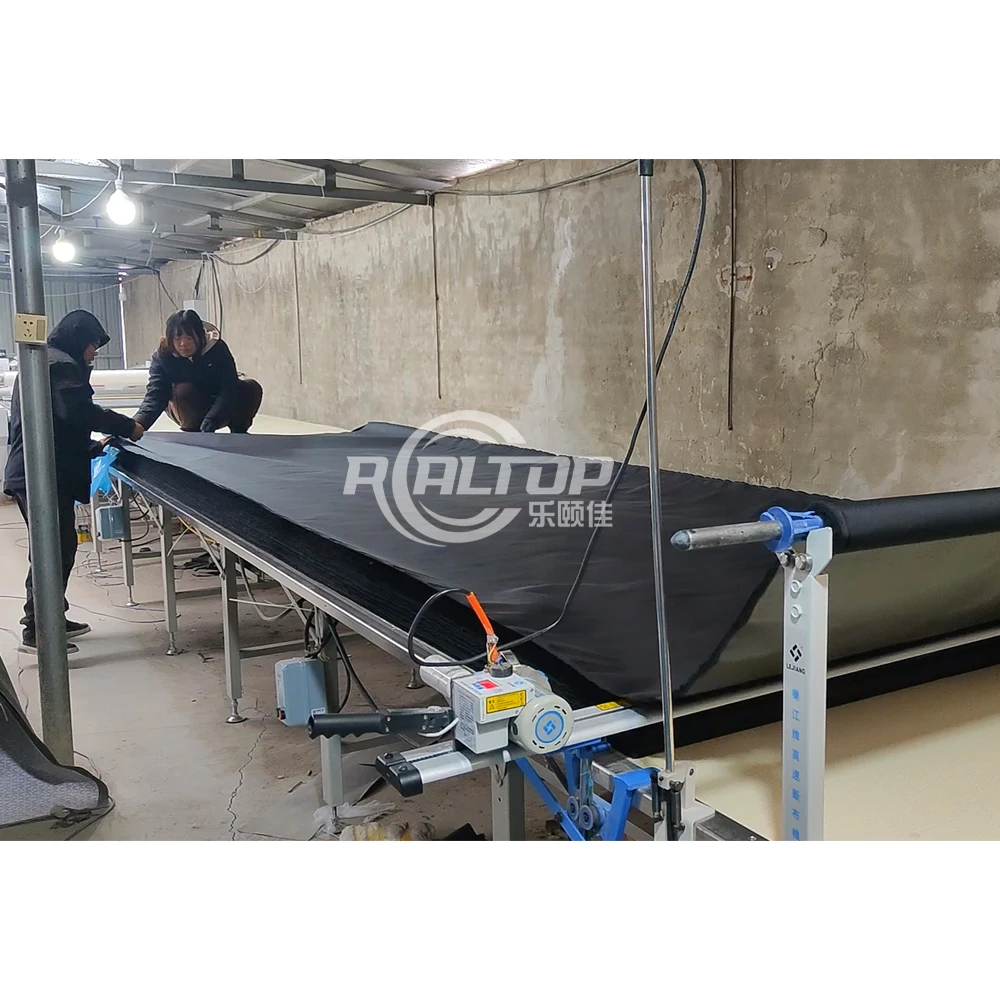
In garment manufacturing, the CNC Oscillating Knife Cutting Machine production line does not start at the cutting head — it starts at the material roll. The German-imported conveyor belt feeding system on this table handles continuous roll-to-sheet presentation, so operators do not manually unroll and smooth fabric before each cut cycle. For factories running high-elastic spandex blends or slippery technical textiles, the auto feeder maintains consistent material tension entering the cutting zone, which matters as much as blade oscillation frequency for edge quality.
How Hold-Down Pressure and Knife Oscillation Interact at Speed
At translational velocities approaching 1200 mm/s, the oscillating knife generates lateral vibration forces that can shift loosely held material. The 7.5 kW vacuum pump working through zoned countertop channels keeps the felt surface gripping the material from below, while the Swiss-imported oscillating head handles full cuts and half cuts without requiring the operator to slow the machine down for intricate contours. This combination is what allows nested garment layouts with mixed piece sizes to cut cleanly in a single pass. [NEED_CITE: relationship between oscillation frequency and material hold-down in CNC knife cutting]
What the Specs Mean on the Factory Floor
The ≤0.1 mm repeated accuracy delivered by rack-and-pinion transmission on Taiwan Hiwin linear guides matters most when a garment pattern includes mirrored left-and-right pieces that must align at the sewing stage. A drift of even half a millimeter across a 2500 mm cut length accumulates into visible misalignment on fitted garments. The 9 kW rated power supports simultaneous operation of the vacuum pump, servo drives, and oscillating head without requiring a dedicated high-capacity circuit beyond the stated 380V±10% supply. The HP-GL compatible instruction system integrates with common nesting software that garment factories already use, reducing the transition time from pattern design to cut output. The modular tool holder accepts round knife, marking pen, and auto feeder attachments, allowing the same table to switch between fabric cutting, pattern marking, and continuous roll-fed operation without a separate machine.
The Hidden Cost of Specifying Only Working Area
Factories that purchase a flatbed cutter based solely on sheet dimensions frequently discover that the vacuum system was designed for large-format signage rather than the small nested pieces typical in garment production. The result is operators taping material edges down by hand, which defeats the purpose of automated cutting and introduces inconsistency across shifts. [NEED_CITE: material lift incidents in high-speed oscillating knife cutting] Another common mismatch occurs when the tool head specified for standard cotton cannot handle sponge composite leather — the blade crushes the foam core instead of slicing it cleanly, and the factory then discovers the head was not interchangeable without significant reconfiguration.
Why Production Managers Source This Configuration Here
The in-house design team configures tool head and table zoning based on the buyer’s actual material stack rather than shipping a default setup. Sample cutting on the buyer’s own fabric at production speed is completed before order confirmation, so edge quality on high-elastic blends or composite leather is verified, not assumed. Software compatibility with the buyer’s existing nesting files is confirmed against the HP-GL instruction system before the machine enters build. The 380V±10% voltage specification is locked in with the buyer’s local electrical standard, and control language is set before shipment. For factories running both knife-sensitive and laser-suitable materials, the manufacturer covers both cutting technologies in-house, allowing the cutting method to follow the material rather than forcing one process across all substrates.
Documentation & Verification
- Machine specification sheet confirming working area, voltage, and tool head configuration for your material range
- Sample cutting report run on your fabric or composite material at intended layer count
- Electrical schematic with voltage confirmation matching your facility power supply
- Tool head and table zoning configuration list matched to your pattern piece size range
- Software licence and HP-GL file format compatibility note for your nesting system
- Factory test record documenting repeated accuracy and cutting edge quality before dispatch
Installation, Commissioning & Support
- Floor space allocation of approximately 3450×2300 mm footprint with clearance for auto feeder roll loading
- Dedicated 380V±10% circuit rated for 9 kW continuous draw with proper earthing for servo drives
- Machine arrives with control electrical box pre-mounted on fuselage to reduce on-site wiring time
- First-run parameter setting for oscillation frequency and vacuum zone priority based on your material
- Operator training on modular tool head changeover between round knife, oscillating blade, and marking pen
- Spare parts list covering felt table surface, Hiwin guide blocks, and conveyor belt segments
Planning Your Cutting Table Integration
To specify this CNC Oscillating Knife Cutting Machine production line correctly, share your primary fabric type, typical layer count, and the size range of your smallest nested pattern pieces. Confirm your local voltage and frequency standard, and identify which nesting software your pattern department currently exports from. If you run both woven fabrics and composite leather on the same line, note the thickness range for each so the correct knife type and vacuum zoning layout are configured before build.
Frequently Asked Questions
Q: How do I verify cutting throughput for my specific fabric and layer count?
A: Request a sample cutting report using your own material at the layer count you plan to run in production. The report documents cutting speed, edge quality, and piece accuracy under realistic conditions rather than generic test fabric, giving you a reliable basis for planning daily output across your garment lines.
Q: How does vacuum zoning affect small pattern pieces in garment nesting?
A: Small pieces like collars and cuffs require concentrated suction directly beneath them. A single-zone vacuum spreads suction evenly across the full table, which leaves small areas under-gripped. Zoned channels in the aluminum countertop let you direct stronger hold-down exactly where intricate nesting clusters sit.
Q: What nesting software and file formats work with the HP-GL instruction system?
A: Most garment CAD and nesting platforms export HP-GL or compatible vector formats. Confirm your specific software version and file extension with the machine supplier before order, so any post-processor adjustments are handled during build rather than after installation on your factory floor.
Q: How do I match different tool heads to materials on the same cutting table?
A: The modular tool holder accepts oscillating knife for woven and knit fabric, round knife for continuous straight cuts, and marking pen for pattern identification. Switching between fabric and sponge composite leather may require a different blade profile, which is specified during the initial sample cutting phase.
Q: What installation conditions does this cutting table require?
A: The 3450×2300×1250 mm machine size requires a level floor with adequate clearance on the feed side for roll loading. A dedicated 380V±10% power supply rated for 9 kW is needed, along with space for the 7.5 kW vacuum pump. Confirm ceiling height accommodates the auto feeder material roll diameter.



商品评价
Clear filtersThere are no reviews yet.