


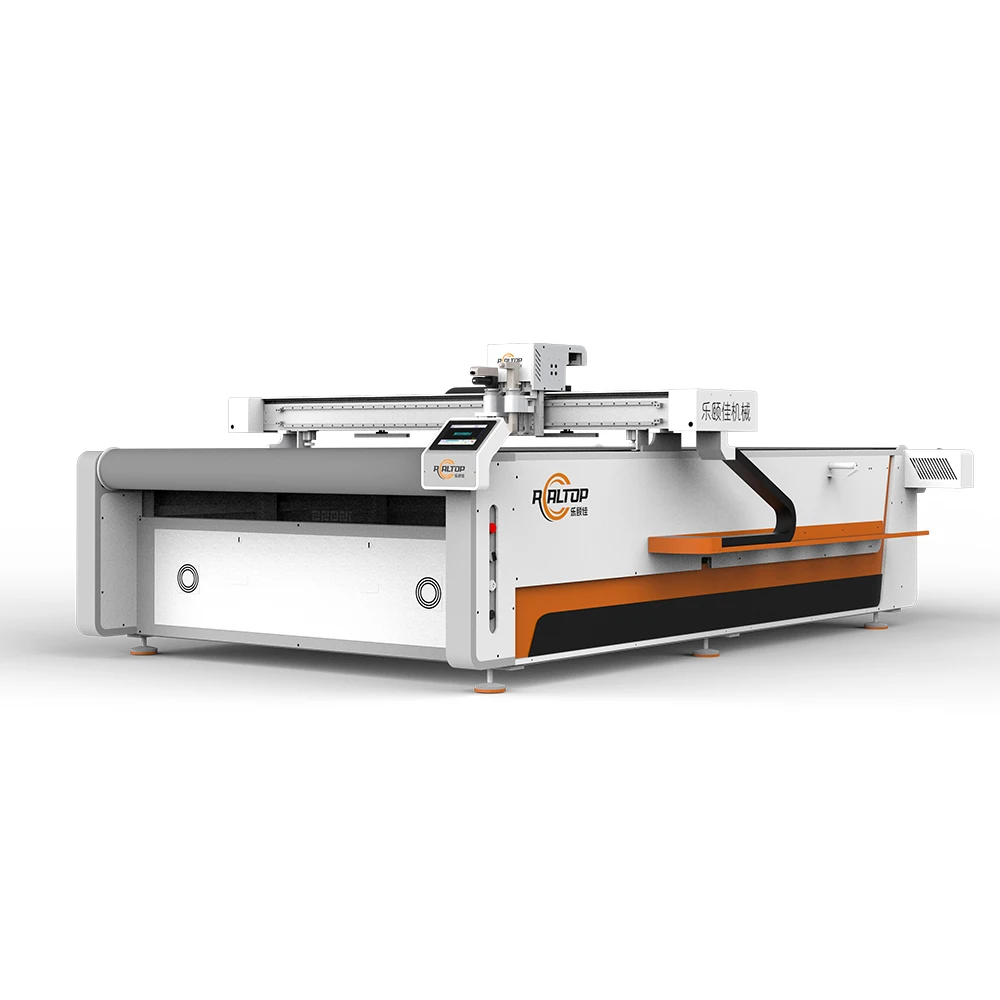
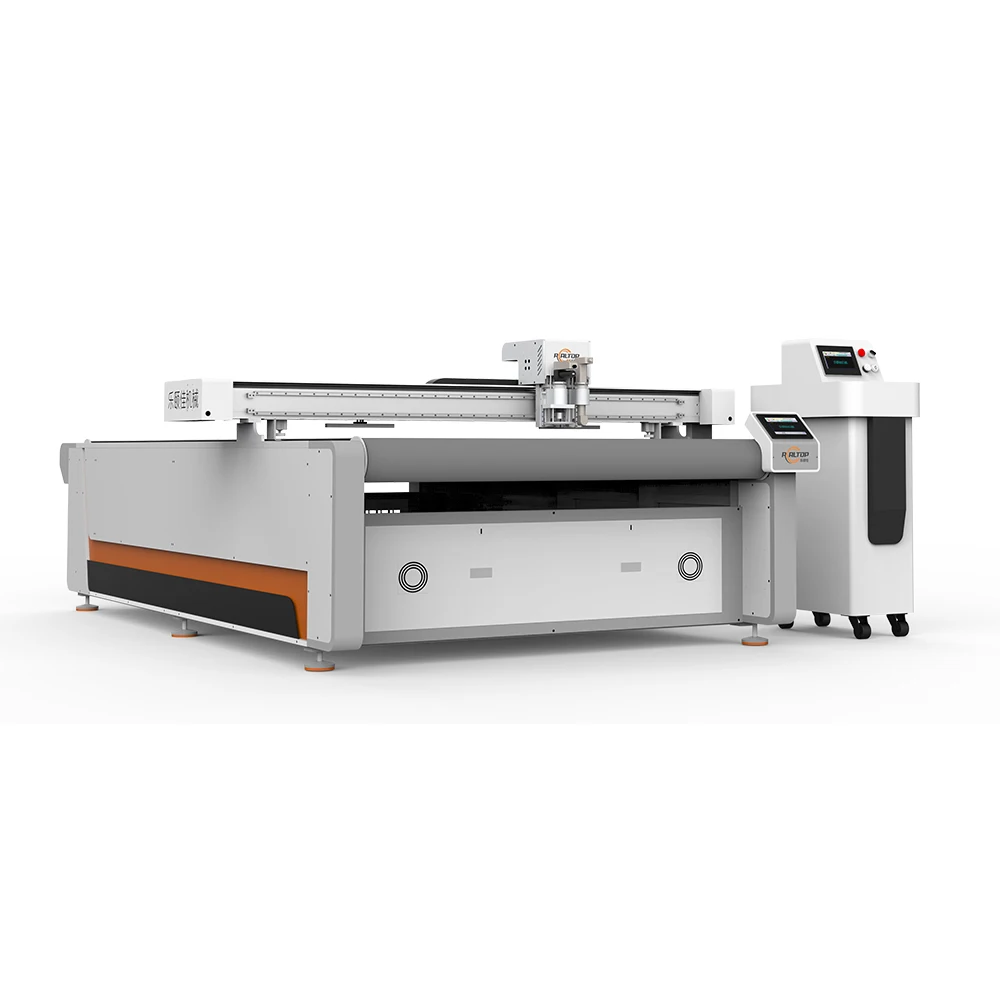
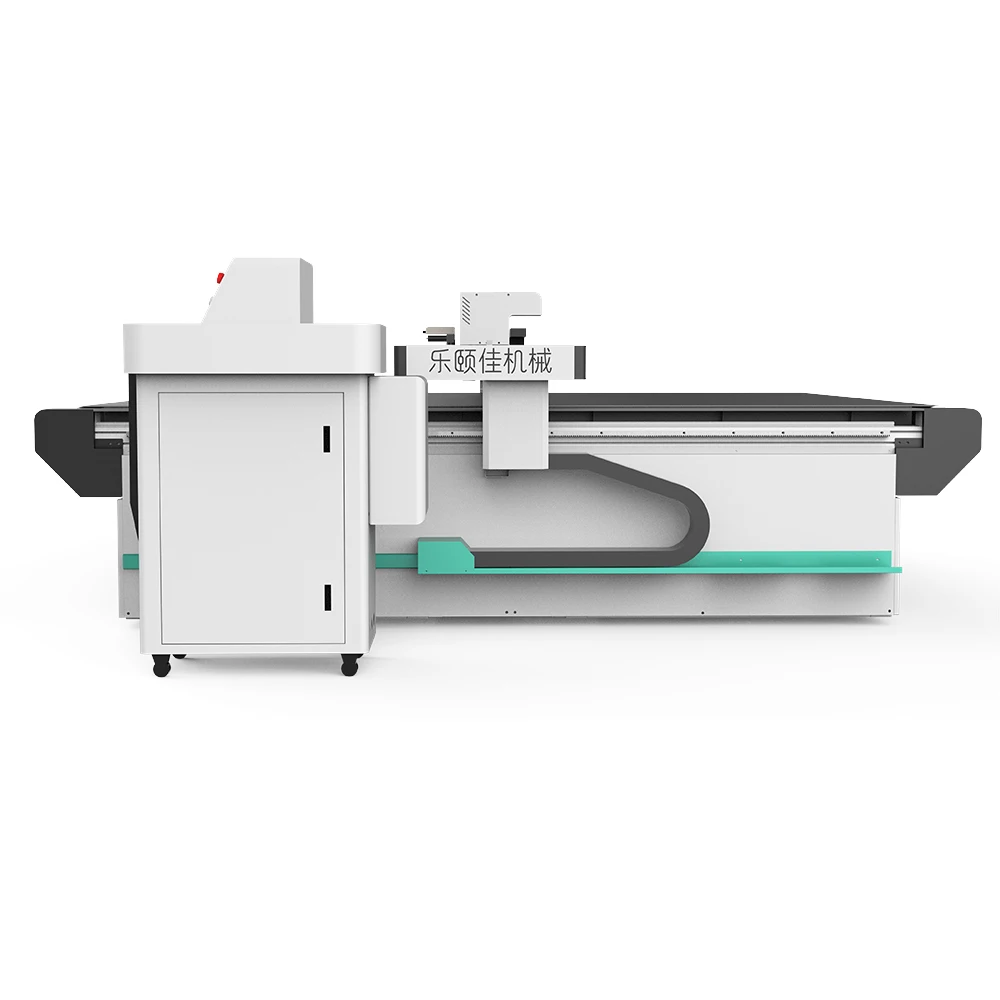
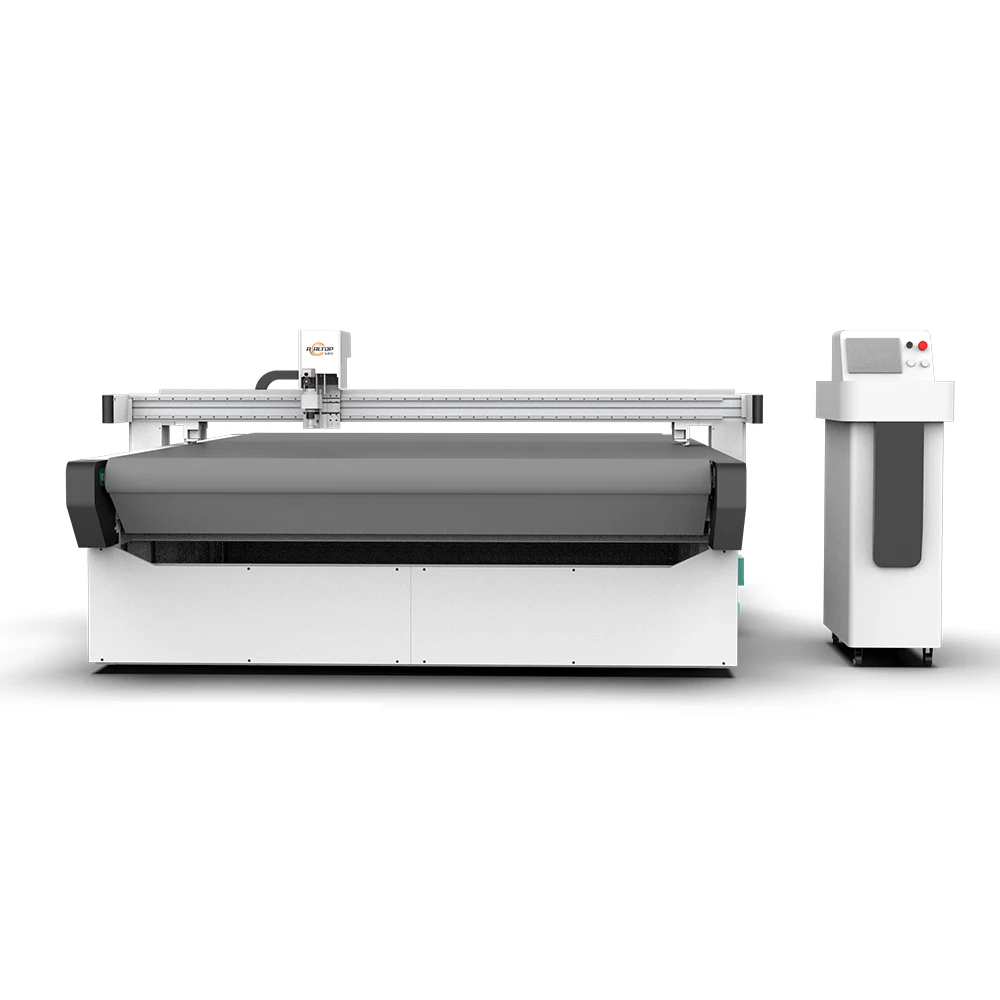
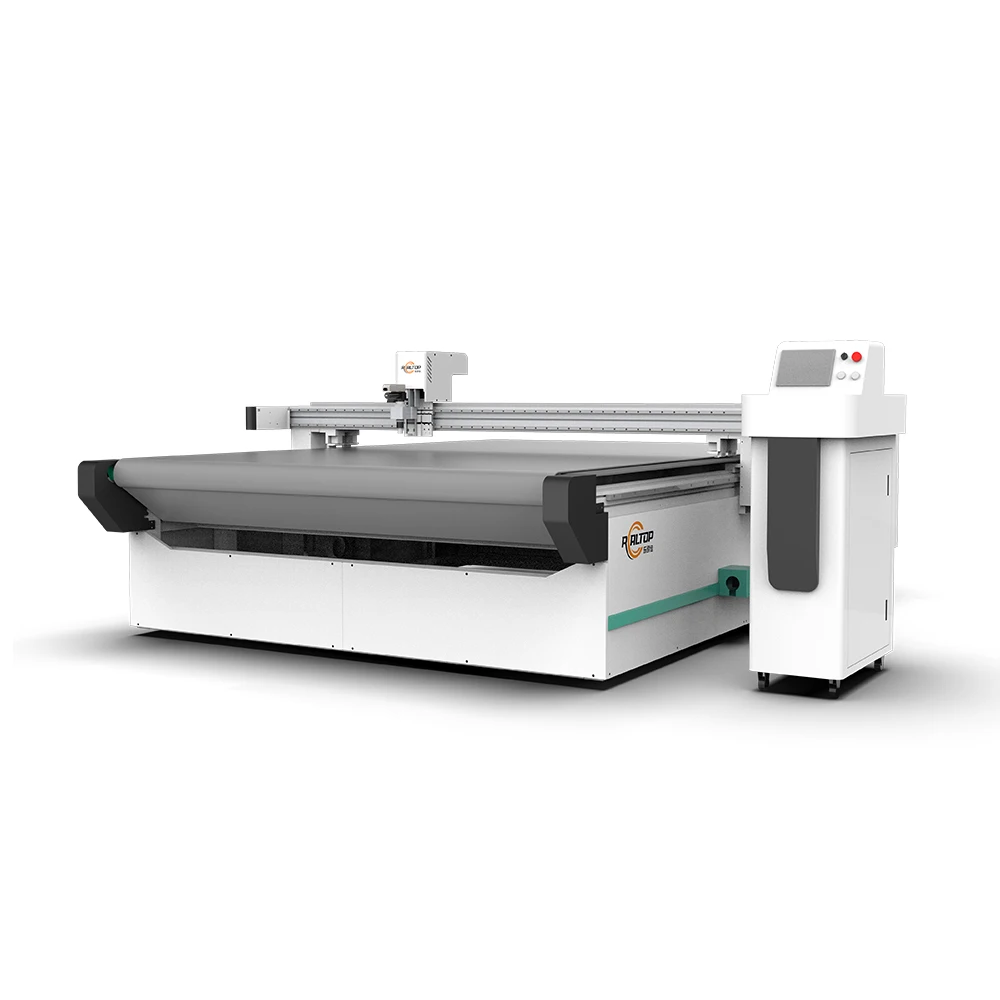

Integrated Knife and Laser Technology — matching the oscillating or rotary tool head to your actual fabric weight and layer stack rather than forcing one cutting method across every production job.
Technical Specifications
| Parameter | Value |
|---|---|
| Model | 1625 |
| Product Type | CNC Oscillating Knife Cutting Machine |
| Working Area | 1600×2500 mm |
| Tool Head Options | Oscillating knife, Driven rotary knife, Creasing wheel, Kiss cutting tool, Pneumatic knife, Milling tool, V groove knife |
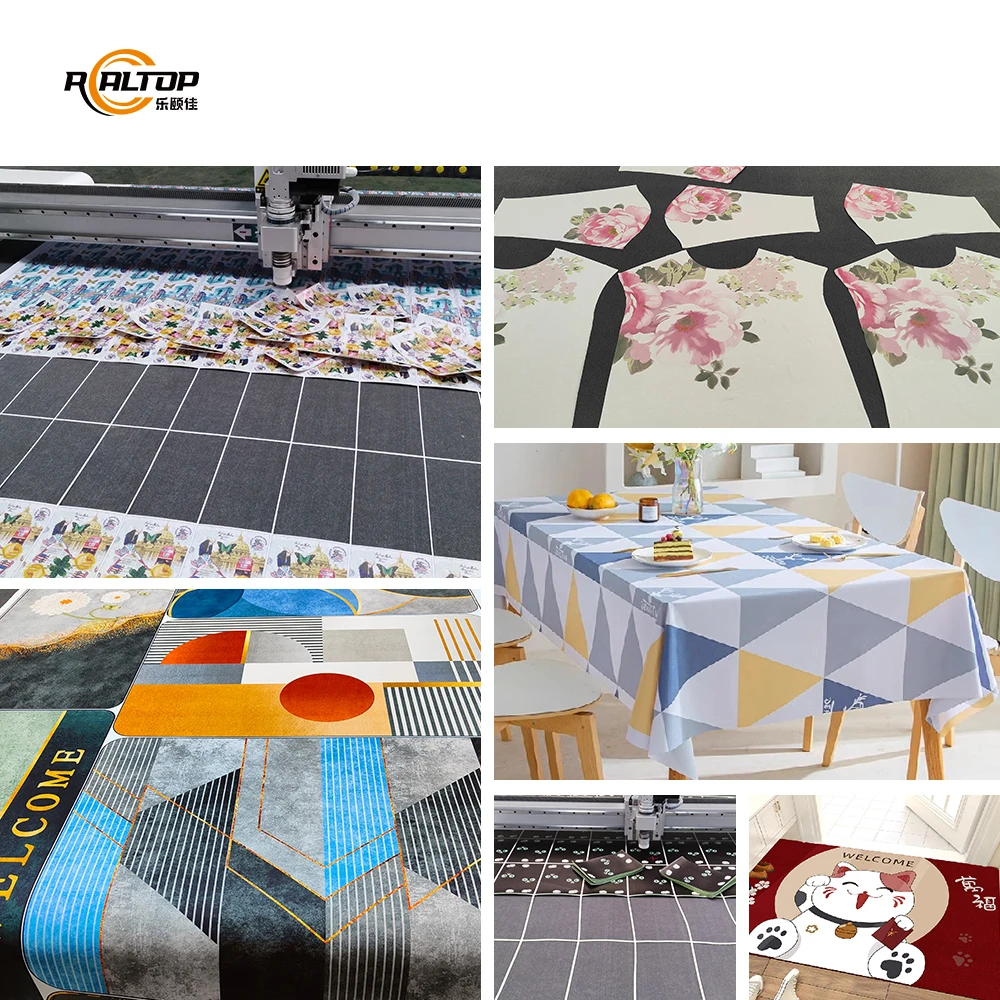
| Applicable Materials | Fabric, Cardboard, Carton, Mats, PVC, EVA, Leather, Acrylic, Foam, PTFE, Rubber |
| Cutting Speed | 0–2000 mm/s |
| Cutting Thickness | ≤ 30 mm (basis to be confirmed by material type and layer count) |
| Positioning Accuracy | ±0.1 mm |
| Vacuum Pump Power | 9 kW |
| Vacuum Table | Aluminum bellows vacuum table |
| Servo Motor Options | Panasonic, Delta, Dorna |
| Voltage Options | 110V / 220V / 380V (frequency to be confirmed) |
| File Format Compatibility | PLT, DXF, AI, PDF |
| Nesting Software | Included (intelligent nesting for material yield optimization) |
| Control System | PLC control panel with optional display languages |
| Software Language Options | English, Russian, Italian, Chinese (custom languages available) |
| Safety Devices | Infrared sensor, Emergency stop |
| Machine Dimensions (L×W×H) | 3300×2100×1350 mm |
| Standards | CE |
Application Suitability
| Application | Material or Output |
|---|---|
| Apparel manufacturing | Suits, knitwear, lace, complex woven and knitted fabrics |
| Automotive interiors | Seat fabrics, carpets, PVC floor mats |
| Home textiles | Sofa upholstery fabrics, curtain panels, rugs |
| Composite material processing | Carbon fiber prepreg, aramid fabrics |
Why "30 mm Cutting Depth" Means Nothing Without Your Fabric in the Machine
Actual cutting capacity depends entirely on your material composition, adhesive content, and how many layers you stack.
I once watched a cutting line go down for four straight days because the sample test used single-layer PVC while the production floor ran five layers of laminated composite. The vacuum could not hold the stack flat, the knife head skipped across the surface, and the edges came out ragged. The machine was never at fault — the specification conversation stopped at working area and never reached the production material. That is where most Cloth CNC Cutting Machine production line orders break down: someone signs off on a 30 mm depth rating without anyone asking what is actually being cut in five-layer stacks at 2000 mm/s [NEED_CITE: oscillating knife cutting depth verification methods for multi-layer textile stacks].
Matching Tool Heads to What Your Production Floor Actually Cuts
The 1625 carries seven different tool head options, and picking the right one is not about choosing the most expensive. Lightweight knits and woven apparel fabrics typically run cleanly with the oscillating knife, which vibrates at high frequency to slice through stacked layers without pulling threads. Heavier automotive carpet and dense PVC mats respond better to a driven rotary knife that shears through the material rather than punching into it.
When the production mix includes both delicate lace and heavy mat stock, a dual-head configuration lets the same Cloth CNC Cutting Machine production line switch between tool types without manual changeover mid-job. The creasing wheel and kiss cutting tool handle packaging insert and gasket work that often runs alongside textile orders in job-shop environments.
Holding the Stack Flat When Vacuum Is the Real Constraint
A 9 kW vacuum pump sounds powerful until you cut small pattern pieces from a full 1600×2500 mm table. The aluminum bellows vacuum table distributes suction across the surface, but small parts — collar pieces, gussets, label panels — lose hold-down force when most of the table is open air. Zoning the vacuum into independent sectors keeps suction concentrated under the actual cutting zone [NEED_CITE: vacuum table zoning requirements for small-part CNC fabric cutting].
Without proper zoning, the bottom layers of a multi-layer stack shift while the top layers stay pinned, producing pieces that are dimensionally correct but misaligned between plies. This problem does not show up on single-layer sample cuts and only appears when production volume demands full-stack cutting.
Reading the Specification Sheet Against Your Production Reality
The ±0.1 mm positioning accuracy rating governs the motion system, not the final cut part. Once the knife pushes through twenty layers of fabric, the blade deflects and the bottom layer can drift from the top by a margin that exceeds the machine’s positioning tolerance. This is standard behavior across flatbed knife cutters and is why sample cutting on your actual production stack — not a single demonstration layer — is the only honest way to verify dimensional accuracy.
The PLC control panel accepts PLT, DXF, AI, and PDF file imports, which covers most pattern workflows. If your existing nesting software outputs a format outside this set, the file compatibility needs confirming before the order is placed. The included intelligent nesting software optimizes layout for material yield, reducing offcut waste on high-volume fabric runs where cloth cost dominates the unit economics.
Servo motor selection between Panasonic, Delta, and Dorna affects acceleration behavior and long-term maintenance parts availability in your region. This is a specification worth locking down early, because swapping servo brands after the machine is built requires rewiring and re-tuning motion parameters.
What Happens When the Specification Conversation Stops Too Early
Choosing a machine on working area alone and discovering later that the knife head cannot handle your adhesive-backed composite at production speed. Running a five-layer stack on a table with undivided vacuum zones and watching small pattern pieces lift and shift mid-cut. Taking delivery and finding the control panel speaks a language your operators cannot read, or the plug does not match the factory receptacle. Each of these failures traces back to a detail that was available to confirm before the order was signed — and was simply never asked about [NEED_CITE: common causes of CNC cutting machine specification mismatches in export orders].
What the Build Side of This Order Actually Looks Like
The machine frame and motion components are built in-house at the Jinan factory, so configuration changes during the order — adding a second tool head, switching vacuum zoning, or changing the control language — stay within the same production flow rather than requiring third-party coordination.
Sample cutting runs on your actual production fabric at your required layer count and speed, generating a test report before commitment. This is not a single-layer demonstration on a material chosen by the factory.
Voltage, plug type, and control language are confirmed in writing with electrical schematic documentation before the machine enters final assembly. The frequency standard for your market is locked down alongside voltage, because a 220V/50Hz motor on a 60Hz supply runs at the wrong speed and burns out prematurely.
Software licensing and file format compatibility are verified against your existing nesting workflow before order placement, so the machine accepts your production files on day one.
Documentation & Verification
- Machine specification sheet confirming tool head and table configuration for your material
- Electrical schematic with voltage, frequency, and plug type matched to your facility
- Sample cutting report on your fabric at your required layer thickness and speed
- Software license and file format compatibility note for DXF, PLT, AI, and PDF workflows
- Factory test record documenting motion accuracy and vacuum performance before dispatch
- Packing photographs showing machine condition at the point of crate closure
Installation, Commissioning & Support
- 9 kW vacuum pump requires a dedicated circuit separate from the servo drive supply on the 1625
- 3300×2100×1350 mm footprint demands verified floor clearance and forklift access at your site
- First-power commissioning includes PLC parameter tuning and servo zero-point calibration
- Operator training covers tool head changeover between oscillating, rotary, and kiss cutting configurations
- Spare parts list matched to your selected servo brand and tool head type for first-year maintenance
What to Prepare Before Starting the Conversation
Send a sample of the actual production fabric — not a catalog swatch — along with the layer count and stack height you intend to cut daily. Confirm your facility voltage and frequency, the preferred control panel language, and whether your existing pattern files come in DXF, PLT, AI, or another format. If your production includes both woven apparel stock and heavier automotive or home-textile materials, specify the full range so the tool head and vacuum zoning recommendations cover every job in your mix.
Frequently Asked Questions
Q: How is cutting thickness verified for my specific fabric and layer count?
A: The ≤ 30 mm rating is a machine travel limit, not a universal material guarantee. Verification happens through a sample cutting test using your actual production fabric at the exact layer count and stack height you plan to run. The resulting cut report documents edge quality, dimensional accuracy across the stack, and any knife deflection observed.
Q: Which tool head is recommended for my material — oscillating, rotary, or pneumatic?
A: Lightweight knits and wovens typically run on the oscillating knife. Dense automotive carpet and PVC mats respond better to the driven rotary knife. The recommendation is finalized only after sample testing on your material, because adhesive content and backing type change the cutting behavior regardless of the face fabric.
Q: Can the nesting software integrate with my existing DXF/AI workflow?
A: The system accepts PLT, DXF, AI, and PDF file formats through the included intelligent nesting software. If your current workflow outputs a different format, compatibility is confirmed before order placement. Software licensing and language configuration are documented in writing prior to shipment.
Q: What vacuum zoning is needed for small pattern pieces to prevent material lift?
A: The aluminum bellows vacuum table on the 1600×2500 mm working area can be divided into independent sectors. When cutting small parts, suction concentrates under the active cutting zone rather than distributing across empty table space. The zoning layout is specified based on your smallest pattern piece dimensions.
Q: How are voltage, frequency, and control language confirmed before shipment?
A: Your facility voltage, frequency, and plug type are documented in an electrical schematic shared for approval before final assembly. The PLC control panel language — available in English, Russian, Italian, Chinese, or custom options — is confirmed in writing on the same specification sheet.



商品评价
Clear filtersThere are no reviews yet.