



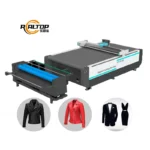
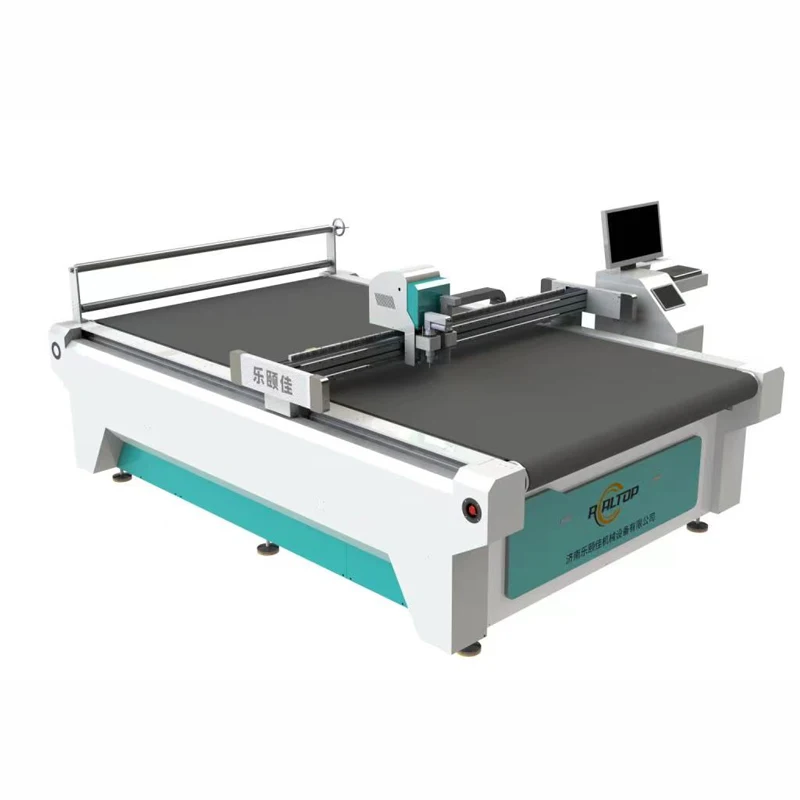
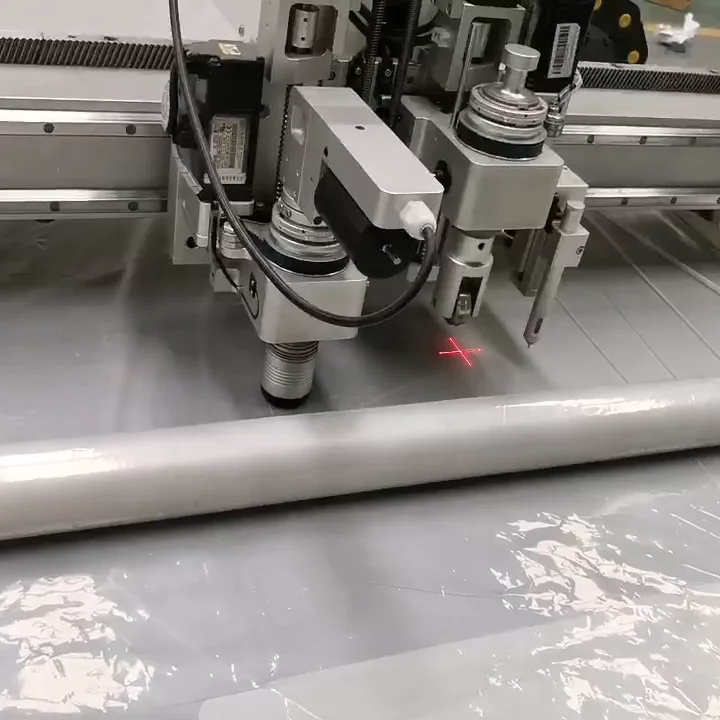
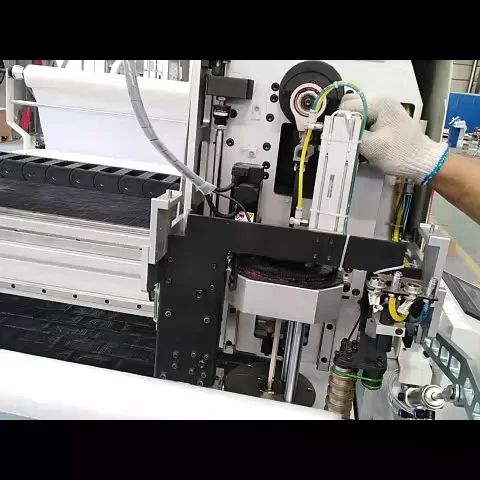
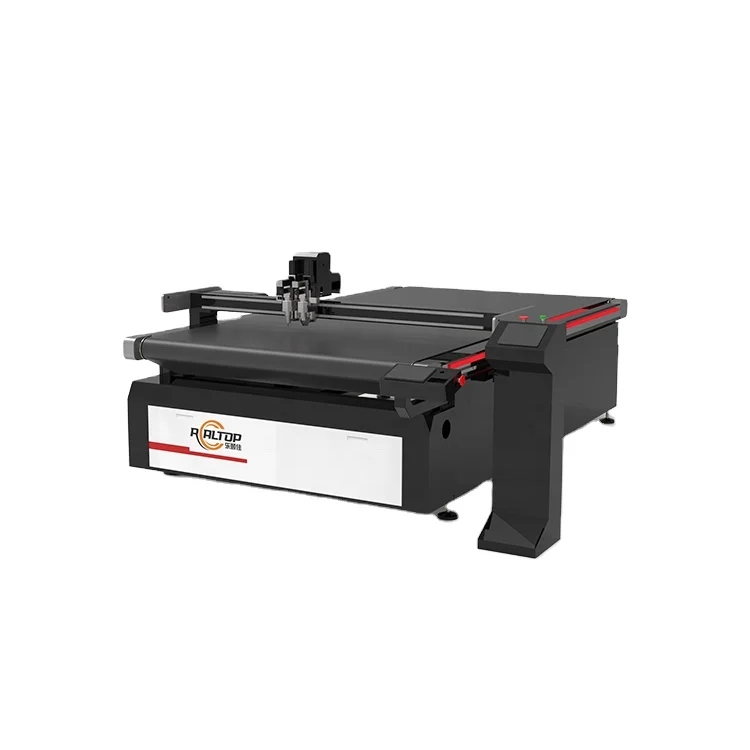
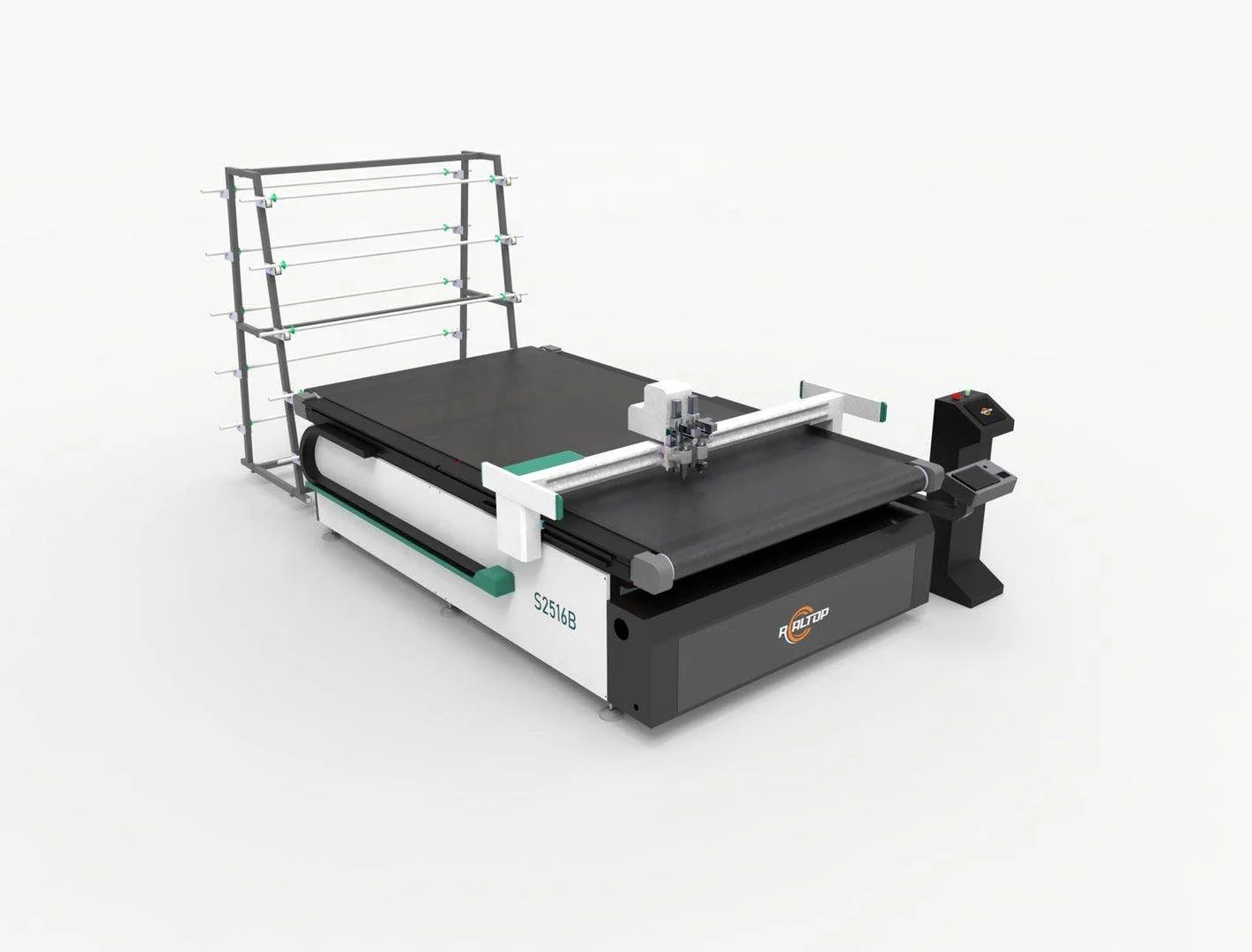
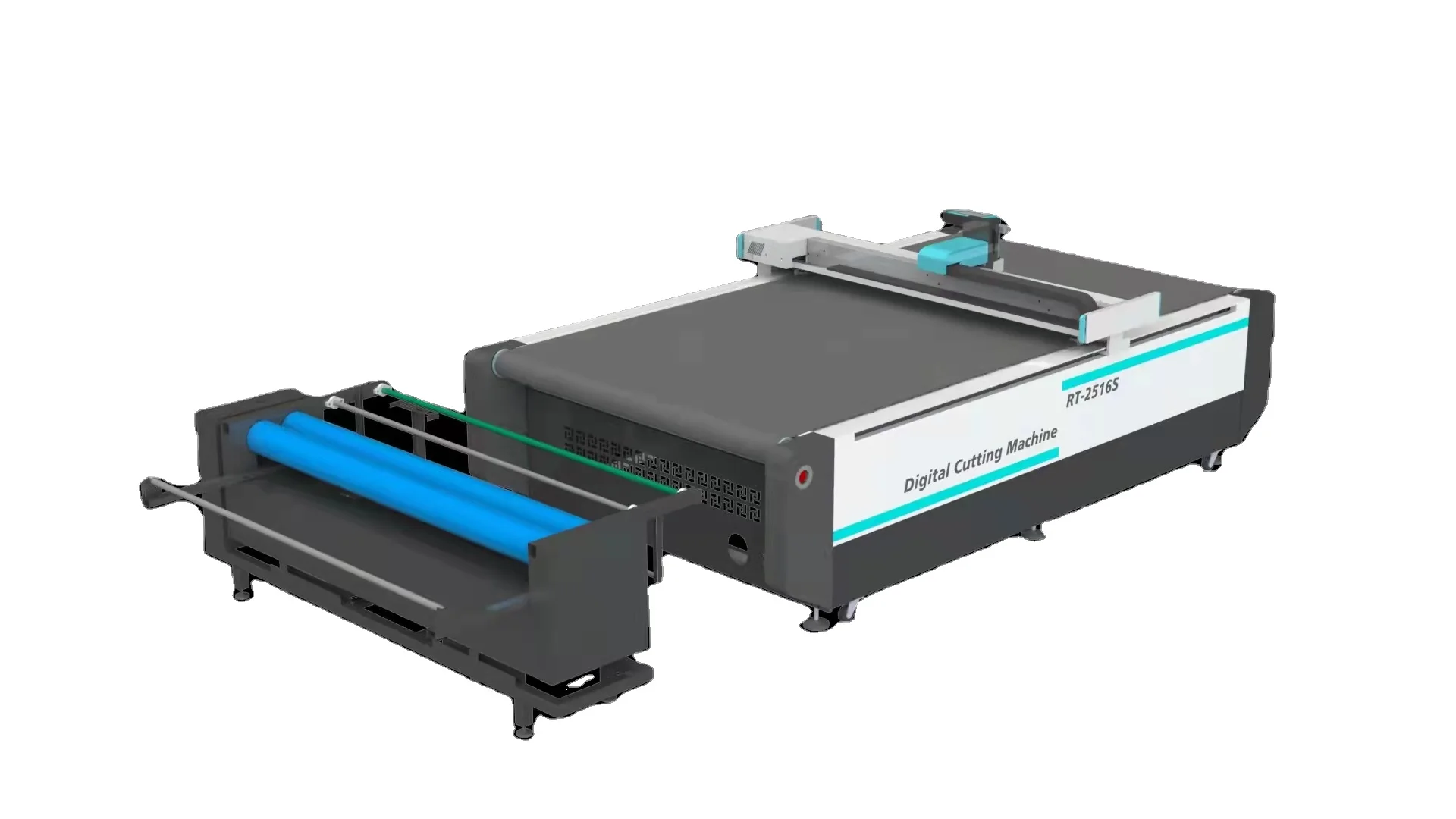

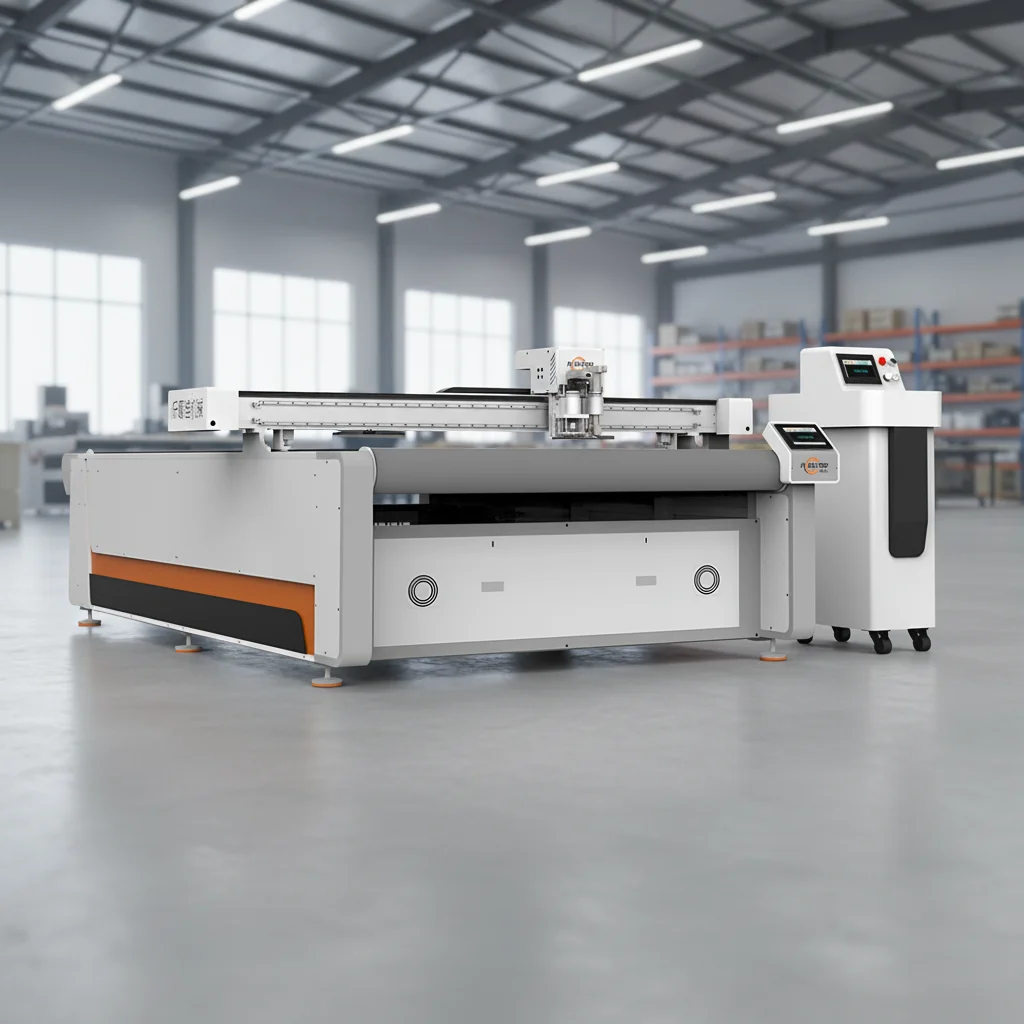
Tool head and table configuration specified per material — The REALTOP RT-D2516/RT-S2516 cloth CNC cutting machine production line is set up with oscillating, drag, circular and pneumatic knife options matched to your fabric ply count, composite density and daily throughput before the machine leaves the factory.
Technical Specifications
| Parameter | Value |
|---|---|
| Model | RT-D2516/RT-S2516 |
| Product Type | CNC Oscillating Knife Cutting Machine with Conveyor & Vacuum Table |
| Working Area | 1600 × 2500 mm |
| Machine Size | 3450 × 2300 × 1250 mm |
| Rated Power | 9 kW |
| Translational Velocity | 800 – 1200 mm/s |
| Cutting Speed | 200 – 800 mm/s (basis to be confirmed with specific fabric weight and ply count) |
| Cutting Thickness | Up to 100 mm (varies with material density and tool head) |
| Repeated Accuracy | ≤ 0.1 mm |
| Servo Motor Options | Delta or Panasonic, IP67 waterproof |
| Vacuum Pump | 7.5 kW, integrated aviation aluminum shell |
| Vacuum Table | Magnesium-aluminum alloy, PVDF powder sprayed, anodic and hard oxidation |
| Transmission System | Digital servo motor, linear guide, synchronous belt, ball screw |
| Voltage | 380V ±10% |
| Software Language Options | English, Russian, Italian, Chinese (special languages customizable) |
| Positioning Systems | Small CCD mark-point camera, panoramic camera recognition, projection positioning |
| Safety Devices | Infrared induction blocking, anti-collision on both beam sides, emergency stop with in-situ resume |
| Instruction System | HP-GL compatible format |
| Key Features | Multi-tool head configuration, conveyor auto-feeding available, Germany imported conveyor belt, Taiwan Hiwin rail |
Application Suitability
| Application | Material or Output |
|---|---|
| Garment and footwear cutting | Multi-ply clothing cloth, shoe material, non-woven fabric, luggage material |
| Automotive interior production | PU, EVA, sponge, composite leather, carpet, floor mats |
| Soft home furnishings | Fabric, textile, leather, composite materials for upholstery and drapery |
| Signage and packaging sample making | Sticker film, vinyl, corrugated cardboard, plastic box, PVC |
| Sports and outdoor products | Foam board, rubber, XPE, PTFE, ETFE composite panels |
| Sealing and gasket fabrication | Rubber, PTFE, fiberglass, gasket material sheets |
Why Material Thickness Changes Everything About Your Cloth CNC Cutting Machine Production Line
A working area number alone does not tell you whether the knife will get through your lay at production speed. I once watched a fabric cutting table sit idle for two weeks in a Dubai workshop because the buyer focused on table size and ignored how many* their 400 GSM fleece. The voltage mismatch was caught only because someone on my team double-checked the single-line diagram before the container was sealed. That same machine, had it shipped without the conversation, would have sat in the port waiting for a transformer while the buyer’s production schedule collapsed.
When you source a cloth CNC cutting machine production line, the thickness and density of your lay dictate the tool head, the knife stroke frequency, the vacuum hold-down pressure, and even the conveyor belt surface. A drag knife that works beautifully on single-ply vinyl will crush and rag through eight layers of neoprene. A circular knife that sails through woven cotton will snag on non-woven technical textiles if the feed rate is not matched to the fiber structure [NEED_CITE: cutting mechanics for layered textile materials].
Matching the Tool Head to Your Fabric Stack
The cloth CNC cutting machine production line RT-D2516/RT-S2516 offers an oscillating knife, pneumatic knife, high-power vibrating knife, circular knife, V-cutting knife, drag knife, creasing wheel, dotted line knife and punching tool. Each of these exists because no single blade geometry handles every textile. Oscillating knives shear through multi-ply woven fabric cleanly because the high-frequency stroke prevents the layers from shifting. Pneumatic knives apply downward force suitable for dense composites like automotive headliner foam. Circular knives handle long straight cuts on single or double plies of lightweight cloth at higher travel speeds, but they cannot execute tight inside corners. Selecting the correct head is not a catalog choice — it is a decision made after test cuts on your actual material stack at your intended daily volume.
Vacuum Zoning and Conveyor Feed for Continuous Workflow
The magnesium-aluminum vacuum table on this cloth CNC cutting machine production line uses PVDF powder coating and anodic oxidation to resist corrosion from sizing agents and fabric dust. The 7.5 kW vacuum pump with integrated aviation aluminum shell and built-in silencer sponge reduces operational noise on the shop floor. More importantly, the suction can be zoned so that small pattern pieces do not lift at the edges during cutting — a common problem when the entire table is under uniform vacuum and a small cutout loses hold-down area once the surrounding material is removed [NEED_CITE: vacuum zoning strategies for flatbed cutting tables]. When paired with the Germany-imported conveyor belt and auto-feeding system, the machine moves roll material forward incrementally, allowing continuous cutting across multiple lays without manual repositioning of the fabric.
What the Specs Mean on Your Shop Floor
The repeated accuracy of ≤ 0.1 mm, driven by Delta or Panasonic IP67 servo motors and Taiwan Hiwin linear guides, matters most when you are nesting tight pattern pieces where a millimeter of drift means the collar piece no longer matches the shoulder seam. The 800 – 1200 mm/s translational velocity governs how fast the head repositions between cuts, which affects your total cycle time more than cutting speed itself on jobs with many small pieces. The CCD mark-point camera and panoramic camera recognition allow the machine to locate printed registration marks on dyed or sublimated textiles, adjusting the cut path in real time so that pattern contours align with the printed design even when the fabric stretches or skews on the table. The HP-GL compatible instruction system means your existing nesting and marker software can output directly without a translation layer that might distort curves or notch geometries.
The Hidden Cost of a Configuration Guess
When a buyer specifies a cloth CNC cutting machine production line by working area and price alone, the consequences show up after installation. A vacuum table with insufficient zoning causes small cut pieces to lift and jam the knife head, triggering emergency stops and wasting the surrounding lay. A wrong tool head produces frayed edges on woven fabric or crushed cells in foam, sending the output to rework or scrap. A CCD system that was promised but never calibrated to the buyer’s print mark size and contrast fails to track at production speed, forcing operators to cut manually around printed contours — exactly the labor the machine was supposed to eliminate [NEED_CITE: common causes of flatbed cutter downtime in textile production]. A voltage or plug mismatch means the machine cannot be energized until a transformer or adapter arrives, and the production window closes.
Why Buyers Source This Line Here
The RT-D2516/RT-S2516 is built by a manufacturer that produces both knife and laser cutting systems in-house, so the cutting method is matched to your material rather than forced into whatever one technology the supplier happens to make. Every tool head and table configuration is specified against your material sample and daily volume before the order is confirmed. Software compatibility with your existing nesting and file format workflow is verified in writing so there is no surprise when the machine arrives and your DXF files open with distorted splines. Voltage, plug type and control language are confirmed on the electrical schematic before shipment, which is something I insist on after watching that rotary knife cutter sit idle in Dubai. Sample cutting on your own fabric or composite material at your production thickness is completed and documented before you commit to the purchase.
Documentation & Verification
- Machine specification sheet listing each tool head and vacuum zone matched to your material
- Electrical schematic confirming voltage, frequency, plug type and control language for your destination market
- Sample cutting report on your fabric or composite at production ply count before dispatch
- Factory test record showing repeated accuracy and cutting edge quality on your material
- Software licence with file format compatibility note for your nesting and marker workflow
- Spare parts list with Swiss imported knife and conveyor belt wear items identified by part number
Installation, Commissioning & Support
- Floor space planning based on the 3450 × 2300 mm machine footprint plus conveyor infeed and outfeed clearance
- Dedicated 380V ±10% circuit rated for the 9 kW machine load plus 7.5 kW vacuum pump startup surge
- Assembled and tested at the factory, then shipped with frame and gantry separated for container loading
- First-run commissioning includes tool head calibration and vacuum zone balancing on your material
- Operator training covering nesting import, CCD mark registration and tool change procedures
- Spare knife blades, conveyor belt segments and vacuum seals shipped with the machine for first-year maintenance
What to Include in Your Inquiry
Send your material type, maximum ply count or sheet thickness, and the largest single piece dimension so we can confirm the tool head and vacuum zoning. Specify your destination market voltage, frequency and plug standard along with your preferred control language. If you run an existing nesting software, share a sample file so we can verify HP-GL compatibility before quotation.
Frequently Asked Questions
Q: How do I verify cutting speed and throughput for my fabric weight and ply count?
A: Request a sample cutting report run on your exact material at your production layer count. The 200 – 800 mm/s cutting speed range applies differently depending on fabric density, fiber type and stack height, so a test cut is the only reliable basis for calculating your daily piece output.
Q: Which tool head should I use for my specific material?
A: Oscillating knives suit multi-ply woven textiles, circular knives handle long straight cuts on lightweight cloth, pneumatic knives manage dense foam and composites, and drag knives work on single-ply vinyl or film. Your material sample and production thickness determine the selection before the machine ships.
Q: How does vacuum zoning affect small-part cutting on fabric?
A: Without zoned suction, small cut pieces lose hold-down area once the surrounding fabric is removed, causing edge lift and jamming the knife. The magnesium-aluminum table with configurable zones maintains vacuum only where uncut material remains, keeping small pattern pieces flat through the final pass.
Q: Can the CCD camera track printed marks on my dyed textiles at production speed?
A: The CCD mark-point camera and panoramic recognition system require a minimum mark size and contrast ratio relative to the fabric background. Send a sample of your printed textile so the camera tracking parameters can be calibrated and documented before the machine is dispatched.
Q: What electrical details must be confirmed before shipment to my market?
A: Voltage, frequency, plug type and control panel language must all be specified and recorded on the electrical schematic. The RT-D2516/RT-S2516 operates at 380V ±10%, and any deviation in your local supply or connector standard must be addressed with transformers or adapters before the machine leaves the factory.



商品评价
Clear filtersThere are no reviews yet.