




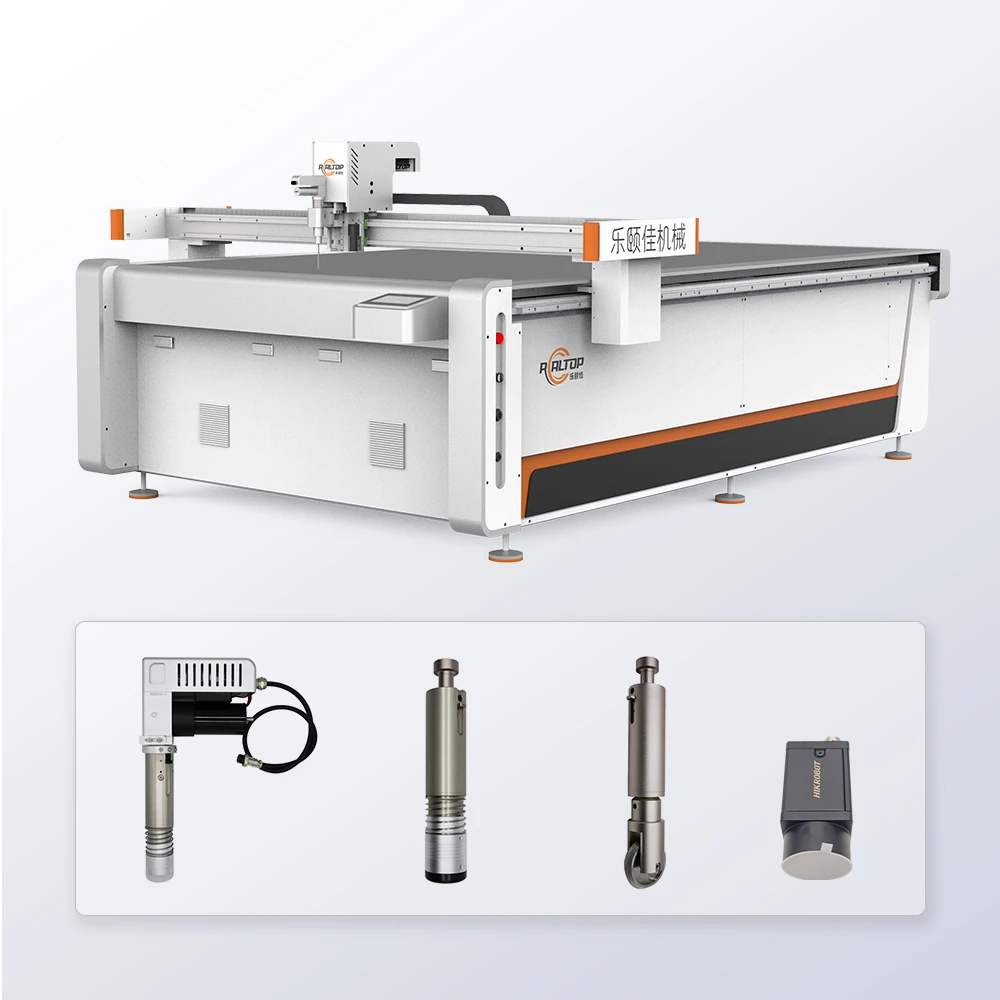
Production-first configuration — tool head, vacuum zoning and software workflow matched to the buyer’s specific nonwoven or woven fabric thickness before the RT-D2516/RT-S2516 is built, rather than quoting a generic table size.
Technical Specifications
| Parameter | Value |
|---|---|
| Model | RT-D2516 / RT-S2516 |
| Product Type | CNC Oscillating Knife Cutting Machine |
| Working Area | 1600×2500 mm |
| Overall Dimensions | 3450×2300×1250 mm |
| Rated Power | 9 kW |
| Voltage | 380V ±10% |
| Fixed Table Type | Flatbed working table |
| Tool Head | Swiss imported knife — vibration full cutting, vibration half cutting, cursor location |
| Safety Device | Infrared sensors |
| Translational Velocity | 800–1200 mm/s |
| Cutting Speed | 200–800 mm/s (basis to be confirmed with buyer material, thickness and layer count) |
| Repeated Accuracy | ≤0.1 mm |
| Transmission System | Digital servo motor, linear guide, synchronous belt, imported ball screw |
| Servo Motor | Japanese Yaskawa (Delta option available on request) |
| Guide Rail | Taiwan Hiwin linear square rail with gear rack drive |
| Vacuum Pump | 7.5 kW |
| Conveyor Belt | Germany imported |
| Cross Beam | Thickened and widened large beam design |
| Instruction System | HP-GL compatible format |
| Standards | CE |
Application Suitability
| Application | Material or Output |
|---|---|
| Garment production lines | Multi-layer woven and knitted fabric, denim with spandex blend, apparel panels |
| Nonwoven fabric processing | PP and PET nonwoven rolls for hygiene, medical and filtration products |
| Leather goods manufacturing | Natural and synthetic leather for footwear, bags and upholstery |
| Composite and foam fabrication | Sponge composite leather, PVC soft sheets, silicon and rubber gaskets |
| Packaging and sample making | Corrugated board samples and flexible packaging prototypes |
Why "Working Area Alone" Is the Wrong Starting Point for a Fabric Cutting Line
The table size tells you nothing about whether the machine will actually hold your material flat at production speed.
I have seen buyers choose a flatbed cutter purely because the working area matched their lay-up dimensions, only to discover that small pattern pieces lift off the table the moment the oscillating knife makes a direction change. The vacuum hold-down is not a single number — it depends on pump capacity, table zoning, belt permeability and the actual footprint of the smallest piece in the nest. A CNC oscillating knife cutting machine production line must be validated against the buyer’s real nesting layout, not a generic demonstration on a large rectangle [NEED_CITE: vacuum hold-down requirements for small-part fabric nesting].
When we configured a cutting line for a children’s jean manufacturer last year, the initial test ran on standard cotton denim and performed well. The customer’s actual production fabric was a knitted denim with elastane content, and the edge quality fell apart — frayed selvedge, pulled threads, dimensional drift across the ply. Two weeks of re-cutting followed before we re-selected the knife profile and adjusted the vacuum zones to match the stretch behavior of that specific blend.
Knife Head Selection Determines Edge Quality, Not Just Cutting Speed
The Swiss imported knife assembly on the RT-D2516/RT-S2516 supports vibration full cutting, vibration half cutting and cursor location. Full cutting severs the ply stack cleanly for garment panels, while half cutting scores the surface for fold lines on packaging samples without penetrating the bottom layer. Cursor positioning allows the operator to register a physical reference point when the printed registration marks on the fabric are damaged or inconsistent. The oscillation frequency and stroke length must be matched to the material — a stiff PVC sheet demands a different knife profile than a four-layer stack of knitted cotton-elastane blend. This is a decision point where a CNC oscillating knife cutting machine production line either succeeds or generates scrap from the first shift.
Vacuum Zoning and Belt Permeability for Small-Part Fabric Cutting
A 7.5 kW vacuum pump paired with a Germany-imported conveyor belt provides the baseline suction, but what matters on the shop floor is how that suction is distributed. The flatbed table is divided into zones, and the operator activates only the zones under the current cutting area so that suction concentrates where the knife is actually working. For nested garment patterns where the smallest piece may be a collar stay or belt loop measuring a few centimeters across, inadequate zoned suction allows the piece to shift mid-cut, ruining the ply alignment for the entire stack. The thickened cross beam and Hiwin linear square rails with gear rack drive keep the gantry stable during these rapid directional transitions [NEED_CITE: relationship between vacuum zoning density and small-part hold-down force].
Reading the Specs That Actually Affect Your Daily Output
The 200–800 mm/s cutting speed range is material-dependent — a single layer of nonwoven PP cuts at the upper end, while a multi-layer lay-up of dense sponge composite leather operates at the lower boundary. The translational velocity of 800–1200 mm/s governs how fast the head repositions between cut paths, which directly affects cycle time on nests with many small pieces. The Yaskawa servo motors driving the Hiwin rails deliver ≤0.1 mm repeatability, which matters when the nesting software has placed pattern pieces with minimal kerf allowance to maximize fabric yield. The 9 kW rated power covers the servo drives, controller and vacuum valve manifold; the vacuum pump draws its own 7.5 kW, so the total electrical supply must account for both circuits independently.
The Cost of Getting the Configuration Wrong
When the tool head is mismatched to the material, the symptoms appear immediately: ragged edges on woven fabric, crushed foam layers, delaminated composite sheets. These are not warranty claims — they are configuration errors that no amount of parameter tuning can correct after delivery. Buyers who skip the sample-cutting step on their actual production material often discover the problem only after the machine is installed, the operator is trained and the first real order is on the floor. The rework cost compounds quickly when a full lay-up of twenty or thirty plies must be scrapped because the knife profile was selected for a demonstration fabric rather than the buyer’s production blend [NEED_CITE: typical fabric scrap rates from incorrect tool head selection].
Why This Production Line Is Configured Before It Is Quoted
The in-house design team covers both knife and laser cutting technologies, so the cutting method is matched to the material rather than forcing every job onto one platform. Tool head and table configuration are specified per material type and daily production volume, not pulled from a standard catalog page. CCD camera positioning is available for printed contour work where registration marks must be tracked at production speed. Software compatibility is confirmed with the buyer’s existing nesting workflow before the order is placed. Sample cutting on the buyer’s own material — at the actual thickness and layer count — is completed before any commercial commitment.
Documentation & Verification
- Machine specification sheet listing confirmed tool head and vacuum table configuration for your material
- Electrical schematic with 380V ±10% baseline and plug type documented for your facility
- Sample cutting report on your actual nonwoven or woven fabric at specified ply count
- Factory test record with dimensional accuracy verification before crating
- HP-GL software licence and file format compatibility note matching your nesting system
- Spare parts list with Swiss knife and conveyor belt consumable lead times noted
Installation, Commissioning & Support
- Dedicated 380V circuit with capacity for 9 kW machine load plus 7.5 kW vacuum pump on independent breaker
- Flat concrete floor with level tolerance sufficient for the 3450×2300 mm machine footprint
- Full assembly verified at factory; machine ships with cross beam and gantry pre-aligned
- First-run parameter setting on your production material conducted during on-site commissioning
- Operator training covers zone activation, knife profile changes and HP-GL file import workflow
- Consumable spare knife blades and belt segments identified with reorder intervals
What We Need to Configure Your Line
Send us the actual fabric you will be cutting — type, weight, blend composition and the maximum ply count in your lay-up. Tell us your daily volume target and the nesting software you currently use so we can verify HP-GL file import. Confirm your facility voltage and frequency, and whether the control interface needs to be in a specific language for your operators.
Frequently Asked Questions
Q: How is the 200–800 mm/s cutting speed validated for my specific material?
A: The speed range is material-dependent. We run a sample cut on your actual fabric at your production ply count and thickness before quoting. The cutting report documents the speed achieved, edge quality and any knife profile adjustments made, so the figure in the quotation reflects your real material rather than a generic demonstration standard.
Q: Will the vacuum table hold small garment pieces down at full cutting speed?
A: The 7.5 kW pump with zoned activation concentrates suction under the active cutting area. During sample cutting we test your smallest nested piece at production speed to confirm hold-down. If zoning adjustments are needed, they are documented in the configuration list before the machine is built.
Q: How do you select the correct knife profile for my fabric blend?
A: We test multiple knife profiles on your actual material — woven, knitted, nonwoven or composite — during the sample-cutting stage. The selected profile, oscillation frequency and stroke setting are recorded in the sample cutting report and locked into the machine configuration before shipment.
Q: Can the system integrate with my existing nesting software?
A: The instruction system accepts HP-GL compatible format as baseline. Before the order is placed, we verify that your nesting software exports files the controller can import without manual re-drawing. Any required file conversion steps are documented in the software compatibility note.




商品评价
Clear filtersThere are no reviews yet.