




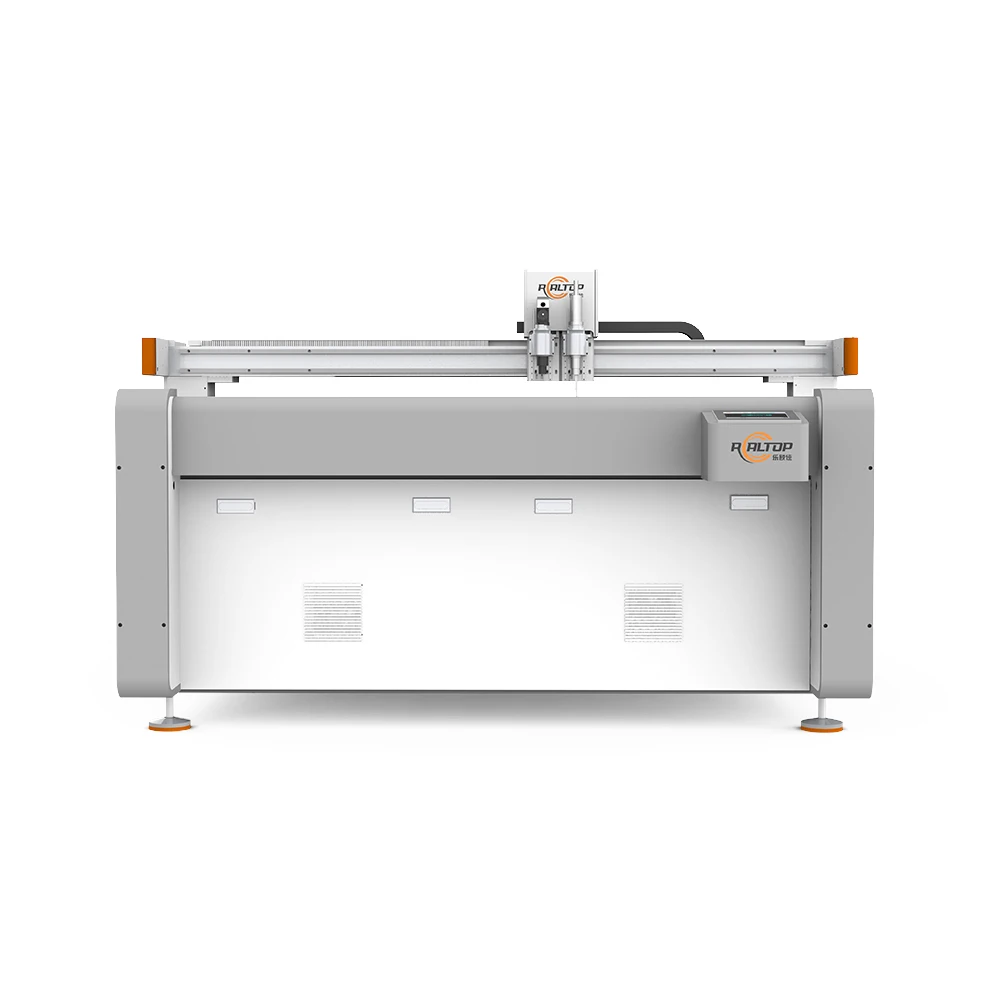
Zone-matched vacuum adsorption — the honeycomb aluminum table follows the active cutting area to hold small packaging blanks flat without manual taping or weighting.
Technical Specifications
| Parameter | Value |
|---|---|
| Model | RT-D2516/RT-S2516 |
| Product Type | CNC Oscillating Knife Cutting Machine for Packaging |
| Working Area | 1600 × 2500 mm |
| Machine Size | 3450 × 2300 × 1250 mm |
| Rated Power | 9 kW |
| Cutting Thickness | ≤ 100 mm (varies with material density and flute profile) |
| Translational Velocity | 800–1200 mm/s |
| Cutting Speed | 200–800 mm/s (varies with cutting material) |
| Repeated Accuracy | ≤ 0.1 mm |
| Transmission System | Digital servo motor, linear guide, synchronous belt, ball screw |
| Servo Motor | Taiwan Delta servo motors and drivers |
| Linear Guide | Taiwan Hiwin rail |
| Vacuum Platform | Aluminum alloy honeycomb structure with auto-follow zone adsorption |
| Vacuum Pump | 7.5 kW |
| Multifunctional Head | Vibration full cutting, vibration half cutting, cursor location |
| Safety Device | Infrared sensors |
| Instruction System | HP-GL compatible format |
| Voltage | 380 V ± 10 % |
| Control Language | English, Russian, Italian, Chinese (special languages configurable) |
| Conveyor Belt | Germany imported belt with auto feeding |
| Table Type | Flat working table |
| Standards | CE declaration where applicable |
Application Suitability
| Application | Material or Output |
|---|---|
| Carton sample making and short-run prototyping | Single-face and double-wall corrugated board, greyboard, folding carton stock |
| Large electrical appliance packaging | Heavy-duty BC-flute and triple-wall corrugated sheets |
| Express paper box and e-commerce mailer production | E-flute and F-flute micro-corrugated, kraft paper, honeycomb paperboard |
| Snack food and consumer goods packaging | Coated carton, ivory board, art paper laminates |
| High-end gift box sample cutting | Rigid box board, foam-core inserts, magnetic closure blanks |
| Printed signage and display cutting | Printed corrugated board, PVC foam board, honeycomb PP |
| Pattern sticker and label contour cutting | Vinyl, self-adhesive film, reflective sheeting |
Why Vacuum Zoning Matters More Than Table Size on a Packaging CNC Cutting Machine Production Line
A large working area does not hold a small carton blank in place — only zone-configured adsorption does.
I have walked into packaging workshops where the operator was taping down small corrugated blanks by hand because the vacuum table pulled air through zones far outside the cutting path. The pump was running full capacity, but suction at the actual cut area was weak. On a packaging CNC cutting machine production line, the board grade changes multiple times per shift, and small die-line shapes are the norm. A single-zone vacuum platform wastes suction on empty table surface, leaving lightweight fluted sheets lifting at the edges mid-cut. The honeycomb aluminum platform on the RT-D2516/RT-S2516 routes suction only to the active cutting zone, keeping the blank flat regardless of how small the part or how porous the flute [NEED_CITE: vacuum adsorption principles for porous sheet materials on CNC flatbed tables].
Matching the Knife Head to the Board Grade
Corrugated packaging spans a wide density range — from thin E-flute micro-corrugated used in consumer product boxes to heavy triple-wall board for industrial crate liners. The multifunctional head on this packaging CNC cutting machine production line combines vibration full cutting and vibration half cutting in a single cycle, so the same machine scores a fold line and then cuts the outer contour without a tool change. The oscillating action slices through fluted layers rather than crushing them, which preserves the compressive strength of the board at the cut edge. For rigid box board and foam-core inserts used in premium packaging, the same head handles the switch without reconfiguration.
CCD Contour Recognition for Printed Corrugated
When packaging carries printed graphics — shelf-ready displays, branded gift boxes, promotional stands — the cut path must follow the printed contour, not the theoretical die-line. The CCD camera system reads registration marks on the printed sheet and adjusts the cutting path in real time. On high-speed runs of micro-corrugated cartons, even a slight registration drift produces visible misalignment between print and cut edge. This packaging CNC cutting machine production line addresses that with camera-based tracking that compensates for sheet distortion introduced during printing or lamination [NEED_CITE: CCD contour tracking accuracy standards for printed packaging substrates].
Reading the Specification Sheet Against Your Actual Board
The rated cutting thickness of ≤ 100 mm covers a broad material range, but real cutting performance depends on the flute profile, liner weight, and moisture content of the board you actually run. A 3 mm E-flute sheet cuts very differently from a 12 mm BC-flute sheet, even though both fall within the stated range. The 7.5 kW vacuum pump generates the suction needed to hold dense, heavy board flat, but the operator must confirm that the selected knife amplitude and feed rate match the specific grade. Taiwan Delta servo motors and Hiwin linear guides deliver the repeated accuracy of ≤ 0.1 mm that keeps crease lines aligned with cut edges across long production runs, which matters when a fold line drifting by even a fraction of a millimeter causes the box to close unevenly.
When the Wrong Tool Head Ruins the Sample
A buyer once sent us a video of creased fold lines cracking on heavy kraft board. The machine they were evaluating used a drag knife for both cutting and scoring, which compresses the top liner instead of creating a clean fold channel. On short-run packaging samples, a cracked fold line means the prototype fails the client review and the entire sample batch is scrapped. Switching to the correct creasing wheel and vibration half-cut combination eliminates that failure mode, but only if the tool head is specified before the machine ships — retrofitting heads later adds downtime and cost [NEED_CITE: tool head selection guidelines for corrugated and rigid packaging board].
Why Source Packaging Cutting Equipment Here
In-house design covers both knife cutting and table configuration, so the vacuum zone layout and tool head combination are specified against your actual board grade and sample volume rather than offered as a generic package. Every machine leaves the Jinan factory with a sample cutting report run on the buyer’s own material, confirming edge quality, crease depth, and registration before the crate is sealed. Software compatibility is verified at the order stage — the HP-GL compatible instruction system and professional carton nesting software are tested against your existing CAD files so there are no import failures on day one. Voltage and control language are confirmed against your facility supply and operator preference before production begins. The design team adjusts working area and conveyor configuration when standard dimensions do not match your sheet size or floor layout.
Documentation & Verification
- Machine specification sheet listing confirmed tool head and vacuum zone layout for your board grade
- Electrical schematic with voltage and frequency matched to your facility supply
- Sample cutting report on your corrugated or cardboard material at production speed
- Software licence and file format compatibility note for your existing CAD workflow
- Factory test record documenting repeated accuracy and crease registration before dispatch
- Operation and maintenance manual in your selected control language
Installation, Commissioning & Support
- The 3450 × 2300 × 1250 mm machine footprint requires a level concrete floor with clearance for conveyor infeed and outfeed
- A dedicated 380 V ± 10 % circuit with appropriate breaker rating must be available before the 9 kW rated load is connected
- The 7.5 kW vacuum pump requires separate ducting and acoustic consideration in enclosed workshop environments
- First-run commissioning includes crease depth calibration on your actual board stock and servo tuning for repeated accuracy
- Operator training covers nesting software file import, zone vacuum control, and tool head changeover between cutting and creasing
- Spare parts list identifies oscillating knife blades, creasing wheels, and conveyor belt segments for routine replacement
Before You Request a Quote
Tell us the specific board grades you run — flute profile, liner weight, and whether the sheets are printed or plain. Share your typical sample dimensions and daily volume so we can match the vacuum zone layout and conveyor feed rate. Confirm your facility voltage, frequency, and preferred control language so the electrical and software configuration is locked before production starts.
Frequently Asked Questions
Q: How is cutting speed verified on corrugated board at different flute profiles and thicknesses?
A: We run sample cuts on your actual board at production speed, adjusting oscillating knife amplitude and feed rate to the flute profile. The cutting report documents edge quality, dust levels, and cycle time per sheet so you see realistic throughput before committing. Speed varies between 200 and 800 mm/s depending on material density.
Q: Which tool head combination handles both full cutting and creasing on the same packaging sample?
A: The multifunctional head combines vibration full cutting for outer contours and vibration half cutting for fold lines in one cycle. For rigid board, a dedicated creasing wheel is added. We specify the tool head combination against your board grade during the order stage so the machine arrives ready for your typical sample mix.
Q: How does vacuum table zoning prevent small carton parts from lifting during high-speed cutting?
A: The honeycomb aluminum platform activates suction only in the active cutting zone rather than across the entire table surface. This concentrates holding force under the blank, keeping small parts flat even at translational velocities up to 1200 mm/s. Zone configuration is matched to your typical blank size range before shipment.
Q: What file formats does the carton nesting software import from existing packaging design workflows?
A: The HP-GL compatible instruction system imports standard vector formats used in packaging CAD software. We verify compatibility with your specific design files during the order stage and document supported formats in the software licence note so there are no import failures at commissioning.
Q: Is CCD camera contour recognition available for printed corrugated board, and how is tracking accuracy confirmed?
A: The CCD camera reads registration marks on printed sheets and adjusts the cutting path to compensate for print-to-sheet distortion. Tracking accuracy is confirmed during the factory sample cutting test using your printed board, and the test record documents registration deviation across the production run before dispatch.



商品评价
Clear filtersThere are no reviews yet.