



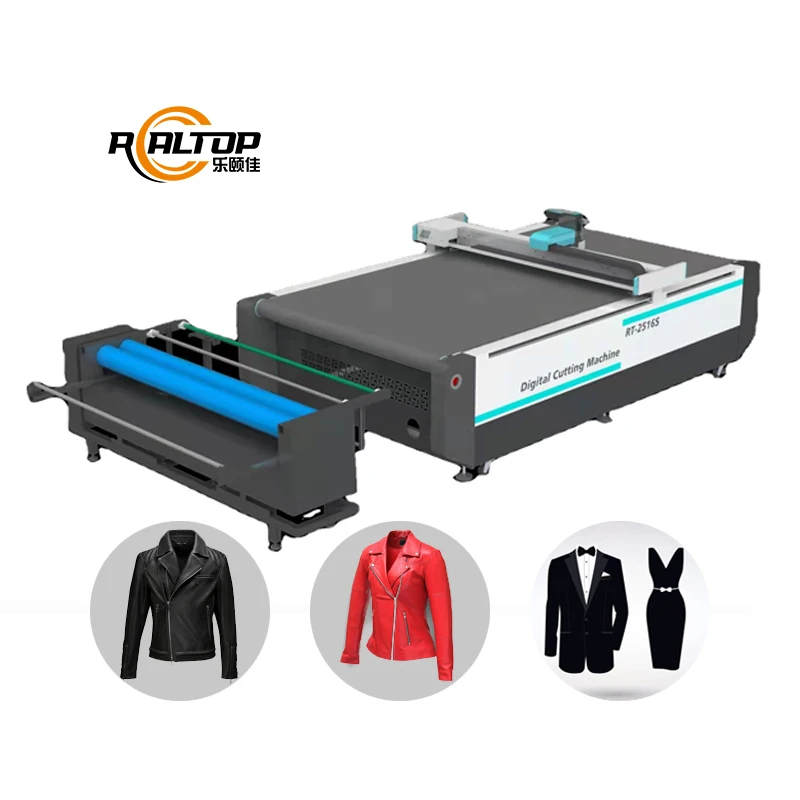
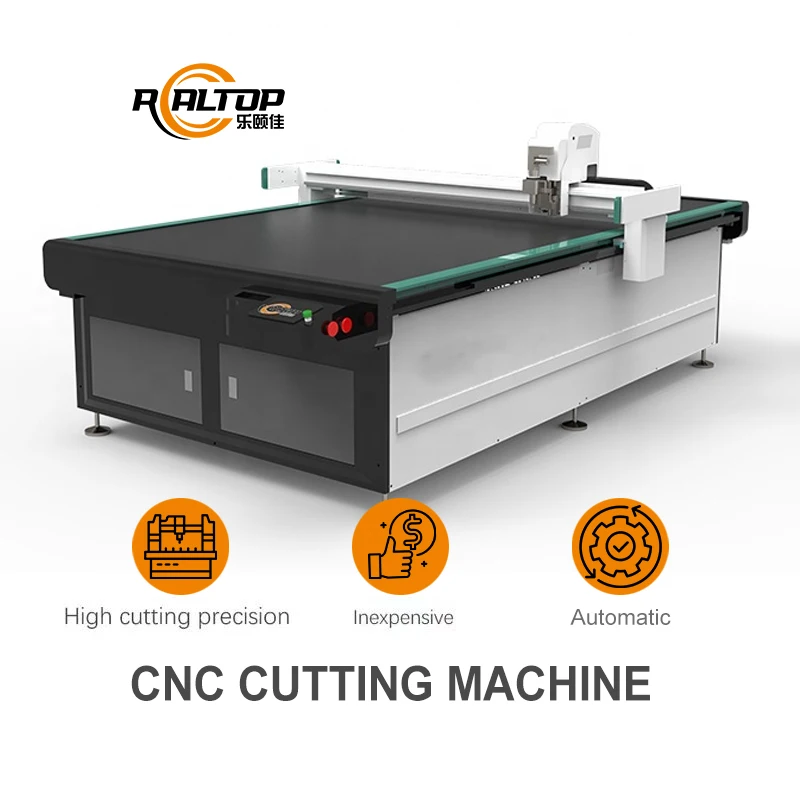
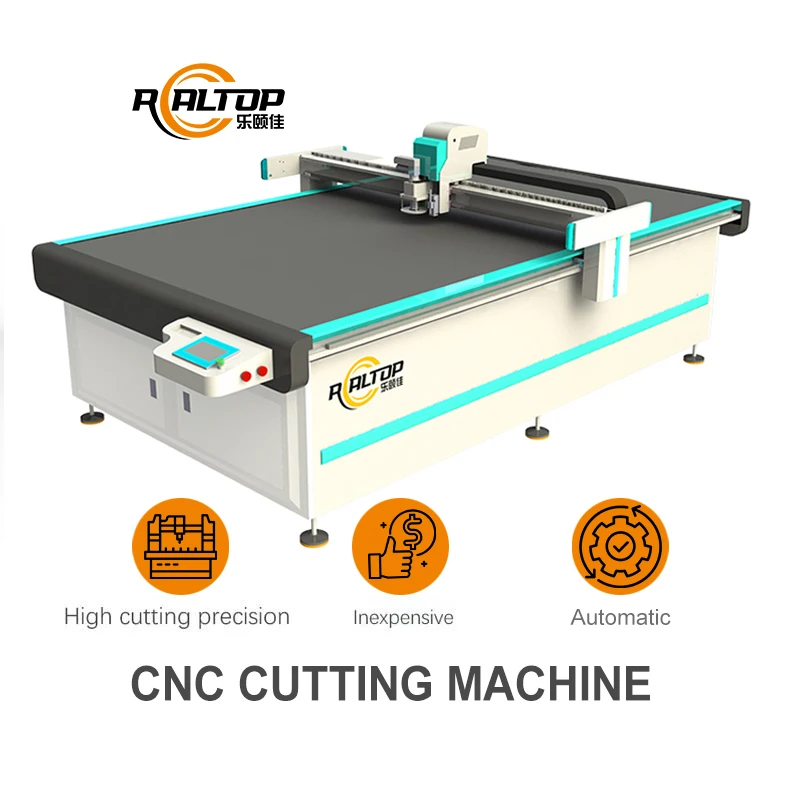
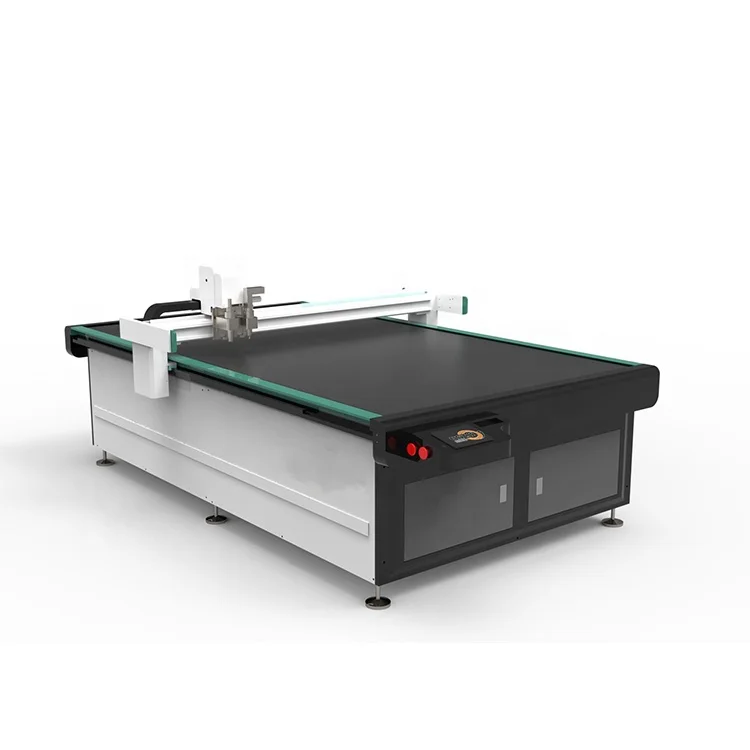
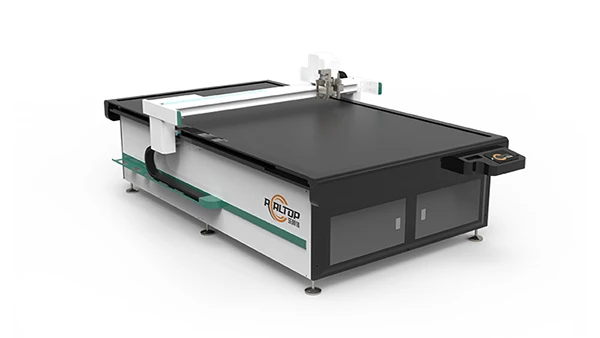
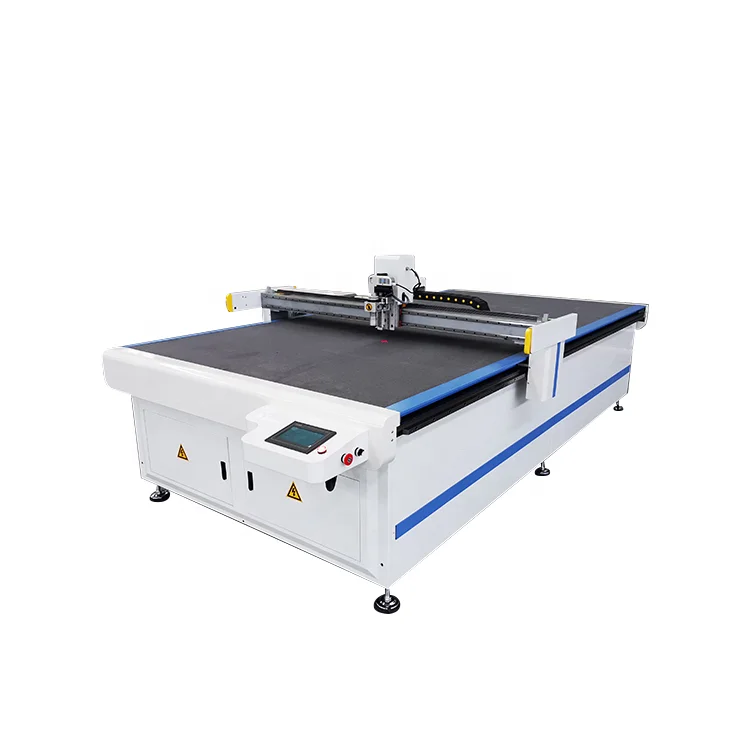

Production-matched cutting configuration — Every RT-D2516/RT-S2516 ships only after the buyer’s own fabric or composite has been sample-cut to confirm edge quality and depth.
Technical Specifications
| Parameter | Value |
|---|---|
| Product Type | CNC Flatbed Digital Cutting Machine |
| Model | RT-D2516/RT-S2516 |
| Working Area | 1600 × 2500 mm |
| Machine Dimensions (L×W×H) | 3450 × 2300 × 1250 mm |
| Rated Power | 9 kW |
| Voltage | 380V ±10% |
| Translational Velocity | 800–1200 mm/s |
| Cutting Thickness Range | 20–80 mm (basis to be confirmed by material test) |
| Repeated Accuracy | ≤0.1 mm |
| Fixed Model | Flatbed vacuum working table |
| Vacuum Pump | 7.5 kW, integrated aviation aluminum shell with built-in silencer |
| Vacuum Table Surface | Magnesium-aluminum alloy, PVDF powder sprayed, anodized |
| Transmission | Digital servo motor, linear guide, synchronous belt, imported ball screw |
| Servo Motor Option | Delta or Panasonic, IP67 waterproof |
| Multifunctional Head Tools | Oscillating knife, drag knife, circular knife, creasing wheel, V-cutting knife, punching, pen, and others |
| Visual Positioning Options | Small CCD mark point, panoramic camera, projection positioning |
| Instruction Format | HP-GL compatible |
| Language Options | English, Russian, Italian, Chinese, others customizable |
| Assembly State | Fully assembled |
Application Suitability
| Application | Material or Output |
|---|---|
| Garment and footwear production | Multi-layer woven fabric, knit, denim, technical textile |
| Automotive interior components | Leather, sponge composite leather, EVA floor mats |
| Luggage and bag manufacturing | PU, PVC, nylon, canvas, synthetic leather |
| Soft home furnishings | Curtain fabric, upholstery textile, foam-backed material |
| Sealing and gasket fabrication | Rubber, PTFE, silicone sheet, non-woven fiber |
| Packaging sample making | Corrugated board, cardstock, foam board |
Why Material Thickness Claims Cause Production-Line Failures
The cloth CNC cutting machine production line you invest in must match actual stack height and density, not just nominal working area. Cutting depth capacity changes drastically between a soft knit and a dense EVA foam of the same millimeter thickness.
A buyer once specified a flatbed cutter based on working area alone, assuming any material under a stated thickness would process cleanly. When their production team loaded high-density EVA instead of the softer PVC foam used during the demo, the oscillating knife stalled mid-pass, edges compressed rather than cut, and daily output dropped sharply. The root cause was never the machine’s travel speed or vacuum hold — it was a mismatch between tool head selection and material shear resistance. This is why sample cutting on the actual production material, at the intended layer count, must happen before the contract is signed [NEED_CITE: industrial cutting tool selection standards by material hardness].
How the Conveyor Feeds a Real Production Rhythm
The Germany-imported conveyor belt on this cloth CNC cutting machine production line enables continuous roll-to-sheet feeding, so operators load fabric at one end and cut parts exit the other without manual repositioning. This matters in garment and automotive interior shops where a single roll may contain hundreds of nested pattern pieces. The conveyor maintains tension and alignment, reducing the fabric shift that causes mis-cuts on deep piles.
Vacuum Zoning Decides Whether Small Parts Stay Flat
The 7.5 kW vacuum pump paired with the magnesium-aluminum alloy table provides strong hold-down across the cutting surface. But in practice, zoned suction is what keeps small pattern pieces — collar stays, gasket rings, shoe uppers — from lifting at high translational velocity. Without adequate zoning, even a powerful pump wastes suction on empty table area while the small part under the knife flutters, producing ragged edges or forcing the operator to slow down [NEED_CITE: vacuum table zoning principles for flatbed digital cutters].
Reading the Specs That Actually Matter on the Floor
The RT-D2516/RT-S2516 lists 800–1200 mm/s translational velocity, but that number describes head travel on empty moves, not cutting speed through material. Real throughput depends on how many layers the oscillating knife can penetrate cleanly in a single pass — a 4 mm knit may allow multi-layer stacking while a 20 mm sponge composite requires single-sheet processing. The repeated accuracy of ≤0.1 mm ensures that nested pieces cut from the same layout file match across production runs, which matters when downstream sewing or assembly depends on tight fit. Servo motor selection between Delta and Panasonic affects long-term positional drift in dusty textile environments, and the IP67 rating protects against fiber ingress. The HP-GL compatible instruction format means most existing nesting and CAD systems can export directly, but file format and nesting workflow should still be confirmed before order to avoid conversion errors.
The Cost of Skipping the Material Test
When a production manager orders based on a catalog thickness number alone, the consequences show up on the first production day. Ragged edges mean rejected parts. Crushed foam layers mean re-cuts and wasted material. A tool head chosen for soft fabric will deflect on dense composites, producing dimensional inaccuracy that propagates into downstream assembly. These problems compound — operators slow the machine to compensate, vacuum pressure is increased to hold shifting material, and the cloth CNC cutting machine production line runs far below its configured capacity [NEED_CITE: common causes of cutting quality loss in flatbed digital systems].
Why Production Managers Source From This Build
In-house design covers both knife and laser cutting methods, so the cutting process is matched to material behavior rather than forcing one technology across every application. The RT-D2516/RT-S2516’s tool head is specified per the buyer’s material stack — oscillating knife for thick composites, drag knife for thin vinyl, circular knife for continuous roll fabric. CCD camera positioning is available for printed contour work on branded textiles and automotive leather. Software compatibility is confirmed against the buyer’s existing nesting files before order. Voltage at 380V±10% is validated against facility supply, and control language is set before shipment. Sample cutting on the buyer’s own material is standard practice, not an optional extra.
Documentation & Verification
- Factory test record run on your specific fabric or composite before dispatch
- Tool head and table configuration list matched to your material and layer count
- Electrical schematic confirming 380V±10% wiring and servo motor brand
- Software licence and HP-GL file format compatibility note included
- Sample cutting report documenting edge quality and depth on your material
- Operation and maintenance manual in your selected control language
Installation, Commissioning & Support
- Verify floor can support the 3450 × 2300 mm footprint plus operator clearance zones
- Dedicated 9 kW circuit at 380V±10% required; confirm local frequency match before energizing
- Machine arrives fully assembled — requires leveling, vacuum hose connection, and servo calibration only
- First-run parameter tuning done on your material samples with tool head pressure and speed adjustment
- Operator training covers nesting import, tool change procedure, and vacuum zone mapping
- Spare oscillating knife blades, drag knife tips, and vacuum table seals included at delivery
What to Send With Your Inquiry
To configure the RT-D2516/RT-S2516 correctly, share your primary material type, typical sheet or roll dimensions, and the maximum stack thickness you plan to cut. Note your facility voltage and frequency, preferred control language, and whether your nesting workflow uses HP-GL or another format. If you run printed fabric requiring contour recognition, specify the mark type and print registration tolerance your downstream process demands.
Frequently Asked Questions
Q: What cutting thickness can the RT-D2516/RT-S2516 handle, and how does it vary by material type?
A: The unit processes materials in the 20–80 mm range, but actual single-pass depth depends on material density and shear resistance. A soft knit may stack multiple layers within that range, while dense EVA or sponge composite may require single-sheet passes. We confirm cutting depth on your specific material through a sample test before order.
Q: How does the auto-feeding conveyor integrate with my existing production workflow?
A: The Germany-imported conveyor belt enables roll-to-sheet feeding, so fabric loads continuously without manual repositioning between cuts. It integrates with upstream roll stands and downstream sorting tables. We confirm belt speed synchronization with your line’s takt time during configuration.
Q: Which tool head should I choose for my fabric, leather, or composite stack?
A: Oscillating knife handles thick composites and foam, drag knife suits thin vinyl and single-layer textile, and circular knife works for continuous roll fabric. The choice depends on your material’s shear resistance and the edge quality your downstream process requires. We select and test the tool head on your material before finalizing configuration.
Q: Can the machine software import my existing nesting files and HP-GL workflows?
A: The instruction system accepts HP-GL compatible format, which covers most major nesting software outputs. However, file conversion can introduce errors in complex nested layouts. We verify compatibility with your specific software and file format before order to ensure clean import without manual correction.
Q: What voltage, language, and control customizations are confirmed before shipment?
A: Standard voltage is 380V±10%, and we confirm this matches your facility supply before production. Control language options include English, Russian, Italian, Chinese, and others by request. Servo motor brand selection between Delta and Panasonic is also confirmed at order to match your maintenance preferences.



商品评价
Clear filtersThere are no reviews yet.