


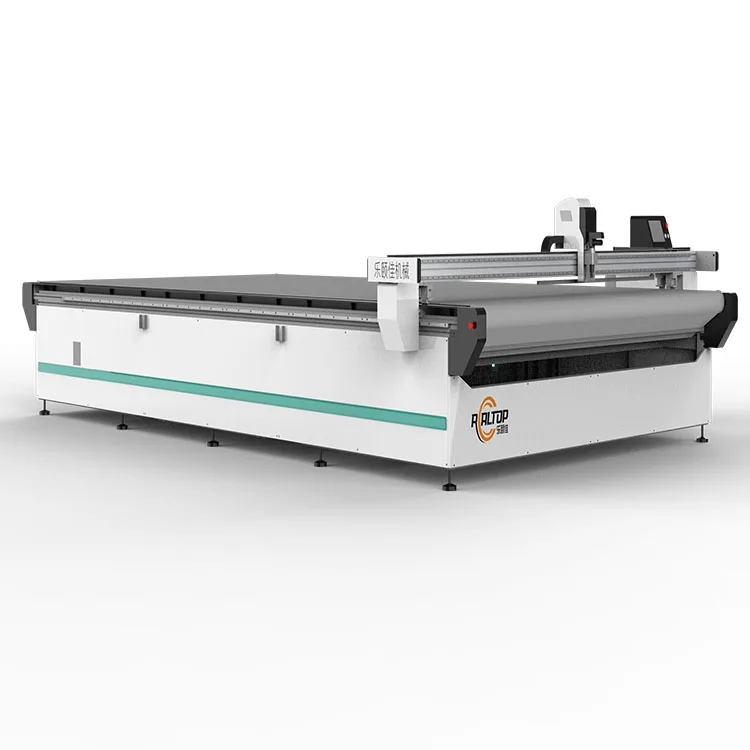
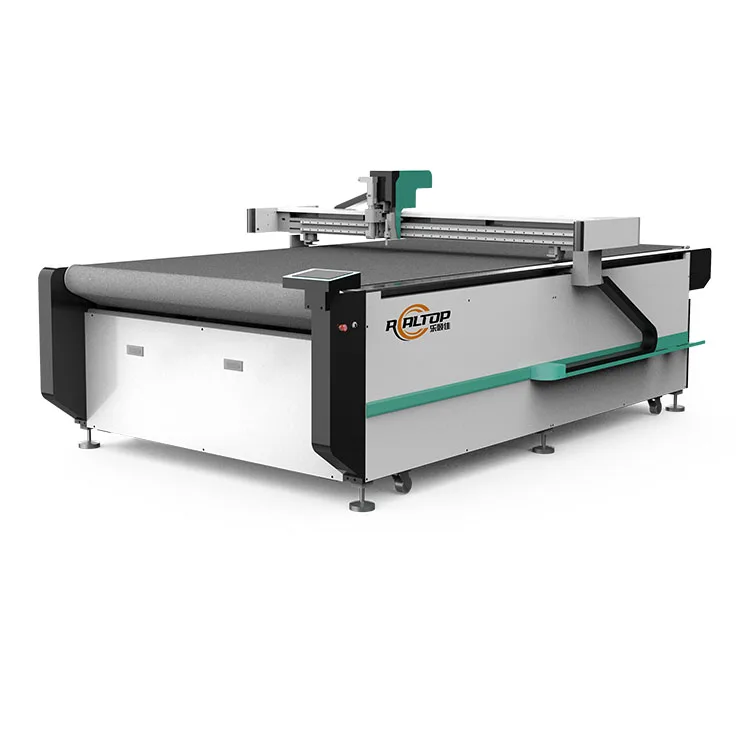
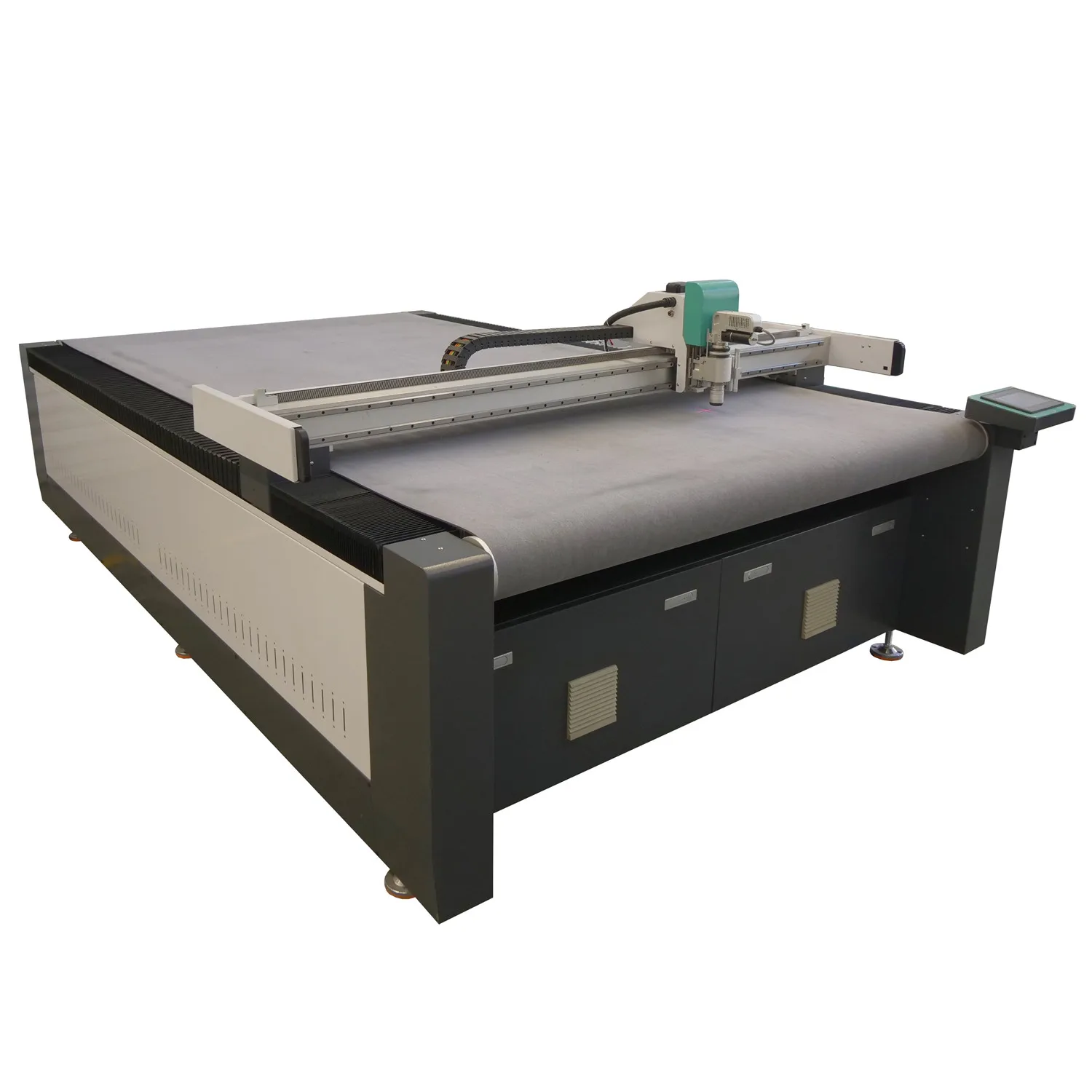
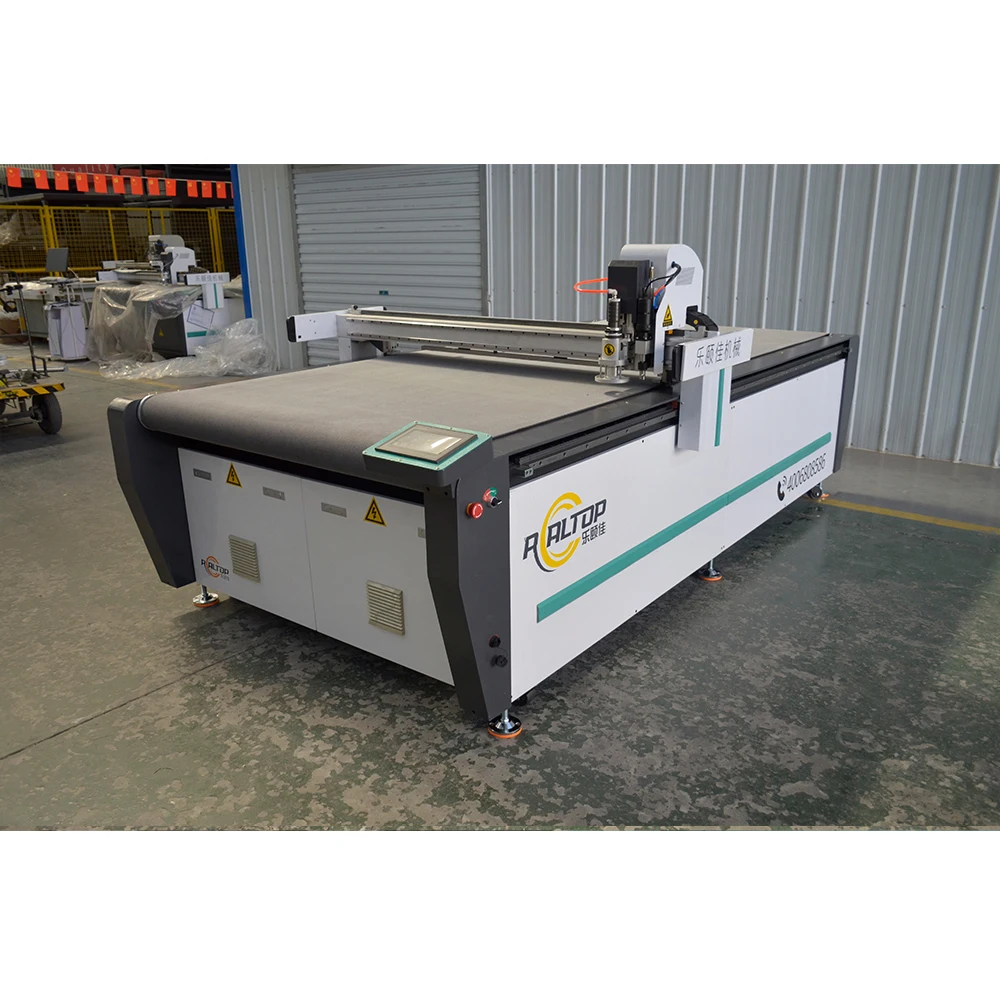

Production-proven cutting configurations — Every oscillating knife stroke and vacuum zone is matched to your specific fabric weight and layer count, verified on your own roll material before the order is confirmed.
Technical Specifications
| Parameter | Value |
|---|---|
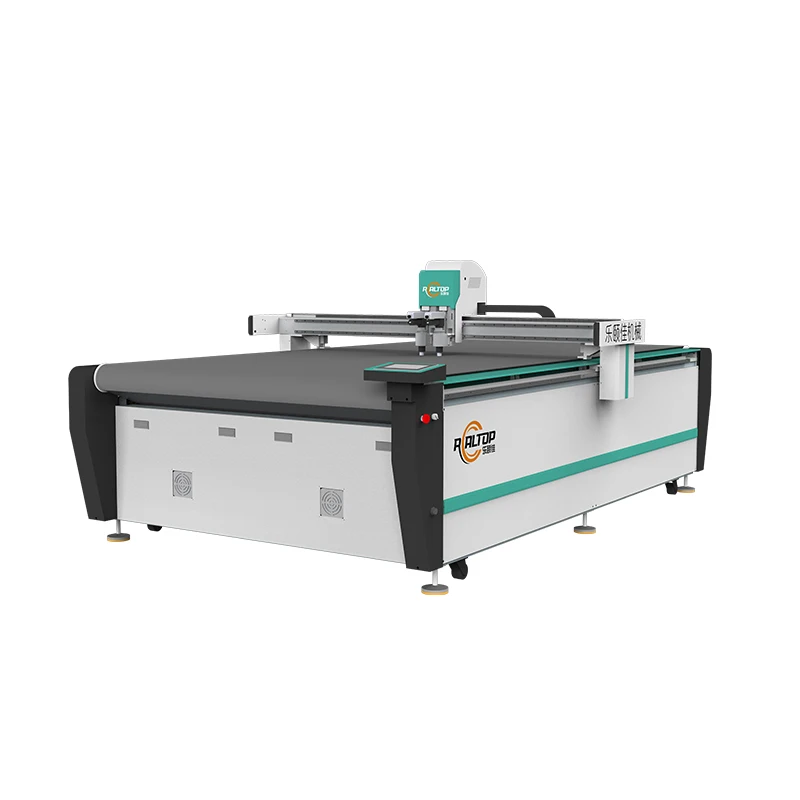
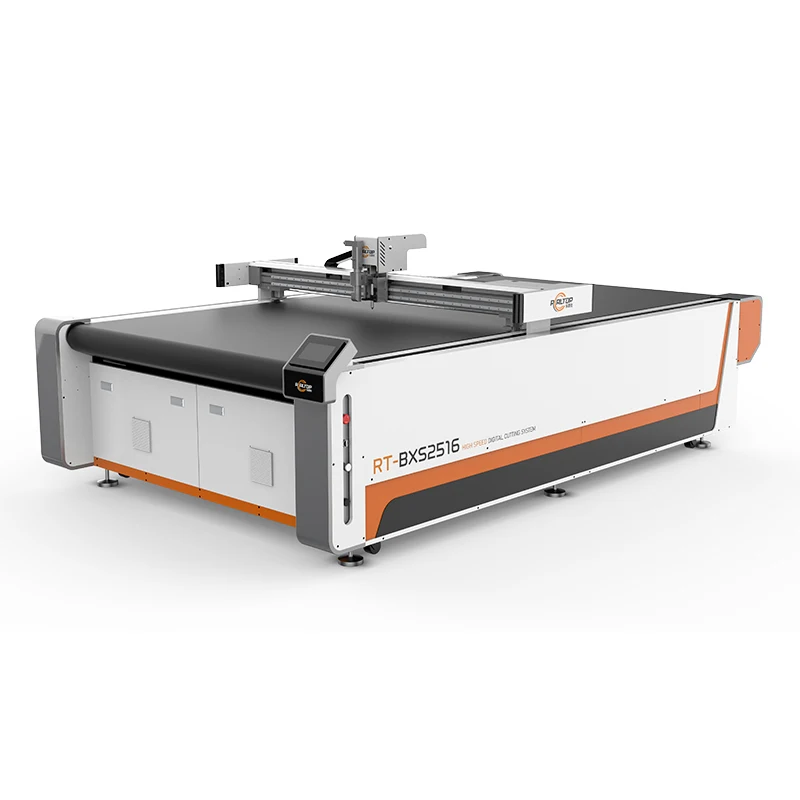
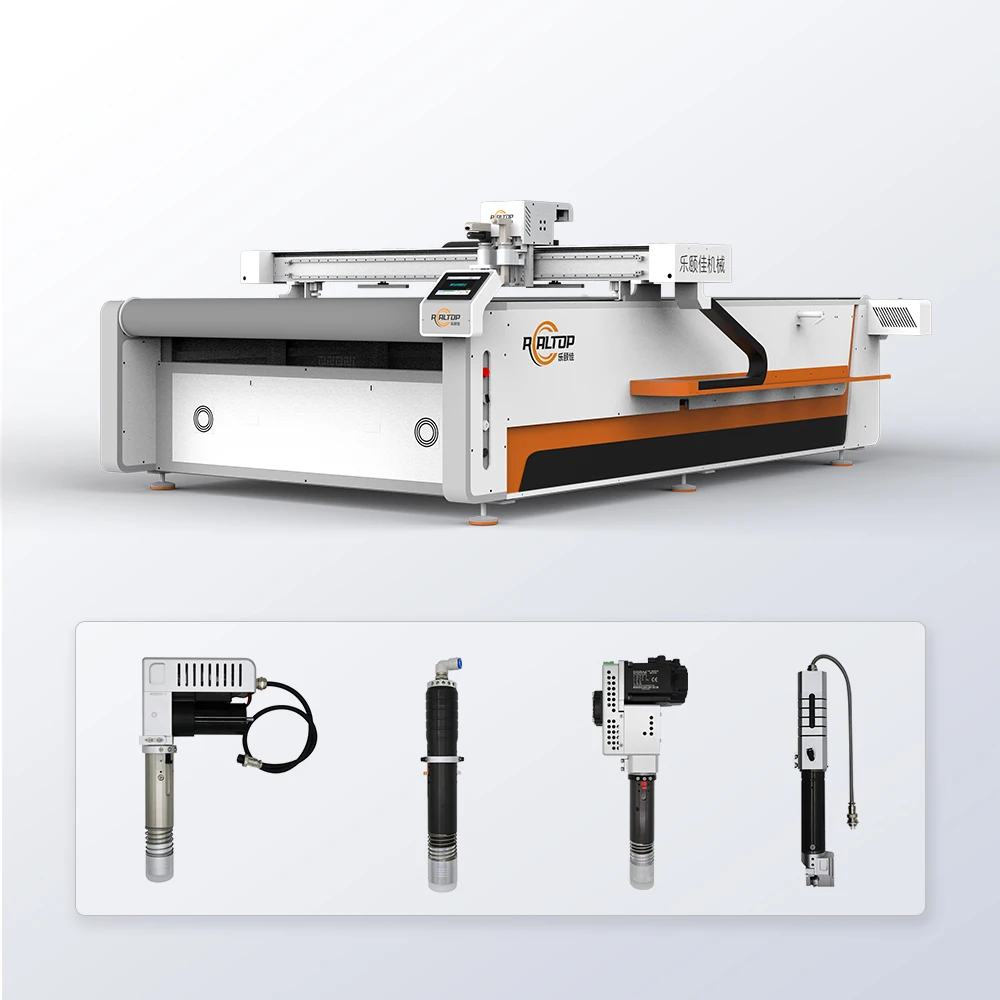
| Product Type | CNC Oscillating Knife Cutting Table |
| Working Area | 1600 × 2500 mm |
| Overall Dimensions | 3450 × 2300 × 1250 mm |
| Rated Power | 9 kW |
| Voltage | 380V ± 10% (3-phase, confirm local frequency) |
| Translational Velocity | 800 – 2000 mm/s |
| Cutting Speed | 200 – 800 mm/s (basis not stated in source — varies by fabric and layers) |
| Maximum Cutting Thickness | ≤ 100 mm (varies with material density) |
| Repeated Accuracy | ≤ 0.1 mm |
| Transmission System | Digital servo motor, linear guide, synchronous belt, ball screw |
| Servo Motor Options | Delta or Panasonic, IP67 protection |
| Vacuum Table Surface | Magnesium-aluminum alloy, PVDF powder coating, anodic oxidation |
| Vacuum Pump | 7.5 kW, integrated aluminum shell with built-in silencer sponge |
| Table Type Options | Flat working table or auto-feeding conveyor (Germany-imported belt) |
| Tool Head Options | Oscillating knife, pneumatic knife, high-power vibrating knife, circular knife, drag knife, creasing wheel, V-cutting knife, punching tool |
| Visual Positioning | CCD camera mark-point positioning, panoramic recognition, projection positioning |
| Instruction System | HP-GL compatible format |
| Supported File Formats | PLT, DXF, AI |
| Control Interface | Touch screen, multi-language (EN, RU, IT, ZH; others customizable) |
| Frame Construction | Thick-walled seamless steel, high-temperature tempering, CNC machined |
| Linear Rail | Taiwan Hiwin |
| Safety Devices | Infrared blocking, anti-collision sensor, emergency stop |
Application Suitability
| Application | Material or Output |
|---|---|
| Garment and footwear pattern cutting | Multi-layer woven fabric, knit textile, non-woven interlining stacks |
| Roller blind and curtain production | Blackout fabric, polyester screen, layered composite shading cloth |
| Automotive interior panels | Shaped carpet, headliner textile, synthetic suede, acoustic felt |
| Soft home furnishing | Upholstery fabric, heavy canvas, velvet, linen for sofa and cushion covers |
| Luggage and bag manufacturing | Nylon, Oxford cloth, PU-coated textile, ballistic fabric |
| Sports and outdoor gear | Neoprene, ripstop nylon, technical laminate panels |
Why Cutting Speed Claims Fail on the Factory Floor
Cutting speed is meaningless without the fabric type, layer count, and knife stroke stated alongside it.
I once configured an auto-feeding cutting line for a roller blind producer in Guangdong. The spec sheet promised 800 mm/s. When we ran their actual three-layer composite blackout cloth, the knife dragged, the edge frayed, and the middle delaminated. The machine was not wrong — the configuration was. We swapped to a high-power oscillating head with adjusted stroke frequency and the cuts came out clean, but at a different pace. A Cloth CNC Cutting Machine production line must be validated against your specific roll stock, not a generic brochure number [NEED_CITE: fabric cutting configuration variables by textile weight and weave].
Matching Knife Stroke to Fabric Density and Layer Count
Selecting the correct tool head is the single most consequential decision in a Cloth CNC Cutting Machine production line. Thin polyester for garments needs a high-frequency, short-stroke oscillating knife for clean edges. Heavy composite shading cloth demands a high-power vibrating knife with*nating. The available heads on this platform — oscillating, pneumatic, circular, drag, and V-cutting — are not interchangeable marketing options. Each corresponds to a measurable range of fabric GSM and stack height. Get this wrong and you either crush the foam backing or leave fibers hanging off every pattern piece.
Vacuum Zoning and Conveyor Tension for Continuous Rolls
A 7.5 kW vacuum pump behind a magnesium-aluminum table does more than hold material down. The PVDF-coated surface reduces friction so fabric slides during auto-feeding but locks flat the instant vacuum engages. For narrow pattern pieces like collar cuts or small gussets, zoned suction prevents edge lift at high translational speeds. The Germany-imported conveyor belt maintains consistent feed tension roll after roll, which matters when your nesting software has placed pieces within millimeters of each other to maximize yield [NEED_CITE: vacuum table zoning requirements for small textile pattern pieces].
Reading the Spec Sheet Against Your Actual Production Reality
The 1600 × 2500 mm working area accommodates standard garment marker widths, but the real question is whether your fabric roll width and lay height match the cutting envelope and the ≤ 100 mm thickness capacity. The repeated accuracy of ≤ 0.1 mm, driven by Taiwan Hiwin linear rails and ball screws, holds pattern piece tolerances tight enough for downstream sewing operations. However, accuracy degrades if the frame is not properly leveled during installation — the thick-walled seamless steel structure with high-temperature tempering provides the mass to resist vibration, but only when the foundation is solid. The digital servo system (Delta or Panasonic, IP67 rated) handles the acceleration and deceleration cycles that a cloth-cutting workflow demands without losing step on directional changes.
The Hidden Cost of Skipping Sample Validation
I have seen producers commit to a full cutting line based on a single-layer sample cut, only to discover during mass production that their actual three-ply layup behaves completely differently under the knife. The edge on a single layer of woven cotton tells you nothing about how that same knife will handle five layers of bonded blackout textile. Without a documented sample cutting report on your production material, you are guessing at tool head selection, vacuum pressure, and feed rate. That guess gets expensive when an entire roll is scrapped [NEED_CITE: material sampling protocols before industrial equipment procurement].
Why This Configuration Approach Works
In-house design covers both knife cutting and vacuum engineering, so the tool head and table are specified together rather than sourced separately and forced to work as a system. Every configuration is documented in a tool head and table list matched to your fabric. CCD camera positioning is available for printed contour work where pattern alignment matters. Software file compatibility — PLT, DXF, AI — is confirmed before the order, not discovered during commissioning. Voltage, plug type, and control language are locked in writing before shipment, which eliminates the most common installation-day surprises.
Documentation & Verification
- Machine specification sheet with your confirmed tool head and vacuum zone layout
- Electrical schematic reflecting your local voltage and frequency requirements
- Sample cutting report executed on your supplied fabric roll with edge quality photos
- Software license and file format compatibility confirmation before dispatch
- Factory test record documenting cutting accuracy across your specified pattern set
Installation, Commissioning & Support
- 380V three-phase dedicated circuit with stable supply confirmed before the 9 kW system powers up
- Level foundation required for the 3450 × 2300 mm footprint to maintain ≤ 0.1 mm repeated accuracy
- Auto-feeding conveyor belt tension calibrated on-site to match your specific roll diameter and weight
- Touch screen language set to your operator team’s preference during commissioning
- Spare blade and knife holder kit supplied based on your daily cutting volume
- Vacuum pump silencer sponge inspected and maintenance interval documented at handover
Before You Request a Quote
Send us your production fabric — the exact roll material, including any composite layers or coatings. Tell us the maximum lay height you run, your daily piece count, and whether you need flat-table batch cutting or continuous auto-feeding. Confirm your workshop voltage and the control language your operators need. If you have existing nesting software, share a sample file so we verify format compatibility before anything is built.
Frequently Asked Questions
Q: How do I choose between oscillating knife and high-power vibrating knife for my fabric?
A: It depends on fabric weight and layer count. Lightweight woven textiles up to a few layers suit a standard oscillating knife with high frequency and short stroke. Heavier composite materials like layered blackout cloth or bonded foam require a high-power vibrating head with longer stroke to penetrate without fraying. We test both on your sample before confirming the configuration.
Q: Can the auto-feeding conveyor integrate with my existing roll loader?
A: The conveyor system accepts standard roll loading from the upstream side. What matters is matching belt tension to your roll diameter and fabric weight so the material feeds without stretching or skewing. Share your roll specifications and we confirm compatibility during the configuration stage.
Q: Should I choose flat table or auto-feeding conveyor for my production volume?
A: Flat tables suit batch cutting with manual lay-up, common in sample rooms or lower-volume workshops. Auto-feeding conveyors serve continuous roll-to-cut workflows where daily piece counts demand uninterrupted operation. The decision rests on your shift pattern and lay-up method, not just output targets.
Q: Can I send my fabric for sample cutting before placing an order?
A: Yes. Ship us your actual production roll material, including any bonded or coated layers. We run it through the configured tool head at production speed, document edge quality, layer separation, and dimensional accuracy, and send you the report with photos before you commit.
Q: What is the blade replacement cycle for continuous production?
A: Blade life depends entirely on your fabric abrasiveness and daily cutting hours. Coated textiles and fiberglass-containing composites wear blades faster than plain weaves. We calculate an estimated replacement interval from your sample test and include a spare blade kit sized for your first production period.



商品评价
Clear filtersThere are no reviews yet.