





Production-Proven Fabric Cutting — Every cloth CNC cutting machine production line we ship is validated on the buyer’s own material roll at actual layer count before the crate is sealed.
Technical Specifications
| Parameter | Value |
|---|---|
| Model | RT-D2516/RT-S2516 |
| Product Type | CNC Oscillating Knife Cutting Machine |
| Working Area | 1600 × 2500 mm |
| Machine Size (L × W × H) | 3450 × 2300 × 1250 mm |
| Rated Power | 9 kW |
| Voltage | 380V ± 10% |
| Translational Velocity | 800 – 2000 mm/s |
| Cutting Speed | 200 – 800 mm/s (basis: depends on material) |
| Cutting Thickness | Up to 100 mm (basis: varies with material density and tool head) |
| Repeated Accuracy | ≤ 0.1 mm |
| Tool Head Options | Swiss imported vibrating knife (full/half cutting), oscillating knife, pneumatic knife, high-power vibrating knife, circular knife, drag knife, creasing wheel, punching, dotted line knife |
| Fixed Model | Flat working table / Auto feeding table |
| Transmission System | Digital servo motor, linear guide, synchronous belt, ball screw |
| Servo Motor | Delta (China) or Panasonic (Japan) optional |
| Vacuum Pump | 7.5 kW |
| Vacuum Table Material | Magnesium-aluminum alloy, PVDF powder sprayed, anodic and hard oxidation treated |
| Safety Device | Infrared sensors, anti-collision beam sensors, emergency stop |
| Visual Positioning | Small CCD camera mark point, panoramic camera recognition, projection positioning |
| Software File Formats | PLT, DXF, AI |
| Conveyor Belt | Germany imported |
| Linear Guide | Taiwan Hiwin rail |
| Control Panel | Touch screen, multi-language supported (English, Russian, Italian, Chinese; others customizable) |
Application Suitability
| Application | Material or Output |
|---|---|
| Table cloth and soft furnishing production | Non-woven fabric, spunbond PP, multi-layer textile rolls |
| Garment batch cutting | Woven cotton, polyester blends, denim, multi-layer fabric stacks |
| Footwear and luggage manufacturing | PU leather, sponge composite leather, shoe lining material |
| Automotive interior panels | Fabric, PU, EVA, composite upholstery panels |
| Carpet and floor mat production | Carpet backing, rubber, EVA foam sheets |
| Gasket and sealing pad fabrication | PTFE, ETFE, silicone, rubber, composite gasket material |
What "Cutting Thickness Up to 100 mm" Actually Means on the Shop Floor
The number on the spec sheet is the ceiling for soft foam — dense non-woven stacks behave completely differently.
I watched a buyer send us a sample of three-layer non-woven table cloth that cut clean at our factory, then run a five-layer stack of a heavier GSM grade on the same cloth CNC cutting machine production line and get ragged edges across every curve. The issue was not the machine but the gap between what the sample proved and what the production floor demanded. Cutting thickness depends on material density, layer count, and which tool head is doing the work — [NEED_CITE: oscillating knife cutting mechanics for layered textiles]. When a supplier quotes a thickness figure without specifying the material grade and layer stacking condition, that figure is only a starting point for your own verification.
Auto-Feeding Conveyor and Continuous Roll Handling
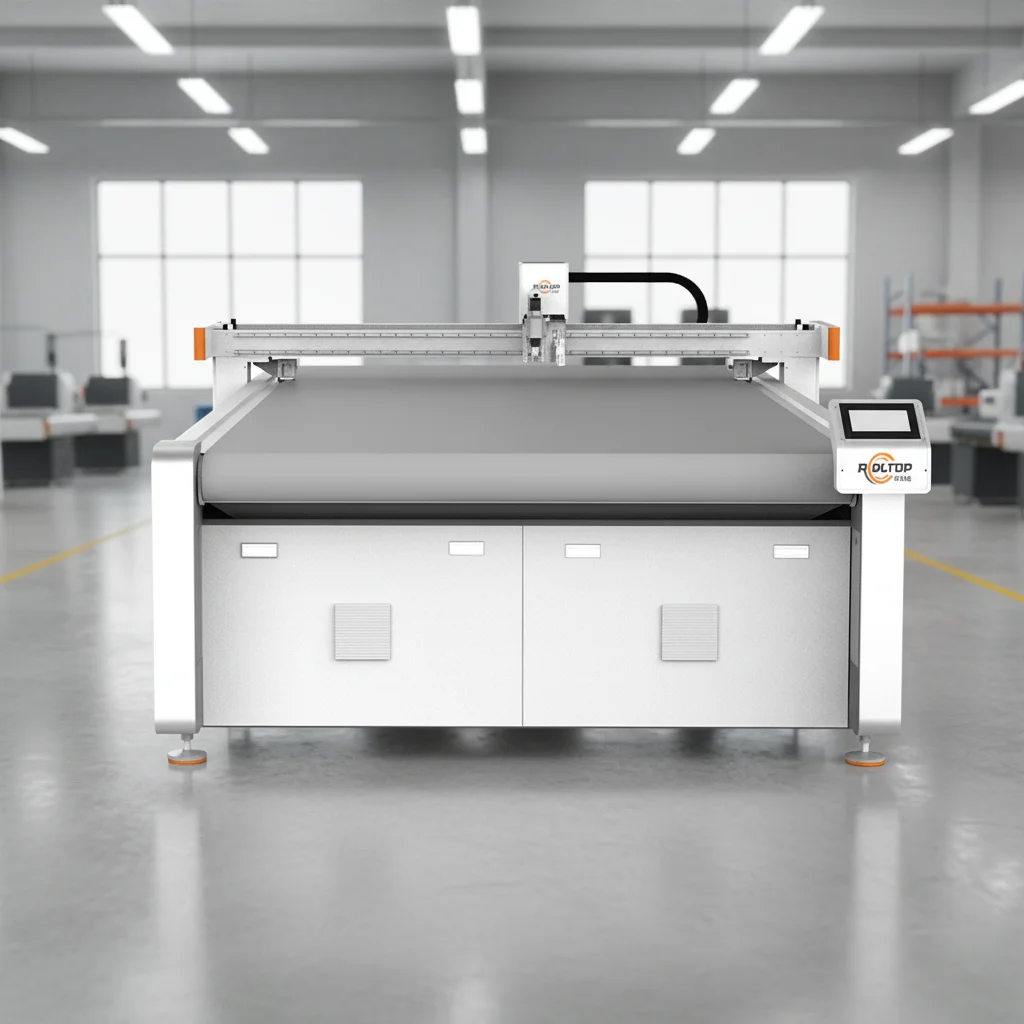
The auto-feeding table variant uses a Germany-imported conveyor belt paired with the 1600 × 2500 mm working area to pull fabric directly from a roll, advance it after each cutting cycle, and keep production running without manual sheet loading. This matters in a cloth CNC cutting machine production line where operators would otherwise spend significant time aligning and smoothing each fabric layer between cuts. The vacuum table underneath holds porous non-woven material flat during the advance so the CCD camera can read printed marks accurately at the next position.
Tool Head Selection Based on Material Behavior
Different fabrics demand different cutting actions. The Swiss imported vibrating knife handles full and half cuts on thin woven and non-woven layers with clean edge release. The high-power oscillating knife pushes through denser composite leather or thick sponge stacks where a standard blade would deflect. The circular knife is suited for long straight cuts on single-layer textile, and the drag knife scores crease lines on packaging samples run alongside cloth work. Selecting the wrong head for a given material stack produces crushed foam cores or frayed textile edges that the garment or automotive interior buyer will reject [NEED_CITE: tool head selection for flexible material cutting].
Reading the Specs That Matter in Production
The 7.5 kW vacuum pump driving a magnesium-aluminum alloy table with zoned adsorption is the reason thin non-woven fabric stays put when the oscillating knife changes direction at 800 mm/s translational velocity. A weaker pump or a single-zone table lets lightweight fabric lift at the cut boundary, causing the knife to drag and produce a jagged edge. The Taiwan Hiwin linear guide and ball screw transmission keep repeated accuracy within 0.1 mm, which is the tolerance required when nesting software packs pattern pieces tightly to minimize fabric waste. The Delta or Panasonic servo motor choice affects how smoothly the head decelerates at tight corners — a factor visible on curved garment pieces where micro-stutters leave small nicks in the cut line.
The Real Cost of Skipping the Material Test
When a buyer confirms a machine based on working area and price without sending their actual production roll for a test cut, three failures typically surface during commissioning. The vacuum zoning may not hold their specific fabric weight, causing small pattern pieces to shift mid-cut. The chosen tool head may handle the sample thickness but stall on the real production stack. The nesting software file import may not translate curve geometry from their existing PLT or DXF templates cleanly, requiring manual path correction on every job [NEED_CITE: CNC file format compatibility in textile cutting workflows]. Each of these problems is solvable before the machine ships — but only if the actual material is on the factory floor during the build.
Why Buyers Run the Test Here Before Shipment
Every cloth CNC cutting machine production line we configure goes through a documented sample cutting run on the buyer’s own roll or stack before crating. The tool head and vacuum zone configuration is matched to the material type and recorded in the build file so the machine arrives ready for that specific job rather than requiring on-site guessing. The CCD camera and panoramic positioning system is calibrated to the buyer’s printed marks, not a generic test pattern. Voltage, plug type, and control panel language are confirmed against the destination market’s electrical standards and operator needs before assembly begins. Software file format compatibility is verified with the buyer’s actual PLT, DXF, or AI files to confirm nesting workflows transfer without geometry loss.
Documentation & Verification
- Factory test record showing cut quality on your fabric roll at confirmed layer count
- Tool head and vacuum zone configuration list matched to your material specification
- Electrical schematic with voltage, plug type, and frequency confirmed for destination market
- Software licence and file format compatibility note covering PLT, DXF, AI import testing
- Operation and maintenance manual in confirmed operator language
- Spare parts list with consumable knife blades and belt replacement intervals
Installation, Commissioning & Support
- 3450 × 2300 mm footprint requires a level concrete floor with clearance for roll loading at the feed end
- 9 kW rated power plus 7.5 kW vacuum pump need dedicated 380V circuits with confirmed frequency
- Machine ships fully assembled; placement requires overhead crane access at the installation bay
- First run includes vacuum zone calibration and CCD mark recognition setup on your printed fabric
- Touch screen training covers nesting software operation in the confirmed language setting
- Consumable knife blades and Germany-imported conveyor belt tracked in spare parts schedule
Before You Request a Quote
Tell us the fabric type, GSM weight, and whether you cut single-layer or multi-layer stacks so we can specify the tool head and vacuum configuration. Confirm your local voltage, frequency, and the control language your operators need on the touch screen. Let us know if your existing workflow uses PLT, DXF, or AI files so we can run a format compatibility check before the quotation is finalized.
Frequently Asked Questions
Q: How do I confirm the machine can handle my multi-layer fabric stack at full production thickness?
A: Send us a roll or sheet sample of the actual material at the layer count and GSM weight you run in production. We mount it on the table, configure the tool head and vacuum zoning to match, and produce a sample cutting report documenting edge quality, cutting speed achieved, and any limitations observed before you commit to the order.
Q: Which tool head should I choose for my specific fabric type?
A: Thin woven and non-woven fabrics typically run on the Swiss imported vibrating knife for clean edge release. Dense composite leather and thick sponge stacks require the high-power oscillating knife to prevent blade deflection. We confirm the selection during the sample cutting test on your material, and multiple heads can be specified if you process different materials on the same machine.
Q: Can the voltage, plug, and control language be customized for my market?
A: Yes. The machine supports 380V ± 10% with frequency and plug type confirmed before assembly. The touch screen control panel ships in English, Russian, Italian, or Chinese as standard, with special languages customizable. All electrical specifications are documented in the schematic you receive before shipment.
Q: Will my existing nesting files import correctly into the machine software?
A: The system accepts PLT, DXF, and AI formats. Before the order, we ask you to send a sample nesting file so we can verify that curve geometry, mark points, and layer assignments transfer without manual correction. Any compatibility notes are documented in the software file format compatibility report included with shipment.
Q: How does the auto-feeding conveyor integrate with upstream roll handling and downstream sorting?
A: The auto-feeding table pulls fabric from the roll across the 1600 × 2500 mm working area using the Germany-imported conveyor belt, advancing after each cutting cycle. Upstream roll cradles and downstream sorting tables are configurable based on your production layout. We discuss integration requirements during the quotation stage to match your existing line workflow.



商品评价
Clear filtersThere are no reviews yet.