




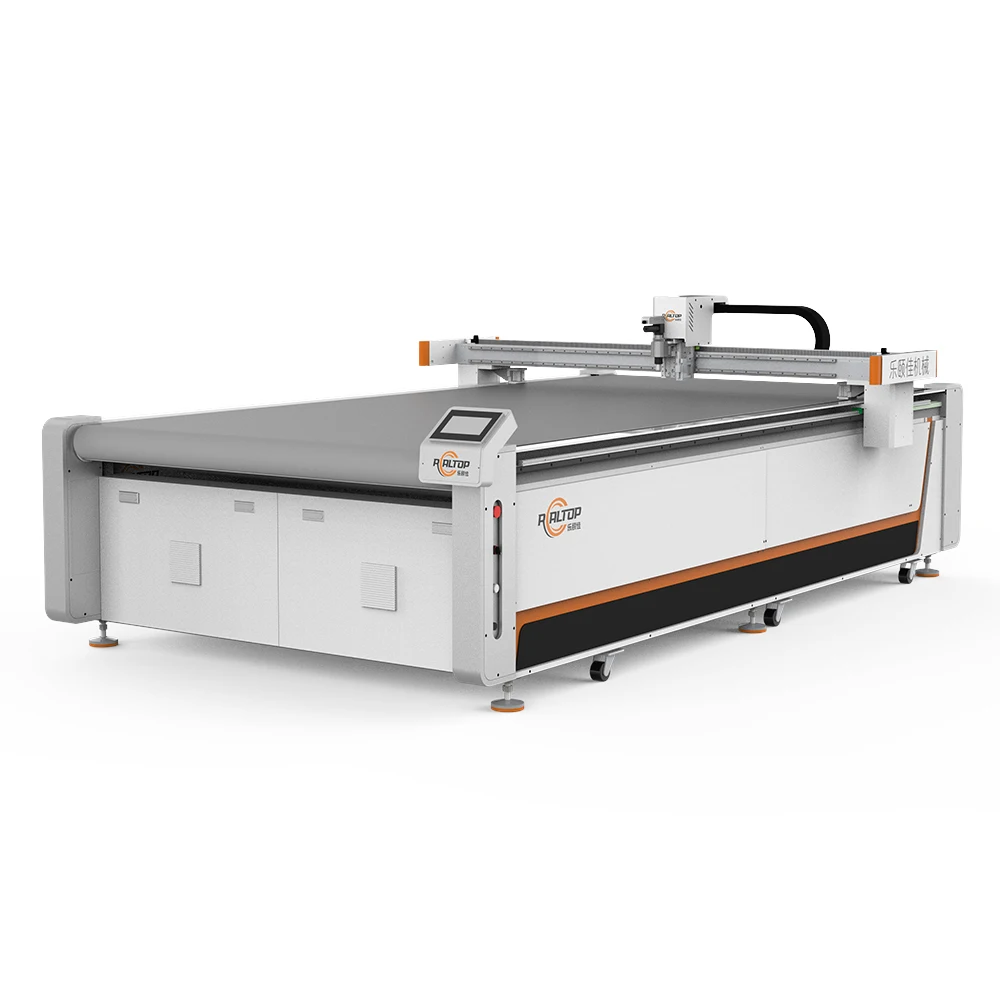
Precision vacuum zoning — the table is segmented to match the buyer’s actual part mix, preventing small carton samples from lifting during high-speed oscillating knife cuts.
Technical Specifications
| Parameter | Value |
|---|---|
| Product Type | CNC Oscillating Knife Cardboard Cutting Machine |
| Model | RT-D2516 / RT-S2516 |
| Working Area | 1600 × 2500 mm |
| Machine Dimensions | 3450 × 2300 × 1250 mm |
| Rated Power | 9 kW |
| Cutting Speed | 800 – 1200 mm/s (basis not stated in source — confirm material and thickness) |
| Cutting Thickness | Up to 100 mm (varies with material density and flute type) |
| Repeatability | ≤ 0.1 mm |
| Tool Head | Swiss-imported oscillating knife (full-cut, half-cut, cursor location) |
| Transmission | Delta servo motor, linear guide, synchronous belt, ball screw |
| Guide Rail | Taiwan Hiwin linear rail |
| Vacuum Pump | 7.5 kW |
| Vacuum Table | Aluminum alloy honeycomb structure with auto-following zone adsorption |
| Feeding System | Germany-imported auto-feeding conveyor belt |
| Safety | Infrared sensors, emergency stop |
| Instruction Format | HP-GL compatible |
| Voltage | 380 V ±10% (frequency to be confirmed for target market) |
| Software | Professional carton nesting, multi-format import, multi-language UI |
| Frame | Welded thick square seamless steel with high-temperature stress relief |
Application Suitability
| Application | Material or Output |
|---|---|
| Packaging sample making | Corrugated board, greyboard, honeycomb cardboard across multiple flute profiles |
| Carton prototyping and short-run production | Single-face, double-wall, and E-flute corrugated stock |
| Printed sticker and label contour cutting | Vinyl, adhesive-backed paper, and synthetic label stock with printed registration marks |
| Signage and point-of-sale displays | Corrugated plastic board, foam board, printed display-grade corrugated |
| Premium gift box production | Thick greyboard and chipboard requiring clean crease-and-cut |
| Business cards, tags, and inserts | Lightweight cardstock and coated board |
Why Vacuum Zoning Decides Whether Small Carton Blanks Stay Flat
A machine rated on working area alone often fails when the vacuum zones are too coarse to hold small carton samples during oscillating knife passes.
When a packaging sample maker cuts a mix of full-size carton blanks and small tags from the same corrugated sheet, the vacuum table must generate sufficient hold-down force across every zone where material sits. If zones span large areas and the part is small, air bleeds through uncovered regions, the pump loses effective suction, and the cardboard lifts at the knife entry point. The result is a ragged edge or a misaligned crease line — exactly the failure mode that sends a sample back for re-cutting. A CNC Cardboard Cutting Machine manufacturer must configure the honeycomb table zones to the actual part dimensions the buyer produces, not just the maximum sheet size. [NEED_CITE: vacuum hold-down requirements for flatbed digital cutting tables]
Aluminum Honeycomb Table with Auto-Following Zone Adsorption
The aluminum honeycomb vacuum table on this CNC Cardboard Cutting Machine uses auto-following zone adsorption, meaning only the zones directly beneath the material draw suction. This design concentrates the 7.5 kW pump’s capacity where it matters, holding small business card blanks and large carton panels with equal stability. The honeycomb structure keeps the table surface flat under repeated vacuum cycles, which is essential for maintaining the stated ≤ 0.1 mm repeatability across the full 1600 × 2500 mm work area.
Swiss-Imported Oscillating Knife Head for Cut and Crease in One Setup
The tool head carries a Swiss-imported oscillating knife that performs full-cut, half-cut, and creasing operations without a tool change. For carton sample making, this means the machine scores a fold line and then cuts the perimeter in a single pass, eliminating the registration drift that occurs when a creasing wheel and a cutting blade operate in separate setups. Half-cut capability also supports sticker contour work where the knife must cut through the face stock without penetrating the backing liner.
Frame Rigidity and Repeatable Accuracy Across the Full Bed
The welded thick square seamless steel frame undergoes high-temperature stress relief before assembly, a process that releases internal welding tension so the structure does not distort over time. On a machine with a 1600 × 2500 mm working area, frame stability directly determines whether the Delta servo motors and Taiwan Hiwin linear rails can maintain ≤ 0.1 mm repeatability at the far corners of the table. Without stress relief, thermal expansion from the workshop environment and vibration from the oscillating knife gradually shift the gantry geometry, producing cumulative errors in carton blank dimensions. [NEED_CITE: welded steel frame stress relief process for CNC flatbed machines]
Specifying the Cutting Parameters for Board Grade and Flute Type
Cutting thickness up to 100 mm is achievable, but the actual depth depends on board density and flute structure rather than a single dial setting. Double-wall corrugated requires a different oscillation frequency and feed rate than solid greyboard of the same thickness. The HP-GL compatible instruction system allows the operator to store material-specific parameter sets — blade angle, oscillation speed, downward pressure — so switching between a 3 mm E-flute sample and a 15 mm honeycomb panel does not require trial-and-error at the table. The professional carton nesting software imports DXF, PLT, and AI files directly, keeping the workflow inside the packaging designer’s existing file format.
The Hidden Cost of Wrong Tool Head and Zone Configuration
Choosing a drag knife instead of an oscillating knife for corrugated board produces crushed flute edges rather than clean cuts, because the drag blade drags through the material rather than vibrating down into it. Similarly, a vacuum table without adequate zoning wastes pump capacity on uncovered areas, so small parts lift and shift mid-cut. These mismatches are rarely caught at the quotation stage; they surface only when the buyer runs production material and the edge quality falls short of the sample approval standard. [NEED_CITE: oscillating knife versus drag knife selection for corrugated and foam materials]
Why Source This CNC Cardboard Cutting Machine Here
In-house design covers both the knife cutting head and the vacuum table layout, so the configuration is matched to the buyer’s board grade and part mix rather than pulled from a standard catalog. Sample cutting runs on the buyer’s own corrugated or greyboard stock before order commitment, producing a documented report with edge quality photographs and measured dimensional accuracy. Voltage, plug type, and control language are confirmed against the destination market’s electrical standard before the machine enters assembly. Software compatibility — including file format import and nesting workflow — is verified during the pre-order stage so the machine integrates with the buyer’s existing design chain. CE declaration documentation is provided where applicable for the target import market.
Documentation & Verification
- Machine specification sheet listing tool head options and confirmed vacuum zone layout
- Electrical schematic with voltage and frequency matched to destination market
- Sample cutting report run on buyer’s own cardboard grade and thickness
- Software licence note confirming file format compatibility and nesting module
- Factory test record documenting repeatability measurement across the full working area
- Spare parts list covering oscillating knife blades, vacuum pump consumables, and conveyor belt
Installation, Commissioning & Support
- Foundation requires level concrete floor to support the 3450 × 2300 mm machine footprint and vibration from the 7.5 kW vacuum pump
- Dedicated 380 V ±10% circuit with confirmed frequency and plug type for the 9 kW rated power draw
- Flat working table configuration ships assembled; conveyor belt and vacuum pump connect on-site
- First-run commissioning includes calibration of oscillation frequency and zone adsorption against buyer’s board stock
- Operator training covers nesting software, multi-language UI navigation, and HP-GL file import workflow
- Preventive maintenance schedule covers Hiwin rail lubrication, vacuum pump filter replacement, and blade inventory planning
Preparing Your Inquiry
Provide the specific cardboard grades and flute types you cut most often, along with typical sheet dimensions and the smallest part size in your production mix. Confirm your facility’s voltage and frequency standard, the preferred control language, and whether your design team works in DXF, PLT, or AI file formats. If possible, send a sample of your board stock so a cutting test can be arranged before the configuration is finalized.
Frequently Asked Questions
Q: How do I match the tool head to different cardboard grades and flute types?
A: Corrugated board with open flutes typically requires the oscillating knife at a higher vibration frequency to shear cleanly through the flute walls. Solid greyboard and chipboard respond better to a slower oscillation with greater downward pressure. The machine stores separate parameter sets for each material, and a sample cutting test on your stock confirms the correct setup before production begins.
Q: Can the software import my existing DXF, PLT, and AI packaging design files?
A: The professional carton nesting software supports multi-format file import including DXF, PLT, and AI. File compatibility is verified during the pre-order stage using your actual design files, so any conversion issues are resolved before the machine ships rather than discovered during installation.
Q: How is voltage, frequency, and control language customized for my market?
A: The standard electrical specification is 380 V ±10%, but frequency and plug type must be confirmed for the destination country. The multi-language control interface supports English, Russian, Italian, Chinese, and additional languages on request. All electrical details are locked in the specification confirmation before assembly begins.
Q: Can I send my own cardboard stock for a sample cutting test before ordering?
A: Yes. The factory runs a sample cutting test on your material at your specified thickness and target speed. The resulting report documents edge quality, crease line definition, and measured dimensional accuracy so you can evaluate performance against your quality standard before committing to the order.
Q: What spare parts should I plan for during the first year of operation?
A: The primary consumables are oscillating knife blades, which wear based on board abrasiveness and daily cutting volume, vacuum pump filters, and the Germany-imported conveyor belt surface. A recommended spare parts list with part numbers is included in the documentation package so you can order replacements through local suppliers or direct from the factory.



商品评价
Clear filtersThere are no reviews yet.