




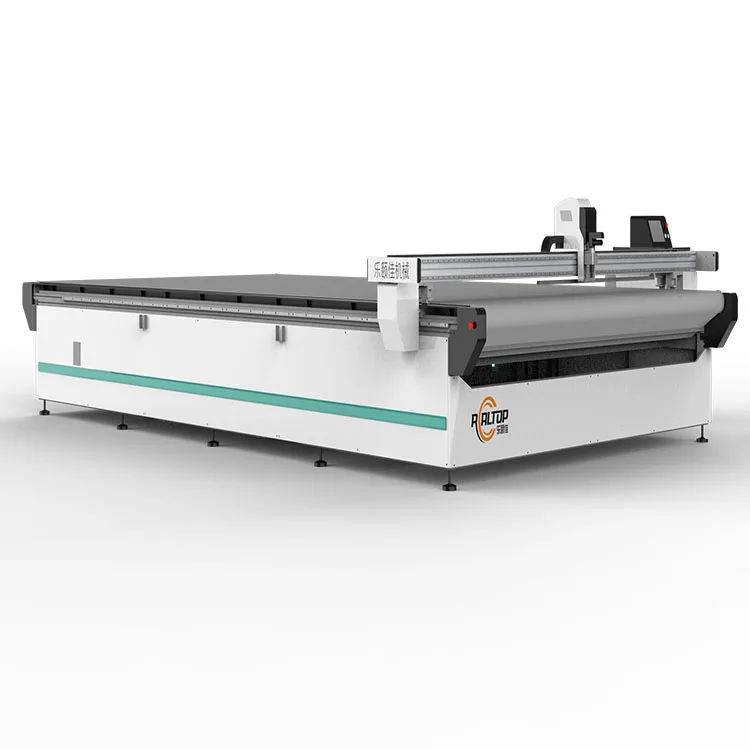
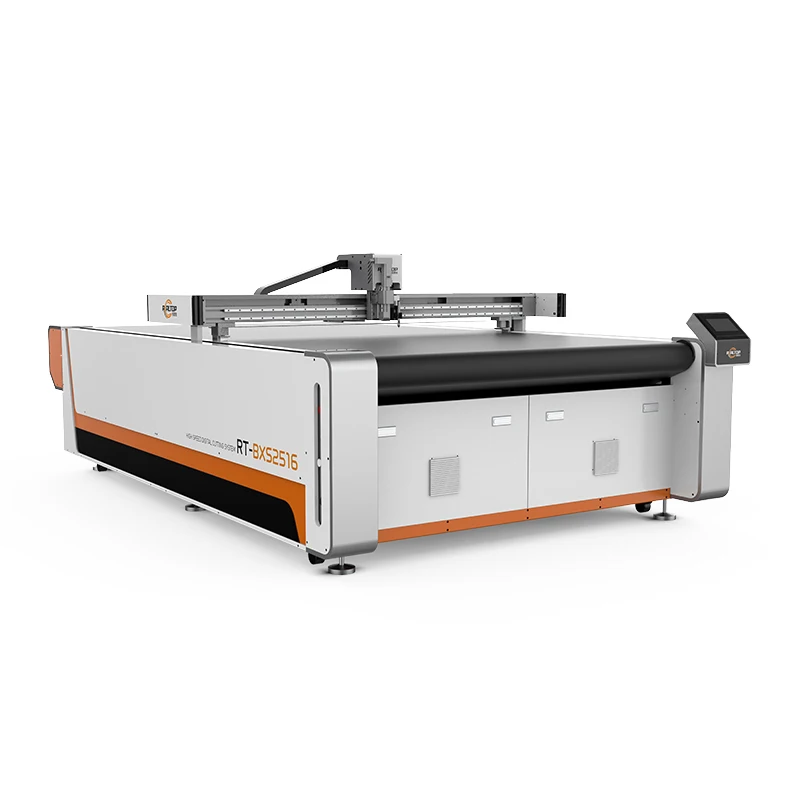

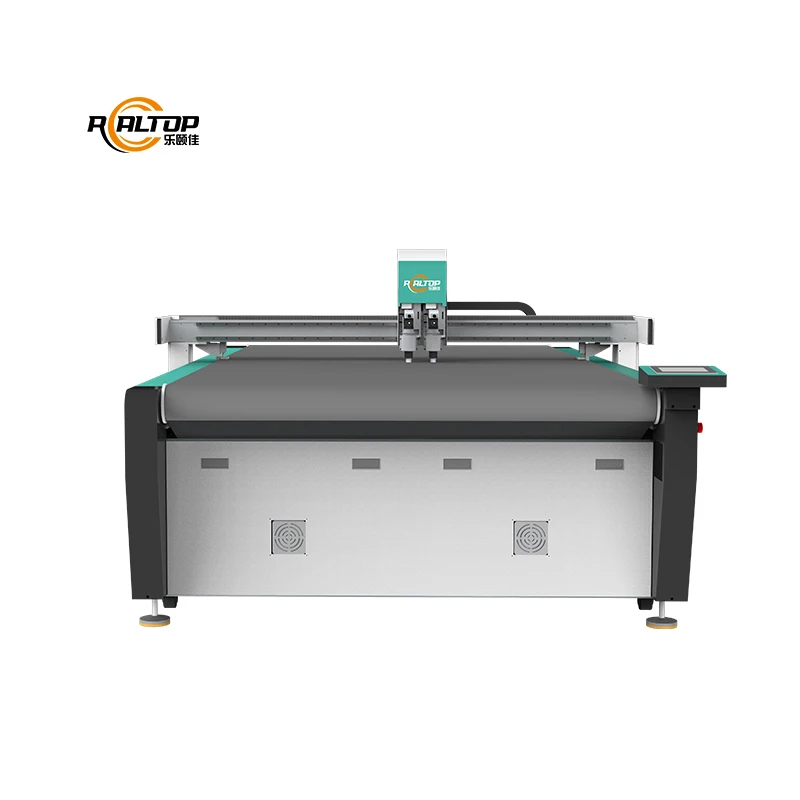
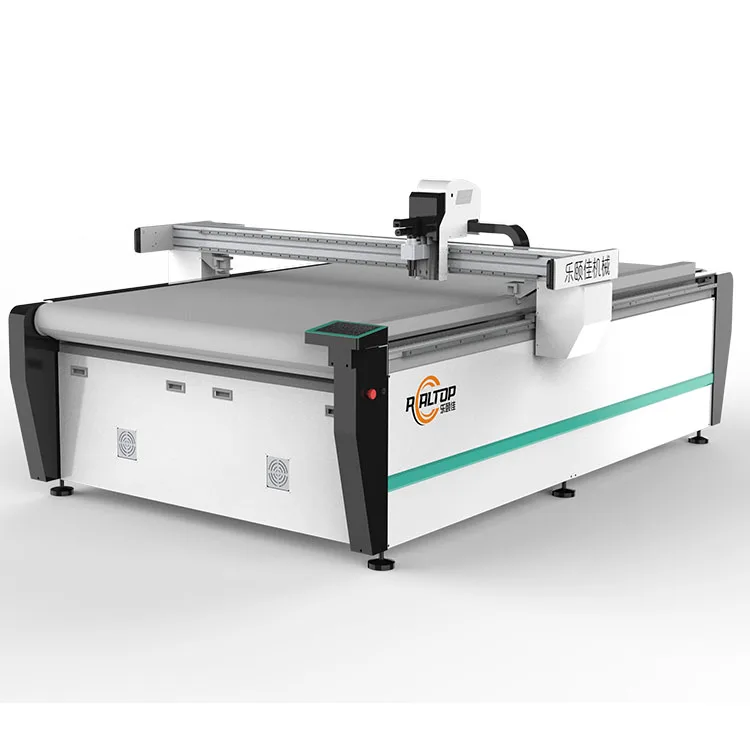
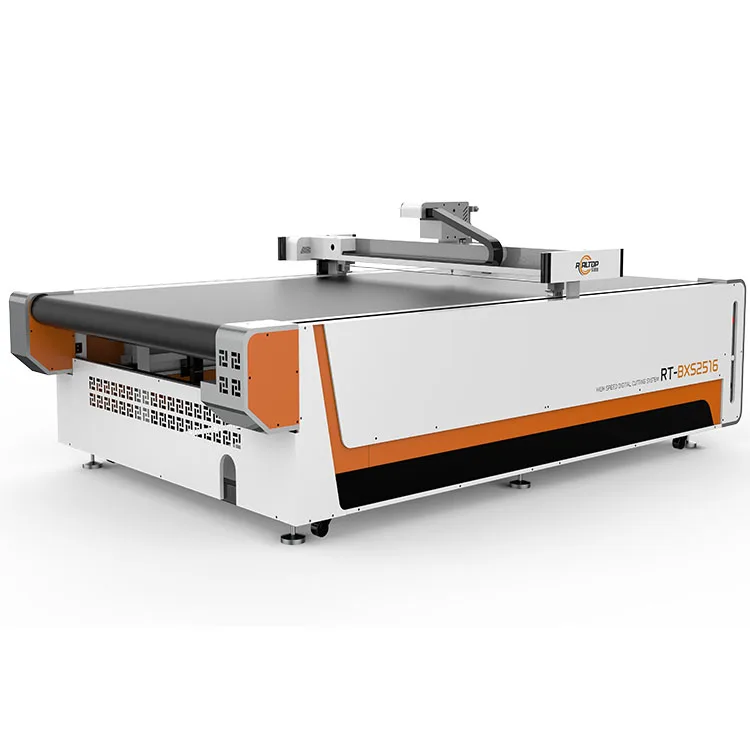

Multi-Tool Head Matching — Oscillating, drag, creasing and punching heads are specified per fabric type and ply count rather than sold as a single fixed setup.
Technical Specifications
| Parameter | Value |
|---|---|
| Product Type | CNC Oscillating Knife Cutting Machine |
| Model | RT-D2516/RT-S2516 |
| Working Area | 1600 × 2500 mm |
| Machine Size | 3450 × 2300 × 1250 mm |
| Rated Power | 9 kW |
| Table Type | Flat working table; auto feeding table available |
| Multifunctional Head | Swiss imported knife with oscillating, pneumatic, high-power vibrating, circular, V-cutting, drag, creasing wheel, dotted line, punching and brush options |
| Translational Velocity | 800–2000 mm/s |
| Cutting Speed | 200–800 mm/s depending on material |
| Cutting Thickness | Up to 100 mm depending on material density (basis to be confirmed) |
| Repeated Accuracy | ≤ 0.1 mm |
| Transmission System | Digital servo motor, linear guide, synchronous belt, ball screw |
| Servo Motor | Delta (Japan Panasonic optional) |
| Rail | Taiwan Hiwin |
| Conveyor Belt | Germany imported |
| Vacuum Table | Aluminum air box platform, magnesium-aluminum alloy with PVDF powder spraying, anodic and hard oxidation |
| Vacuum Pump | 7.5 kW, integrated aviation aluminum shell with built-in silencer |
| CCD / Visual Positioning | Small CCD mark point positioning, panoramic camera recognition, projection positioning |
| Control Panel | Touch screen, multiple language options |
| Software Compatibility | PLT, DXF, AI formats; auto typesetting |
| Voltage | 380 V ± 10 % |
| Safety Device | Infrared sensors, anti-collision, emergency stop |
Application Suitability
| Application | Material or Output |
|---|---|
| Garment and footwear production | Multi-layer woven fabric, knitted textile, non-woven fabric, shoe lining and upper material |
| Automotive interior trimming | Sponge composite leather, carpet, floor mat material, gasket stock |
| Soft home furnishing | Curtain fabric, upholstery textile, foam-backed cloth, carpet |
| Luggage and bag manufacturing | PU, EVA, PVC sheet, composite leather, woven and non-woven panels |
| Sports and outdoor goods | Neoprene, coated fabric, technical textile, XPE foam laminate |
| Graphic advertising and signage | Vinyl, sticker film, PVC banner, corrugated board for display |
When a Working-Area Quote Misses the Real Production Problem
Choosing a CNC oscillating knife cutting machine production line workflow on table size alone leaves the actual material behavior unaddressed, and that gap shows up the moment the first coated or laminated fabric hits the belt.
Cutting quality on multi-layer cloth depends on tool head selection, vacuum zoning and feed rate coordination, not on footprint.
I have stood in cutting rooms where the machine table was the right dimension but the oscillating frequency was tuned for single-ply cotton, not the coated waterproof textile the factory actually ran. Edges frayed, layers shifted mid-cut, and a week of parameter adjustment followed — all because the initial specification conversation stopped at working area. A cloth CNC cutting line earns its place on the shop floor only when the tool head, vacuum zone map and nesting software are each matched to the real fabric stack and daily volume. [NEED_CITE:]
How Tool Head Selection Shapes Edge Quality Across Fabric Types
Different cloth constructions respond to blade action in fundamentally different ways. A woven denim stack cuts cleanly under a high-frequency oscillating knife, while a knit jersey tends to curl and shift unless a drag knife or circular blade takes over for contour work. The multifunctional head on this system allows the operator to switch between oscillating, pneumatic, V-cutting and drag knife tools without re-fixturing the material. This flexibility matters when a single production run includes both straight-panel blanks and curved pattern pieces, which is the norm rather than the exception in garment cutting rooms running a CNC oscillating knife cutting machine production line workflow.
Vacuum Zoning and Small-Piece Stability at Production Speed
A full-sheet vacuum table holds a large panel flat without difficulty, but garment pattern pieces — collar stands, pocket flaps, cuff strips — are small enough to lift at the edges when the knife exits a cut. The magnesium-aluminum alloy platform on this machine is divided into independently controlled suction zones so that vacuum concentrates under the active cutting area. Germany-imported conveyor belts maintain registration as material advances between cuts. When a cutting room runs hundreds of small pieces per hour, zone-level vacuum control is what separates clean edges from rework piles. [NEED_CITE:]
Reading the Specification Sheet for What It Actually Means on the Floor
The 9 kW rated power covers both the cutting head drive and the 7.5 kW vacuum pump, so the electrical supply must account for simultaneous peak draw during full-table adsorption. Translational velocity reaches 2000 mm/s for positioning moves, but actual cutting speed drops to 200–800 mm/s depending on fabric density and ply count — a coated ballistic nylon stack will cut slower than a single-ply cotton shirting. The Taiwan Hiwin rail and Delta servo combination keeps repeated accuracy within 0.1 mm across the 1600 × 2500 mm working area, which matters when pattern pieces must align with pre-printed registration marks tracked by the CCD camera. Panoramic vision positioning further supports contour work on printed textiles where mark placement varies from roll to roll. Software accepts PLT, DXF and AI files with auto typesetting, so the nesting workflow does not require re-drawing patterns in a proprietary format.
What Happens When the Wrong Configuration Ships
A factory cutting automotive carpet with a standard oscillating knife — instead of a high-power vibrating blade rated for dense pile — will see crushed edges and incomplete cuts through the backing layer. Small gasket pieces cut on a vacuum table without zone control lift during the final pass, producing dimensional drift that only shows up at assembly. Software that cannot import the buyer’s existing DXF nesting files forces the production team to re-draw every pattern, adding hours of prepress work before the first cut runs. Voltage mismatches discovered after delivery mean transformer rentals, delayed commissioning and idle operators. [NEED_CITE:]
Why Production Managers Source This Line Here
In-house design covers both knife and laser cutting, so the cutting method is matched to the fabric rather than forced into a single technology. Tool head and table configurations are specified per material stack and daily volume before the order is placed. CCD camera and panoramic positioning options are confirmed against the buyer’s actual printed registration mark size and spacing. Software file format compatibility is verified with sample files before the machine enters production. Voltage, plug type and control panel language are locked in at quotation stage, not discovered during unpacking. Sample cutting on the buyer’s own cloth roll provides an edge-quality and speed benchmark that both sides sign off before shipment. [NEED_CITE:]
Documentation & Verification
- Machine specification sheet listing confirmed tool head and vacuum zone configuration
- Electrical schematic with voltage and frequency matched to destination country
- Sample cutting report on buyer-supplied fabric showing edge quality and speed
- Software licence and PLT, DXF, AI file format compatibility confirmation note
- Factory test record documenting repeated accuracy across the full working area
- Packing photographs showing machine crating and accessory box contents
Installation, Commissioning & Support
- Floor must support the 3450 × 2300 mm footprint with level tolerance for linear rail alignment
- Dedicated 380 V circuit with capacity for 9 kW continuous draw including the vacuum pump
- Auto feeding table and conveyor belt calibrated on site to match fabric roll width and tension
- First-run parameter tuning for buyer’s cloth type, ply count and nesting pattern
- Touch screen control language set to operator preference during commissioning
- Oscillating knife blades, conveyor belt segments and vacuum pump filters supplied as initial spare parts
Preparing Your Inquiry
Share the fabric type, ply count and maximum sheet or roll width you run daily, along with the pattern mix — large panels versus small contoured pieces. Specify the local voltage and frequency, and indicate which file formats your design department currently outputs. If you need CCD contour recognition, send a sample printed panel so mark size and contrast can be evaluated before configuration is finalized.
Frequently Asked Questions
Q: Which tool head should I specify for cutting multi-layer woven fabric versus single-ply knit?
A: High-frequency oscillating knives suit dense woven stacks where clean shear edges are critical. Knit fabrics tend to curl under oscillation, so a drag knife or circular blade often produces cleaner contours. The multifunctional head on this CNC oscillating knife cutting machine production line workflow allows switching between tools within the same job, so a single setup can handle both panel blanks and curved trim pieces.
Q: Will the vacuum table hold small garment pieces flat during high-speed cutting?
A: The magnesium-aluminum alloy platform is divided into suction zones that concentrate vacuum under the active cutting area. Small pieces such as collar stands and pocket flaps remain held because the zone directly below them stays active while adjacent zones manage airflow. This zoning is what keeps dimensional accuracy within the 0.1 mm repeated tolerance at production cutting speeds.
Q: How does CCD positioning perform on printed textile rolls with varying mark placement?
A: The system offers small CCD mark-point positioning, panoramic camera recognition and projection positioning. Panoramic mode scans the full working area to locate registration marks even when their position drifts between rolls. Before shipment, a sample printed panel from your production run is tested to confirm that mark size, contrast and spacing are within the camera’s detection range.
Q: What file formats does the nesting software accept from standard garment design systems?
A: The software supports PLT, DXF and AI file formats with auto typesetting. If your design department works in a proprietary format, a conversion test is run before the order is finalized to confirm that pattern geometry, notch marks and grain-line annotations transfer correctly into the nesting workflow.



商品评价
Clear filtersThere are no reviews yet.