


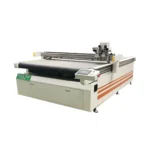


Precision-Matched Cutting Workflows — The 1625 CNC oscillating knife cutting machine production line is built around your fabric thickness, layer count, and daily volume rather than sold as a generic specification sheet.
Technical Specifications
| Parameter | Value |
|---|---|
| Product Type | CNC Oscillating Knife Cutting Machine |
| Working Area | 1600×2500 mm |
| Cutting Thickness | Up to 30 mm (basis not stated in source; confirm material type and layer count) |
| Cutting Speed | 0–2000 mm/s |
| Cutting Accuracy | ±0.1 mm (repeat positioning accuracy) |
| Tools Available | Oscillating knife, Driven rotary knife, Creasing wheel, Kiss cutting tool, Pneumatic knife, Milling tool, V groove knife |
| Applicable Materials | Fabric, Cardboard, Carton, Mats, PVC, EVA, Leather, Acrylic, Foam, PTFE, Rubber |
| Vacuum Table | Aluminum bellows vacuum table |
| Vacuum Pump | 9 kW |
| Machine Frame | Heavy-duty frame with precision-ground surface |
| Voltage Options | 110V, 220V, 380V (frequency not stated in source) |
| Servo Drive Options | Panasonic, Delta, Dorna (source value — verify against manufacturer catalog) |
| Control Panel | PLC control panel with optional display languages |
| Supported File Formats | PLT, DXF, AI, PDF |
| Safety Device | Infrared sensor device and emergency stop device |
| Machine Size | 3300×2100×1350 mm |
| Language Options | English, Russian, Italian, Chinese; special languages customizable |
| Standards | CE |
Application Suitability
| Application | Material or Output |
|---|---|
| Apparel Manufacturing | Suits, knitwear, lace, complex fabrics, and pattern-matching layouts |
| Automotive Interiors | Seat fabrics, carpets, and PVC floor mats |
| Home Textiles | Sofa fabrics, curtains, rugs, and multi-layer upholstery cutting |
| Composite Processing | Carbon fiber prepreg, aramid, and specialty industrial materials |
Why "Working Area" Alone Can Ruin Your Fabric Output
A 1600×2500 mm table only matters if the vacuum zoning, tool head, and feed rate are matched to your specific textile. When buyers select a CNC oscillating knife cutting machine production line based solely on bed size, they often discover that small pattern pieces lift during high-speed cutting or that dense multi-layer layups crush under the wrong blade frequency. I have seen automotive seat cover operations where the vacuum adsorption was too broad, leaving intricate headrest panels shifting mid-cut and generating noticeable edge deviation [NEED_CITE: vacuum hold-down requirements for flexible automotive textiles]. The actual yield loss in these situations is rarely captured in the initial quotation.
Matching the Blade to the Textile Structure
Selecting the correct tool head is the first variable that determines whether your knitwear, woven, or technical fabric exits the table with a sealed edge or a frayed perimeter. The 1625 supports interchangeable heads including the oscillating knife for standard woven stacks, the driven rotary knife for single-ply knits that tend to stretch, and the pneumatic knife for dense, compressible foams used in upholstery. Running a heavy automotive carpet on an oscillating blade meant for lace guarantees crushed fibers and rework. A CNC oscillating knife cutting machine production line configured with the wrong head will consistently produce ragged edges regardless of how well the nesting software is programmed.
Managing Material Shift in Multi-Layer Layups
When cutting sofa fabrics or curtain panels in volume, the layup height often reaches several centimeters, and the bottom plies experience different friction than the top. The 9 kW vacuum pump paired with the aluminum bellows table is designed to pull air through the entire bed surface, but production managers must understand how zoning affects small versus large pieces. If the vacuum zones are not isolated, cutting a small collar pattern next to a large back panel can cause the smaller piece to flutter once the blade completes its path [NEED_CITE: vacuum zoning strategies for mixed-nest textile cutting]. Consistent hold-down is what separates a clean edge from a shifted stack that requires manual sorting downstream.
Reading the Specifications That Actually Affect Yield
The ±0.1 mm repeat positioning accuracy ensures that pattern-matching layouts for premium apparel align correctly across multiple nests, which is critical when cutting striped or checked fabrics where a visible mismatch means the entire piece is scrapped. The 0–2000 mm/s cutting speed range must be balanced against fabric density; running at maximum speed on a loose-weave material will drag the bottom ply, while running too slowly on a dense composite generates heat that can melt synthetic fibers. The 9 kW vacuum pump rating indicates the suction capacity available to hold multi-layer layups flat, but the actual effectiveness depends on the table’s zone configuration and the porosity of the fabric being processed. Furthermore, the PLC control panel with dedicated packaging box structure design software suggests flexibility beyond simple textile cutting, allowing the same machine to handle corrugated sample making if the production schedule requires it.
The Hidden Cost of Unverified Software Integration
Importing a buyer’s existing DXF or AI files into the machine’s nesting software often reveals hidden incompatibilities that only appear during the first production run. A pattern file that nests perfectly on a competitor’s table might generate overlapping tool paths or ignore grain-line markers on this system if the software license and file format compatibility are not confirmed before shipment. I once spent three days on-site adjusting parameters because the nesting algorithm did not respect the directional nap of a velvet fabric, forcing the operator to manually rotate every piece and destroying the automated yield advantage [NEED_CITE: textile nesting software grain-line and nap direction handling]. Verifying software behavior with actual production files prevents this silent throughput loss.
Why This Configuration Fits Your Production Floor
The heavy-duty frame with a precision-ground surface provides the mass required to absorb the vibration of the oscillating knife at high frequencies, preventing resonance that would otherwise blur the cut edge on delicate silks or technical membranes. In-house design and production covering both knife and laser technologies allow the cutting method to be matched to the material, meaning a buyer processing both leather and acrylic can source from one engineering team rather than forcing one method onto an incompatible material. Tool head and table configurations are specified per material and daily volume, so a high-mix garment factory receives a different setup than a dedicated automotive carpet supplier. Sample cutting on the buyer’s own material is conducted before commitment, providing a physical report that confirms edge quality and achievable layer count rather than relying on generic catalog claims. Voltage, language, and specification customization are confirmed in writing, ensuring the control panel speaks the operator’s language and the electrical cabinet matches the local grid frequency.
Documentation & Verification
- Machine specification sheet detailing the configured tool heads and vacuum table zoning for your specific fabric types.
- Electrical schematic and voltage confirmation matching your facility’s power supply frequency and phase requirements.
- Sample cutting report executed on your actual material, documenting edge quality and maximum layer count.
- Software license and file format compatibility note confirming integration with your existing DXF, PLT, AI, or PDF nesting workflow.
- Operation and maintenance manual translated into your selected control language with specific blade replacement intervals.
- Spare parts list identifying wear items specific to the configured oscillating or rotary knife assemblies.
Installation, Commissioning & Support
- Foundation must support the 3300×2100×1350 mm footprint and dynamic load of the heavy-duty frame during high-speed oscillation.
- Dedicated electrical circuit required for the selected voltage option (110V, 220V, or 380V) and the 9 kW vacuum pump startup surge.
- Machine arrives partially assembled; the aluminum bellows vacuum table requires leveling on-site to ensure uniform suction across the 1600×2500 mm area.
- First-run commissioning includes calibrating the PLC control panel and verifying repeat positioning accuracy of ±0.1 mm on your production files.
- Operator training covers tool head changeover procedures for the oscillating knife, driven rotary knife, and pneumatic knife options.
- Daily maintenance focuses on clearing fabric dust from the vacuum table pores and inspecting the infrared sensor device alignment.
Preparing Your Production Data for Quotation
To determine the correct tool head and vacuum configuration, we need to know the specific fabric composition, the maximum layup thickness you intend to cut, and your target daily output in linear meters or nested pieces. Please provide sample DXF or AI files so we can verify software compatibility and nesting yield before the machine is built. Confirming your local voltage and required control panel language at this stage prevents delays during final assembly and commissioning.
Frequently Asked Questions
Q: How is the cutting configuration matched to my specific material and production volume?
A: The tool head selection—whether oscillating knife for wovens, driven rotary for knits, or pneumatic for foams—is determined by your material density and edge quality requirements. The vacuum table zoning is then configured based on the average size of your nested pieces to prevent small parts from lifting during the cutting cycle.
Q: What throughput can I expect on my specific fabric layup?
A: Throughput depends on the fabric type, total layup thickness, and the complexity of the nest layout. The machine operates at speeds up to 2000 mm/s, but the actual cycle time is established during the sample cutting test on your material, which confirms the achievable layer count and cutting speed without compromising edge quality.
Q: Does the software accept my existing DXF and AI files?
A: The system supports PLT, DXF, AI, and PDF formats, but compatibility with your specific nesting workflow must be verified. We request a sample file set before order confirmation to ensure that grain-line markers, pattern-matching rules, and kerf compensation settings translate correctly into the machine’s PLC control environment.
Q: Can I send my material for a sample cutting test before ordering?
A: Yes, sending your actual fabric or composite material is a standard step in our sales process. We run the sample on the configured 1625 machine and provide a report detailing the edge finish, the maximum clean cutting thickness, and the recommended tool head, allowing you to evaluate the result before committing to the purchase.



商品评价
Clear filtersThere are no reviews yet.