


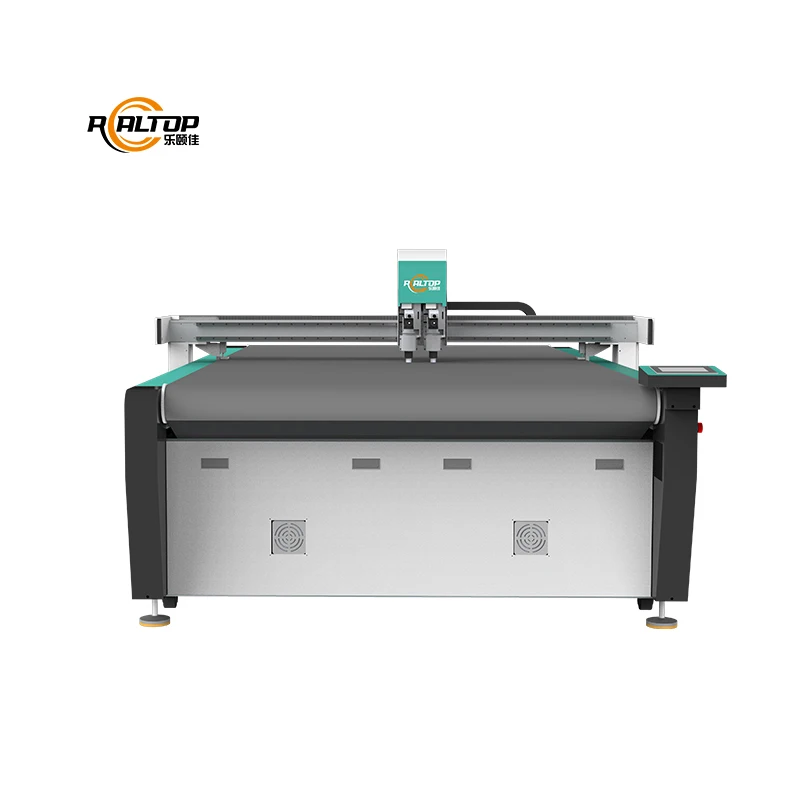
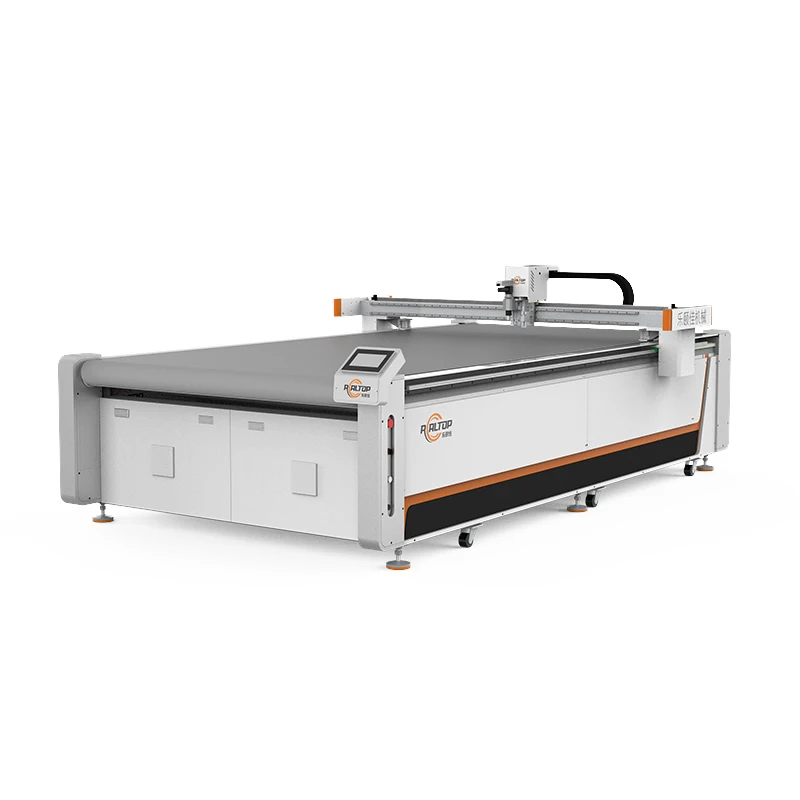
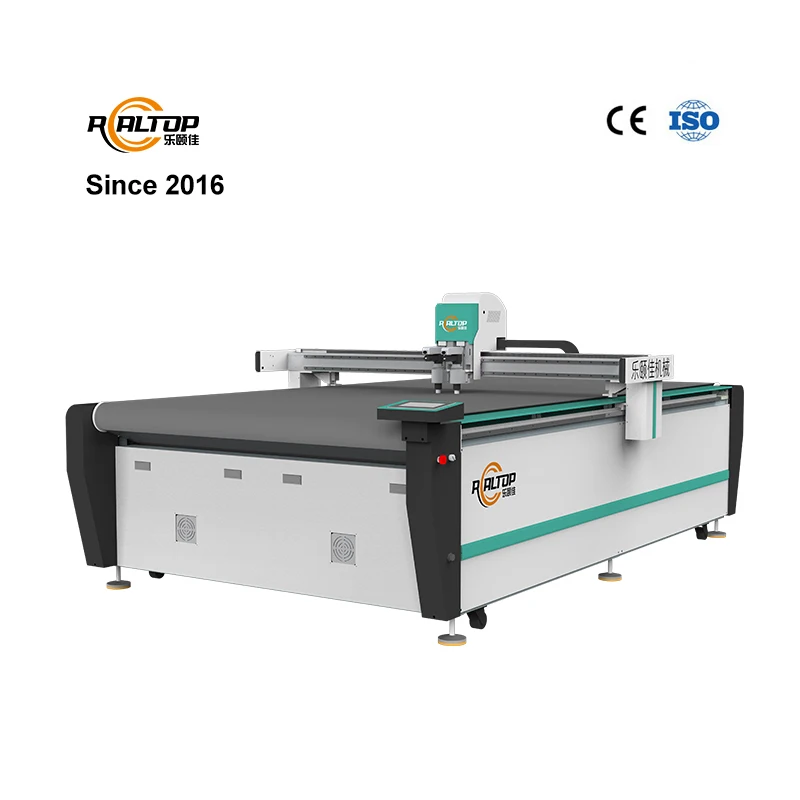
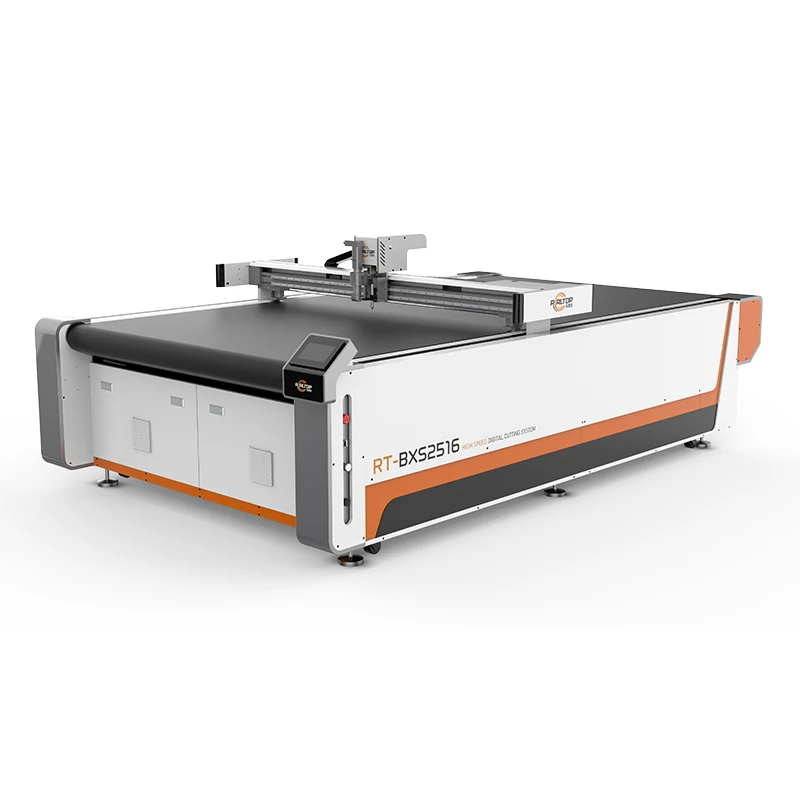
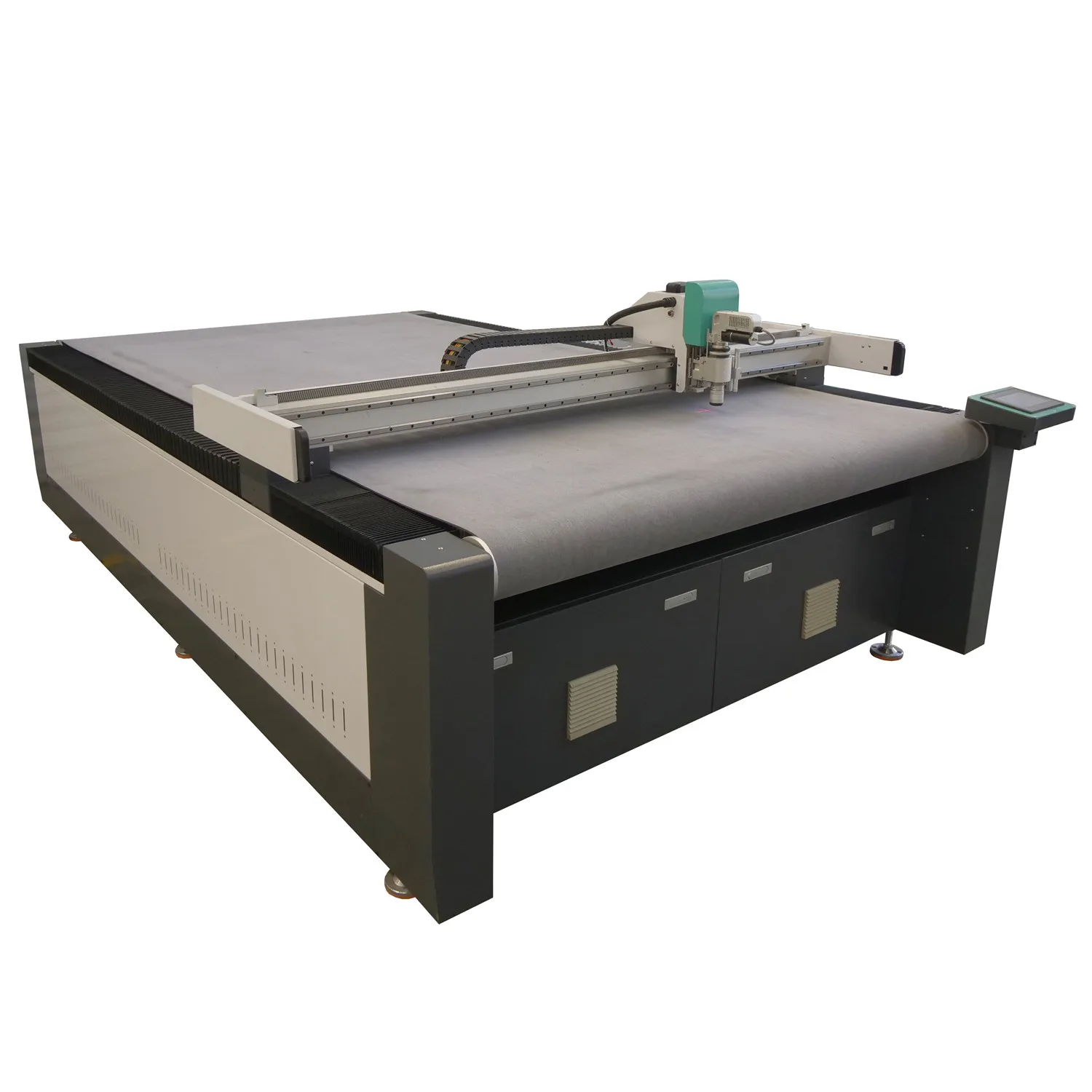
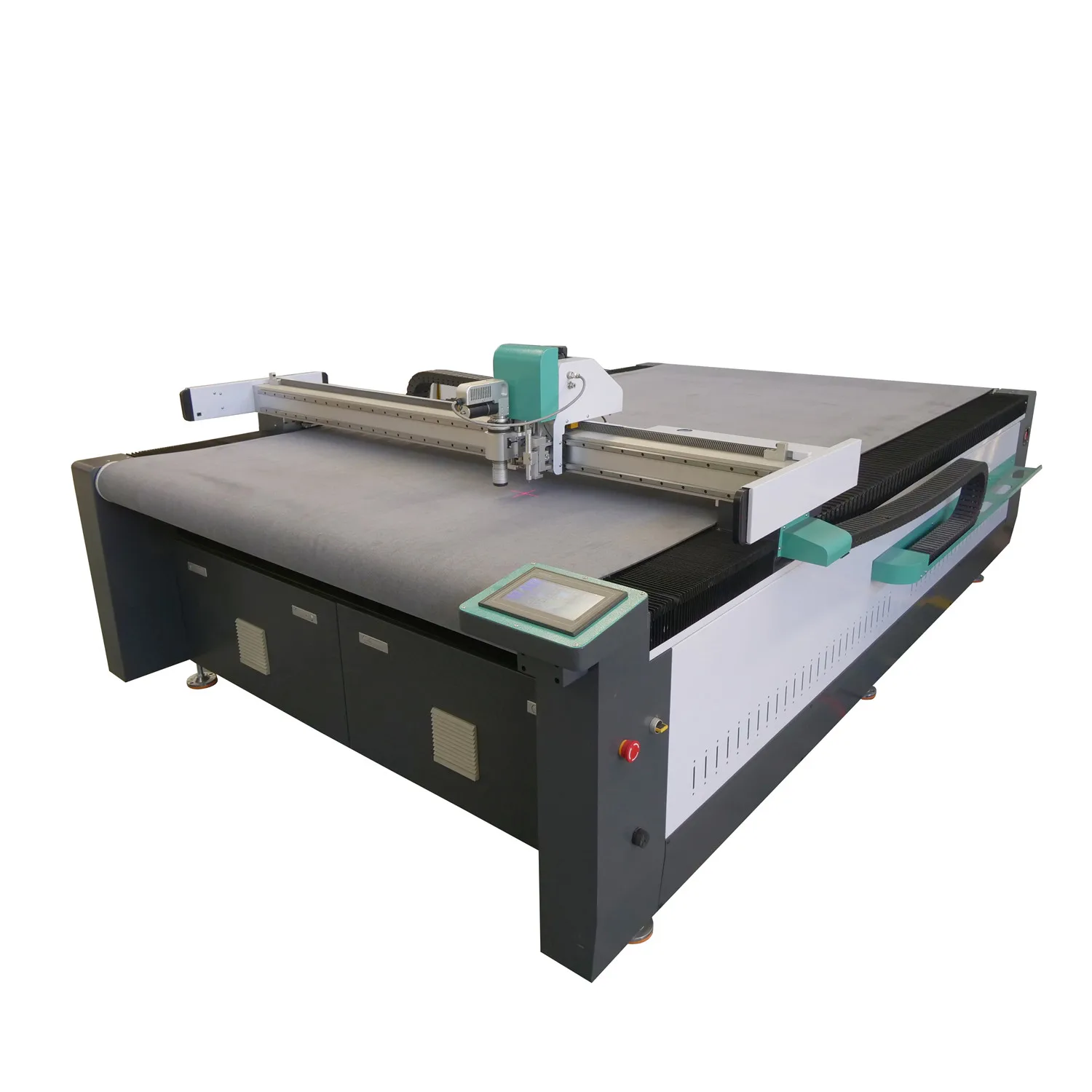

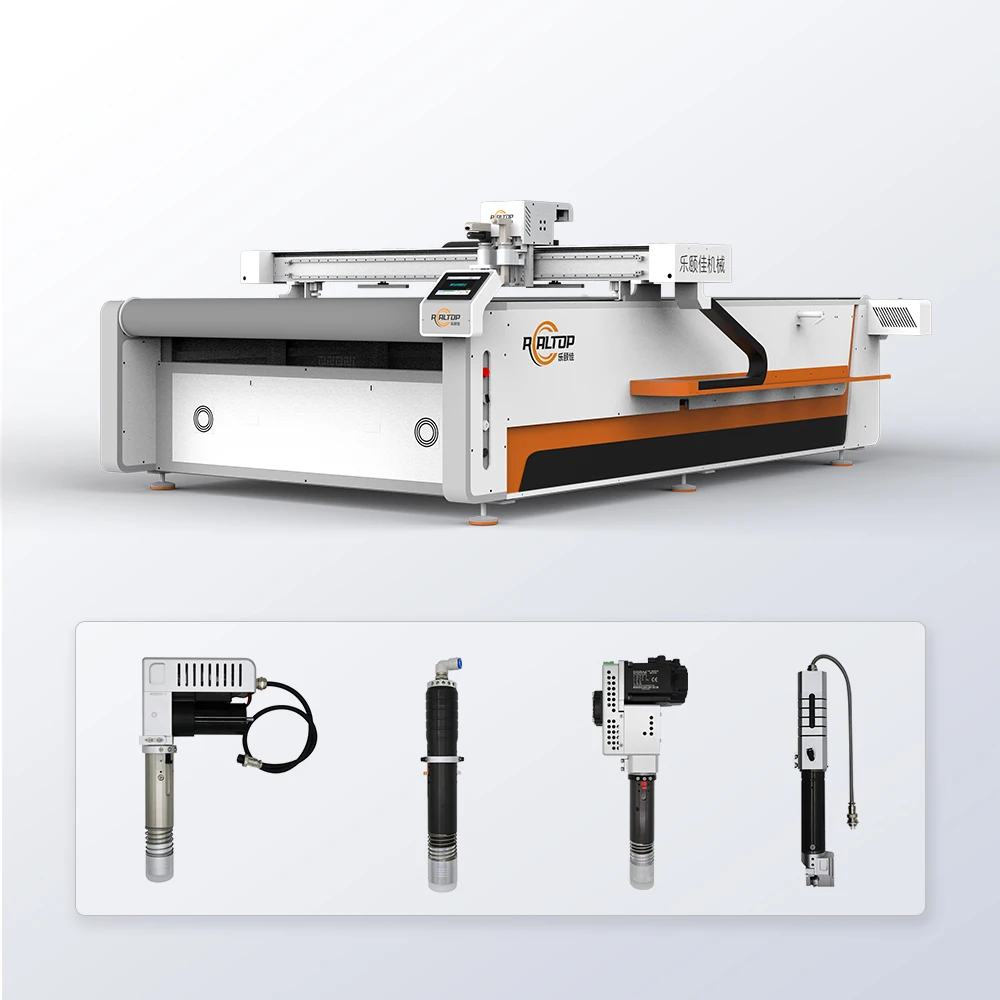
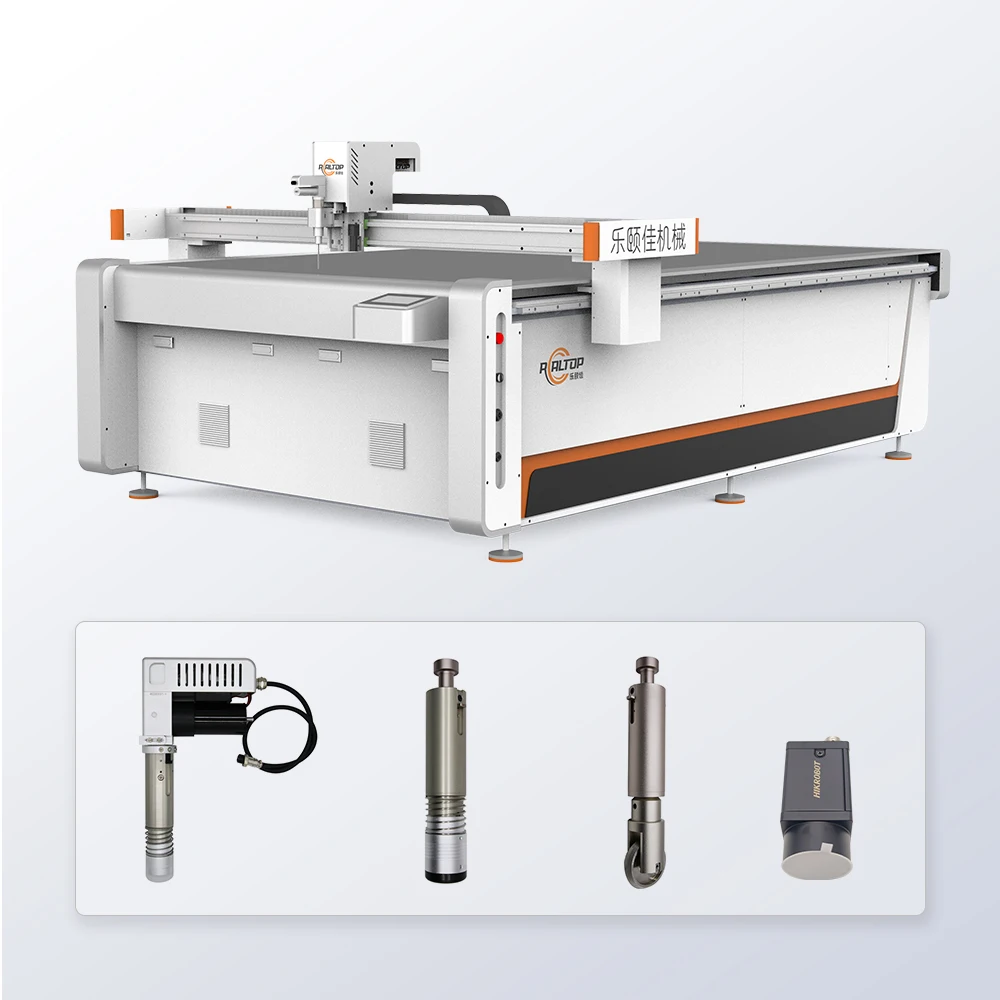
Material-Specific Tooling and Configuration — Every oscillating knife and vacuum zone on the RT-D2516/RT-S2516 is selected after sample testing on your actual fabric or leather stock, so the cutting depth and edge quality match your production reality rather than a generic datasheet.
Technical Specifications
| Parameter | Value |
|---|---|
| Model | RT-D2516/RT-S2516 |
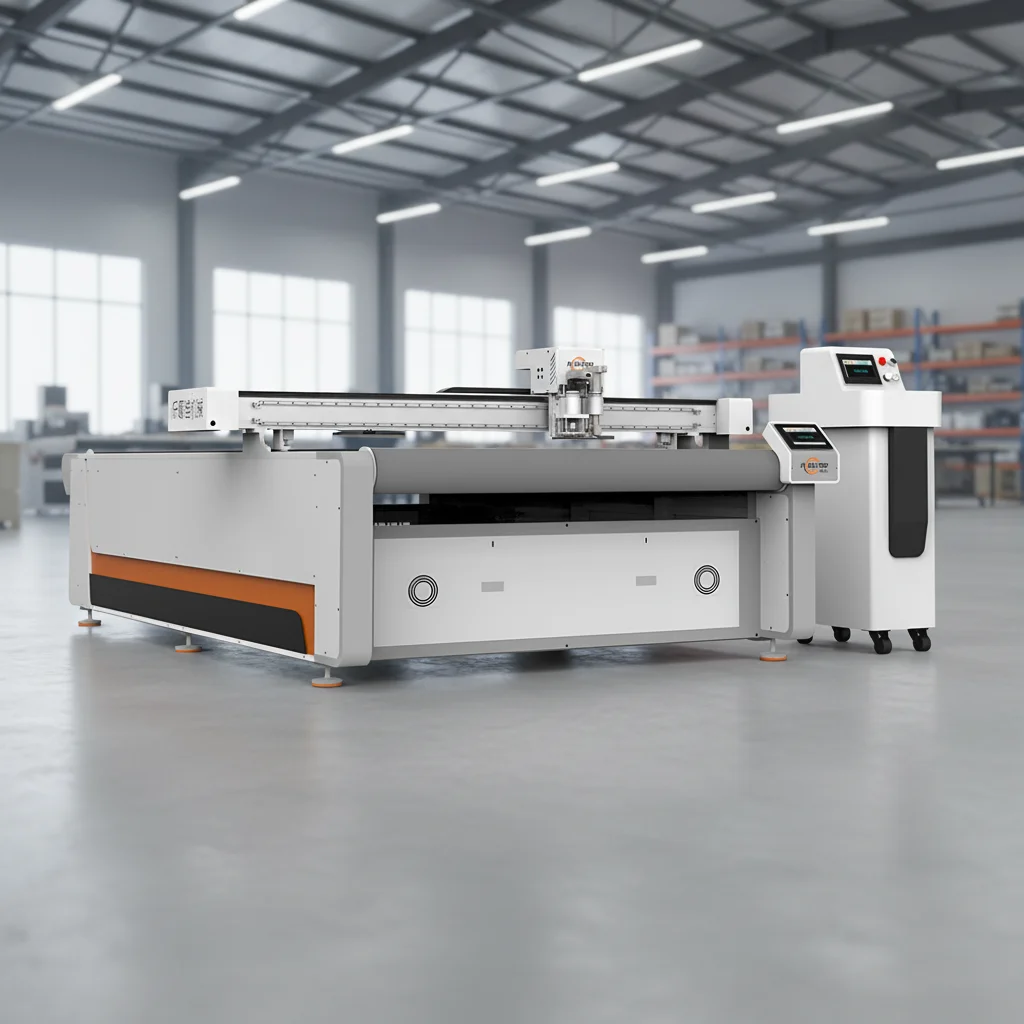
| Product Type | CNC Oscillating Knife Cutting Machine |
| Working Area | 1600 × 2500 mm |
| Machine Size | 3450 × 2300 × 1250 mm |
| Rated Power | 9 kW |
| Cutting Thickness | ≤100 mm (varies with material density and composition) |
| Translational Velocity | 800–2000 mm/s |
| Cutting Speed | 200–800 mm/s (according to different cutting materials) |
| Repeated Accuracy | ≤0.1 mm |
| Transmission System | Digital servo motor, linear guide, synchronous belt, ball screw |
| Servo Motor | Delta (optional Panasonic) |
| Linear Guide | Taiwan Hiwin rail |
| Vacuum Pump | 7.5 kW |
| Vacuum Table | Magnesium-aluminum alloy, fluorocarbon PVDF powder spraying, anodic oxidation |
| Conveyor Belt | Germany imported |
| Tool Head Options | Oscillating knife, pneumatic knife, high-power vibrating knife, circular knife, V cutting knife, drag knife, creasing wheel, dotted line knife, punching, brush |
| Visual Positioning Options | Small CCD camera mark point positioning, panoramic camera recognition positioning, projection positioning |
| Multifunctional Head | Swiss imported knife (vibration full cutting, vibration half cutting, cursor location function) |
| Safety Device | Infrared sensors |
| Control Panel | Touch screen, multiple language supported |
| Software | Auto typesetting, supports PLT, DXF, AI formats |
| Instruction System | HP-GL compatible format |
| Voltage | 380V ± 10% |
| Language Options | English, Russian, Italian, Chinese (customizable) |
| Fixed Model Options | Flatted working table, auto feeding table |
| Standards | CE (declaration where applicable) |
Application Suitability
| Application | Material or Output |
|---|---|
| Garment and footwear production | Multi-layer fabric, clothing cloth, shoe material, non-woven fabric |
| Automotive interior manufacturing | Leather, sponge composite leather, gasket materials, carpet and floor mats |
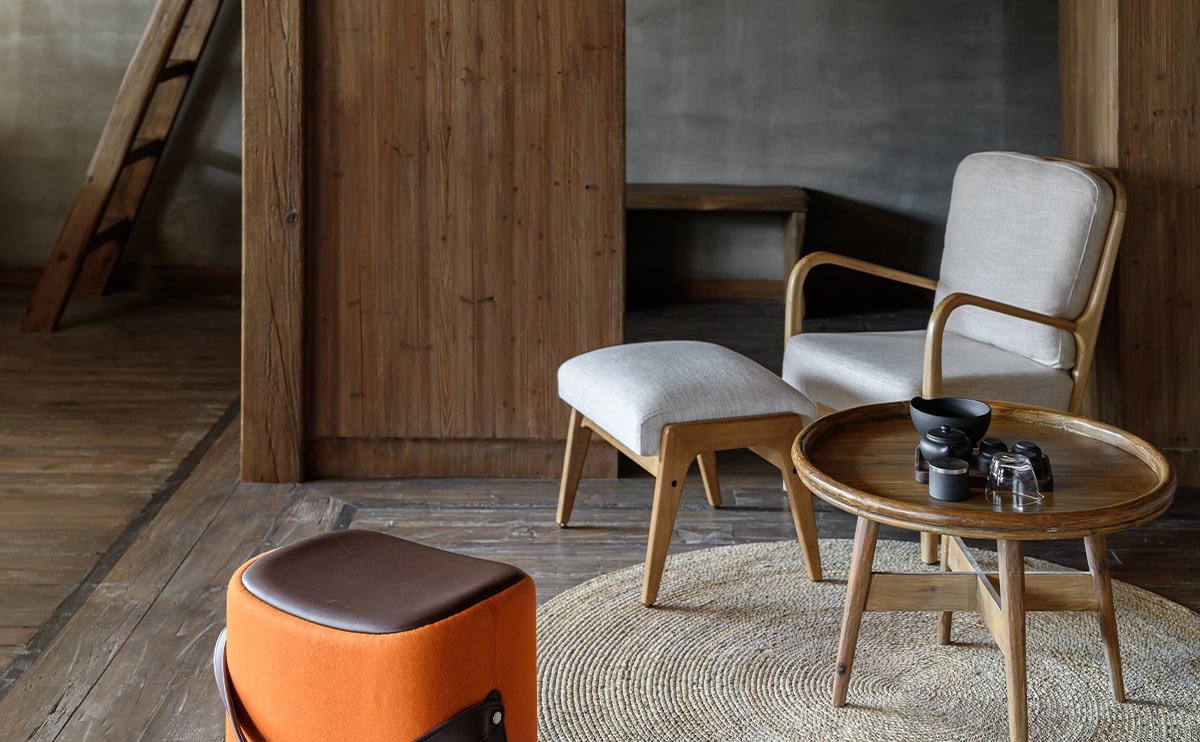
| Luggage, bags and soft furnishings | PU, EVA, composite materials, textile and lining fabrics |
| Sports and outdoor goods | XPE, EVA, foam board, composite laminates |
| Sealing and industrial gaskets | Rubber, PTFE, ETFE, silicone sheet |
| Packaging and carton sampling | Corrugated cardboard, cardboard, plastic box, film |
Why Specified Cutting Depth Matters More Than Working Area for a CNC Oscillating Knife Cutting Machine for Fabric and Leather Production
A 1600 × 2500 mm table means nothing if the knife cannot penetrate your specific material stack at production speed.
Buyers often start their inquiry with the working area they need, then discover weeks later that the machine they ordered cannot cut through the material thickness their production actually requires. I once spent three days on-site reconfiguring tool heads and vacuum zones for an automotive interior client who had ordered based on table size alone — their high-density composite was twice the resistance of the standard foam used during initial testing. The cutting depth a CNC oscillating knife cutting machine for fabric and leather production can handle depends on material density, fiber orientation, and laminate structure, not just the stroke length of the blade [NEED_CITE: material density and cutting resistance in textile composites]. That mismatch between quoted capacity and real-world material behavior is one of the most common reasons cutting equipment sits idle or runs at reduced throughput after installation.
Swiss Tooling and Blade Selection for Different Fabric Structures
The Swiss imported multifunctional head on the RT-D2516/RT-S2516 delivers full cutting, half cutting, and cursor location through a single tool station. For loosely woven textiles, a standard oscillating knife with a moderate vibration frequency produces clean edges without pulling threads. Dense woven or coated materials like automotive leather and sponge composite leather require a high-power vibrating knife at adjusted amplitude to push through without crushing the foam core. Drag knives work for thin films and single-layer vinyl where the material offers minimal resistance. Having these CNC oscillating knife cutting machine for fabric and leather production tool options available from the same head means operators can switch between materials across a single shift without a mechanical refit.
CCD Positioning for Printed Contour Workflows
When garment or automotive interior producers work with pre-printed fabrics — logos, patterns, or registration marks already on the textile — the small CCD camera or panoramic camera options detect those marks and align the cut path accordingly. The projection positioning alternative projects the cut outline directly onto the material surface, letting operators visually verify alignment before the blade engages. For multi-layer fabric stacks, the panoramic camera captures a broader field to maintain registration across the entire working area, which matters when nesting software has packed dozens of pattern pieces into a single lay. Visual recognition at production speed depends on mark contrast and print quality, so confirming this on your actual printed stock before commitment avoids surprises on the factory floor [NEED_CITE: optical mark recognition requirements for textile cutting systems].
Reading the Specification Sheet Beyond Working Area and Power
The RT-D2516/RT-S2516 delivers a repeated accuracy of ≤0.1 mm across its 1600 × 2500 mm table, which directly affects how tightly nested pattern pieces can be placed without risking overlap into adjacent cuts — tighter nesting means better material yield and less fabric waste per lay. The 7.5 kW vacuum pump paired with the magnesium-aluminum alloy table and PVDF-coated surface generates the suction needed to hold multi-layer fabric flat, but vacuum zoning must be configured for the actual part size being cut; a full-table vacuum field will lose grip on small pieces surrounded by already-cut waste areas. The Taiwan Hiwin linear guides and ball screw transmission maintain positional accuracy across long production runs, while the Delta servo motors (with Panasonic as an option) control acceleration profiles so the knife does not drag or overshoot at corner points. Cutting speed ranges from 200 to 800 mm/s depending on material, which is why that figure must always be read alongside the material type rather than treated as a single throughput claim.
The Hidden Cost of Wrong Configuration Choices
Choosing a machine without verifying the tool head against your material leads to ragged edges on fabric, crushed foam layers in automotive composites, or incomplete cuts that leave tab connections requiring manual separation afterward. Insufficient vacuum zoning causes small pattern pieces to lift during cutting, producing dimensional errors that cascade into downstream sewing or assembly operations. Ordering a machine without confirming the voltage and plug type for your facility can delay commissioning by weeks while transformers or adapters are sourced locally — and running a 380V ± 10% system outside its tolerance range risks servo motor damage that may not surface until months into production [NEED_CITE: electrical supply tolerance requirements for industrial servo systems]. Skipping the sample cutting test on your own material before order commitment is the single most common shortcut that creates these downstream problems.
Why Sourcing This CNC Oscillating Knife Cutting Machine for Fabric and Leather Production Here
Both knife cutting and laser cutting technologies are designed and manufactured in-house, so the cutting method is matched to your material rather than forced into whichever technology a single-technology supplier offers. Tool head and vacuum table configurations are specified per your material type, thickness, and daily production volume rather than shipped in a default arrangement. CCD camera positioning and software file format compatibility are confirmed during the sample cutting stage, not assumed from a brochure. Voltage, control language, and plug type are locked in before production begins, supporting operators in English, Russian, Italian, or Chinese environments. Sample cutting on your own material is standard procedure before any order commitment, providing a physical reference for edge quality and achievable cutting depth.
Documentation & Verification
- Factory test record showing cutting results on your specific fabric thickness and material type before dispatch
- Electrical schematic confirming 380V ± 10% wiring and servo motor configuration for your facility
- Tool head and vacuum table configuration list matched to your material and production volume
- Software licence with confirmed PLT, DXF, and AI file format compatibility for your nesting workflow
- Sample cutting report on your material documenting edge quality, achievable thickness, and cutting speed
- Operation and maintenance manual in your selected control language with spare parts list included
Installation, Commissioning & Support
- The 3450 × 2300 × 1250 mm machine footprint requires a level concrete floor with clearance for conveyor-fed material infeed and outfeed
- Dedicated 380V ± 10% circuit rated for the 9 kW machine load plus 7.5 kW vacuum pump running simultaneously
- Machine arrives as a single-frame unit with bolt-on conveyor sections; full assembly and leveling completed on-site
- First-run commissioning includes servo tuning, vacuum zone mapping, and cutting parameter calibration on your production material
- Operator training covers tool head changes, CCD mark registration, and nesting software workflow in your selected language
- Spare parts package includes replacement blades, vacuum seals, and conveyor belt sections identified in the documentation set
What to Share When Requesting a Quotation
Provide the specific material types you cut — including composition, thickness range, and whether materials are single-layer or stacked — along with your typical sheet dimensions and daily production volume. Confirm your facility voltage, frequency, and preferred control panel language so the electrical and software configuration is set before build. If you work with pre-printed materials requiring contour recognition, send sample prints so CCD tracking can be validated during the sample cutting stage.
Frequently Asked Questions
Q: How is the cutting thickness verified for my specific fabric or leather material?
A: Before order commitment, we run sample cuts on your actual material using the tool head and vacuum configuration planned for your production. The sample cutting report documents achievable thickness, edge quality, and cutting speed for each material type. This physical test replaces any generic thickness claim with evidence from your own stock, so you know exactly what the machine will handle before it ships.
Q: Which tool head is recommended for single-layer versus multi-layer fabric cutting?
A: Single-layer fabrics typically work well with the standard oscillating knife or drag knife, depending on material density. Multi-layer stacks — common in garment and automotive interior production — require the high-power vibrating knife to penetrate cleanly without shifting between plies. The tool head selection is finalized during sample testing on your actual lay configuration, not guessed from a specification sheet.
Q: Does the CCD camera track printed marks accurately at production speed?
A: The small CCD and panoramic camera options detect registration marks on pre-printed textiles and align the cut path accordingly. Tracking reliability depends on mark contrast, print quality, and fabric surface texture. We validate camera performance on your printed material during the sample cutting stage, confirming that mark detection holds across the full working area at the cutting speed your production requires.
Q: What file formats does the software support and can it integrate with my existing nesting workflow?
A: The software supports PLT, DXF, and AI formats and is compatible with HP-GL instruction output. If your existing nesting workflow generates files in these formats, integration is straightforward. We confirm file format compatibility and import behavior before order, using sample files from your production to verify that nesting layouts translate correctly to the cutting path.
Q: How is voltage, plug type, and control language confirmed before shipment?
A: During the specification confirmation stage before production begins, we lock in your facility voltage — the system supports 380V ± 10% — along with plug type and control panel language from available options including English, Russian, Italian, and Chinese. This confirmation is documented in the electrical schematic provided before build, so there are no compatibility surprises when the machine arrives at your facility.


商品评价
Clear filtersThere are no reviews yet.