





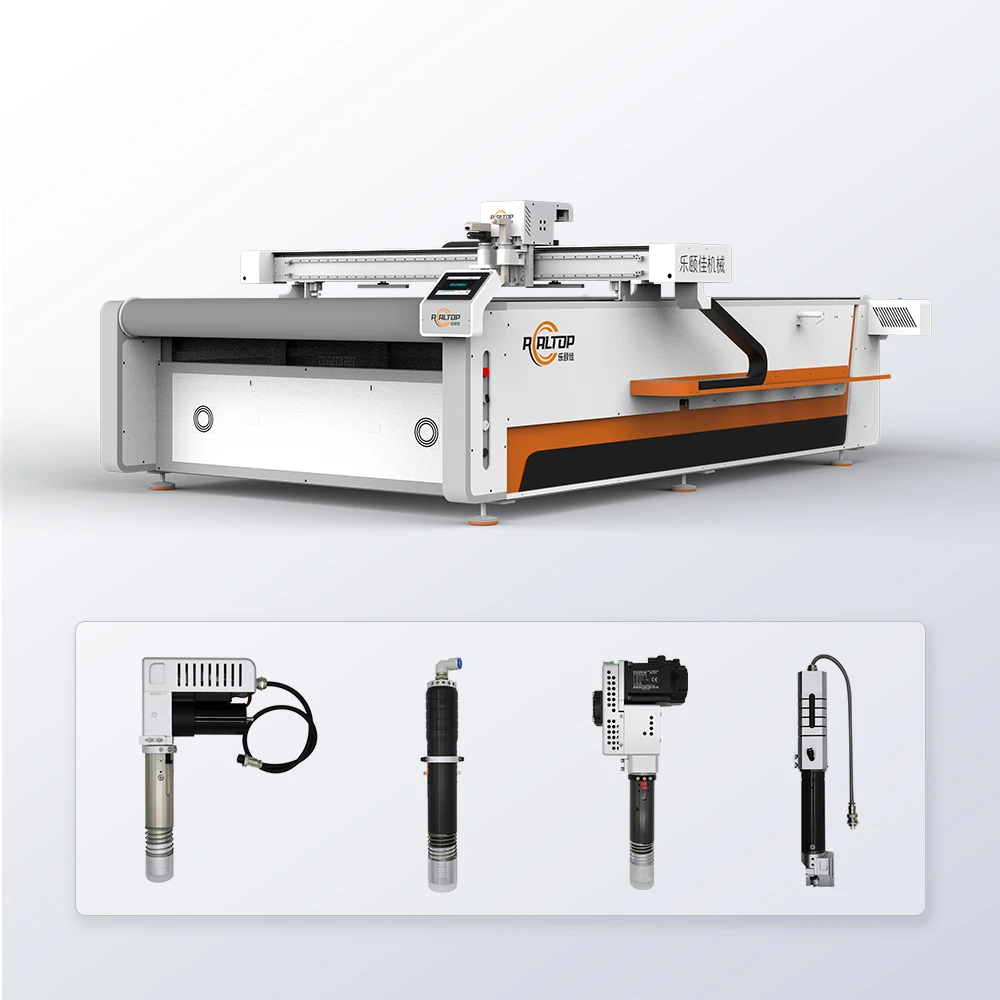
Blade-to-Fabric Matching — Every oscillating knife, driven rotary tool and creasing wheel is specified against your actual roll stock, so the cut edge you approve on sample day is the edge you see on the production floor.
Technical Specifications
| Parameter | Value |
|---|---|
| Product Type | CNC Oscillating Knife Cutting Machine |
| Working Area | 2500×2200 mm |
| Cutting Speed Range | 0–1500 mm/s |
| Maximum Cutting Thickness | ≤ 30 mm |
| Cutting Accuracy | ±0.1 mm |
| Positioning Repeatability | ±0.1 mm |
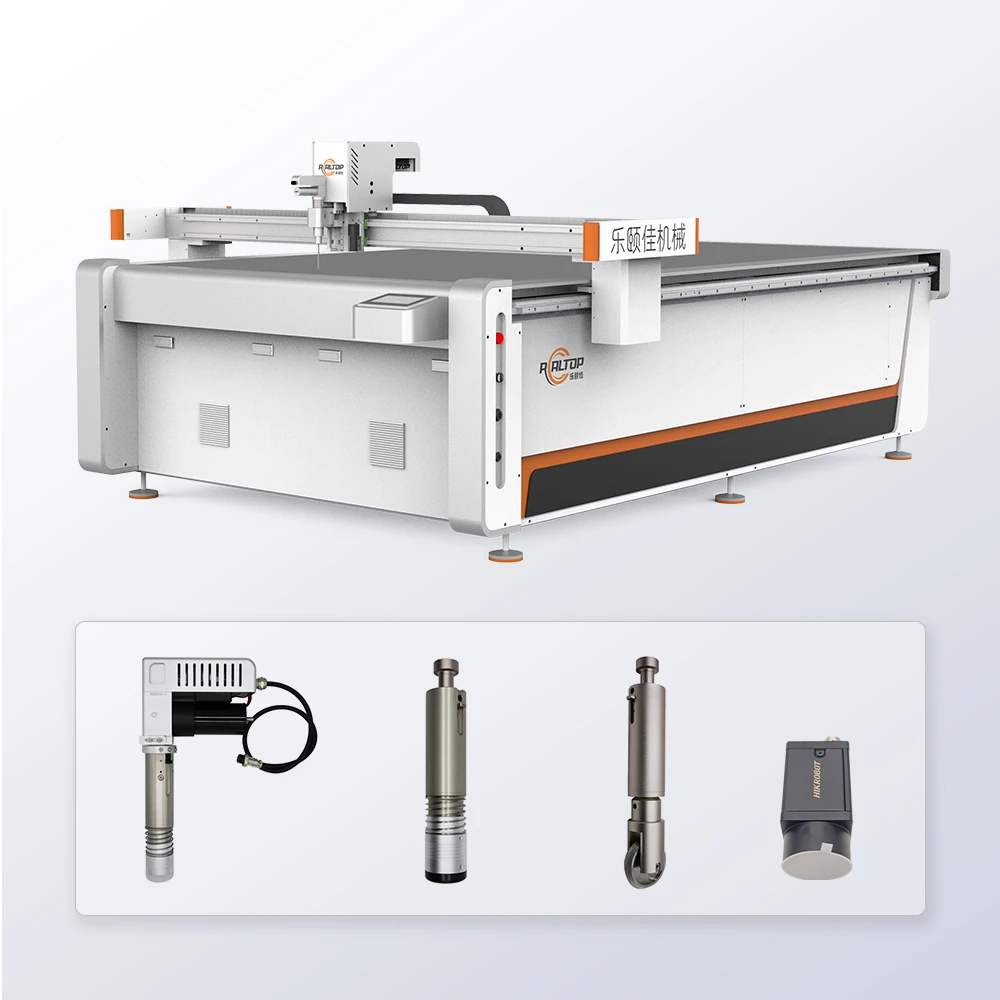
| Tool Head Options | Oscillating knife, Driven rotary knife, Creasing wheel, Kiss cutting tool, Pneumatic knife, Milling tool, V groove knife |
| Vacuum Table | Aluminum bellows vacuum table with full-surface suction |
| Vacuum Pump | 9 kW |
| Servo Motor Options | Panasonic, Delta, Dorna |
| Control System | PLC control panel with intuitive interface |
| File Formats Supported | PLT, DXF, AI, PDF |
| Voltage Options | 110V, 220V, 380V |
| Language Options | English, Russian, Italian, Chinese (custom available) |
| Safety Devices | Infrared sensor and emergency stop |
| Machine Frame | Heavy-duty frame with precision-ground surface |
| Overall Dimensions (L×W×H) | 3300×2700×1350 mm |
| Applicable Materials | Fabric, Cardboard, Carton, Mats, PVC, EVA, Leather, Acrylic, Foam, PTFE, Rubber |
Application Suitability
| Application | Material or Output |
|---|---|
| Dress panel cutting in garment production | Stretch knit, spandex blends, woven cotton, linen |
| Footwear upper and lining blanks | Leather, synthetic PU, textile layers |
| Home textile and soft furnishing pieces | Coral fleece, velvet, upholstery fabric |
| Yoga and fitness mat shaping | PVC, TPE, EVA with wave-edge and cut-out profiles |
| Automotive floor mat trimming | Loop carpet, full-coverage mats, non-slip backing |
| Packaging sample and carton prototyping | Cardboard, corrugated board, greyboard |
What a Misconfigured Feed System Does to Your Dress Panels
A stretchy knit that cuts cleanly on the sample table can deform under conveyor tension, leaving every panel undersized before the needle ever touches it.
I learned this the hard way sourcing cutting lines for garment factories. A children’s dress order in spandex blend ran flawlessly on our woven sample fabric. Once we switched to the customer’s actual roll, the conveyor feed stretched every piece — hundreds of panels came out undersized and went straight to scrap. The cloth CNC cutting machine itself was not at fault; the feed method was never matched to that specific fabric behavior. [NEED_CITE: material deformation during automated fabric feeding]
Matching the Tool Head to the Fabric Behavior
The right tool head is the first decision that separates a clean garment panel from a frayed reject. Oscillating knives handle tightly woven and mid-weight knits where a fast vertical stroke produces a sealed edge without pulling the weave. Driven rotary knives take over on heavier, layered fabrics or continuous-ply lay-ups common in footwear and bag production, where the blade must stay in constant contact to avoid drag marks. For dress production mixing delicate linings with structured outer shells, both tools may sit on the same gantry, switched automatically between pattern pieces.
Why Vacuum Zoning Decides Small-Piece Yield
A 2500×2200 mm table is generous enough for full garment lays, but dress cutting nests dozens of small pattern pieces — collars, cuffs, pocket flaps — that lift off the surface if suction is uniform and undifferentiated. Zoned vacuum activation means only the area under active cutting draws air, holding small parts flat without wasting pump capacity on empty table space. The aluminum bellows surface on this cloth CNC cutting machine delivers full-surface suction, but the zoning configuration must be confirmed against your typical nest layout before the machine ships. [NEED_CITE: vacuum hold-down requirements for small nested garment pieces]
Reading the Specs That Matter for Garment Work
The ±0.1 mm cutting accuracy and matching repeatability specification tell you the gantry can return to the same coordinate reliably, which matters when a dress pattern has mirror-image pieces that must align at the side seam. The 0–1500 mm/s speed range gives the operator room to slow down on tight curves — princess seams, armholes, collar stands — where a maximum-speed pass would push the blade and distort the edge. The 9 kW vacuum pump is sized to maintain suction through a full lay of lightweight woven or knit fabric; heavier multi-ply stacks may need zoning confirmation or a higher-capacity pump option. File format compatibility with PLT, DXF, AI and PDF means your existing pattern-making software — whether Gerber, Optitex or Lectra exports — should pass through without a conversion step, but this must be tested with your actual files before order confirmation.
The Hidden Cost of Skipping a Material Test Cut
Choosing a cloth CNC cutting machine on working area alone is the most common mistake I see at trade shows. A buyer specifies a large table, signs the order, and then discovers the machine cannot hold their thinnest lining fabric flat during cutting because the vacuum zones are too broad. Another buyer selects an oscillating knife for a foam-backed synthetic and ends up with crushed edges because a pneumatic knife or V-groove tool would have been the correct call. Every one of these problems surfaces after installation, when the machine is already bolted to your floor and the return shipping quote exceeds the unit price. [NEED_CITE: post-installation reconfiguration costs for misconfigured CNC cutting equipment]
Why This Machine Gets Specified for Dress Production
In-house design covering both knife and laser cutting means a buyer can match the method to the fabric rather than force a single technology across every material. The tool head and table configuration here are specified per garment type and daily cut volume, not picked from a default list. Software file format compatibility is confirmed with your actual pattern files before the order is finalized, eliminating the surprise of an incompatible nesting workflow on day one. Voltage, control language and documentation are customized for the destination country, so the PLC panel speaks your operator’s language from the first shift. A test cut on your own roll stock — the same fabric that will run in production — is completed and signed off before the machine leaves the factory.
Documentation & Verification
- Machine specification sheet confirming tool head and table zoning configuration
- Electrical schematic with voltage and frequency matched to your facility supply
- Sample cutting report produced on your garment fabric before dispatch
- Factory test record documenting accuracy and repeatability across a full pattern nest
- Software licence and file format compatibility note for PLT, DXF, AI and PDF workflows
- Spare parts list covering blades, knife holders and vacuum table seals
Installation, Commissioning & Support
- Floor space of at least 4000×3500 mm required to accommodate the 3300×2700 mm footprint with operator clearance
- Dedicated electrical circuit matching the confirmed voltage — 110V, 220V or 380V — with the 9 kW vacuum pump on its own breaker
- Machine ships as a single assembly; rigging plan needed for workshop door clearance at 1350 mm height
- First-day commissioning includes vacuum zone mapping and tool head calibration against your fabric thickness range
- Operator training covers PLC panel navigation, file import from your pattern software and blade-change procedure
- Consumable spares kit includes oscillating and rotary knife blades sized to your most-used tool heads
What to Share Before Requesting a Quotation
Send a sample of your primary dress fabric — the actual roll, not a swatch card — along with your typical lay height and daily panel volume. Confirm your workshop voltage and frequency, preferred control language and the nesting software you currently use. If you run a mix of knits, wovens and interlinings, list each with its approximate thickness so the tool head configuration can cover the full range without unplanned changeovers.
Frequently Asked Questions
Q: Can the driven rotary knife handle multi-ply lays of stretch knit for dress production?
A: The driven rotary knife is designed for continuous contact cutting, which suits heavier multi-ply stacks where the blade must follow the material without lifting. For stretch knits specifically, the feed system and vacuum hold-down must be matched to the fabric’s elongation characteristics. A sample cut on your actual lay-up is the only reliable way to confirm edge quality and dimensional accuracy.
Q: How do I verify that my existing pattern files will load without conversion issues?
A: The control system accepts PLT, DXF, AI and PDF formats. Before order confirmation, send a set of your production patterns — including nested layouts with small pieces — so the software team can run a full import test and confirm that curve resolution, layer mapping and piece labeling transfer correctly to the PLC panel.
Q: What happens if my workshop voltage does not match the standard options listed?
A: Voltage is configurable across 110V, 220V and 380V, and frequency must be confirmed alongside voltage for your local grid. The electrical schematic and component ratings are adjusted before build. This conversation needs to happen before production starts, because retrofitting a servo motor or vacuum pump after assembly is costly and delays shipment.
Q: Is the vacuum table sufficient for holding small dress pieces like collars and cuffs?
A: The aluminum bellows table provides full-surface suction, but small pieces require zoned vacuum activation to concentrate hold-down force where cutting is happening. The zoning layout should be configured around your typical nest arrangement. Share your most common pattern layout so the vacuum zones can be mapped before the machine is finalized.
Q: Can I test the machine on my fabric before committing to the order?
A: A sample cutting run on your own roll stock is part of the standard sales process. You send the fabric, specify the lay height and pattern pieces, and receive a cutting report with edge quality photographs, dimensional measurements and recommended tool head settings. This eliminates the risk of discovering a feed or hold-down issue after the machine arrives at your facility.



商品评价
Clear filtersThere are no reviews yet.