



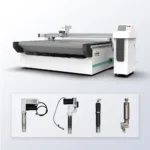


Zoned vacuum holding — Magnesium-aluminum alloy table with PVDF coating and hard oxidation keeps small garment pieces flat during high-speed cutting on the RT-D2516/RT-S2516.
Technical Specifications
| Parameter | Value |
|---|---|
| Product Type | CNC Oscillating Knife Cutting Machine |
| Model | RT-D2516/RT-S2516 |
| Working Area | 1600 × 2500 mm |
| Machine Size | 3450 × 2300 × 1250 mm |
| Rated Power | 9 kW |
| Vacuum Pump | 7.5 kW |
| Table Type | Flat working table / Auto-feeding table (configurable) |
| Translational Velocity | 800–2000 mm/s |
| Cutting Speed | 200–800 mm/s (varies with material type and thickness) |
| Cutting Thickness | ≤100 mm (varies with material) |
| Repeated Accuracy | ≤0.1 mm |
| Transmission System | Digital servo motor, linear guide, synchronous belt, ball screw (imported) |
| Servo Motor | Delta (optional Panasonic) |
| Guide Rail | Taiwan Hiwin |
| Conveyor Belt | Germany imported |
| Multifunctional Head | Swiss imported knife (vibration full cutting, vibration half cutting, cursor location); options include oscillating knife, pneumatic knife, high-power vibrating knife, circular knife, V-cutting knife, drag knife, creasing wheel, dotted line knife, punching, brush |
| Safety Device | Infrared sensors, anti-collision beam sensors, emergency stop |
| Instruction System | HP-GL compatible format |
| Software | Auto typesetting, supports PLT, DXF, AI formats |
| Visual Positioning | Small CCD camera mark point positioning, panoramic camera recognition, projection positioning (optional) |
| Control Panel | Touch screen, multiple language supported |
| Voltage | 380V ± 10% |
| Vacuum Table Material | Magnesium-aluminum alloy, fluorocarbon PVDF powder spraying, anodic oxidation, hard oxidation |
| Frame | Thick-walled seamless steel structure, high-temperature tempering, CNC machining center finished |
Application Suitability
| Application | Material or Output |
|---|---|
| Garment and footwear production | Woven fabric, non-woven fabric, leather, synthetic leather in multi-layer stacks for pattern cutting |
| Automotive interior trimming | Leather, sponge composite leather, PU, EVA for seat covers, door panels and headliners |
| Soft home furnishing and carpet | Textile, carpet, sponge, composite padding in large-format single or multi-layer cutting |
| Bags and luggage | PU, PVC, Oxford cloth, composite materials for panel cutting |
| Gasket and sealing pad | Rubber, PTFE, ETFE, silicone sheet for industrial seal production |
| Packaging sample making | Corrugated cardboard, cardboard, foam board for carton prototyping |
Why the Wrong Tool Head Ruins Your Fabric Before the First Cut Is Done
A cloth CNC cutting line is only as reliable as the tool head matched to the material, and swapping knives after delivery is a costly lesson most production managers learn the hard way.
The oscillating knife, circular knife and drag knife each solve a different cutting problem — and choosing wrong means ragged edges on woven fabric or crushed cells in multi-layer foam composites.
I have walked into garment workshops in Southeast Asia where the fabric was lifting off the table mid-cut because the vacuum zoning did not match the pattern piece size. The machine was powerful enough, but the holding system was specified for large panels rather than the small collar and cuff pieces the factory actually produced. In another case, an automotive interior supplier ordered a single knife head and then discovered that sponge composite leather required a completely different oscillation frequency to avoid delamination [NEED_CITE: CNC knife cutting tool head selection for composite material separation].
How the RT-D2516/RT-S2516 Matches the Production Floor
The RT-D2516/RT-S2516 is designed around a single principle: the cutting method must follow the material, not the other way around. The multifunctional head accepts a Swiss imported oscillating knife for full and half cutting, alongside options for circular knife, drag knife, pneumatic knife, creasing wheel and punching — all mountable in one workstation so the operator can switch without re-fixturing the sheet.
For garment manufacturers running multi-layer fabric stacks, the auto-feeding table with a Germany imported conveyor belt enables continuous roll-to-sheet workflow, reducing idle time between cuts. The Delta servo system (Panasonic optional) drives the cutting head at translational velocities up to 2000 mm/s, while actual cutting speed is governed by material density and layer count rather than a single headline figure.
Contour Recognition That Keeps Up with Printed Fabric
Printed fabric cutting depends on the camera tracking registration marks at production speed — not just locating them at setup. The RT-D2516/RT-S2516 offers small CCD camera mark point positioning, panoramic camera recognition or projection positioning as optional configurations. Each serves a different workflow: the CCD camera reads discrete marks on cut pieces, while the panoramic camera captures the full printed layout for contour-matched cutting across large-format textiles [NEED_CITE: CCD visual positioning accuracy in textile cutting at production speed].
The nesting software accepts PLT, DXF and AI files and performs auto typesetting to optimize material yield. This matters when a garment factory is cutting dozens of pattern sizes from a single fabric roll, where even a small yield improvement translates directly into material savings across a production run.
Reading the Specs That Actually Matter on the Shop Floor
The repeated accuracy of ≤0.1 mm is achieved through the combination of Taiwan Hiwin guide rails, imported ball screws and digital servo control — a motion system that maintains positional consistency across the full 1600 × 2500 mm working area. For garment pattern pieces that must align at the sewing stage, this tolerance directly affects downstream assembly.
The vacuum table uses a magnesium-aluminum alloy platform treated with fluorocarbon PVDF powder spraying, anodic oxidation and hard oxidation. This multi-layer treatment resists knife scoring and chemical exposure from adhesives commonly present in composite materials. The 7.5 kW vacuum pump delivers the suction needed to hold lightweight, porous fabrics flat — a requirement that becomes critical when cutting small pattern pieces where edge lift can shift the entire cut [NEED_CITE: vacuum table zoning requirements for small fabric pattern pieces].
The 9 kW rated power and 380V ± 10% voltage specification must be confirmed against the buyer’s local electrical supply before shipment. In Southeast Asian workshops, voltage fluctuation is common, and a machine specified without confirming the local frequency and plug standard can sit idle for weeks while transformers and adapters are sourced.
The Hidden Cost of Skipping the Layout Check Before Shipment
A machine that cannot fit through the workshop door or align with the existing auto-spreader is a production line that does not start on schedule. I have seen cutting tables delivered to factories in Vietnam where the workshop pillars were not accounted for in the floor plan, leaving the auto-feeding conveyor unable to connect to the upstream spreading equipment. The RT-D2516/RT-S2516 measures 3450 × 2300 × 1250 mm — dimensions that must be checked against door clearance, ceiling height and column spacing before the machine leaves the factory.
When the table type is configured as an auto-feeding system, the conveyor belt length and feeding direction must align with the existing roll handling setup. Getting this wrong means either modifying the workshop or modifying the machine — neither of which is cheap or fast [NEED_CITE: industrial equipment installation layout verification before shipment].
Why This Machine Fits the Production Line
In-house design covering both knife and laser technologies means the cutting method is chosen based on the material, not forced into a single process. A buyer cutting leather and woven fabric on the same line can specify the correct tool head for each rather than compromise on edge quality.
Tool head and table configurations are specified per material type and production volume, documented in a configuration list that accompanies the quotation. The sample cutting process runs on the buyer’s own material before order confirmation, producing a report that records cutting speed achieved, edge quality and layer count tested.
Software compatibility is confirmed before the order is placed — the file formats, nesting workflow and control panel language are checked against the buyer’s existing systems. Voltage and plug type are locked in at the same stage, eliminating the post-shipment electrical surprises that delay commissioning.
The frame is built from thick-walled seamless steel structure, processed through high-temperature tempering and finished on a CNC machining center, providing the rigidity needed for consistent cutting across the full working area over years of continuous operation.
Documentation & Verification
- Factory test record on your fabric type and layer count before dispatch
- Tool head and table configuration list matched to your material specification
- Sample cutting report on buyer-supplied material with edge quality documentation
- Electrical schematic with voltage and plug standard confirmed per destination market
- Software license with PLT, DXF, AI file format compatibility verified
- Operation and maintenance manual with spare parts list included at shipment
Installation, Commissioning & Support
- Floor space planning for 3450 × 2300 × 1250 mm footprint including conveyor clearance and column avoidance
- Dedicated 380V ± 10% circuit with confirmed frequency and plug type for destination country
- Vacuum pump 7.5 kW power supply verified against local electrical capacity before wiring
- Touch screen control panel configured in buyer’s preferred language before commissioning begins
- Tool head calibration on buyer’s material with cutting speed and depth parameters set during first run
- Spare parts list covering Swiss knife blades, conveyor belt segments and vacuum seals for first-year maintenance
What to Prepare Before Requesting a Quotation
To configure the RT-D2516/RT-S2516 for your production line, provide your primary material type, maximum thickness, sheet or roll dimensions and daily cutting volume. Specify the workshop layout including door clearance, ceiling height and pillar positions so the feeding direction and table type can be planned correctly. Confirm your local voltage, frequency and plug standard, and share a sample of your existing DXF or AI files so software compatibility can be verified before the order is finalized.
Frequently Asked Questions
Q: How is cutting speed verified and what determines the actual production rate?
A: Cutting speed of 200–800 mm/s is material-dependent. A sample cutting test on your specific fabric, leather or composite material is run before order confirmation, documenting the speed achieved, layer count and edge quality. This report becomes the baseline for your production planning rather than relying on a single headline figure.
Q: Which tool head should I use for my specific material?
A: The oscillating knife handles multi-layer fabric and foam, the circular knife suits single-layer woven textiles, and the drag knife works for thin vinyl and sticker materials. The multifunctional head accepts all these options in one workstation, and the correct configuration is determined during the sample cutting test on your material.
Q: Can the software import my existing DXF and AI files for nesting?
A: The auto typesetting software supports PLT, DXF and AI formats. Compatibility with your existing nesting workflow is confirmed before order placement by testing your actual production files on the system, ensuring pattern import, nesting logic and output match your current process.
Q: How is the vacuum table configured to hold small garment pieces flat?
A: The magnesium-aluminum alloy vacuum table with PVDF coating provides zoned suction across the 1600 × 2500 mm working area. Zone configuration is specified based on your typical pattern piece size so that small collar or cuff pieces receive adequate holding force to prevent material lift during high-speed cutting.
Q: What voltage and control language will my machine ship with?
A: Voltage at 380V ± 10%, plug type and frequency are confirmed against your local electrical standard before shipment. The touch screen control panel is configured in your preferred language during production, and this specification is documented in the electrical schematic provided with your order confirmation.



商品评价
Clear filtersThere are no reviews yet.