




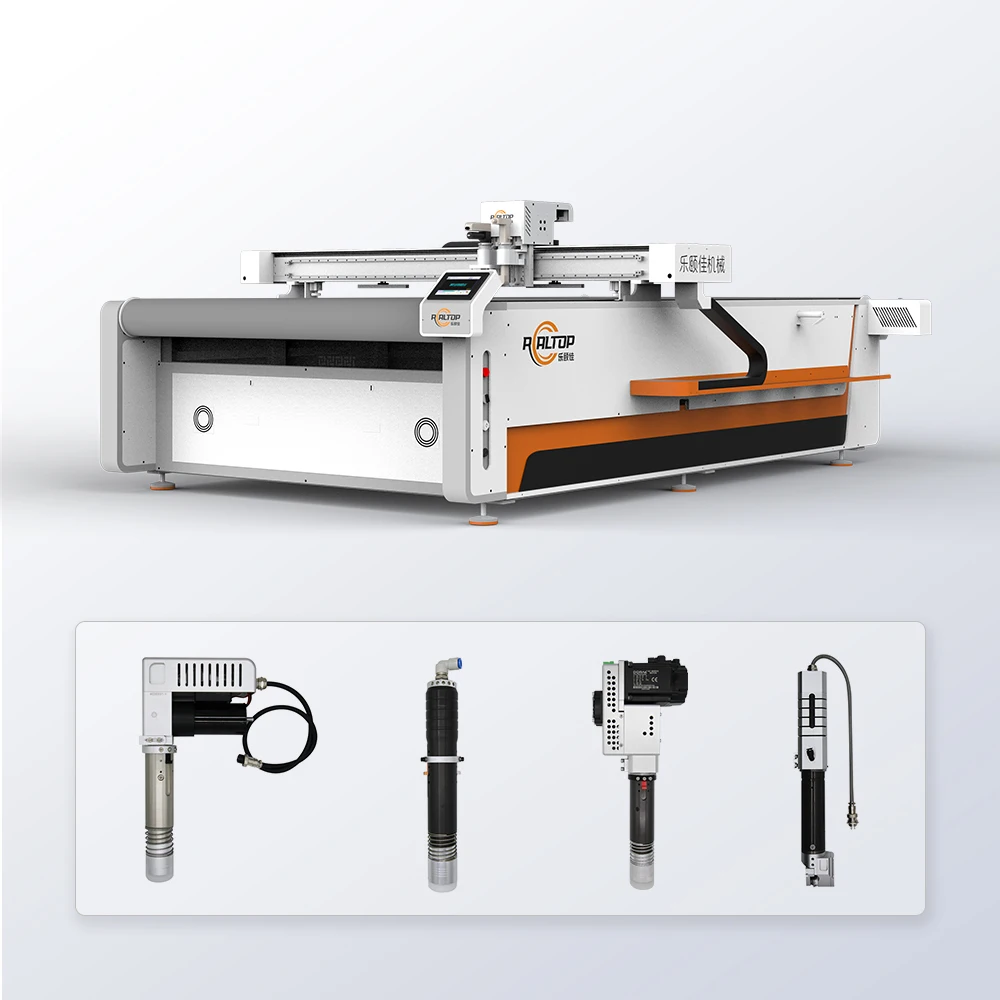
Tool head matched to material — Swiss oscillating knife configured for single-layer stretch fabric or multi-layer layup, selected after sample cutting on your actual cloth.
Technical Specifications
| Parameter | Value |
|---|---|
| Product Type | CNC Oscillating Knife Cutting Machine |
| Model | RT-D2516/RT-S2516 |
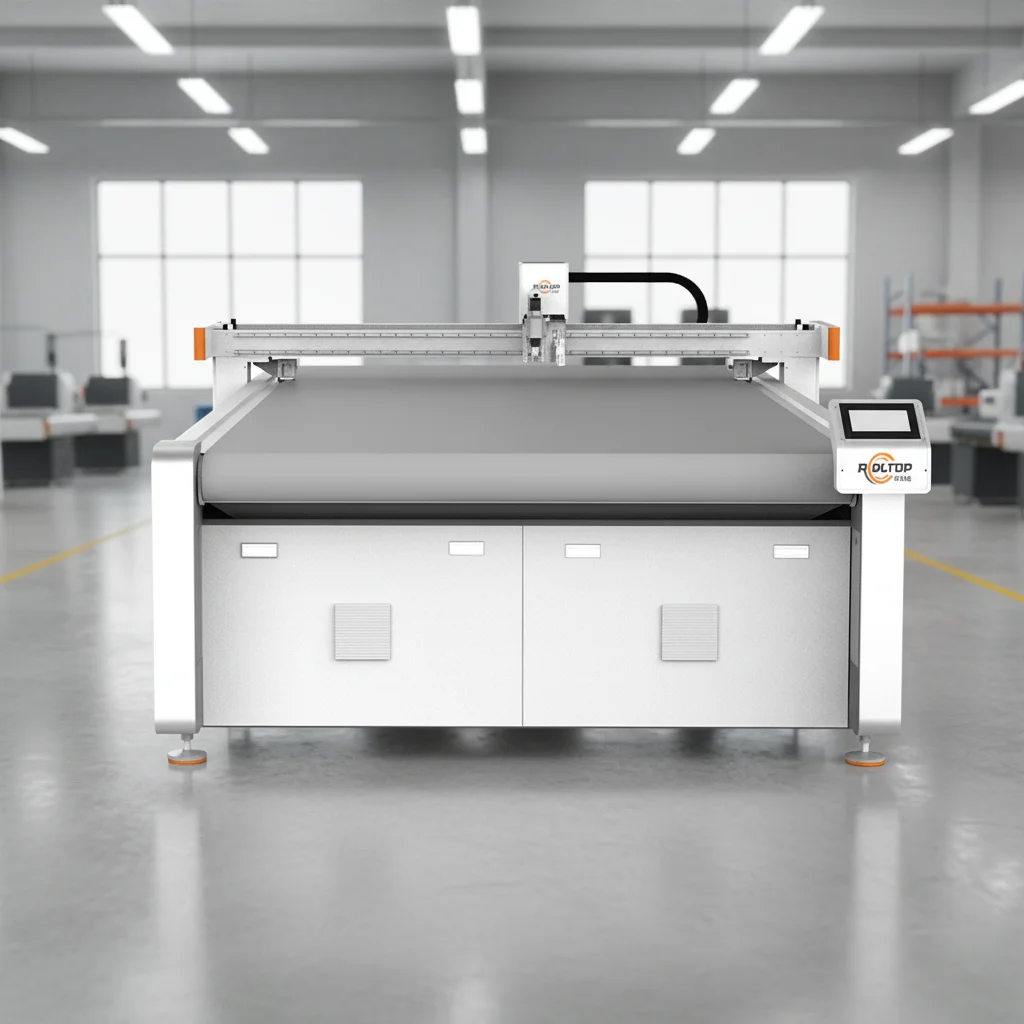
| Working Area | 1600×2500 mm |
| Machine Size | 3450×2300×1250 mm |
| Rated Power | 9 kW |
| Translational Velocity | 800–2000 mm/s |
| Cutting Speed | 200–800 mm/s (basis to be confirmed per material and thickness) |
| Repeated Accuracy | ≤0.1 mm |
| Cutting Thickness | ≤100 mm (varies with material) |
| Transmission System | Digital servo motor, linear guide, synchronous belt, ball screw |
| Vacuum Platform | Aluminum air box platform, integrated or split box adsorption |
| Auto Feeding | Germany imported conveyor belt |
| Vacuum Pump | 7.5 kW |
| Tool Head Options | Oscillating knife, pneumatic knife, high-power vibrating knife, circular knife, V cutting knife, drag knife, creasing wheel, dotted line knife, punching, brush |
| Visual Positioning Options | Small CCD camera mark point positioning, panoramic camera recognition positioning, projection positioning |
| Nesting Software | Auto typesetting, supports PLT, DXF, AI formats |
| Control Panel | Touch screen, multiple language supported |
| Voltage | 380V±10% |
| Servo Motor Options | Made in China or made in Japan (Panasonic or Delta) |
| Instruction System | HP-GL compatible format |
Application Suitability
| Application | Material or Output |
|---|---|
| Garment batch cutting | Clothing cloth, non-woven fabric, stretch knit and woven textiles in single or multi-layer layup |
| Footwear and luggage production | Shoe material, luggage material, PU, EVA, sponge composite leather |
| Automotive interior trimming | Sponge composite leather, carbon fiber preform, XPE foam, gasket material |
| Packaging and carton sample making | Corrugated cardboard, sticker, film, foam board |
| Soft home furnishings | Carpet, floor mat fabric, curtain textile, upholstery cloth |
| Composite and technical textile fabrication | PTFE, ETFE, fiberglass, rubber, silicon, PVC sheet |
Why Cutting Speed Claims Mean Nothing Without Your Fabric in the Machine
A circular cloth cutting machine rated at high translational velocity can still stall or produce ragged edges the moment it meets your specific high-elasticity spandex blend. The cutting speed of 200–800 mm/s listed on any CNC knife cutting machine production line is a range, not a promise — the actual figure depends on fiber composition, weave density, layer count and whether the material stretches under the feed belt. I have watched production managers receive equipment that ran flawlessly on standard cotton test swatches, only to see output drop sharply once their own stretch fabric hit the table.
Send your material first, verify the cut quality and feed rate on the exact cloth you will run in production.
When the knife frequency and feed speed are not tuned to the actual fabric behavior — especially high-stretch knits and elastane blends — the blade drags, the edge frays, and the nesting yield suffers. The auto feeding conveyor and vacuum hold-down must work together to keep the material flat without distorting the weave. Without a sample cutting report on your own roll, you are guessing [NEED_CITE: material-specific cutting parameters for technical textiles].
Matching the Tool Head to Your Fabric Behavior
The Swiss imported oscillating knife on the RT-D2516/RT-S2516 handles full cutting, half cutting and cursor location in a single head, but that is only the starting point. For loosely woven or high-stretch circular knit fabric, the vibration amplitude and blade geometry must be set so the blade severs fibers cleanly instead of pulling them. The turnkey cloth cutting solution only delivers when the tool head selection accounts for whether you are cutting a single ply of delicate mesh or a multi-layer layup of heavy fleece.
Pneumatic and circular knife options sit alongside the oscillating head for specific tasks — a circular knife suits long continuous cuts on roll goods, while a pneumatic knife can handle thicker compressed materials. The choice is never universal; it follows the material.
Vacuum Zoning and Fabric Stability on the Conveyor
Large-format roll fabric tends to lift at the edges once the knife exits a cut, especially on lightweight synthetics. The aluminum air box platform on this machine supports integrated or split box adsorption, meaning the vacuum zones can be matched to the nesting pattern. If your production involves many small pattern pieces — garment panels, shoe uppers, luggage components — split zoning keeps each section anchored independently so parts do not shift before the knife completes the contour.
The 7.5 kW vacuum pump must generate sufficient hold-down force across the 1600×2500 mm working area without pulling stretch fabrics out of shape [NEED_CITE: vacuum hold-down requirements for elastic textile cutting]. Balancing adsorption force against material distortion is a configuration decision, not a default setting.
Reading the Specs That Actually Affect Your Floor Output
The repeated accuracy of ≤0.1 mm matters most when you are nesting dozens of garment panels per sheet and the downstream sewing operation expects consistent seam allowances. If the machine drifts beyond that tolerance over a long cutting run, cumulative error pushes panels out of spec and increases fabric waste.
Translational velocity between 800 and 2000 mm/s governs how fast the head moves between cuts, while cutting speed between 200 and 800 mm/s is the actual blade-through-material rate. These two numbers together determine your real cycle time. A machine that travels fast between points but cuts slowly through thick multi-layer layup will not outperform one with a modest travel speed and a high knife frequency suited to your cloth weight.
The Delta or Panasonic servo motor options affect long-term positional stability. Japan-sourced servos tend to hold tighter tolerance over extended production shifts in hot workshop environments, though this comes at a configuration cost that should be weighed against your accuracy requirements.
The nesting software accepts PLT, DXF and AI files, which covers most garment and footwear pattern workflows. If your design team uses a proprietary CAD system, file format compatibility must be confirmed before the order is placed — not after the machine arrives.
The Hidden Cost of Skipping the Sample Cut
When a buyer specifies a cloth CNC cutting machine based only on working area and price, the first week of production often reveals problems that no brochure warned about. Ragged edges on stretch fabric, crushed foam cores, small pieces lifting off the table mid-cut — each of these defects traces back to a configuration mismatch that a sample cutting test would have caught. The rework cost in wasted material, delayed shipments and operator frustration typically exceeds the time it takes to send fabric rolls to the factory for a trial run [NEED_CITE: cost of configuration mismatch in CNC textile cutting].
Why Production Managers Source This Configuration Here
In-house design covering both oscillating knife and conveyor feeding means the RT-D2516/RT-S2516 is built around the cutting method your material requires, not forced into a single standard build.
Tool head and vacuum table configuration are specified per material and production volume, documented in a configuration list before production starts.
Sample cutting on your own fabric roll generates a cutting report showing edge quality, achievable speed and nesting yield before you commit to the order.
Software compatibility is confirmed against your existing PLT, DXF or AI nesting files so the workflow transitions without reprogramming.
Voltage, control language and electrical specifications are locked to your site requirements — the 380V±10 system is verified against your local supply standard before shipment.
Documentation & Verification
- Machine specification sheet listing the exact tool head and vacuum zoning assigned to your material
- Sample cutting report produced on your cloth, showing edge quality and speed achieved
- Electrical schematic with voltage and frequency matched to your facility supply
- Software licence and file format compatibility note for PLT, DXF and AI imports
- Factory test record documenting cutting accuracy across the full 1600×2500 mm table before packing
- Operation and maintenance manual in your selected control language
Installation, Commissioning & Support
- Foundation must be level and rated for the 3450×2300×1250 mm footprint with clearance for the auto feeding conveyor
- Dedicated 380V±10% circuit required for the 9 kW rated power draw and 7.5 kW vacuum pump
- Machine ships partially assembled; vacuum table and conveyor belt are aligned and calibrated on site
- First-run commissioning includes knife frequency and feed speed tuning on your production fabric
- Operator training covers nesting software setup, tool head changeover and vacuum zone adjustment
- Spare parts list includes Swiss knife blades, conveyor belt segments and vacuum pump filters
What to Include With Your Inquiry
Send the specific fabric type, weight per square meter, stretch percentage and whether you run single-ply or multi-layer layup. State your target daily output in cut pieces or linear meters and the nesting file format your design team currently uses. Confirm your site voltage, frequency and preferred control panel language so the electrical and software configuration is locked before production begins.
Frequently Asked Questions
Q: How do I know which tool head suits my stretch knit fabric?
A: The oscillating knife, circular knife and pneumatic knife each behave differently on elastic textiles. We run a sample cut on your actual fabric roll, adjusting knife frequency and blade type until the edge is clean and the material does not distort. The final tool head selection is documented in your configuration list before the machine is built.
Q: Will the nesting software work with my existing design files?
A: The auto typesetting software supports PLT, DXF and AI file formats. Before you place an order, we import your production files and verify that pattern geometry, kerf compensation and grain line markers transfer correctly. If your CAD system outputs a different format, we confirm compatibility or recommend a conversion workflow.
Q: What vacuum zoning do I need for small garment panels?
A: Small pattern pieces tend to lift from the table when the knife exits a contour. The split box adsorption option on the aluminum air box platform lets you activate vacuum only under the active cutting zone, keeping small parts anchored without wasting suction on empty table area. Zoning is configured based on your typical nesting layout.
Q: How is the machine calibrated for my local power supply?
A: The standard voltage is 380V±10%, but your local supply frequency and tolerance may differ. We confirm your exact voltage and frequency during the inquiry stage, provide an electrical schematic for your electrician to review, and build the electrical cabinet to match. Servo motor options are also selected at this stage.
Q: What does on-site installation and training involve?
A: After the machine is positioned on a level foundation with the required power circuit, our technician aligns the conveyor belt and vacuum table, tunes knife parameters on your fabric, and trains your operators on software operation, tool head changeover and daily maintenance. A spare parts kit and maintenance manual are included.




商品评价
Clear filtersThere are no reviews yet.