



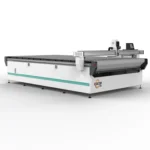


Tool head and table configuration specified per material and production volume — an oscillating knife cutting platform configured from blade profile to vacuum zoning based on your actual fabric ply count and pattern size, not a generic working-area quote.
Technical Specifications
| Parameter | Value |
|---|---|
| Product Type | CNC Oscillating Knife Cutting Machine with Auto Nesting |
| Effective Cutting Size | 2500×1600 / 2500×1800 / 2500×2000 / 3000×1600 / 3000×2000 mm |
| Max Idle Speed | 2500 mm/s |
| Actual Cutting Speed | 500–2000 mm/s (depending on material thickness and hardness) |
| Repeated Positioning & Cutting Accuracy | ±0.1 mm (depending on material thickness and hardness) |
| Cutting Depth Control Accuracy | 0.03 mm |
| Repeatability | ±0.01 mm |
| Cutting Head | Imported MAXON oscillating knife head |
| Blade Options | Tungsten steel 35# / 26# / 16# |
| Laser Module | 150W CO2 (rated or peak not specified in source) |
| Motor / Drive | Imported Delta drive; optional Japanese Yaskawa / Panasonic servo |
| Framework | CO₂ protection welded bed, secondary vibration aging treatment |
| Guide Rail / Rack | Taiwan HIWIN guide rail / Taiwan YYC rack |
| Conveyor Belt | 4 mm Holland imported Ammeraal felt |
| Voltage | 380V or 220V (optional) |
| Air Pump Power | 9 kW |
| Main Motor Power | 2 kW |
| Control Interface | 7-inch LCD touch screen |
| Software | CUT-REALTOP with intelligent auto nesting module |
| Data Transfer | Ethernet interface |
| Total Weight | 1300 kg |
| Feeding Method | Fixed table or auto-feeding (optional) |
Application Suitability
| Application | Material or Output |
|---|---|
| Garment batch cutting | Multi-layer woven, knit, and technical fabric with nested pattern layout |
| Footwear upper and lining | Natural leather, synthetic leather, textile composites |
| Automotive interior trim | Seat cover fabric, headliner material, door panel insert composites |
| High-volume textile production | Roll-fed multi-layer fabric with auto-feeding conveyor |
| Technical gasket and foam | Closed-cell foam, rubber sheet, non-metallic gasket stock |
Why Vacuum Zoning Matters More Than Working Area on a Fabric Cutting Table
A large-format table with undifferentiated vacuum pull will lose hold on small nested pattern pieces, causing fabric lift and ruined plies mid-cut.
Production managers sourcing a CNC Oscillating Knife Cutting Machine for fabric production often anchor the decision on bed size alone — a 3000×2000 table looks capable until the nesting layout produces dozens of small pieces near the table edge. Without adequate vacuum zoning, the outer zones cannot generate sufficient hold-down force, and lightweight fabric plies shift during high-speed knife travel [NEED_CITE: vacuum hold-down requirements for multi-ply textile cutting]. The result is ragged edges on the smallest pattern pieces and ply displacement that compounds across the entire lay.
I watched this happen at a garment factory where the cutting table was specified on working area without a vacuum map review. Small collar and cuff pieces consistently drifted during the final passes, forcing operators to re-cut from separate lays and adding unplanned fabric waste to every batch.
How the Nesting Module Translates Pattern Complexity into Material Yield
The CUT-REALTOP intelligent automatic nesting module calculates piece placement across the fabric width to minimize offcut waste. For garment and footwear producers running dozens of pattern pieces per style, the module handles irregular contours — curved armholes, tapered leg panels, asymmetric upper shapes — and rotates pieces to find the tightest arrangement. The auto nesting fabric cutter workflow moves from DXF or PLT import directly to the cutting queue, reducing the gap between pattern design and shop-floor output.
Roll-Fed Workflow for Continuous Garment and Textile Runs
When daily volume justifies it, the optional auto-feeding conveyor with the 4 mm Ammeraal felt belt enables a continuous roll-to-cut sequence. The fabric advances, the oscillating knife completes the nested layout, and the belt indexes forward for the next lay — all without an operator manually repositioning the material. For high-volume garment lines cutting hundreds of plies per shift, this removes the manual lay-and-reset cycle that otherwise limits throughput [NEED_CITE: continuous feeding benefits in multi-layer textile cutting operations].
Blade Selection, Vacuum Zones, and the Specs That Decide Cut Quality
The imported MAXON oscillating knife head with tungsten steel blades in 35#, 26#, and 16# profiles determines edge character across different fabric weights. A heavier 35# blade suits dense multi-layer woven stacks, while a narrower 16# blade suits single-ply technical textiles where edge compression must be minimized. Cutting speed ranges from 500 to 2000 mm/s depending on material thickness and hardness, and the 0.03 mm depth control accuracy lets the operator set the knife to penetrate exactly the required ply count without scoring the conveyor belt underneath. The HIWIN guide rail and YYC rack deliver the ±0.1 mm positioning accuracy needed for pattern pieces that will be sewn together with tight seam allowances. Vacuum zoning across the table surface should be confirmed against your smallest nested piece size, because uniform pull across a 3000×2000 mm bed does not guarantee hold-down on a 40 mm collar tab [NEED_CITE: vacuum zoning standards for CNC flatbed cutting tables].
What Happens When the Blade Profile and Fabric Type Are Mismatched
Specifying the oscillating knife head without testing against your actual fabric composition leads to predictable failures. A standard blade on TPU-coated composite fabric generates heat at the cut edge, fusing adjacent plies together and producing rejects that are not discovered until the sewing line opens the bundle. I spent two days on-site at a Dubai workshop recalibrating after exactly this scenario — the sample cutting had used standard polyester, but production ran on coated composites, and the edge melt contaminated an entire batch. Request a sample cutting report on your own material at your target ply count before the order is finalized [NEED_CITE: material-specific cutting validation in textile manufacturing].
What Distinguishes This Platform for Production Buyers
In-house design and production covers both knife and laser cutting technologies, so the cutting method is matched to the material rather than forced into one approach. Tool head and table configuration is specified per material and production volume, meaning the blade, vacuum zoning, and feeding method all respond to the actual fabric and daily output. CCD camera positioning is available for printed contour work where pattern alignment depends on registered marks. Software compatibility is confirmed before order to ensure your existing DXF, PLT, or AI pattern files import without re-drawing. Voltage, language, and control specification customization aligns the machine to the facility’s electrical standard and operator interface requirements.
Documentation & Verification
- Machine specification sheet listing confirmed blade profile and vacuum zone count
- Electrical schematic with voltage, plug type, and frequency for your facility
- Tool head and table configuration list matched to your fabric type and ply count
- Sample cutting report on your actual fabric at production thickness before dispatch
- Software license and file format compatibility note for your CAD workflow
- Spare parts list identifying blades, felt belt sections, and pneumatic wear items
Installation, Commissioning & Support
- Floor space planning for the 3000×2000 mm maximum format plus roll-feed clearance
- Dedicated 380V or 220V circuit with confirmed amperage for the 9 kW air pump and 2 kW main motor
- Machine arrives as a single welded frame — confirm workshop door width against 1300 kg unit
- First-run parameter setting for oscillating frequency, knife depth, and vacuum zone calibration
- Operator training on CUT-REALTOP nesting module, file import, and red-light preview positioning
- Blade replacement schedule and Ammeraal felt belt tensioning procedure documented in manual
Before You Request a Quote — What Production Managers Need to Provide
To configure the CNC Oscillating Knife Cutting Machine for fabric production accurately, share the fabric types and thicknesses you run, the typical ply count per lay, and your maximum roll width or sheet size. Confirm your facility voltage and frequency, the control interface language your operators require, and whether your existing pattern CAD files are in DXF, PLT, or another format. If you need continuous roll-fed cutting, provide the daily output target so the feeding method and nesting density can be matched.
Frequently Asked Questions
Q: How is cutting speed verified for my specific fabric type and ply count?
A: Actual cutting speed ranges from 500 to 2000 mm/s depending on material thickness and hardness. Before commitment, a sample cutting test is run on your actual fabric at your production ply count, and the resulting report documents the speed, blade profile, and edge quality achieved so you can confirm suitability before the order proceeds.
Q: Can the auto nesting module work with my existing pattern CAD files?
A: The CUT-REALTOP software with its intelligent automatic nesting module imports standard formats including DXF and PLT. File format compatibility is confirmed before the order is placed, and a test import of your actual pattern files verifies that contours, notch marks, and grain-line directions transfer correctly to the cutting queue.
Q: What vacuum zoning is available for small garment pieces versus large panels?
A: Vacuum table zoning is configured to match your pattern piece size range. Small nested garment pieces like collar tabs require concentrated hold-down across multiple zones, while large automotive panels use broader zone coverage. The zoning layout should be reviewed against your nesting output before production begins.
Q: How do I choose between fixed table and auto-feeding configuration?
A: Fixed-table suits sheet-fed or short-run fabric cutting where plies are manually laid. Auto-feeding with the Ammeraal conveyor belt suits continuous roll-fed production at higher daily volumes, advancing material automatically between nested cuts. Your daily output target and fabric roll width determine which configuration fits.
Q: Can I send my own material for sample cutting before committing?
A: Yes. The standard process requires sample cutting on the buyer’s own fabric material before the order is finalized. The resulting report documents edge quality, cutting depth, and blade performance at your specified ply count, giving production managers verified data rather than a generic demonstration on standard stock.


商品评价
Clear filtersThere are no reviews yet.