



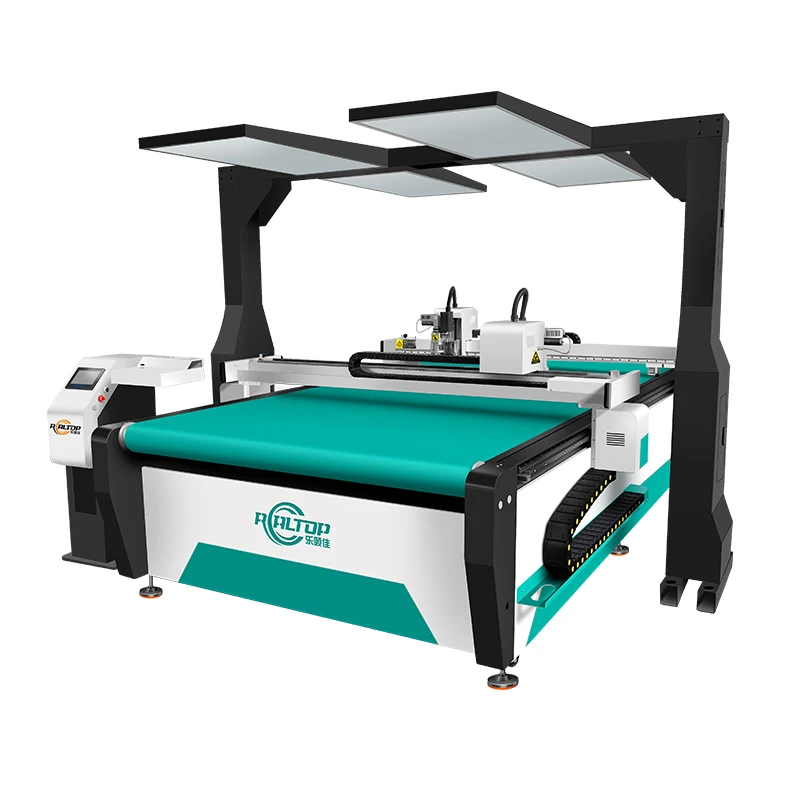
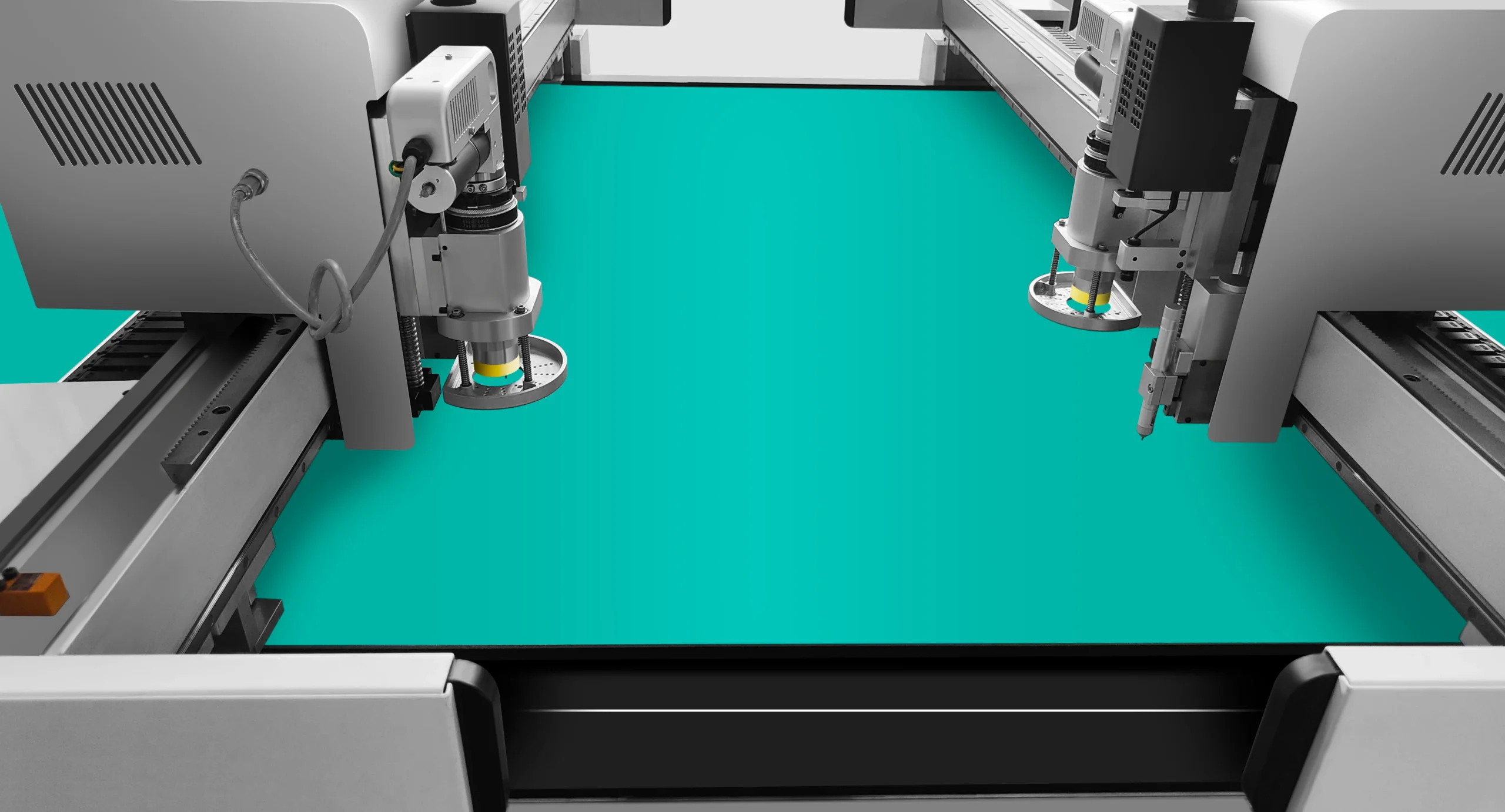
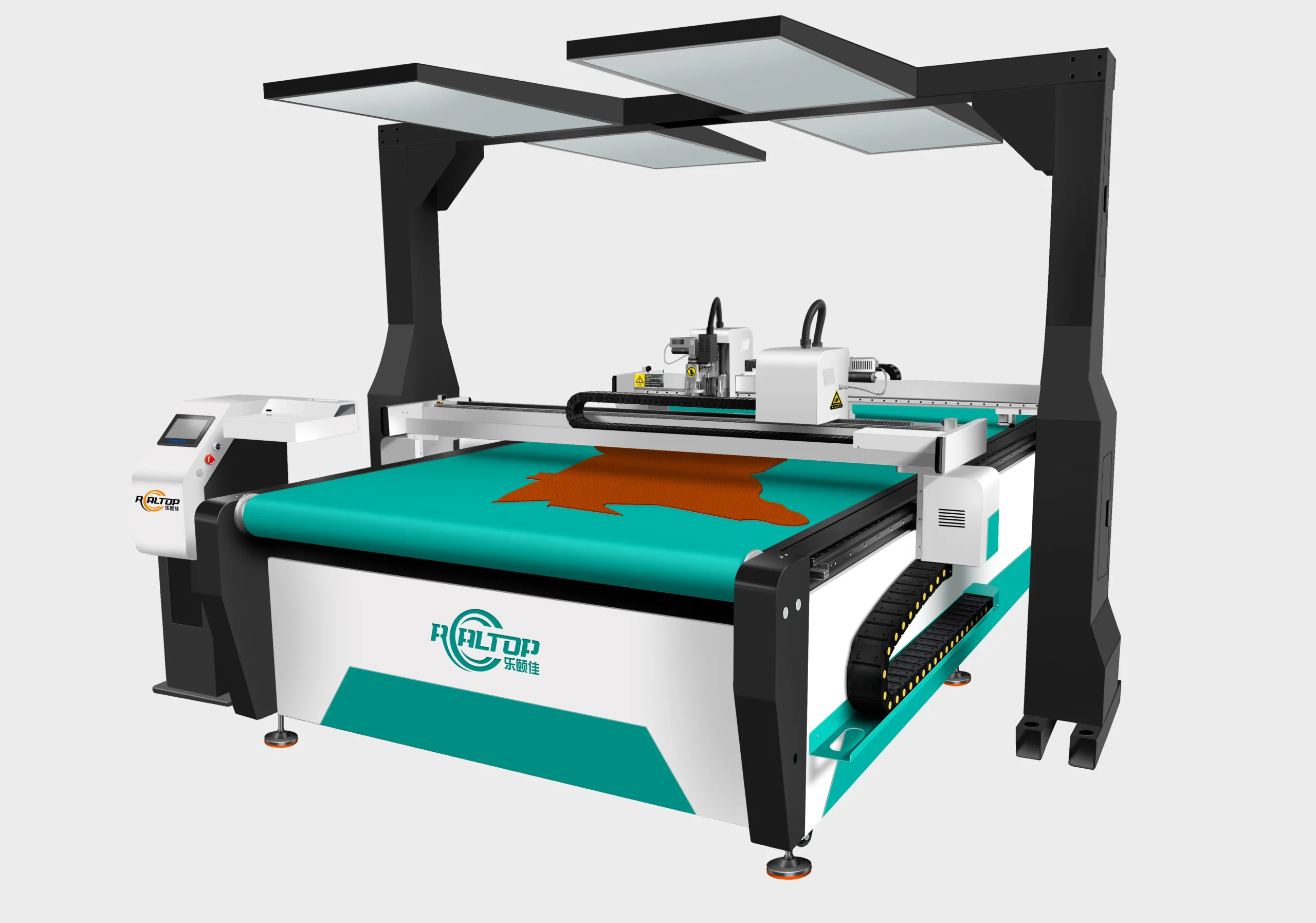
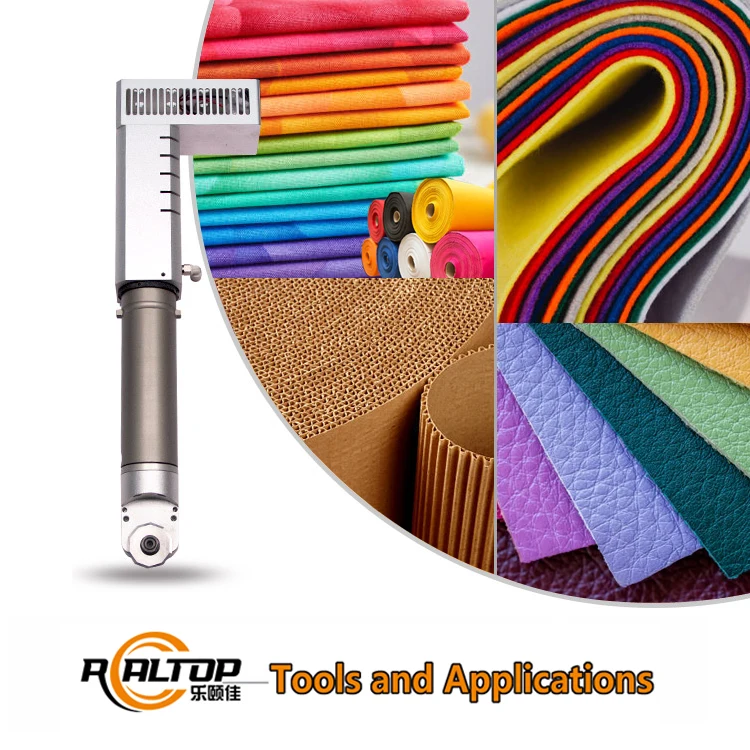

Multi-Tool Head Configuration — Oscillating knife, drag knife, creasing wheel and punching tools selected per leather type and thickness, not forced into a single cutting method.
Technical Specifications
| Parameter | Value |
|---|---|
| Model | RT-D2516/RT-S2516 |
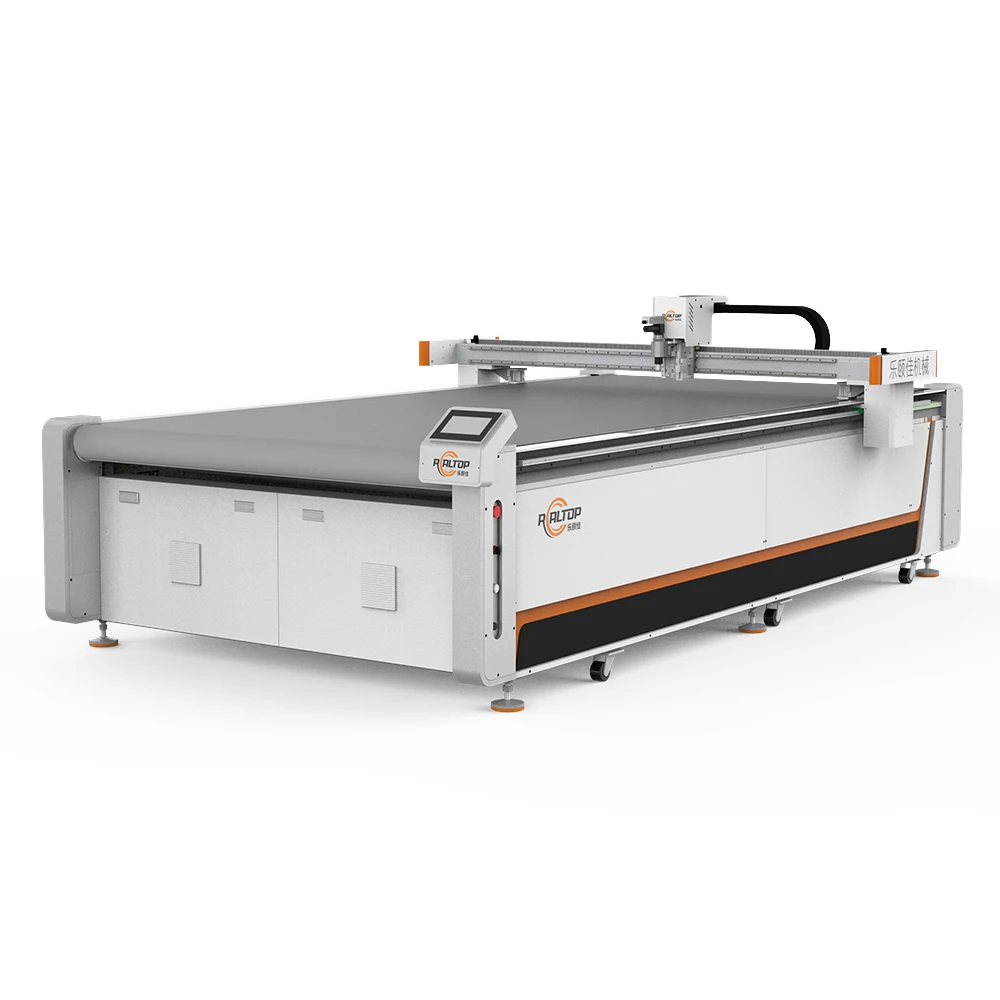
| Product Type | CNC Oscillating Knife Cutting Machine |
| Working Area | 1600×2500 mm |
| Overall Dimensions | 3450×2300×1250 mm |
| Rated Power | 9 kW |
| Voltage | 380V±10% (frequency to be confirmed) |
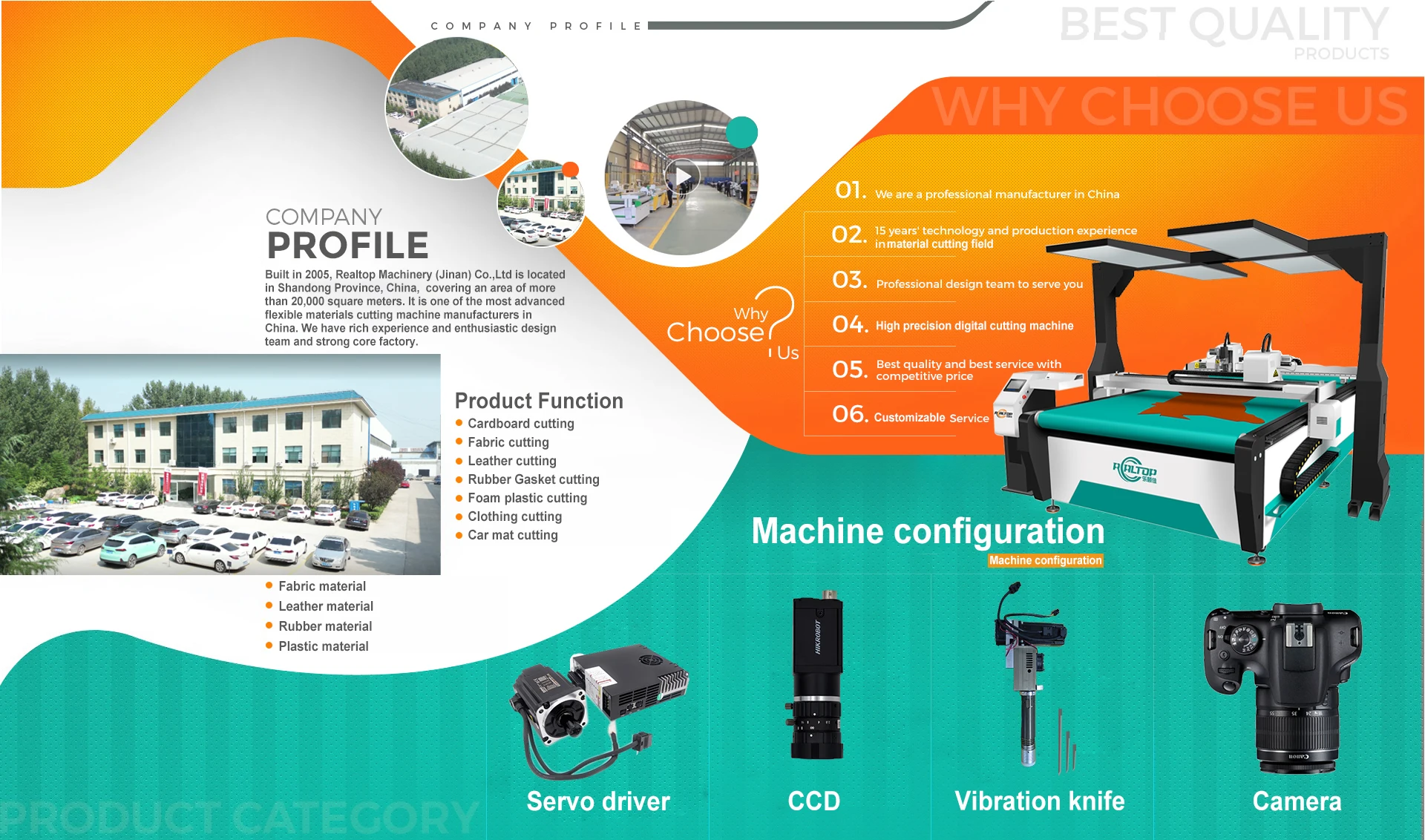
| Transmission System | Delta servo motor, Taiwan Hiwin linear guide rail, synchronous belt, ball screw |
| Positioning Accuracy | ≤0.1 mm (basis to be confirmed) |
| Translational Velocity | 800–1200 mm/s |
| Cutting Thickness | 20–80 mm (basis to be confirmed) |
| Tool Head Options | Oscillating knife, pneumatic knife, high-power vibrating knife, circular knife, V-cutting knife, drag knife, creasing wheel, dotted line knife, punching, brush |
| Vision System | CCD camera mark point positioning, panoramic camera recognition, projection positioning (optional) |
| Working Table | Flat vacuum table with aluminum alloy adsorption, 7.5 kW vacuum pump |
| Feeding System | Automatic pulling and receiving, Germany imported conveyor belt |
| Safety Device | Infrared sensors |
| Instruction System | HP-GL compatible format |
| Software | Realtop self-developed software, pattern cutting design software, multi-language support |
| Frame | Hard steel frame structure |
| Key Features | Automatic feeding, CCD contour recognition, multi-tool head, CE declaration where applicable |
Application Suitability
| Application | Material or Output |
|---|---|
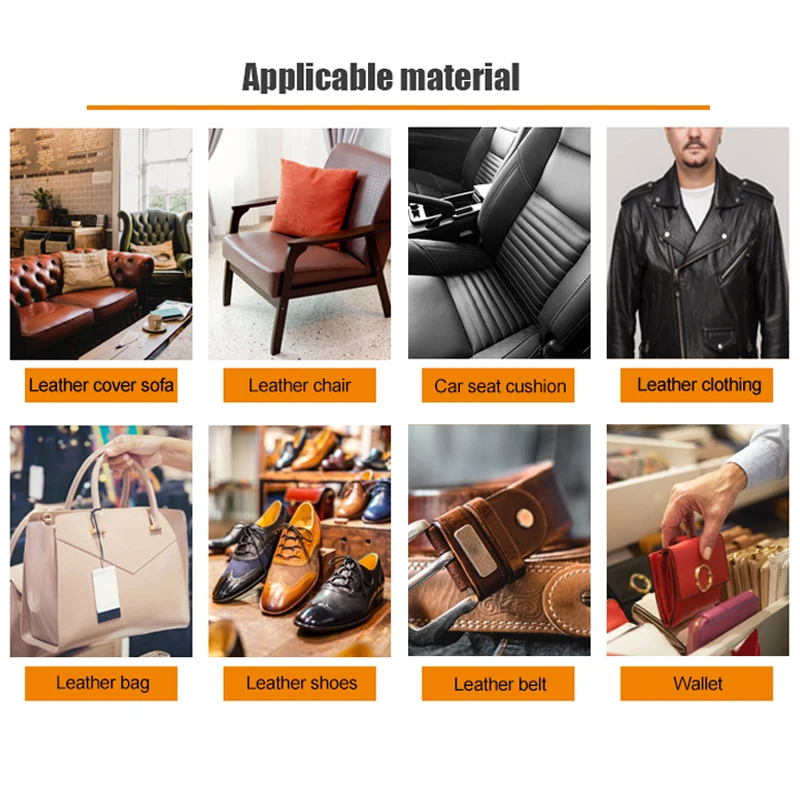
| Footwear and Leather Goods | Natural and synthetic leather hides for shoes, boots, luggage and handbags |
| Automotive Interior Production | Seat covers, door panels, floor mats from leather and composite materials |
| Garment and Luggage Manufacturing | Flexible fabrics, PU, EVA and composite layers in medium to high volume runs |
| Soft Home Furnishings | Upholstery leather, carpet and floor mat components |
| Gasket and Sealing Production | Rubber, gasket material and soft composite sheets |
Why the Wrong Tool Head Ruins Your Leather Cut Quality
Edge finish is decided by tool head selection before the machine ever runs.
A machine specified on working area alone, then found unable to handle the material thickness, is a common story. But the more frequent failure happens when the tool head is wrong for the leather. Natural cowhide behaves completely differently from synthetic PU leather under the blade. Natural leather has variable density and fibrous structure that demands a high-power vibrating knife to push through cleanly, while synthetic materials often require a precise oscillating knife to prevent melting or ragged edges. We saw a workshop cutting automotive seat covers with a drag knife meant for vinyl, and the result was frayed edges on every curved section [NEED_CITE: leather cutting edge quality standards for automotive suppliers]. The buyer blamed the machine when the real issue was a tool head mismatch.
Leather CNC Cutting Machine Production Workflow Throughput
The leather CNC cutting machine production workflow throughput depends entirely on how your material stack and daily volume are matched to the machine’s configuration. A footwear factory cutting thin synthetic leather for shoe uppers needs different vacuum zoning and feed rates than an automotive supplier processing thick natural hides for seat covers. The automatic feeding system with conveyor belt integration allows continuous roll or sheet workflow, but only when the vacuum table zoning is correctly specified for your smallest part size.
Vacuum Hold-Down and Small Part Stability
Vacuum table zoning is where most leather cutting operations fail without warning. When you cut small components like belt loops, zipper tabs or decorative patches, a single-zone vacuum table loses suction across the remaining surface area, and those small pieces lift during the final cuts. The 7.5 kW vacuum pump on this system provides strong adsorption, but the aluminum alloy table must be zoned to match your part layout [NEED_CITE: vacuum table zoning requirements for small part cutting]. Without proper zoning, the blade catches the lifted edge, creates a ragged cut, and can damage the knife tip. We configure the vacuum zones based on your actual nesting pattern and smallest component dimensions before the table is built.
Inside the Drive and Motion System
The Taiwan Hiwin linear guide rails and Delta servo motors provide the repeatability required for long production runs where hundreds of identical leather pieces must cut within tolerance. The synchronous belt and ball screw transmission system translates motor rotation into precise linear motion, and the hard steel frame structure prevents vibration from accumulating across the 1600×2500 mm working area. When you run a nesting pattern with fifty shoe upper pieces, each one must match the next within the positioning accuracy specification, or your downstream stitching operators will reject the batch.
Spec Interpretation for Your Production Reality
The 9 kW rated power covers the vacuum pump, servo drives, and tool head motors combined, which means your facility’s electrical supply must handle this continuous draw plus any startup surge from the vacuum pump. The 380V±10% voltage specification requires confirmation of your local frequency at 50 Hz or 60 Hz before the control system is configured. The translational velocity of 800–1200 mm/s represents the maximum travel speed between cuts, not the actual cutting speed through material, which varies with leather thickness and density. The cutting thickness range of 20–80 mm must be verified against your specific leather type, because a dense natural hide at 30 mm thickness may require different tool head pressure than a soft foam composite at the same thickness.
The Hidden Cost of Wrong Configuration Choices
When the CCD camera contour recognition is promised but cannot track printed marks at production speed, you end up with misaligned cuts on printed leather patterns and wasted material [NEED_CITE: CCD contour recognition accuracy requirements for printed leather]. When the software cannot import your existing DXF or PLT file format, your design team spends hours recreating patterns that should transfer directly. When voltage and control language are not confirmed before shipment, the machine arrives and sits idle while you source a transformer or struggle with a control panel in a language your operators cannot read.
Why Source From This Workshop
The in-house design team covers both knife and laser cutting technologies, so your leather application is matched to the correct cutting method rather than forced into one approach. Tool head and table configuration are specified per your material type and production volume, with a sample cutting report on your own leather before commitment. CCD camera positioning is tested on your printed patterns to verify contour recognition at your target production speed. Software compatibility with your existing nesting workflow is confirmed before the order is placed. Voltage, control language and electrical specifications are verified against your facility requirements before the machine leaves the factory [NEED_CITE: electrical specification verification for industrial equipment export].
Documentation & Verification
- Sample cutting report on your leather type and thickness before order confirmation
- Tool head and vacuum table zoning configuration list matched to your material stack
- Electrical schematic and voltage confirmation for your facility’s supply frequency
- Software licence and file format compatibility note for your DXF or PLT workflow
- Factory test record showing positioning accuracy across the full working area
- Operation and maintenance manual in your specified control language
Installation, Commissioning & Support
- Foundation requirements for the 3450×2300×1250 mm footprint with level concrete floor
- Dedicated 380V circuit with capacity for 9 kW continuous draw plus vacuum pump startup surge
- Fully assembled unit with factory test before shipment, positioned and leveled on arrival
- First-run parameter setting for your specific leather type, thickness and nesting pattern
- Operator training on tool head changes, vacuum zoning adjustment and software import procedures
- Spare parts list with oscillating knife blades, vacuum pump filters and guide rail lubrication schedule
Before You Request a Quote
Provide your leather type, thickness range and whether you process natural hides or synthetic rolls. Specify your daily production volume and the smallest component size in your typical nesting pattern. Confirm your facility’s voltage, frequency and the control language your operators require. If you run existing nesting software, share the file format so compatibility can be verified before commitment.
Frequently Asked Questions
Q: How is cutting thickness verified for my specific leather type?
A: We require a sample of your actual leather or composite material to run test cuts before order confirmation. The sample cutting report documents edge quality, cutting depth achieved and cycle time for your specific material stack, so you know the machine handles your production requirements before commitment.
Q: Which tool head works for natural leather versus synthetic materials?
A: Natural leather with fibrous structure typically requires a high-power vibrating knife to cut cleanly through variable density, while synthetic PU or EVA often performs better with an oscillating knife to prevent edge melting. The wrong tool head causes ragged edges, crushed material or excessive blade wear depending on the mismatch.
Q: How does CCD contour recognition perform on printed leather patterns?
A: The panoramic camera and CCD mark-point positioning system is tested on your actual printed patterns to verify tracking accuracy at production speed. We confirm the system can identify and follow your registration marks before the vision system is finalized for your machine configuration.
Q: What vacuum table zoning do I need for small leather components?
A: The vacuum table zoning is configured based on your smallest component size and typical nesting pattern. Without proper zoning, small parts like zipper tabs or decorative patches lose hold-down force and lift during cutting, causing ragged edges and potential knife damage.



商品评价
Clear filtersThere are no reviews yet.