




Material-Matched Configuration — every oscillating knife, drag knife and vacuum zone is selected after a cutting test on your actual cloth roll, not guessed from a catalogue grid.
Technical Specifications
| Parameter | Value |
|---|---|
| Model | RT-D2516 / RT-S2516 |
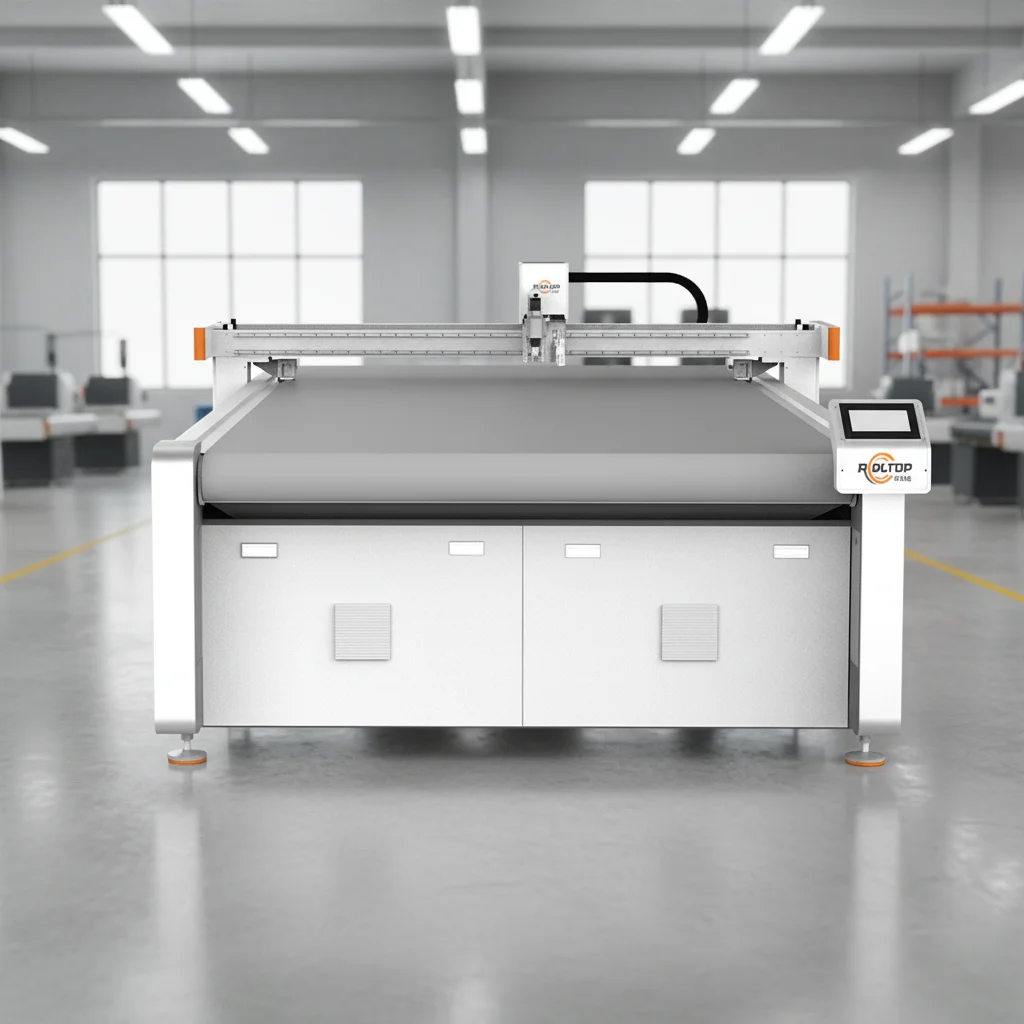
| Product Type | CNC Oscillating Knife Cutting Machine for Cloth and Flexible Materials |
| Working Area | 1600 × 2500 mm |
| Machine Footprint | 3450 × 2300 × 1250 mm |
| Rated Power | 9 kW |
| Voltage | 380V ±10% |
| Translational Velocity | 800–2000 mm/s |
| Cutting Speed | 200–800 mm/s (basis not stated in source — confirm material, thickness and tool head) |
| Cutting Thickness | ≤100 mm (varies with material density and tool head selection) |
| Repeated Accuracy | ≤0.1 mm |
| Transmission System | Digital servo motor, linear guide, synchronous belt, imported ball screw |
| Servo Motor Options | Delta (China) or Panasonic (Japan) |
| Table Type | Flat working table or auto-feeding conveyor (optional) |
| Vacuum Pump | 7.5 kW |
| Vacuum Table Surface | Magnesium-aluminum alloy with PVDF fluorocarbon powder spray and anodic oxidation |
| Tool Head Options | Oscillating knife, pneumatic knife, high-power vibrating knife, circular knife, V-cutting knife, drag knife, creasing wheel, dotted line knife, punching, brush |
| Visual Positioning | Small CCD mark point positioning, panoramic camera recognition, projection positioning |
| Safety Devices | Infrared induction blocking, beam-side anti-collision, emergency stop |
| Control Panel | Touch screen with multi-language support |
| Software File Formats | PLT, DXF, AI with auto nesting |
| Warranty | 1 year |
| Assembly State | Fully assembled and factory tested before shipment |
Application Suitability
| Application | Material or Output |
|---|---|
| Garment and footwear production | Single or multi-layer woven fabric, knit textile, lining, shoe upper material, synthetic leather |
| Soft home furnishing | Sofa upholstery fabric, curtain cloth, carpet, non-woven textile, fur |
| Luggage, bags and travel goods | Nylon, canvas, PU, EVA foam, XPE composite sheets |
| Automotive interior trimming | Cloth-backed composites, headliner fabric, sound-deadening textile layers |
| Technical textile and gasket | PTFE, ETFE, fiberglass cloth, silicone sheet, rubber sealing pads |
Why Software Compatibility Breaks the Cloth CNC Cutting Machine Production Line Workflow
Confirming PLT, DXF and AI file import before order prevents the nesting software from becoming a bottleneck on day one.
A garment factory in Southern Europe once received a flatbed cutter that could not open their existing DXF pattern library, forcing the CAD team to redraw three seasons of styles. The cloth CNC cutting machine production line workflow stalled for two weeks while the software vendor patched a custom translator [NEED_CITE: common DXF entity translation failures in nesting software]. When the nesting engine finally ran, the auto-typesetting algorithm ignored the fabric grain direction, pushing waste above what the buyer had budgeted. These problems surface only after the machine is bolted to the floor and the first roll is loaded.
Matching the Tool Head to the Fabric Weight
Selecting the correct oscillating or circular knife is the first decision that shapes edge quality on woven and knit cloth. A single-layer silk chiffon demands a high-frequency, low-amplitude vibrating blade to prevent fraying, while a 60-layer stack of denim requires a pneumatic knife with enough stroke to shear through the full bundle without dragging the bottom plies. The RT-D2516 / RT-S2516 offers oscillating, pneumatic, high-power vibrating, circular and drag knife heads that can be swapped as the order book shifts between light apparel cloth and heavy shoe material. Running the wrong head on a technical textile like fiberglass-reinforced composite dulls the blade within hours and leaves ragged edges that fail downstream sewing inspection.
Holding Small Pattern Pieces Flat Under the Knife
Garment patterns often include collar stays, pocket flaps and belt loops smaller than 80 mm across. A single-zone vacuum table cannot generate enough hold-down force on these pieces once the surrounding fabric is cut away, allowing the oscillating blade to lift and skip. The magnesium-aluminum alloy table on this system is segmented so that vacuum can be directed only to the zone where the knife is working, keeping micro-patterns pinned without wasting suction on empty bed space [NEED_CITE: vacuum zoning practices for small-part digital cutting]. The 7.5 kW pump maintains stable negative pressure even when cutting porous non-woven or loosely woven linen that would otherwise bleed air and lose grip.
Reading the Numbers That Actually Matter in the Shop
A 9 kW rated power figure tells the electrical contractor what breaker size to pull, but it is the 200–800 mm/s cutting speed range that defines how fast the cloth CNC cutting machine production line workflow can feed the sewing floor — and that range only holds true when material thickness and tool head are specified together. The ≤0.1 mm repeated accuracy ensures that nested patterns stay within tolerance across a full 1600 × 2500 mm bed, which matters when a shirt front and its matching back panel are cut hours apart. Imported ball screws and linear guides keep the carriage tracking straight over long shifts, preventing cumulative drift that would otherwise show up as mismatched seam lengths. Servo options from Delta or Panasonic let buyers align spare parts sourcing with their existing automation inventory.
The Cost of Skipping the Cutting Test
Ordering a cloth CNC cutting machine on working area alone, then discovering the chosen tool head crushes rather than shears your foam-backed automotive textile, turns a capital investment into a downtime event. The blade chatters, the edge seals poorly, and the cutting speed must be dialed back to keep quality acceptable [NEED_CITE: tool wear rates on composite automotive textiles]. Small garment pieces lift off an un-zoned vacuum bed, forcing operators to hand-hold them and destroying any throughput advantage the machine promised. Voltage mismatches surface later, when the 380V servo drive trips on a 415V supply and the factory electrician has to source a step-down transformer before the line can restart.
Why Production Managers Source This Cutter Here
In-house design covers both knife and CCD vision systems, so the cutting method is matched to the material rather than forced into a single technology. Every tool head and vacuum zone is specified per fabric weight, layer count and daily volume after a sample cut on the buyer’s own cloth. CCD camera and panoramic positioning are confirmed against the buyer’s printed registration marks at full traverse speed before the machine leaves Jinan. Software compatibility for PLT, DXF and AI nesting workflows is verified in writing before the order is locked. Voltage, plug type, control panel language and safety labeling are customized to the destination market, not left as a surprise at un-crating.
Documentation & Verification
- Factory test record on your fabric type with edge quality photos and cycle time logged
- Tool head and vacuum zone configuration list matched to your material stack-up
- Software licence key with confirmed PLT, DXF and AI nesting file compatibility
- Electrical schematic showing 380V ±10% wiring, breaker rating and servo drive map
- CE declaration covering machinery and low-voltage directives for export markets
- Sample cutting report on your cloth with measured accuracy and blade wear note
Installation, Commissioning & Support
- Requires a level concrete floor capable of supporting the 3450 × 2300 mm footprint plus roll feed clearance
- Dedicated 380V three-phase circuit rated for 9 kW continuous load plus 7.5 kW vacuum pump
- Arrives fully assembled; only conveyor extension and vacuum hose connection needed on site
- First-run parameter tuning for your fabric weight, layer count and chosen tool head
- Operator training covers nesting software import, CCD mark teaching and tool change procedure
- Spare oscillating and circular blades, vacuum seals and drive belts included in first shipment
What We Need to Quote the Right Configuration
Send a fabric swatch or roll sample, the range of material weights and layer counts you plan to cut, and your target daily output in linear meters or pattern pieces. Confirm the local voltage and frequency, the control language your operators prefer, and whether your existing CAD system exports PLT, DXF or AI. If you run printed textiles that require contour cutting, include a sample with registration marks so the CCD camera can be tested before shipment.
Frequently Asked Questions
Q: How is cutting speed verified against my specific cloth type and layer count?
A: We run your actual fabric sample — single-layer through full stack — on the selected tool head, then record the maximum speed that still delivers a clean edge. The resulting figure is written into the sample report, so the 200–800 mm/s catalogue range is replaced by a number tied to your material.
Q: Which tool head is recommended for my fabric weight — single-layer versus multi-layer?
A: Light apparel cloth under 200 gsm typically runs on a high-frequency oscillating knife for clean edges, while multi-layer denim or technical stacks need a pneumatic knife with deeper stroke. We match the head to your heaviest scheduled material and include quick-change tooling so lighter jobs can switch back.
Q: Does the nesting software integrate with my existing PLT, DXF and AI pattern files?
A: Yes. Before order confirmation we import a set of your production files, run the auto-typesetting engine, and send you the nesting layout plus grain-direction handling report. Any entity translation issues are resolved while the machine is still in build, not after it reaches your floor.
Q: What vacuum table zoning is needed when cutting small garment pattern pieces?
A: The magnesium-aluminum table is divided into independently valved zones. When cutting collars, cuffs or pocket flaps, only the active zone under the knife head is energized, preventing small parts from shifting while the rest of the bed remains at lower suction to save energy.
Q: How does CCD contour tracking perform on printed fabric marks at full production speed?
A: We test the small CCD or panoramic camera against your printed registration marks at the traverse speed your job requires. If the fabric surface is glossy or the ink contrast is low, we adjust lighting and lens settings during the sample cut, then document the successful tracking parameters before shipment.





商品评价
Clear filtersThere are no reviews yet.