


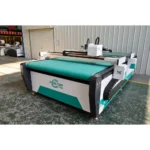
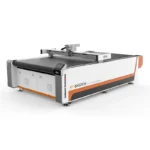

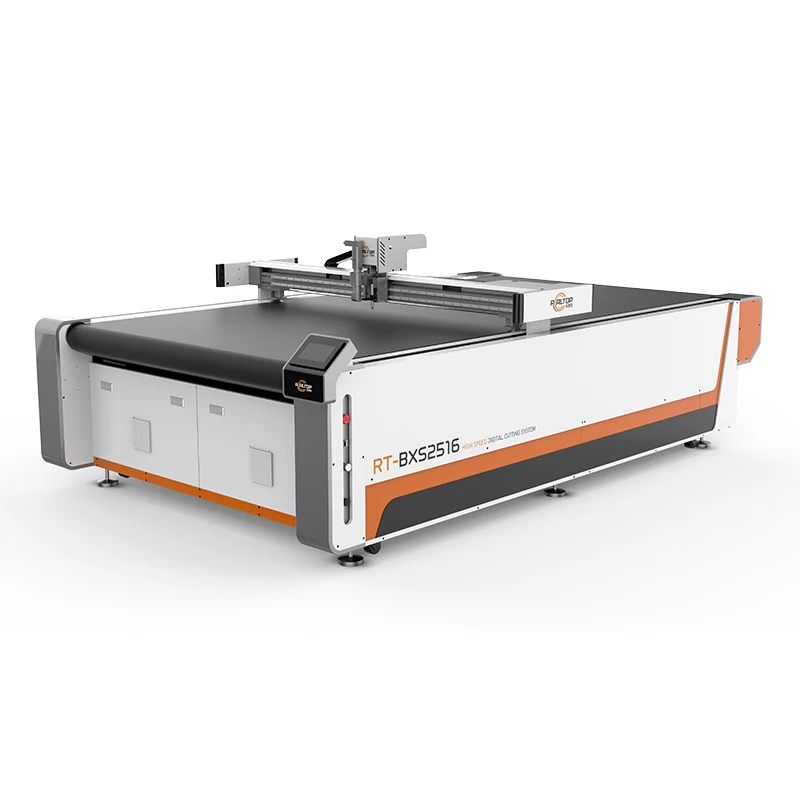
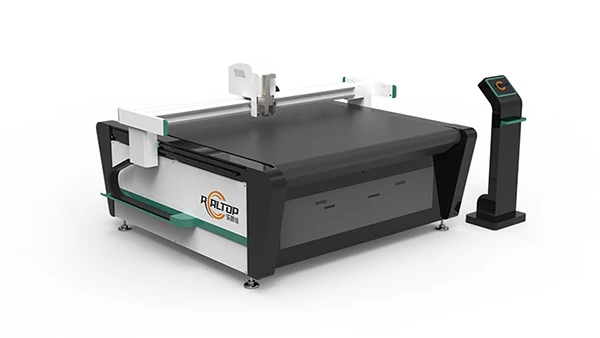

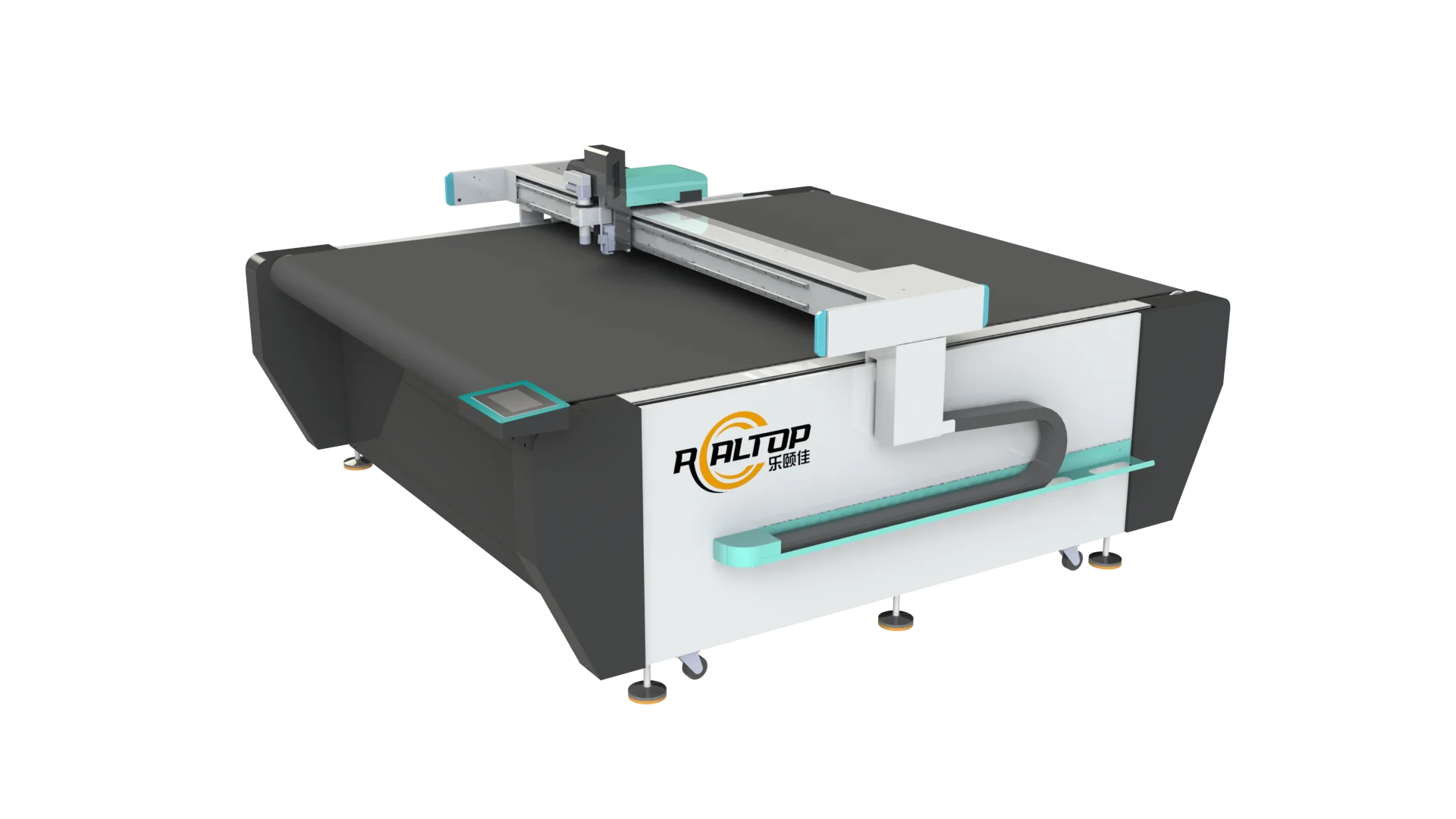


Cutting Method Matched to Material — In-house design covers both knife and laser technologies, so production workflows on fabric, leather and composites are assigned the right cutting process rather than forced into one method.
Technical Specifications
| Parameter | Value |
|---|---|
| Product Type | CNC Oscillating Knife Cutting Machine |
| Model | RT-D2516 / RT-S2516 |
| Working Area | 1600 × 2500 mm |
| Overall Dimensions | 3450 × 2300 × 1250 mm |
| Rated Power | 9 kW |
| Table Configuration | Flatbed working table or auto feeding table available |
| Cutting Speed | 200–800 mm/s (according to different cutting materials) |
| Translational Velocity | 800–2000 mm/s |
| Repeated Accuracy | ≤0.1 mm |
| Cutting Thickness | ≤100 mm (varies with material) |
| Transmission System | Digital servo motor, linear guide, synchronous belt, ball screw |
| Vacuum System | 7.5 kW vacuum pump with vacuum table |
| Multifunctional Head | Swiss imported knife (vibration full cutting, vibration half cutting, cursor location) |
| Tool Head Options | Oscillating knife, pneumatic knife, high-power vibrating knife, circular knife, V cutting knife, drag knife, creasing wheel, dotted line knife, punching, brush |
| Visual Positioning | Small CCD camera mark point positioning, panoramic camera recognition, projection positioning |
| Control Panel | Touch screen with multiple language support |
| Platform | Aluminum air box (integrated or split box option) |
| Software | Auto typesetting software, supports PLT, DXF, AI formats |
| Voltage | 380V ± 10% |
| Safety Device | Infrared sensors |
| Instruction System | HP-GL compatible format |
| Certification | CE (basis not stated in source — confirm certification details) |
Application Suitability
| Application | Material or Output |
|---|---|
| Garment and footwear production | Multi-layer clothing cloth, shoe material, non-woven fabric with nesting optimization |
| Automotive interior trimming | Printed leather, PU, EVA, sponge composite leather with CCD contour tracking |
| Luggage and bag manufacturing | PVC, composite leather, PU sheet cut to pattern outlines |
| Carpet and floor mat fabrication | Carpet, sponge, XPE foam with oscillating knife and vacuum hold-down |
| Packaging sample making | Corrugated cardboard, plastic box board with creasing wheel and drag knife |
| Soft home furnishings | Fabric, textile, cloth processed on auto feeding table for continuous runs |
| Gasket and sealing pad production | PTFE, ETFE, rubber, silicon cut to dimensional tolerance |
| Sports and outdoor products | Carbon fiber prepreg, composite materials requiring clean edge finishing |
Why Ragged Edges Appear When the Tool Head Misses the Material
Matching the oscillating knife frequency and blade geometry to the actual fabric composition prevents crushed foam and torn weave patterns.
I once watched a buyer in South America run standard PU leather samples on a vibrating knife setup that performed flawlessly. Weeks later, their real production stock turned out to be a glass-fiber coated composite, and the same blade shredded the surface. After two days of re-tuning, the line was back on track, but the lesson stuck: every production job deserves its own tool head specification before the machine ships [NEED_CITE: oscillating knife frequency selection for composite materials]. When a CNC oscillating knife cutting machine is configured without confirming actual material composition, edge quality becomes unpredictable across the production run.
Production Workflow for Garment and Footwear Cutting
Garment and footwear manufacturers running multi-layer fabric benefit from the auto feeding table and nesting software on this CNC oscillating knife cutting machine, which lays material continuously across the 1600 × 2500 mm working area. The Swiss imported knife performs full cutting and half cutting passes, allowing kiss-cuts on pattern markers without penetrating the conveyor belt. Production managers evaluate daily volume against cutting speed ranges of 200–800 mm/s, choosing between flatbed batch processing and continuous feed depending on order size and fabric roll width.
Contour Recognition on Printed Leather and Composites
Automotive interior producers cutting printed leather and composite panels rely on the CCD camera positioning system to track mark points and recognize panoramic contours at production speed. The small CCD camera locates registration marks while the panoramic camera option handles full-sheet recognition for printed patterns. Repeated accuracy of ≤0.1 mm, maintained through Taiwan Hiwin linear guides and ball screw transmission, keeps contour cuts within tolerance even when the material stretches or shifts slightly during the vacuum hold-down phase [NEED_CITE: CCD positioning accuracy standards in automotive textile cutting].
How Core Parameters Shape Actual Cutting Results
The 7.5 kW vacuum pump paired with the aluminum air box platform holds fabric flat across the full working area, but vacuum zoning becomes critical when cutting small gasket or pattern pieces that might lift at high translational velocity. A split box option allows operators to isolate vacuum zones to the active cutting region, reducing air leakage on smaller parts. The Delta servo motor and synchronous belt transmission sustain 800–2000 mm/s translational velocity between cuts, though actual cutting speed drops to 200–800 mm/s depending on material density and layer count. Touch screen control with multiple language support means the operator interface can be set to the local language before the machine leaves the factory, avoiding commissioning delays. The auto typesetting software accepts PLT, DXF and AI files, which covers most nesting workflows already in use at garment and packaging facilities.
The Cost of Skipping Material Verification Before Shipment
Choosing a tool head based on catalog descriptions rather than actual material samples leads to compressed foam edges, frayed textile borders, or incomplete cuts on dense composites. A pneumatic knife might slice cleanly through single-layer leather but struggle with multi-layer sponge composite leather that an oscillating knife handles without delamination. When vacuum table zoning is not matched to the smallest piece in the nesting layout, parts lift mid-cut, producing dimensional drift across the batch [NEED_CITE: vacuum hold-down requirements for small part CNC cutting]. Software incompatibility discovered after delivery forces production managers to rebuild nesting files from scratch, losing days of scheduled output.
Why Production Managers Source This Equipment Here
In-house design and production cover both knife and laser cutting technologies, so the cutting method is matched to the material rather than forcing one process to handle everything. Tool head and table configurations are specified per material type and daily production volume, with sample cutting performed on the buyer’s own material before any commitment. CCD camera positioning and software compatibility are confirmed during the pre-order stage, not discovered during commissioning. Voltage, control language, and plug type customization is finalized before production begins, reducing on-site adjustment after delivery.
Documentation & Verification
- Factory test record showing cutting speed and repeatability on your specified fabric type
- Sample cutting report on your actual material with edge quality and thickness verification
- Tool head and table configuration list matched to your material and daily volume
- Software licence and file format compatibility note for PLT, DXF and AI workflows
- Electrical schematic confirming voltage and frequency for your local supply
- Machine specification sheet with Delta servo and Hiwin rail component details
Installation, Commissioning & Support
- 3450 × 2300 mm footprint requires level concrete floor with clearance for auto feeding table extension
- 9 kW rated power at 380V ± 10% needs a dedicated circuit with appropriate breaker rating
- Machine ships with flatbed or auto feeding configuration pre-assembled and tested at factory
- First-run parameter setting includes vacuum zone mapping, tool head calibration and feed rate tuning
- Operator training covers touch screen interface navigation in the confirmed local language
- Spare parts list identifies Swiss knife blades, vacuum seals and synchronous belt replacements
Preparing Your Inquiry
Send material type, thickness and maximum sheet size so the correct tool head and table configuration can be specified. Include your daily cutting volume and whether you run single-layer or multi-layer nesting, which determines flatbed versus auto feeding selection. Confirm your local voltage, frequency and preferred control language to avoid post-delivery electrical or interface modifications. If your material has coatings, laminations or unusual composition, request sample cutting on your actual stock before finalizing the order.
Frequently Asked Questions
Q: How do I choose the right tool head for my material thickness and edge quality requirement?
A: Each material responds differently to blade type and oscillation frequency. The oscillating knife handles most woven fabrics and foams, while the pneumatic knife suits dense leather and the drag knife works on thin vinyl. We run sample cuts on your actual material, document edge quality and cutting depth, and confirm the tool head configuration before production.
Q: What cutting speed can I expect on my specific fabric type and layer count?
A: Cutting speed ranges from 200 to 800 mm/s depending on material density and the number of layers. Translational velocity between cuts reaches 2000 mm/s. We test your actual material during sample verification and record the achievable speed in the cutting report so you can plan daily output accordingly.
Q: Does the software support my existing nesting workflow and file formats?
A: The auto typesetting software accepts PLT, DXF and AI formats, which covers most nesting programs used in garment, footwear and packaging industries. We confirm file format compatibility and test import with your sample files before the order is finalized, preventing workflow disruption after delivery.
Q: How does CCD camera positioning handle printed contour recognition at production speed?
A: The small CCD camera tracks mark points for registration, while the panoramic camera option recognizes full printed contours across the sheet. Repeated accuracy stays within 0.1 mm through linear guide and ball screw transmission, keeping contour cuts aligned even on stretched or slightly shifted materials during continuous production runs.
Q: What vacuum table zoning is available for small parts that tend to lift during cutting?
A: The aluminum air box platform is available in integrated or split box configurations. The split option isolates vacuum zones to the active cutting area, reducing air leakage and improving hold-down on small gasket pieces or pattern parts that would otherwise lift at high translational velocity.



商品评价
Clear filtersThere are no reviews yet.