


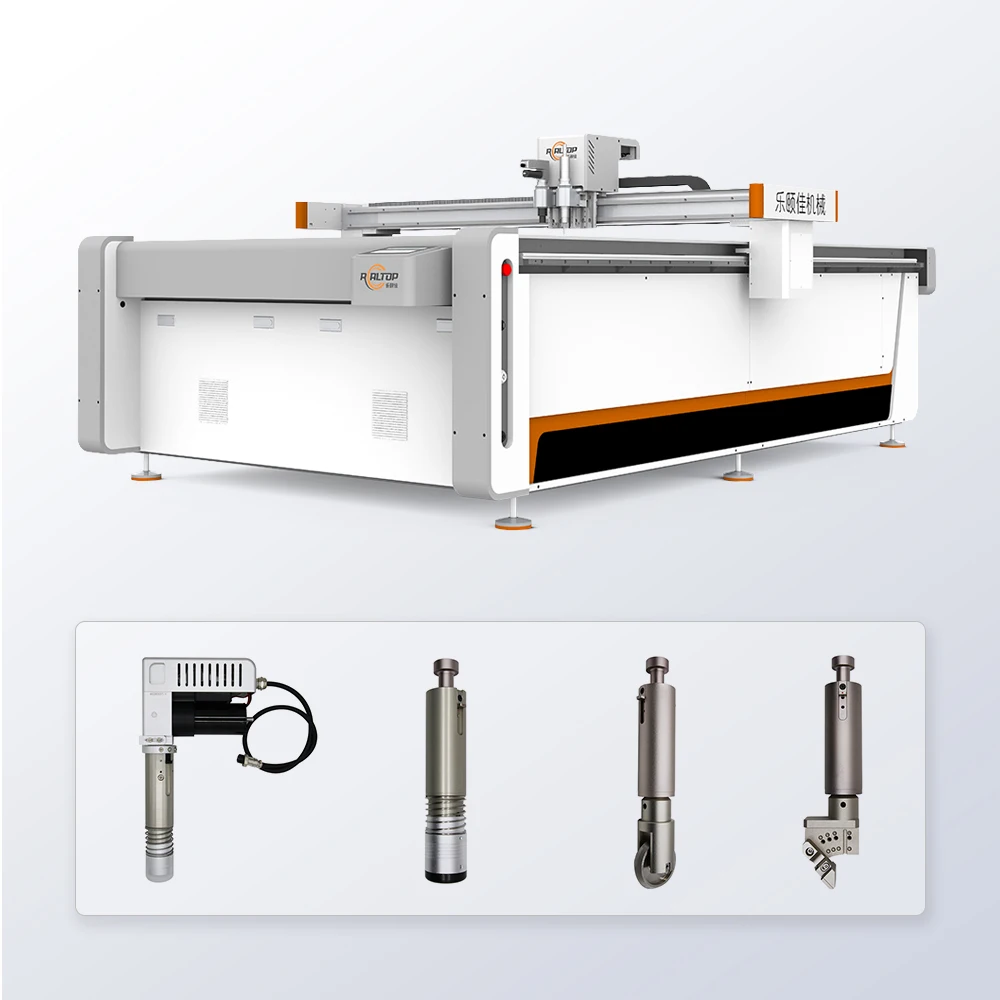

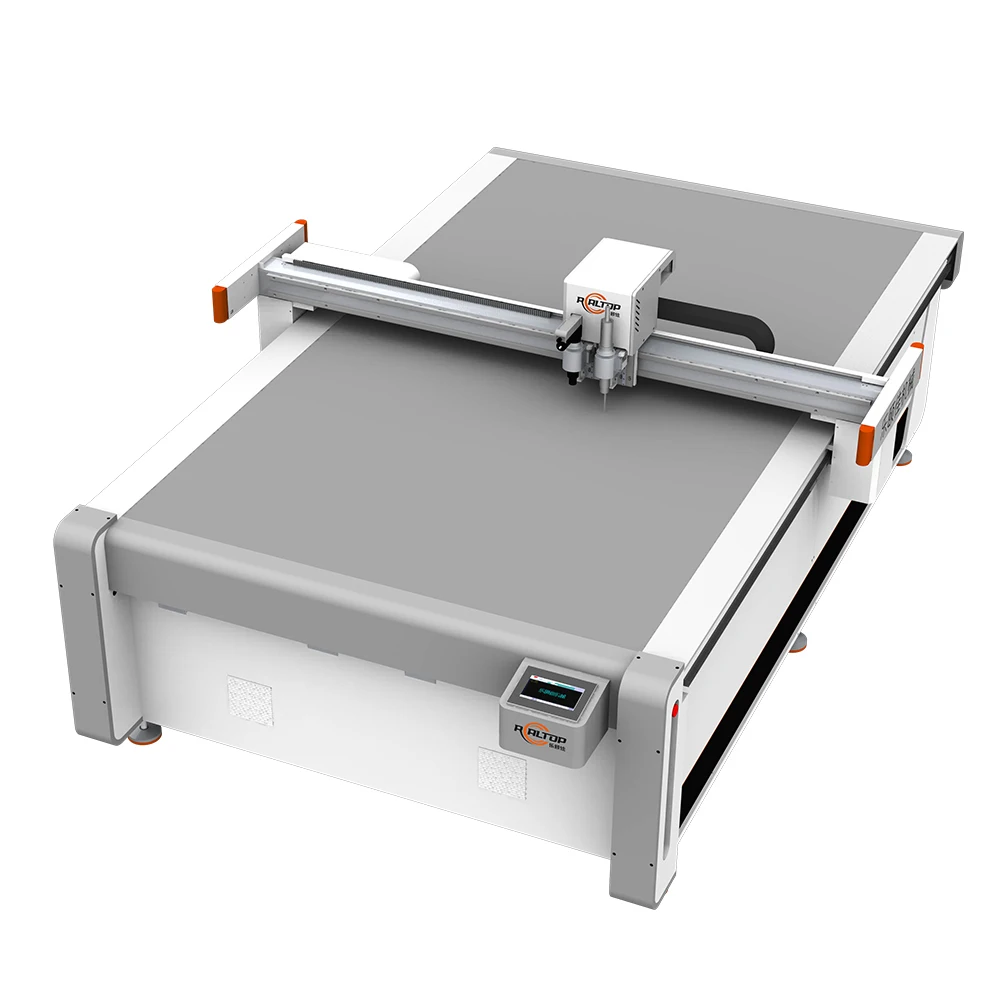
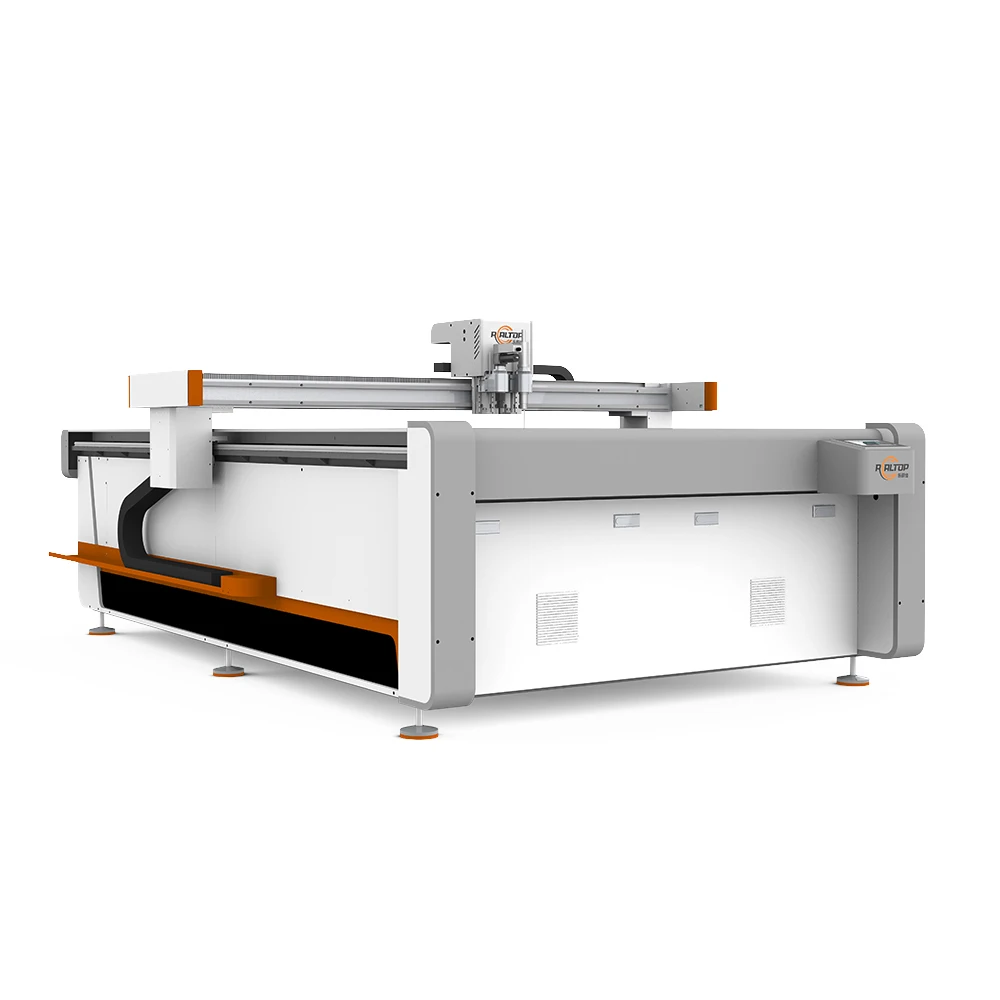
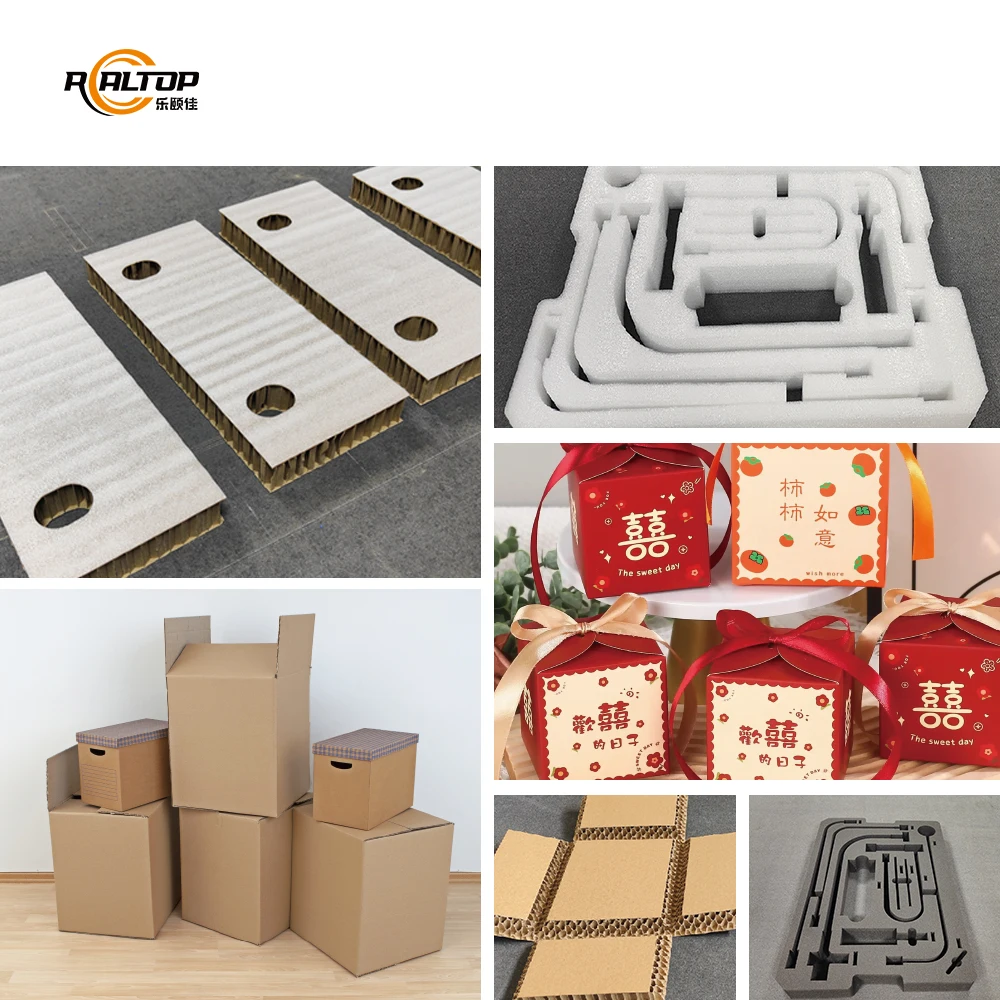

Tool head versatility — seven interchangeable cutting and creasing tools configured per substrate, from E-flute corrugated to coated cardstock and tinted film, validated on your actual stock before order confirmation.
Technical Specifications
| Parameter | Value |
|---|---|
| Model | 1625(std.) |
| Product Type | CNC Oscillating Knife Cutting Machine |
| Working Area | 1600×2500 mm |
| Tools Available | Oscillating knife, Driven rotary knife, Creasing wheel, Kiss cutting tool, Pneumatic knife, Milling tool, V groove knife |
| Cutting Speed | 0–1500 mm/s |
| Maximum Cutting Thickness | 40 mm |
| Cutting Accuracy | ±0.1 mm |
| Vacuum Pump | 9 kW |
| Vacuum Table | Aluminum bellows vacuum table |
| Voltage Options | 110V, 220V, 380V |
| Profile Format | PLT, DXF, AI, PDF |
| Control System | PLC control panel (source value — verify against manufacturer catalog) |
| Servo Motors | Panasonic, Delta, Dorna (source value — verify against manufacturer catalog) |
| Language Options | English, Russian, Italian, Chinese (customizable) |
| Safety Device | Infrared sensor device and emergency stop device |
| Machine Size | 3300×2100×1350 mm |
| Certification | CE |
Application Suitability
| Application | Material or Output |
|---|---|
| Packaging sample making and short-run carton production | Corrugated cardboard (E-flute, B-flute, BC-flute), greyboard, art paper |
| Foam insert fabrication for protective packaging | EVA foam, EPE foam, PU foam cut to tight tolerance profiles |
| Specialty paper and cardstock processing | Coated cardstock, specialty paper, adhesive-backed sheets |
| Rubber and mat cutting for packaging accessories | Rubber mats, velvet/fleece fabric, non-woven fabric |
| Thin plastic and film cutting | PVC sheets, PET sheets, tinted film, composite laminates |
| Leather and synthetic material sample cutting | Genuine leather, synthetic leather for packaging embellishments |
Why a 40 mm Cutting Depth Claim Can Mislead Your Packaging Line
Real cutting capacity depends on substrate density, ply count, and tool head selection — not just the maximum stroke of the oscillating knife.
A machine specified on working area alone often fails when the buyer introduces coated corrugated, high-density foam inserts, or multi-ply cardstock stacks that resist the knife differently than standard brown carton [NEED_CITE: material hardness and cutting resistance in corrugated packaging substrates]. I once configured a vacuum table for a Middle Eastern buyer based on the grammage he provided, only to discover his actual stock was coated thick cardstock that lifted at the edges the moment the knife engaged. The entire first batch was scrapped. That job now runs on a zoned vacuum setup with adjusted hold-down pressure, confirmed by sample cutting before the machine left the factory. The lesson applies to every packaging CNC cutting machine production line: thickness ratings without material context are incomplete specifications.
Matching Tool Heads to Packaging Substrate Behavior
The 1625(std.) offers seven interchangeable tool heads, and selecting the correct one for your material stack is the single most consequential decision in the configuration process. An oscillating knife handles corrugated flutes cleanly at production speed, while a creasing wheel produces the fold lines that carton assembly depends on. Kiss cutting tools score adhesive-backed labels without penetrating the release liner, and V-groove knives produce the angled channels needed for rigid box construction. Switching between these tools on a single CNC oscillating knife cutting table means a packaging sample maker can move from a corrugated shipping box to a foam-lined presentation case without changing machines or fixtures.
Vacuum Table Zoning and Small-Part Hold-Down
The aluminum bellows vacuum table paired with a 9 kW pump provides the suction foundation, but zoning determines whether small carton components stay flat during cutting. Ungrouped vacuum zones mean full-table suction even when cutting a 50×50 mm corner tab, and the airflow imbalance can lift thin film or lightweight cardstock at the cut boundary [NEED_CITE: vacuum hold-down principles for CNC flatbed cutting of thin packaging materials]. Zoned activation directs suction only to the area under the cutting path, which matters when your nesting layout mixes large carton blanks with small insert tabs on the same sheet.
How Cutting Accuracy and Drive Systems Affect Crease Registration
The ±0.1 mm cutting accuracy specification matters most when crease lines and cut outlines must align precisely across a folded carton structure. Misaligned creases cause the carton to close unevenly or fail automated packing line feeders. PLC-controlled servo drives maintain this registration by coordinating the creasing wheel path and the oscillating knife path within the same tolerance band across the full 1600×2500 mm working area. For packaging runs where a single box design repeats hundreds of times across a shift, this repeatability prevents the gradual drift that accumulates on machines with less rigid motion control. Software compatibility with PLT, DXF, AI, and PDF files means your existing packaging structure designs transfer directly to the machine without intermediate conversion steps that introduce rounding errors [NEED_CITE: file format compatibility in digital packaging sample making workflows].
The Cost of Skipping the Sample Cutting Step
When a packaging buyer commits to a configuration based solely on a specification sheet, the risk concentrates on the first production day. A pneumatic knife that slices through single-wall corrugated effortlessly may crush double-wall BC-flute at the same stroke setting, producing ragged edges that compromise box compression strength. A vacuum table without adequate zoning for small die-cut shapes causes film lift, resulting in inaccurate kiss cuts that leave labels partially attached to the waste matrix. These failures do not appear in the quotation stage — they appear after the machine is installed, powered on, and expected to deliver finished samples to a client waiting on a deadline [NEED_CITE: common packaging CNC cutting machine commissioning failures].
Why Procurement Through This Channel Works for Packaging Fabricators
Tool head and table configuration is specified per material and production volume, not offered as a standard package that the buyer must then adapt. Sample cutting on the buyer’s own corrugated stock, foam density, or tinted film thickness is completed before the order is finalized, producing a cutting report that documents tool selection, feed rate, and edge quality on your actual substrate. Voltage, plug type, and control language are confirmed before shipment rather than discovered during installation. The in-house design team covers both knife cutting technologies and table engineering, so a packaging sample maker can request a configuration matched to their specific mix of carton, foam, and film work without forcing one method onto every material. Software compatibility with existing nesting and box design workflows is verified before the machine enters production.
Documentation & Verification
- Machine specification sheet listing all seven tool head options and their material suitability
- Electrical schematic with voltage and frequency confirmed against your facility supply before dispatch
- Tool head and vacuum table configuration list matched to your corrugated ply count and foam density
- Sample cutting report on your actual packaging substrate documenting edge quality and dimensional accuracy
- Software licence and file format compatibility note confirming PLT, DXF, AI, PDF workflow integration
- Factory test record captured before shipment showing cutting and creasing registration across your box designs
Installation, Commissioning & Support
- 3300×2100 mm footprint requires level concrete floor with clearance for material loading on all sides
- Dedicated electrical circuit matching confirmed voltage (110V / 220V / 380V) with appropriate breaker rating for the 9 kW vacuum pump plus servo loads
- Machine arrives partially assembled; table leveling and gantry alignment completed on-site during commissioning
- First-run parameter setting includes vacuum zone mapping, tool depth calibration, and creasing pressure adjustment on your stock
- Operator training covers tool changeover procedures, nesting software import, and PLC control panel navigation in your selected language
- Spare parts list identifies consumable blades, creasing wheels, and vacuum table seals with recommended replacement intervals
What We Need to Configure Your Machine Correctly
Provide the specific packaging substrates you run — corrugated flute type, foam density, film thickness — along with your typical sheet dimensions and daily sample volume. Confirm your facility voltage and frequency, your preferred control language, and the design software your team currently uses for box structure files. If you have an existing nesting workflow or downstream folding and gluing equipment, share those details so the configuration aligns with your full production chain rather than operating in isolation.
Frequently Asked Questions
Q: How do I determine which tool head to use for corrugated cardboard versus foam inserts?
A: Corrugated flutes from E-flute through BC-flute typically run on the oscillating knife for clean edge cuts, with the creasing wheel handling fold lines in the same job setup. EVA and EPE foam inserts are cut with the oscillating knife at adjusted stroke frequency and depth to prevent compression at the cut boundary. The tool head selection is confirmed during sample cutting on your actual material before the configuration is finalized.
Q: Can the vacuum table hold down small packaging parts without film lift?
A: The aluminum bellows vacuum table with its 9 kW pump provides sufficient suction, but small parts and thin films require zoned activation so that airflow concentrates under the active cutting path rather than spreading across the full 1600×2500 mm surface. Zone configuration is matched to your typical nesting layout during the sample cutting phase, ensuring that lightweight cardstock tabs and tinted film pieces remain flat throughout the cut cycle.
Q: Will my existing packaging design files work with this machine’s software?
A: The system accepts PLT, DXF, AI, and PDF formats, which covers most packaging structure design platforms. File format compatibility and nesting workflow integration are confirmed before order placement. If your team uses a dedicated box structure design program, we verify import accuracy during the sample cutting stage to ensure crease and cut paths register correctly without manual re-drawing.
Q: What electrical and language preparations are needed before the machine arrives?
A: Voltage must be confirmed from the available options (110V, 220V, or 380V) along with plug type and frequency for your facility. The control language is set before shipment from available options including English, Russian, Italian, and Chinese, with customization available for other languages. These details are documented in the electrical schematic and configuration list provided before production begins.
Q: Is sample cutting mandatory before I commit to the purchase?
A: Sample cutting on your actual packaging substrate is the standard procedure before configuration is locked. You send representative samples of your corrugated board, foam, film, or cardstock, and the cutting test documents tool selection, feed parameters, edge quality, and dimensional accuracy. This report accompanies the machine documentation and serves as the baseline for acceptance testing after installation.





商品评价
Clear filtersThere are no reviews yet.