


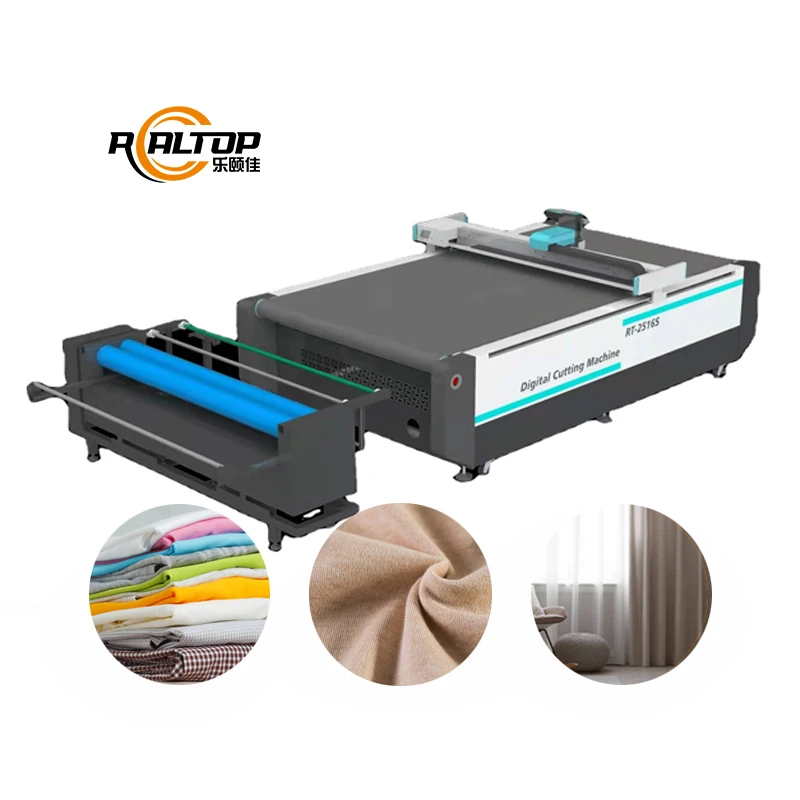
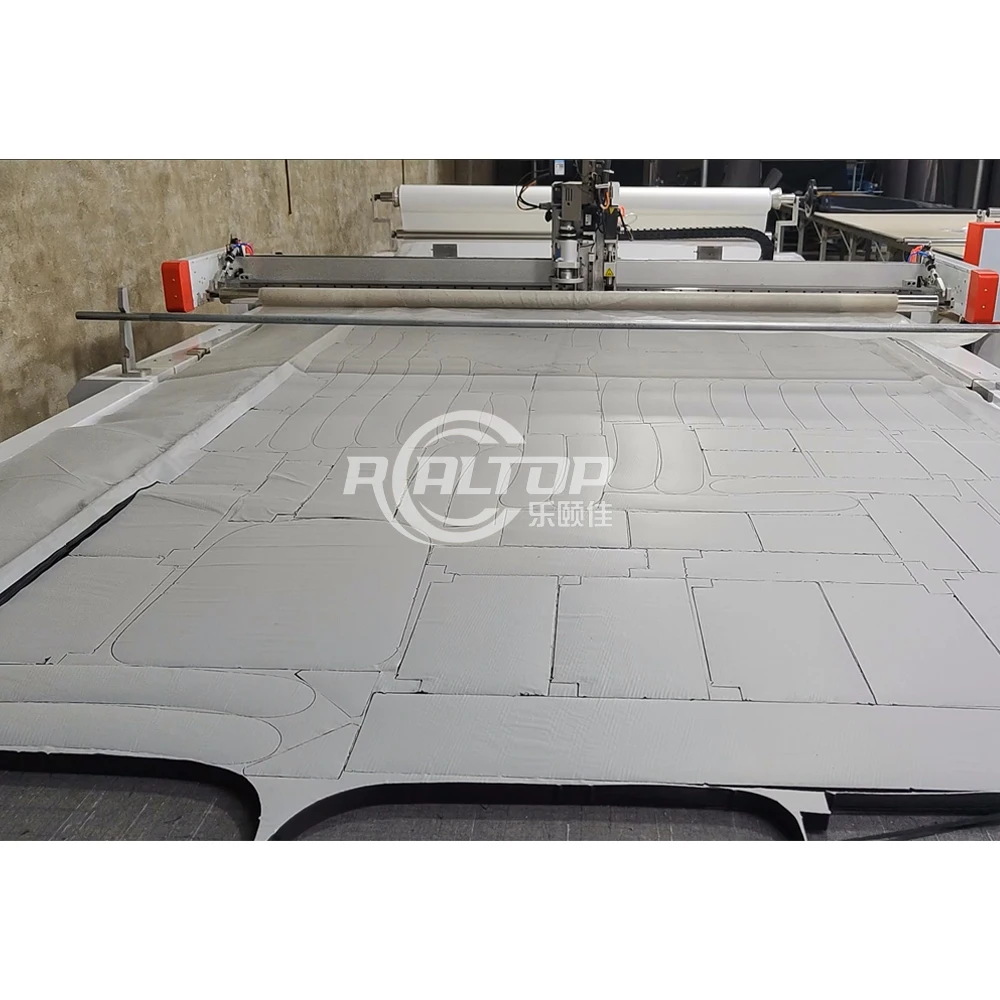
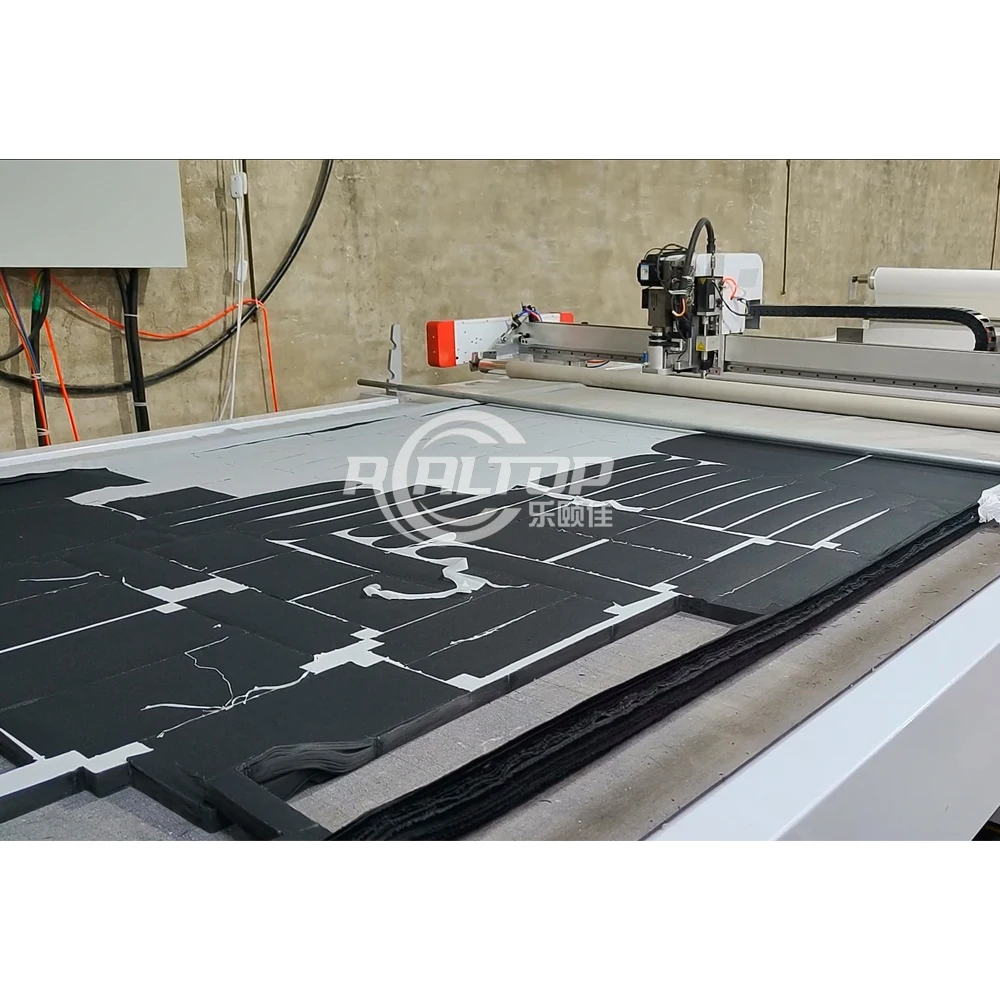
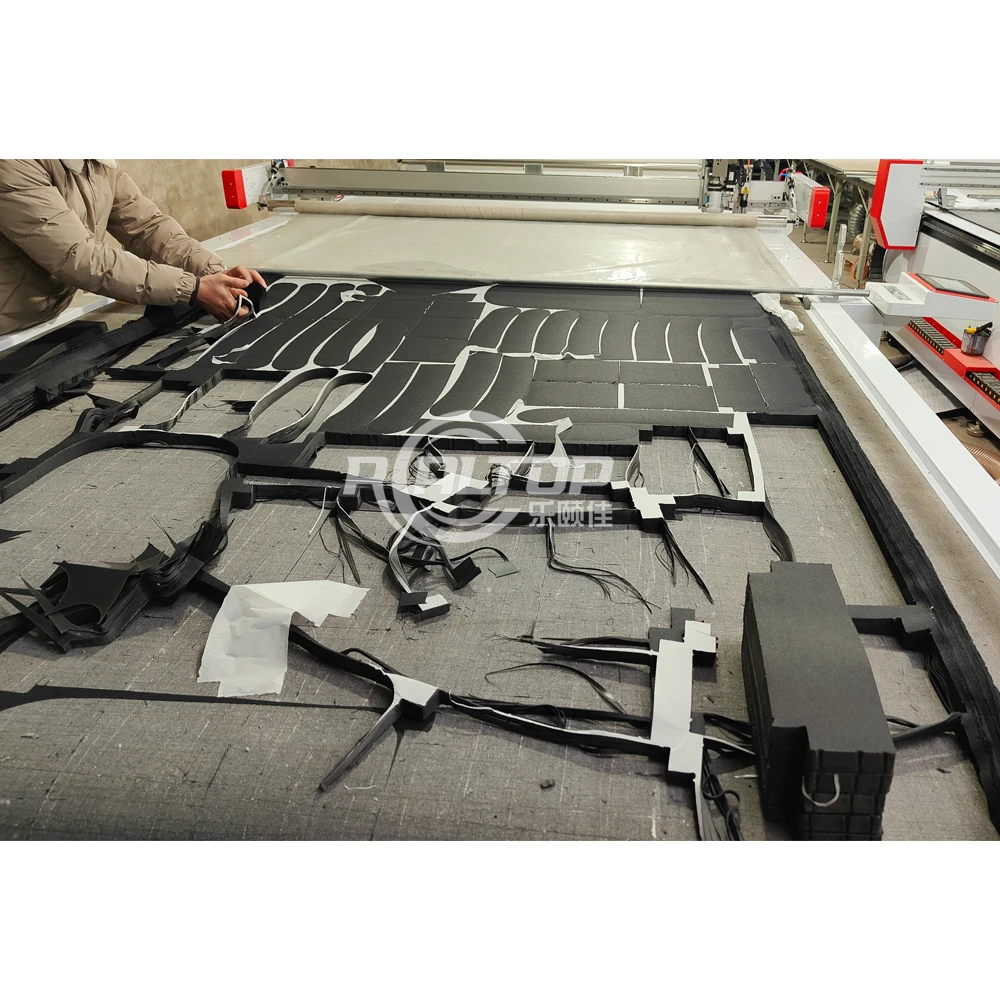
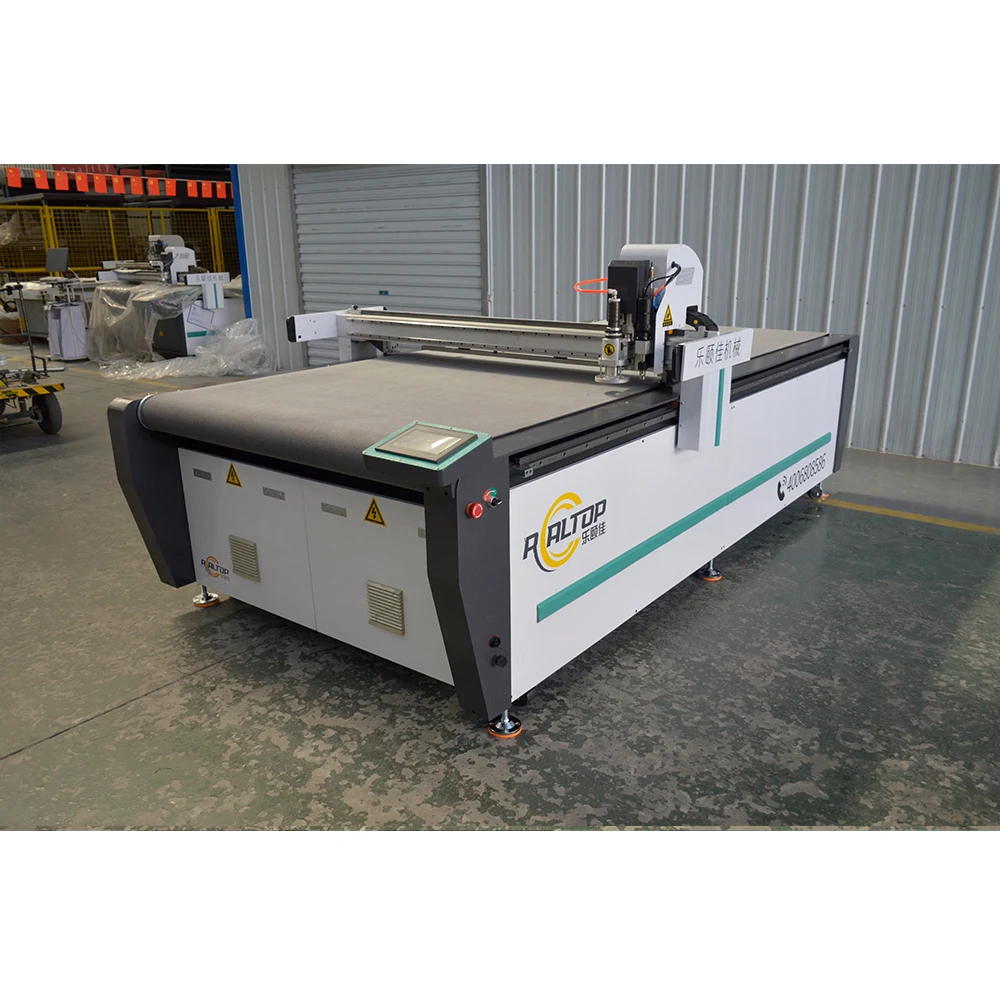

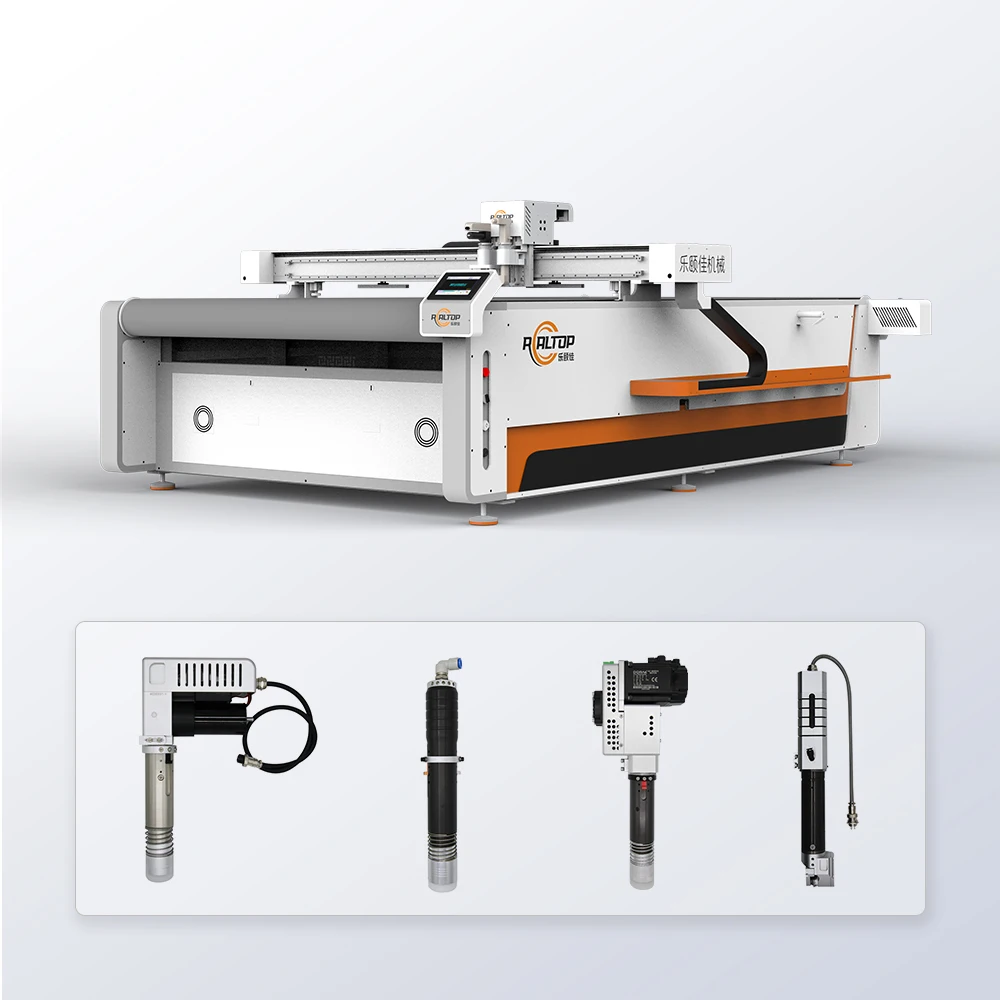
Workflow-Integrated Cutting Cell — the RT-D2516/RT-S2516 is engineered as a complete production cell with auto-feeding conveyor, vacuum hold-down and modular tool heads, rather than a standalone table, fitting directly into garment and textile manufacturing workflows.
Technical Specifications
| Parameter | Value |
|---|---|
| Product Type | Cloth CNC Cutting Machine |
| Model | RT-D2516/RT-S2516 |
| Working Area | 1600 × 2500 mm |
| Machine Size | 3450 × 2300 × 1250 mm |
| Rated Power | 9 kW |
| Cutting Thickness | ≤50 mm (according to different cutting materials) |
| Translational Velocity | 800–1200 mm/s |
| Repeated Accuracy | ≤0.1 mm |
| Tool Head | Swiss imported knife with vibration full cutting, vibration half cutting and cursor location |
| Transmission System | Digital servo motor, linear guide, synchronous belt, ball screw |
| Servo Motor | Delta servo motor (Panasonic servo motor optional) |
| Linear Guide | Taiwan Hiwin rail |
| Auto Feeding | Yes, with Germany imported conveyor belt |
| Vacuum Table | Yes, with 7.5 kW vacuum pump |
| Table Surface | High-density felt |
| Lathe Bed Structure | Overall welding process, imported milling machine processing |
| Instruction System | HP-GL compatible format |
| Voltage | 380V ±10% |
| Safety Device | Infrared sensors |
| Language Options | English, Russian, Italian, Chinese, special languages customizable |
| Standards | CE |
Application Suitability
| Application | Material or Output |
|---|---|
| Garment fabric cutting | Single-ply to multi-layer textiles, woven and knit fabrics |
| Leather goods manufacturing | Natural leather, synthetic leather, PU panels |
| Automotive interior panels | Sponge composite leather, PVC, soft trim materials |
| Textile converting | Silicon, rubber, soft glass, flexible composites |
| Pattern and sample making | Cardboard templates, pattern drafting media |
Why Cutting Thickness Claims Fail on the Factory Floor
A cloth CNC cutting machine rated at 50 mm will not achieve that depth on every material you send through it, because real cutting capacity depends on fabric density, adhesive content and ply compression rather than a single headline number. Actual cutting depth must be verified on your own material stack before the order is confirmed.
I have seen buyers commit to a machine after watching it slice cleanly through a standard cotton demo roll, only to discover that their sponge composite leather with high adhesive content required a completely different vibration frequency and blade geometry. The edges came out crushed and fibrous, and the entire batch had to be recut [NEED_CITE: oscillating knife frequency adjustment for composite materials with adhesive interlayers]. This is why we run your actual fabric before any quotation is finalized, adjusting tool head settings and vacuum zoning to match what your production floor actually processes day after day.
Auto-Feeding and Conveyor Integration for Continuous Production
The RT-D2516/RT-S2516 integrates a Germany imported conveyor belt with auto-feeding capability, allowing continuous roll or ply feeding without manual repositioning between cuts. The high-density felt table surface works with the 7.5 kW vacuum pump to hold flexible materials flat during transport and cutting. This cloth CNC cutting machine is designed for production environments where operators load rolls at one end and collect cut pieces at the other, maintaining workflow rhythm across garment and textile converting operations.
Modular Tool Head Configuration for Multi-Material Workflows
The Swiss imported knife head supports full cutting, half cutting and cursor location within a single tool holder, reducing changeover time when a production run includes different cut types. The modular holder also accommodates a round knife, marking pen and auto feeder interface, so the same cloth CNC cutting machine handles both precision contour work and bulk straight-line tasks [NEED_CITE: modular tool head compatibility for garment cutting applications]. For automotive interior producers switching between leather panels and sponge composite gaskets, this means one machine covers multiple product categories without requiring a second capital investment.
Reading the Specs That Actually Matter
The Delta servo motor paired with Taiwan Hiwin linear rails delivers ≤0.1 mm repeated accuracy, which is critical when cutting nested garment patterns where adjacent pieces share a cut line and any drift wastes material. The 7.5 kW vacuum pump provides hold-down force across the full 1600 × 2500 mm table, but small pattern pieces like collars and cuffs require zoning to maintain suction directly under the cutting path rather than bleeding vacuum across the entire surface. The 9 kW rated power covers both the cutting head and conveyor drive simultaneously, so operators do not experience power sag when the auto-feeder engages mid-cycle. Translational velocity of 800–1200 mm/s gives a working range that balances speed with edge quality depending on whether you are cutting single-ply silk or multi-layer denim [NEED_CITE: servo motor and linear guide performance in CNC cutting applications].
What Happens When Vacuum Zoning Gets Ignored
Buyers who specify a machine on working area alone often discover that small garment pieces lift during cutting because the vacuum table pulls air across zones where no material is present. The result is ragged edges, miscut contours and fabric waste that accumulates silently across hundreds of production hours. I have walked through workshops where operators were manually pinning small pieces to the felt surface as a workaround, which defeats the purpose of automated cutting entirely and introduces positioning errors that compound through the assembly line [NEED_CITE: vacuum table zoning requirements for small pattern pieces in garment cutting].
Why Production Managers Source From This Line
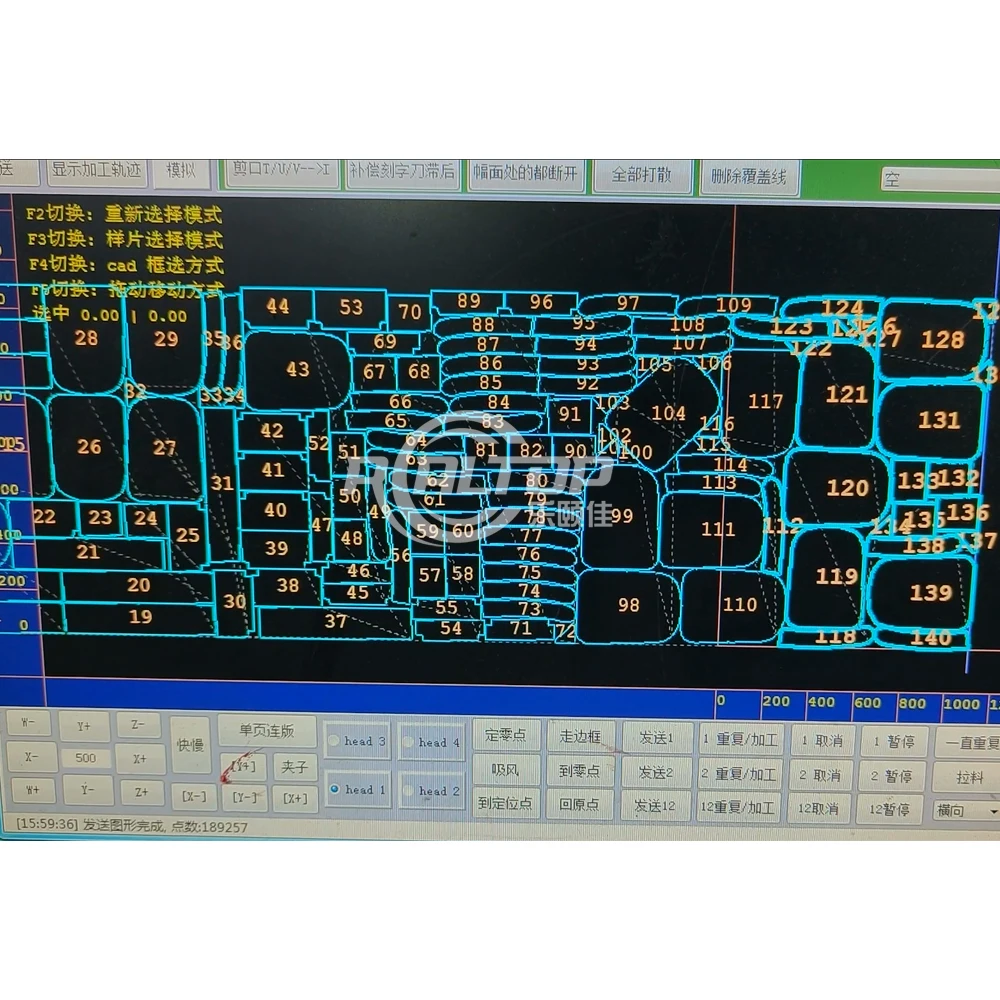
The in-house design team covers both knife and laser cutting technologies, so a buyer can match the cutting method to the material rather than forcing one method to handle everything. Tool head and table configurations are specified per material type and production volume before the order enters manufacturing. CCD camera positioning is available for printed contour work where fabric carries registration marks. Software compatibility with HP-GL and buyer-specific file formats is confirmed during the sample stage, not after shipment. Voltage, language and control interface are customized to the destination market before the machine leaves the factory floor.
Documentation & Verification
- Factory test record on your specific fabric type and ply count before dispatch
- Tool head and table configuration list matched to your material thickness range
- Software licence and file format compatibility note for HP-GL and your nesting workflow
- Electrical schematic with voltage and frequency confirmation for your local grid
- Sample cutting report with edge quality photographs on your supplied material
- Spare parts list with recommended consumables for your production volume
Installation, Commissioning & Support
- 3450 × 2300 mm footprint requires level floor with clearance for conveyor infeed and outfeed
- 380V ±10% three-phase supply with dedicated 9 kW circuit and proper grounding
- Machine ships as integrated unit with bolt-down points aligned to welded bed structure
- 7.5 kW vacuum pump requires exhaust routing to workshop exterior or filtration system
- Operator training covers Delta servo tuning, blade changeover and HP-GL file import
- Taiwan Hiwin rails require periodic lubrication on the schedule specified in the manual
- Infrared sensor calibration verified on-site during commissioning for safe operation
Preparing Your Inquiry
Production managers evaluating a cloth CNC cutting machine for line integration should provide fabric type, ply count, maximum stack thickness and daily cutting volume to receive a configuration that matches actual workflow demands. Include your local voltage and frequency standard along with the control language preference so the electrical package is built correctly from the start. If your existing nesting software exports specific file formats, share sample files during the inquiry stage to confirm compatibility before commitment.
Frequently Asked Questions
Q: How is cutting thickness verified for my specific fabric stack?
A: We run your actual material through the machine, adjusting vibration frequency and blade type to match fabric density and adhesive content. A sample cutting report documents edge quality, cut depth and any tool head modifications required. This test happens before quotation, not after delivery.
Q: Can the software import my existing nesting and pattern files?
A: The instruction system supports HP-GL compatible format. We request sample files from your current nesting software during the inquiry stage to verify import, nesting accuracy and cut path generation before the machine enters production.
Q: What customization range is available for working area and conveyor?
A: The standard 1600 × 2500 mm working area can be adjusted for different roll widths and ply lengths. Conveyor belt speed, vacuum table zoning and tool head selection are configured based on your material type and production volume requirements.
Q: How does vacuum table zoning handle small pattern pieces?
A: The vacuum system divides the table into zones so suction concentrates under the active cutting area. Small pieces like collars and cuffs remain flat without lift, preventing miscuts and edge fraying that occur when vacuum bleeds across uncovered zones.
Q: What is the after-sales support process for production-line integration?
A: Installation includes positioning, electrical connection verification and infrared sensor calibration. Operator training covers blade changes, servo tuning and file import. Spare parts lists and maintenance schedules are provided in the language specified at order.





商品评价
Clear filtersThere are no reviews yet.