



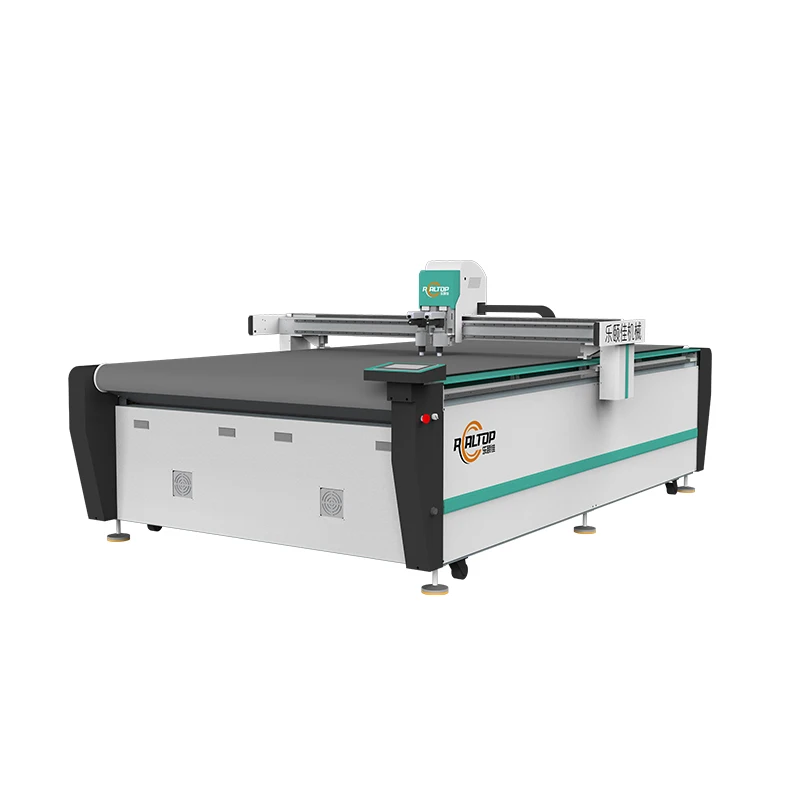
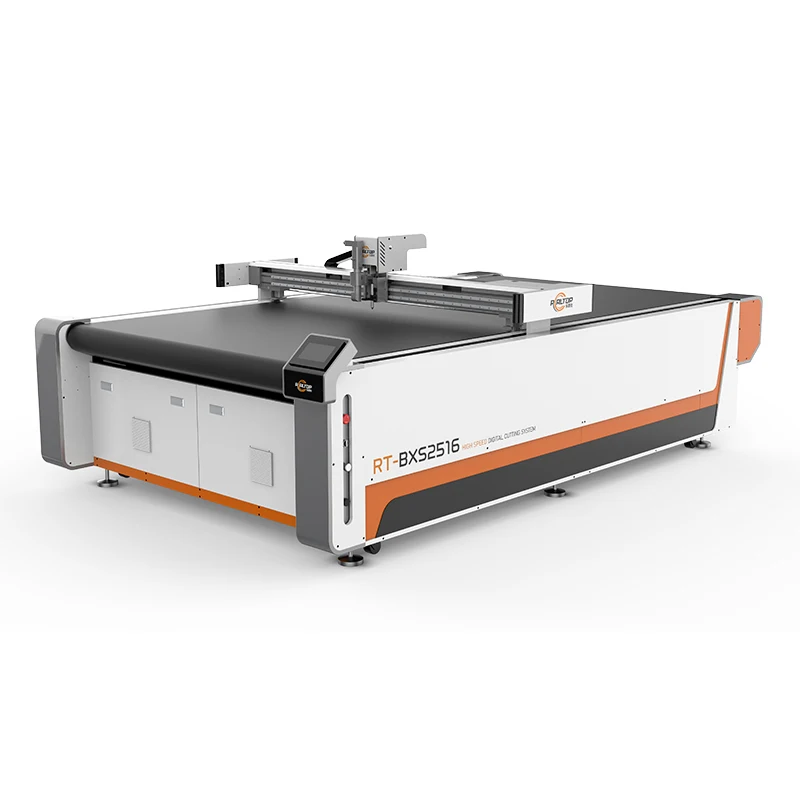
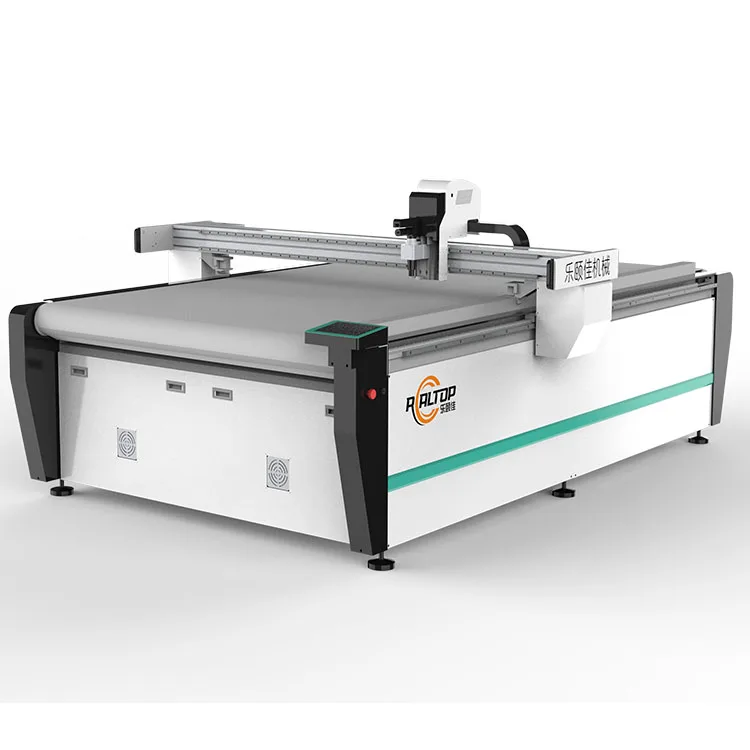
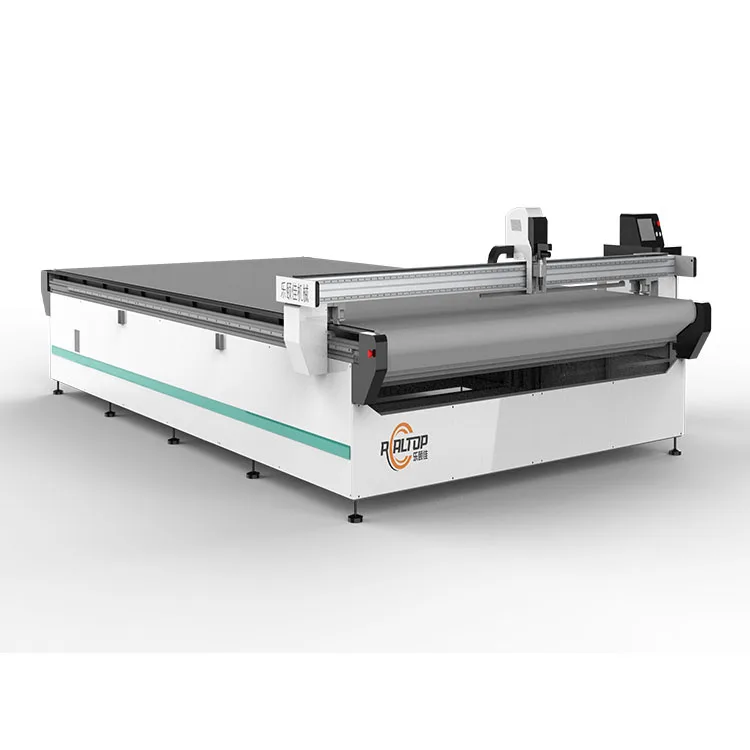
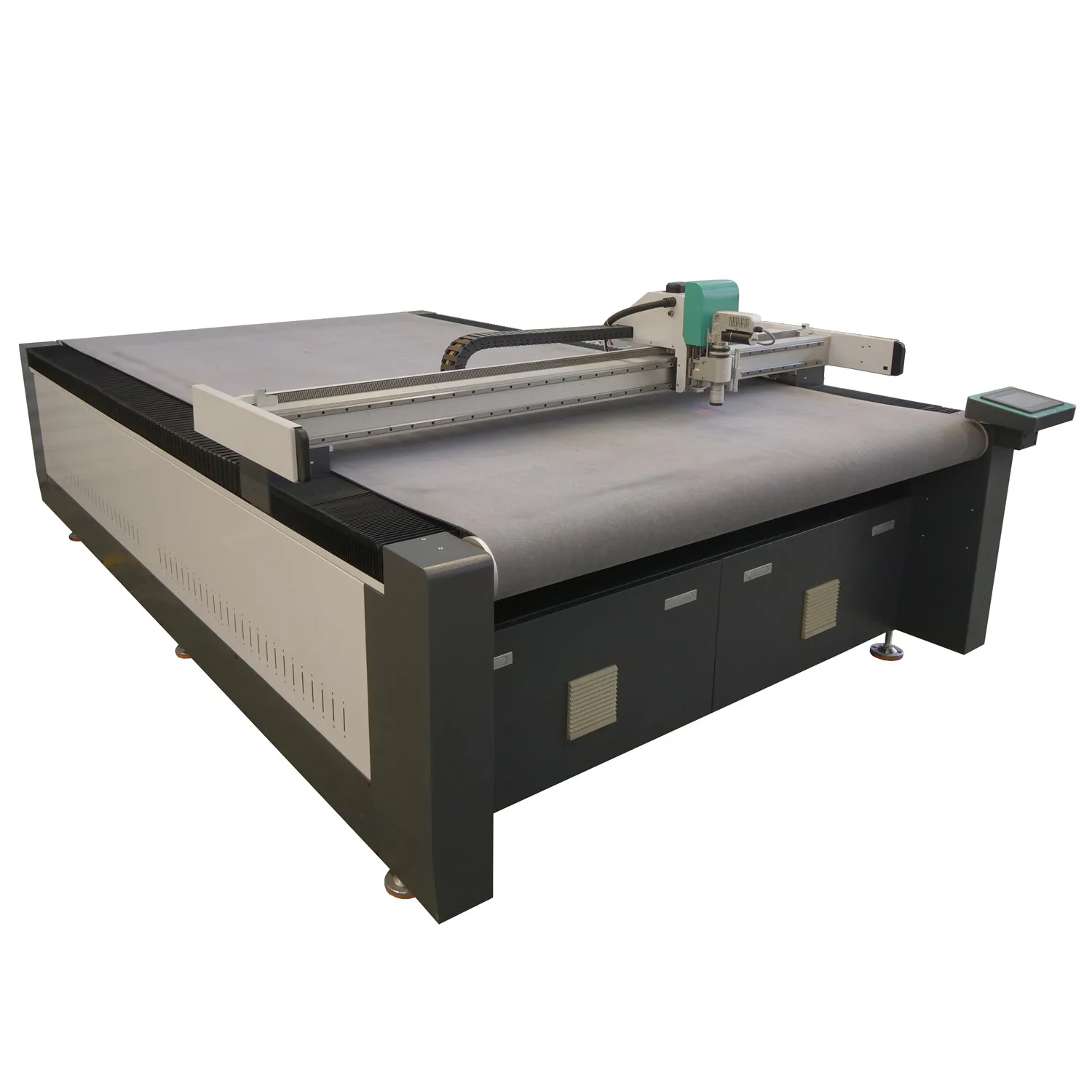
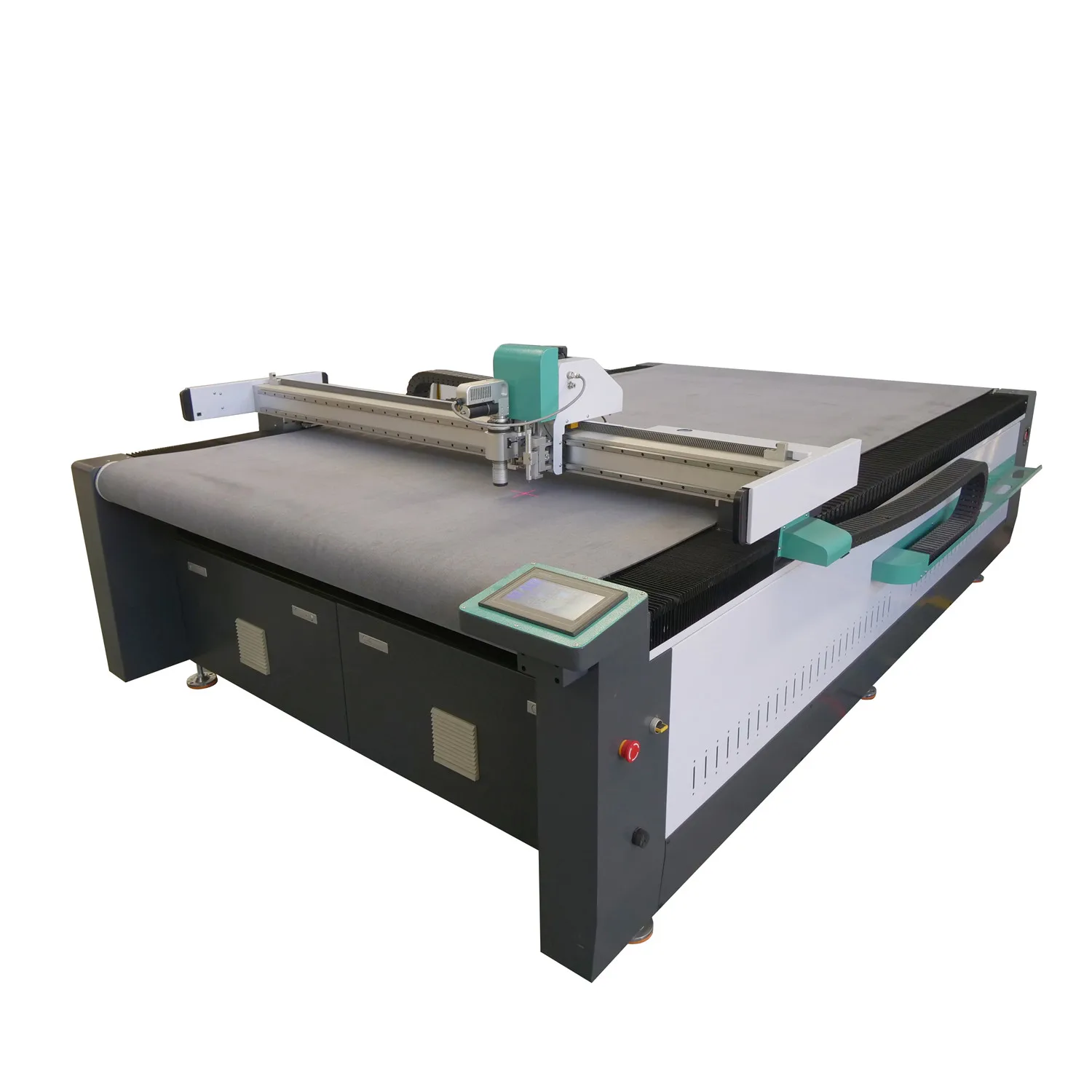

Production-floor cutting accuracy — we match tool head, vacuum zoning and feed rate to your actual faux fur backing thickness before the machine leaves our Jinan factory.
Technical Specifications
| Parameter | Value |
|---|---|
| Product Type | CNC Oscillating Knife Cutting Machine |
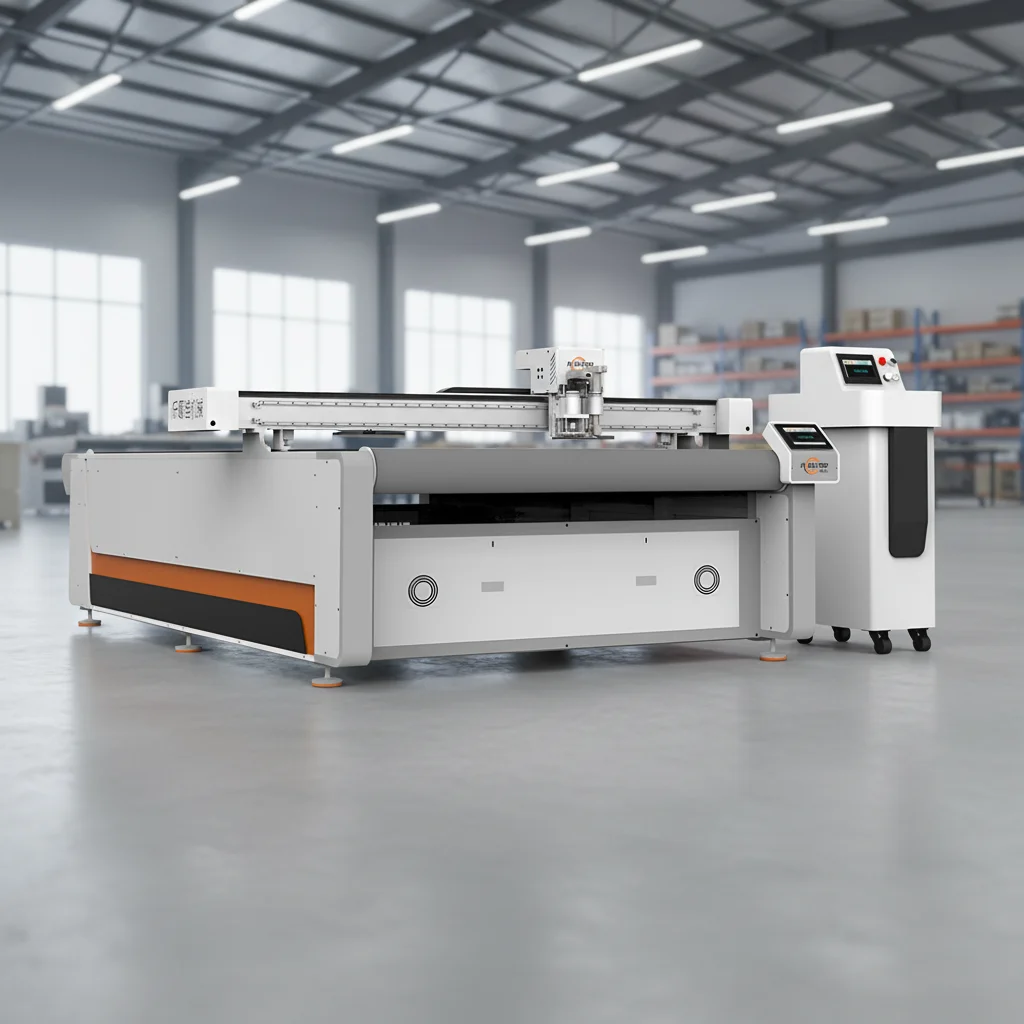
| Working Area | 1600 × 2500 mm |
| Machine Dimensions | 3450 × 2300 × 1250 mm |
| Rated Power | 9 kW |
| Table Type | Flat working table or auto-feeding conveyor |
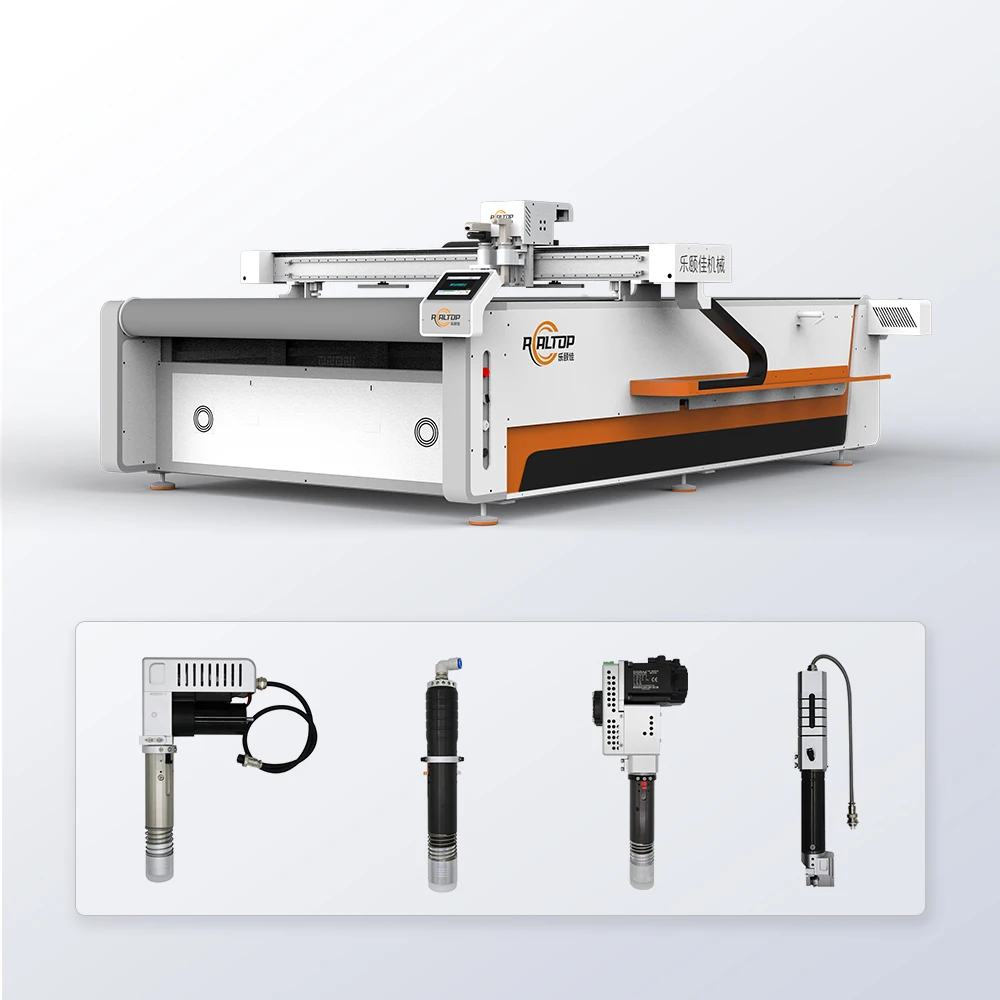
| Tool Head Options | Oscillating knife, pneumatic knife, high-power vibrating knife, circular knife, drag knife, creasing wheel, punching, V-cutting knife |
| Translational Velocity | 800 – 2000 mm/s |
| Cutting Speed | 200 – 800 mm/s (varies with material density and ply count) |
| Cutting Thickness | Up to 100 mm (basis not stated in source — confirm block format / material / thickness) |
| Repeated Accuracy | ≤ 0.1 mm |
| Transmission System | Digital servo motor, linear guide, synchronous belt, ball screw |
| Servo Motor | Delta (Panasonic optional) |
| Vacuum Pump | 7.5 kW |
| Guide Rail | Taiwan Hiwin |
| Conveyor Belt | Germany imported |
| Safety Device | Infrared sensor array |
| Control Panel | Touch screen with multi-language support |
| Software Compatibility | PLT, DXF, AI formats; auto typesetting and nesting |
| Vision Positioning | Small CCD mark-point, panoramic camera, projection positioning (optional) |
| Voltage | 380 V ±10% |
| Instruction Format | HP-GL compatible |
Application Suitability
| Application | Material or Output |
|---|---|
| Garment and footwear cutting | Single or multi-layer garment cloth, shoe lining, faux fur with thick backing |
| Automotive interior panels | Sponge composite leather, PU, EVA, non-woven textile, carpet and floor mat stock |
| Soft home furnishing | Curtain fabric, upholstery textile, composite sofa panels, cushion foam layers |
| Sports and outdoor goods | Neoprene, technical fabric, multi-layer composite for bags and luggage |
| Advertising and packaging | Corrugated cardboard, sticker film, foam board, plastic box stock, gasket sheets |
Why "Up to 100 mm Cutting Depth" Is Not Enough Information for a Cloth CNC Cutting Machine Production Line
A thickness number without the material construction behind it is a guess, not a specification.
I once stood in a faux fur plant outside Mexico City where a brand-new digital knife cutter was idling on the floor. The supplier had promised the machine handled 60 mm stock based on a sample of short-pile fur with a thin knit backing. The buyer’s actual production material was long-hair faux fur on a dense woven substrate nearly twice as thick — and the oscillating blade stalled halfway through, leaving compressed fibers and ragged edges that failed quality inspection [NEED_CITE: material backing density effect on knife cutting performance]. We spent weeks adjusting blade oscillation frequency, down-pressure and vacuum hold-down zoning while finished goods piled up in the warehouse. That is why any Cloth CNC Cutting Machine production line must be validated against the exact material stack that will run on it, not a catalog sample.
Matching the Knife to the Fiber Structure
Every textile behaves differently under a vibrating blade. A sharp oscillating knife slices cleanly through woven faux fur backing without pulling the pile, while a circular knife suits continuous single-layer roll cutting where edge sealing is not required. For multi-layer garment cloth laid up several plies high, a high-power vibrating knife maintains consistent perpendicularity through the stack. This Cloth CNC Cutting Machine production line supports all these tool heads on a single multifunctional carriage, letting the operator switch between cutting, creasing and marking without re-fixturing the material.
Vacuum Zoning and Small-Part Hold-Down
Faux fur and garment fabric are light, and once the blade passes through, air turbulence from the oscillating head can lift small cut pieces off the table surface. The 7.5 kW vacuum pump on this system pulls through a zoned table, but zoning only works when the active zones match the footprint of the parts being nested. If your pattern produces many small components — shoe uppers, collar pieces, gasket inserts — the table must be configured with dense, independently valved zones so that vacuum is concentrated exactly where material remains [NEED_CITE: vacuum table zoning principles for flatbed digital cutters]. Without that, edge drift on the final cuts becomes a recurring defect.
Reading the Spec Sheet Like a Production Manager
The 1600 × 2500 mm working area defines the maximum single-sheet footprint, but effective throughput on a Cloth CNC Cutting Machine production line depends on how the auto-feeding conveyor synchronizes with upstream spreading or roll-loading. If your lay-up table spreads a 2000 mm ply, the conveyor must index that length without introducing tension that distorts the fabric grain. The Delta servo drive and Taiwan Hiwin linear guide maintain positional accuracy within 0.1 mm across the full travel, which matters when CCD camera positioning is tracking printed registration marks on sublimated textile at cutting speeds approaching 800 mm/s. The HP-GL compatible instruction system and PLT / DXF / AI file support mean your existing nesting software does not need replacement — a point worth confirming before the order is placed, because software incompatibility is one of the most common reasons a new cutter sits idle during commissioning.
The Cost of Skipping a Material Test Cut
When a machine is specified only on working area and nominal thickness, the mismatch surfaces on the first production day. A pneumatic knife selected for thin vinyl may leave uncut fibers in dense faux fur backing. Insufficient vacuum zoning on small nested parts causes lift, producing dimensional drift that only shows up during sewing or assembly downstream. A vision system quoted for contour recognition but not tuned for the contrast level of your printed marks will miss registration at line speed, scraming entire panels [NEED_CITE: CCD contour recognition failure modes on printed textile]. These are not warranty claims — they are specification gaps that could have been closed with a sample cutting report on the buyer’s own material before the machine was built.
Why This Machine Is Configured Before It Is Shipped
Our design team in Jinan engineers both knife and laser cutting platforms in the same facility, which means the cutting method is chosen to fit the material rather than forced into one technology. Each tool head and vacuum table zone layout is specified against the buyer’s actual part geometry and ply height. CCD camera positioning is calibrated for the buyer’s print contrast and mark size. Software file-format compatibility is verified with a test import of the buyer’s nesting files before order confirmation. Voltage, plug configuration and control-panel language are documented and locked before production begins, so the machine arrives matching the factory’s electrical standard and the operator’s working language.
Documentation & Verification
- Machine specification sheet listing every selected tool head and optional configuration
- Electrical schematic with voltage and frequency confirmed against your plant supply
- Sample cutting report produced on your faux fur or fabric stack before dispatch
- Tool head and vacuum zone configuration map matched to your nested part geometry
- Software license and file-format compatibility note for your nesting or PLM workflow
- Factory test record showing repeated accuracy across the full 1600 × 2500 mm travel
Installation, Commissioning & Support
- Foundation must support 3450 × 2300 mm footprint and 9 kW total power draw on a dedicated 380 V circuit
- Auto-feeding conveyor section arrives pre-assembled; flat-table variant requires on-site leveling
- First-run parameter tuning of oscillation frequency and blade pressure against your production material
- Operator training on tool head changeover, nesting import and CCD mark-point calibration
- Spare-parts kit covering blades, conveyor belt segments and vacuum seals for the initial operating period
- Scheduled maintenance intervals documented for guide rail lubrication and synchronous belt tension checks
Before You Send the Inquiry
To size the Cloth CNC Cutting Machine production line correctly, we need the material type and backing construction, the maximum ply height or stack thickness you intend to cut, and your target daily output in linear meters or nested panels. Please also share your local voltage and frequency standard, preferred control-panel language, and whether your upstream workflow uses roll stock or pre-spread lays. If printed contour cutting is part of the job, send a sample of the printed fabric so we can validate CCD tracking before the machine enters production.
Frequently Asked Questions
Q: How thick can this machine actually cut on faux fur with a heavy woven backing?
A: The specification sheet lists up to 100 mm, but that figure depends on material density, backing construction and the tool head selected. We run a test cut on your actual faux fur roll at your target ply count and record the edge quality, blade pressure and oscillation frequency that produced it. That report becomes part of your order documentation.
Q: Which tool head should I choose for multi-layer garment fabric versus single-layer faux fur?
A: Multi-layer garment cloth typically requires a high-power oscillating knife to maintain perpendicular cuts through the full stack, while single-layer faux fur with thick backing responds better to a standard oscillating blade at higher frequency. Both heads mount on the same multifunctional carriage, so the machine can switch between them as your production schedule requires.
Q: Will the auto-feeding conveyor keep pace with my existing spreading table?
A: The conveyor indexes material at a rate set by the servo drive, and that rate must be synchronized with your upstream lay-up or roll-spreading speed to avoid fabric tension or slack. We confirm the indexing cycle against your spreading workflow during the specification phase so the two systems integrate without bottleneck.
Q: Can the CCD camera track printed registration marks on sublimated polyester at full cutting speed?
A: Panoramic camera recognition and small CCD mark-point positioning are both available, but performance depends on mark contrast, size and the speed at which the head traverses. We test your printed textile sample under production-speed conditions and document the tracking reliability before the vision system is finalized in your configuration.
Q: What does first-year support cover after installation?
A: Commissioning includes on-site parameter tuning for your material, operator training on tool changeover and software import, and a starter spare-parts kit covering blades, belt segments and seals. Remote diagnostics through the touch-screen control panel are available for software or calibration questions throughout the first operating year.




商品评价
Clear filtersThere are no reviews yet.