


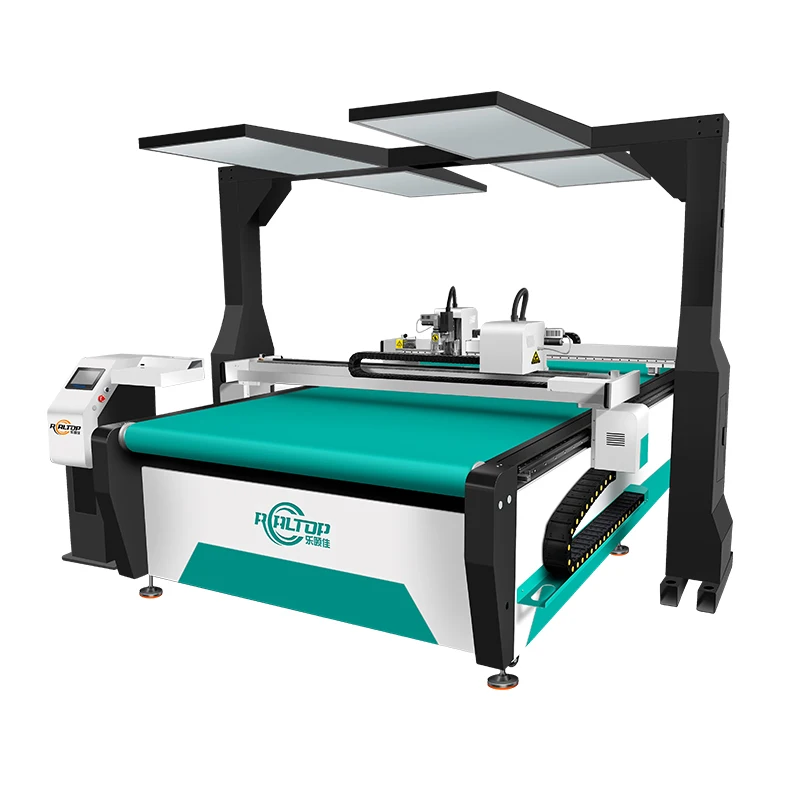
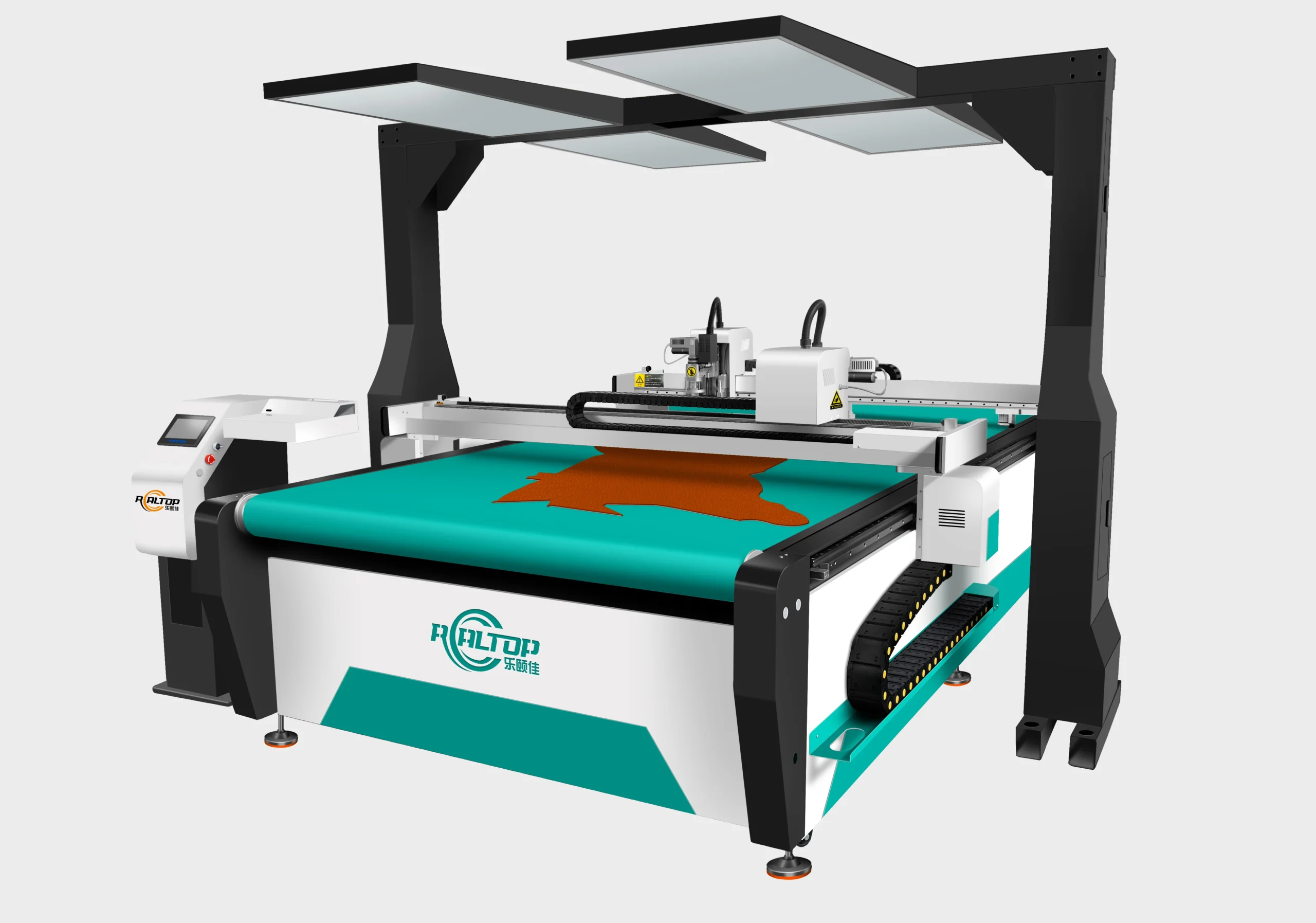
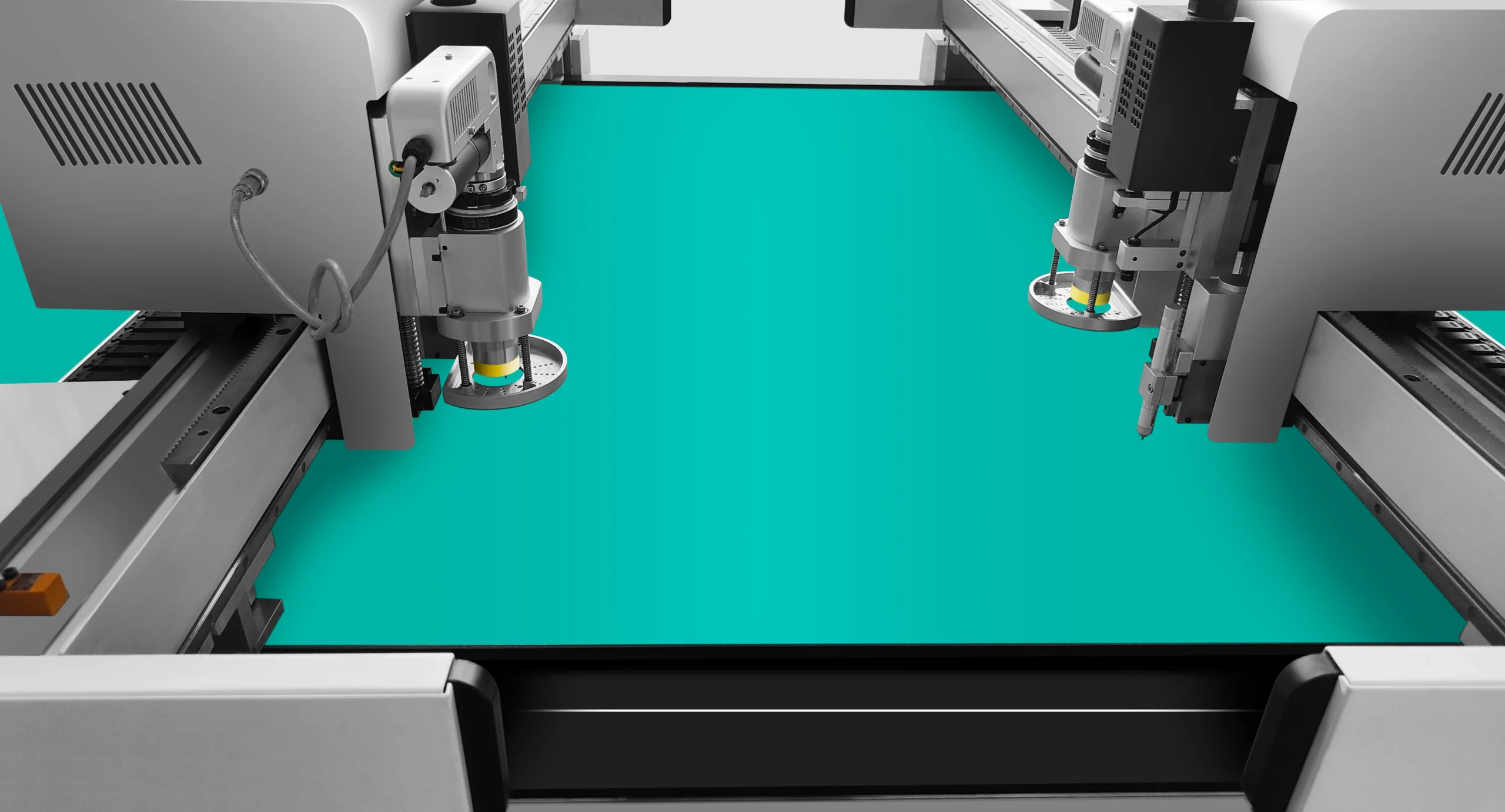
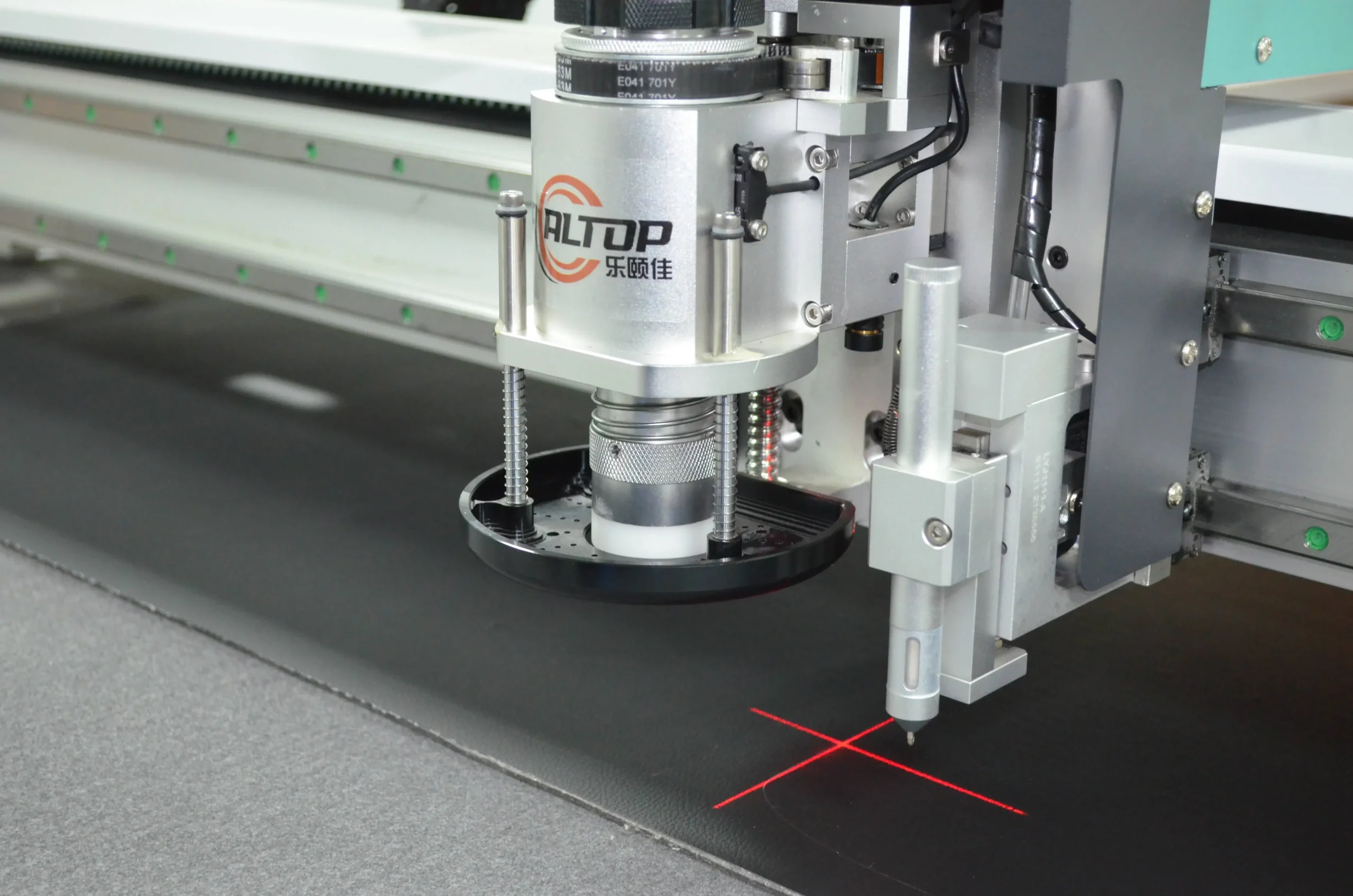
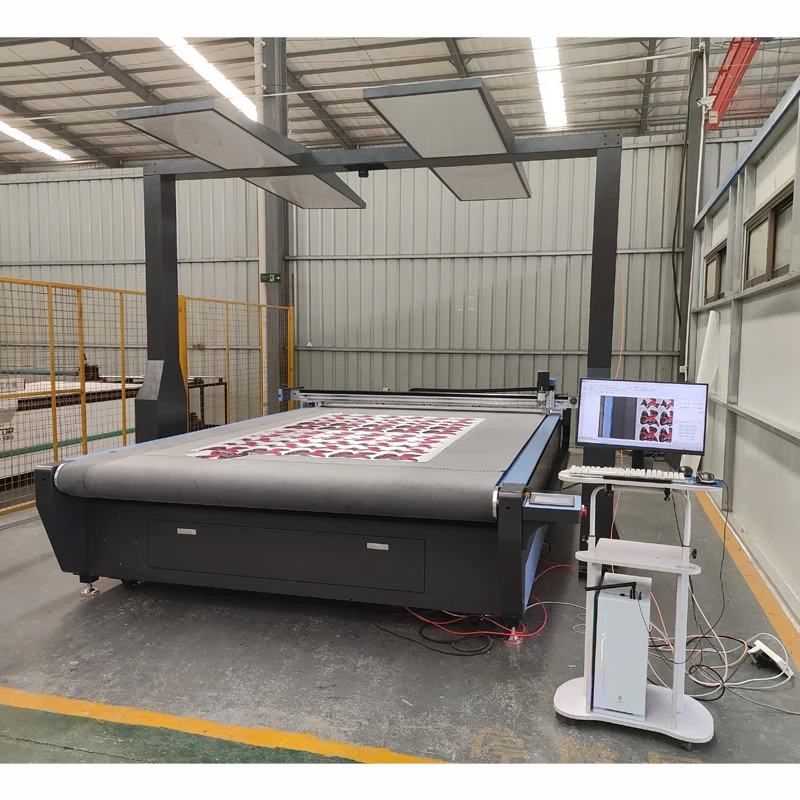

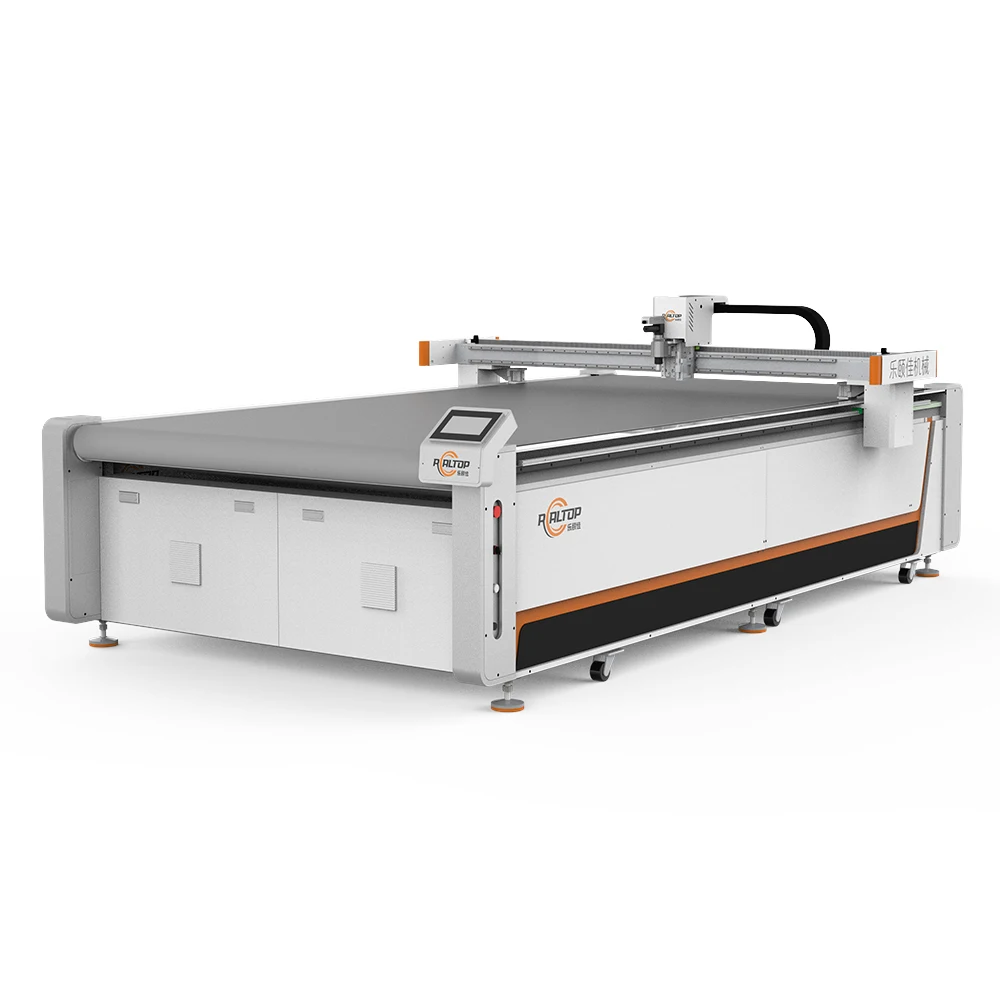
Integrated Multi-Tool Vision Cutting — panoramic camera recognition paired with oscillating knife, drag knife and creasing wheel heads configured per material profile.
Technical Specifications
| Parameter | Value |
|---|---|
| Model | RT-D2516 / RT-S2516 |
| Working Area | 1600 × 2500 mm |
| Machine Size | 3450 × 2300 × 1250 mm |
| Rated Power | 9 kW |
| Vacuum Pump | 7.5 kW |
| Table Type | Flat working table with conveyor option |
| Cutting Thickness Range | 20–80 mm depending on material density and tool head selection |
| Repeated Accuracy | ≤ 0.1 mm |
| Translational Velocity | 800–1200 mm/s |
| Transmission System | Digital servo motor, linear guide, synchronous belt, ball screw |
| Servo Motor | Delta servo motor |
| Rail | Taiwan Hiwin rail |
| Conveyor Belt | Germany-imported belt |
| Positioning System Options | Small CCD camera mark point positioning, panoramic camera recognition, projection positioning (optional) |
| Tool Head Options | Oscillating knife, pneumatic knife, high-power vibrating knife, circular knife, V-cutting knife, drag knife, creasing wheel, dotted line knife, punching, brush |
| Instruction System | HP-GL compatible format |
| Voltage | 380V ± 10% |
| Safety Device | Infrared sensors |
| Technology Certification | 5 patents technology certification (home and abroad) |
Application Suitability
| Application | Material or Output |
|---|---|
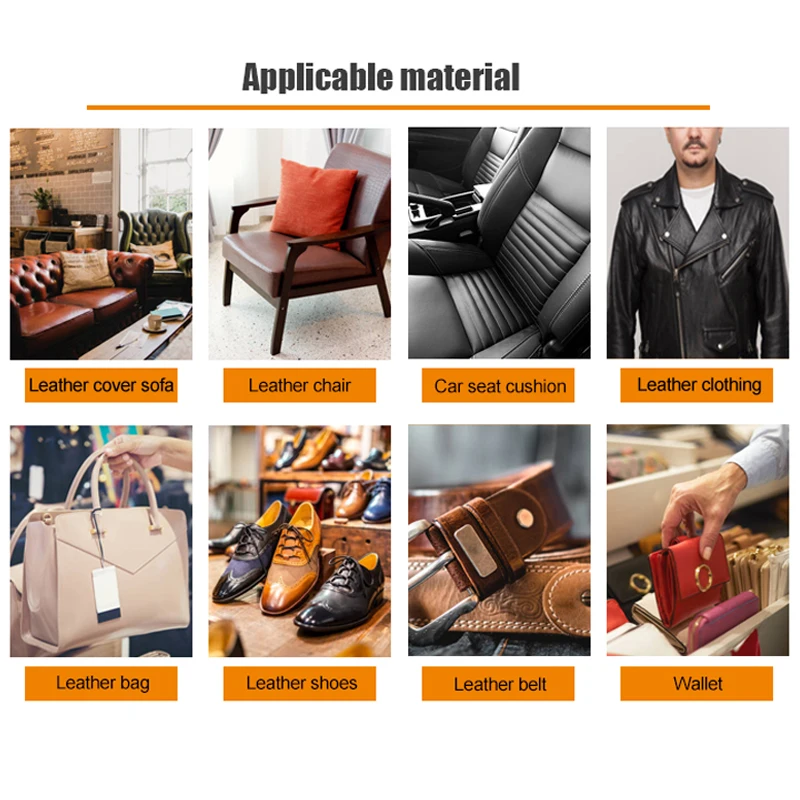
| Footwear upper and component cutting | Natural leather, PU leather, synthetic shoe material, shoe lining fabric |
| Automotive interior trimming | Seat cover leather, floor mat composite, EVA foam, gasket rubber |
| Garment and luggage panel cutting | Multi-layer textile, nylon, canvas, non-woven fabric, PU |
| Packaging and carton sample making | Corrugated cardboard, cardboard, plastic box sheet, sticker film |
| Soft furnishing and carpet production | Carpet, sponge, foam board, cloth, composite materials |
| Industrial gasket fabrication | PTFE, ETFE, rubber, fiberglass, sealing pad materials |
When the Camera Cannot Keep Up with the Conveyor Belt
A panoramic vision system only matters if it reads printed marks at full production speed, not just during slow sample runs. Our CCD recognition positioning is validated on your actual printed material before the machine ships.
I once walked into a shoe factory in León where the operator had slowed the feed rate down to a crawl just so the camera could lock onto contour marks on printed leather. The CNC oscillating knife cutting machine was technically "working," but the line throughput had collapsed. The problem was not the knife — it was a vision system that had never been tested on the specific ink and substrate at operational speed [NEED_CITE: vision system performance on varying substrate reflectivity]. We now run panoramic camera recognition tests on buyer-supplied hides and printed sheets as part of the pre-shipment protocol, documenting cycle time and positional accuracy on each material.
Matching Tool Heads to Material Behavior in Shoe and Automotive Production
Leather hides vary in density from belly to backbone, and a single oscillating knife setting will not cut cleanly across the entire surface. The RT-D2516 and RT-S2516 support multiple tool heads in a single setup — oscillating knife for through-cutting, drag knife for thinner synthetics, creasing wheel for fold lines on carton and packaging, and punching for eyelet and ventilation holes. This means a footwear producer can cut uppers, score fold lines and punch holes in one continuous operation without manual tool changes. The Swiss-imported knife delivers vibration full cutting, vibration half cutting and cursor location functions, giving operators granular control over cut depth on layered shoe materials.
How Automatic Feeding Changes the Cutting Workflow
Manual lay-up of leather hides onto a flat table creates idle time between cuts. The Germany-imported conveyor belt system on this platform feeds material continuously, and the panoramic camera identifies irregular hide edges and surface flaws before the knife engages. For automotive interior producers running seat cover panels and floor mats, this means the CNC oscillating knife cutting machine production line operates with less manual intervention between hides. The projection positioning option previews cut layout on the material surface before cutting begins, reducing waste on expensive leather [NEED_CITE: material yield optimization in automotive leather cutting].
Why Transmission and Vacuum Specs Matter on the Shop Floor
The Taiwan Hiwin rail and Delta servo motor combination holds repeated accuracy to within 0.1 mm, which is critical when cutting interlocking pattern pieces for shoe uppers where even slight deviation causes assembly problems downstream. The 7.5 kW vacuum pump provides hold-down force across the flat working table, but zoning matters as much as pump power. Small gasket parts and narrow automotive trim strips can lift off the table if vacuum zones are not segmented properly, so confirming your typical smallest part dimensions before configuration is essential. The 9 kW rated power and 380V ± 10% supply requirement also need to be checked against your facility electrical capacity — a voltage mismatch at startup can damage servo drives before the first cut is made.
The Hidden Cost of Skipping a Material Trial
I once configured a machine for a buyer who sent samples of standard garment leather, and the test cuts were clean. When the machine arrived at their facility, they were actually running a coated rigid recycled leather that the oscillating knife could not penetrate cleanly — the edge tore instead of cutting. The entire cutting line stalled. Since then, I insist on cutting the buyer’s actual production material before finalizing the tool head and knife frequency settings. Skipping this step leads to ragged edges on footwear components, crushed foam cores on automotive panels, and rejected batches that erode the yield advantage you bought the machine to achieve [NEED_CITE: material variability impact on cutting edge quality].
Why Production Facilities Source This Platform Here
In-house design and production covers both knife and laser cutting technologies, so buyers match the cutting method to their material rather than forcing one technology across every substrate. Tool head and table configuration is specified per material type and daily production volume, not sold as a fixed package. CCD camera positioning for printed contour work is tested on buyer-supplied material before order confirmation. Software compatibility with HP-GL format is confirmed against your existing nesting workflow. Voltage, control language and plug type are verified before shipment to match local electrical standards. Sample cutting on your own leather, fabric or composite material is completed and documented before you commit to the order.
Documentation & Verification
- Factory test record on your leather thickness and material type before dispatch
- Tool head and table configuration list matched to your specific production materials
- Sample cutting report documenting edge quality, cycle time and positional accuracy on your material
- Software license and HP-GL file format compatibility confirmation for your nesting system
- Electrical schematic with voltage, frequency and plug type verified for your facility
- Operation and maintenance manual in your preferred control language
Installation, Commissioning & Support
- 3450 × 2300 mm footprint requires level concrete floor with clearance for conveyor feed and material exit
- 380V ± 10% dedicated circuit with independent breaker for the 9 kW rated power draw plus 7.5 kW vacuum pump
- Machine ships with table and gantry separated; reassembly and rail alignment performed on site
- First-run calibration includes vacuum zone mapping, servo tuning and CCD camera registration on your material
- Operator training covers tool head changeover, nesting software workflow and HP-GL file import procedures
- Spare parts list includes oscillating knife blades, conveyor belt segments and vacuum seals specific to your configuration
Preparing Your Inquiry
Send us your actual production material samples — the specific leather grade, fabric weight or composite thickness you run daily, not a generic catalog spec. Tell us your typical sheet size, the smallest part dimension you cut, and your facility voltage and frequency. Let us know which nesting software you currently use so we can confirm file format compatibility before quotation.
Frequently Asked Questions
Q: How is cutting throughput verified for my specific leather thickness and pattern complexity?
A: We run your actual leather hides through the machine before shipment and document the cycle time, edge quality and positional accuracy in a sample cutting report. Throughput depends on hide shape, pattern nesting density and the number of tool head changes per sheet, so we test with your real production files rather than quoting a generic speed figure.
Q: Which tool head configuration matches my material stack and edge quality requirements?
A: The available heads include oscillating knife, pneumatic knife, high-power vibrating knife, drag knife, creasing wheel and punching tools. We recommend the combination based on your material type, thickness range and edge finish requirement, confirmed through a trial cut on your actual stock before the order is finalized.
Q: Can the CCD system track printed marks on my irregular leather hides at full production speed?
A: The panoramic camera recognition option is designed for irregular contour extraction on natural hides. We test it on your printed or marked leather at operational cutting speed, not at reduced feed rates, and document the registration accuracy in the sample report so you know what to expect on your shop floor.
Q: What software file formats and nesting workflows are compatible with my existing design system?
A: The instruction system supports HP-GL compatible format. Before order confirmation, we verify that your current nesting software exports files the machine controller can read directly, and we document this compatibility in writing so there are no integration surprises during commissioning.
Q: How do I confirm vacuum table zoning is sufficient for my small automotive gasket parts?
A: Small parts require segmented vacuum zones to prevent lifting during cutting. Provide us with your smallest gasket dimensions and material type, and we configure the 7.5 kW vacuum pump zoning accordingly, then validate hold-down performance during the factory test on your actual gasket material.





商品评价
Clear filtersThere are no reviews yet.