




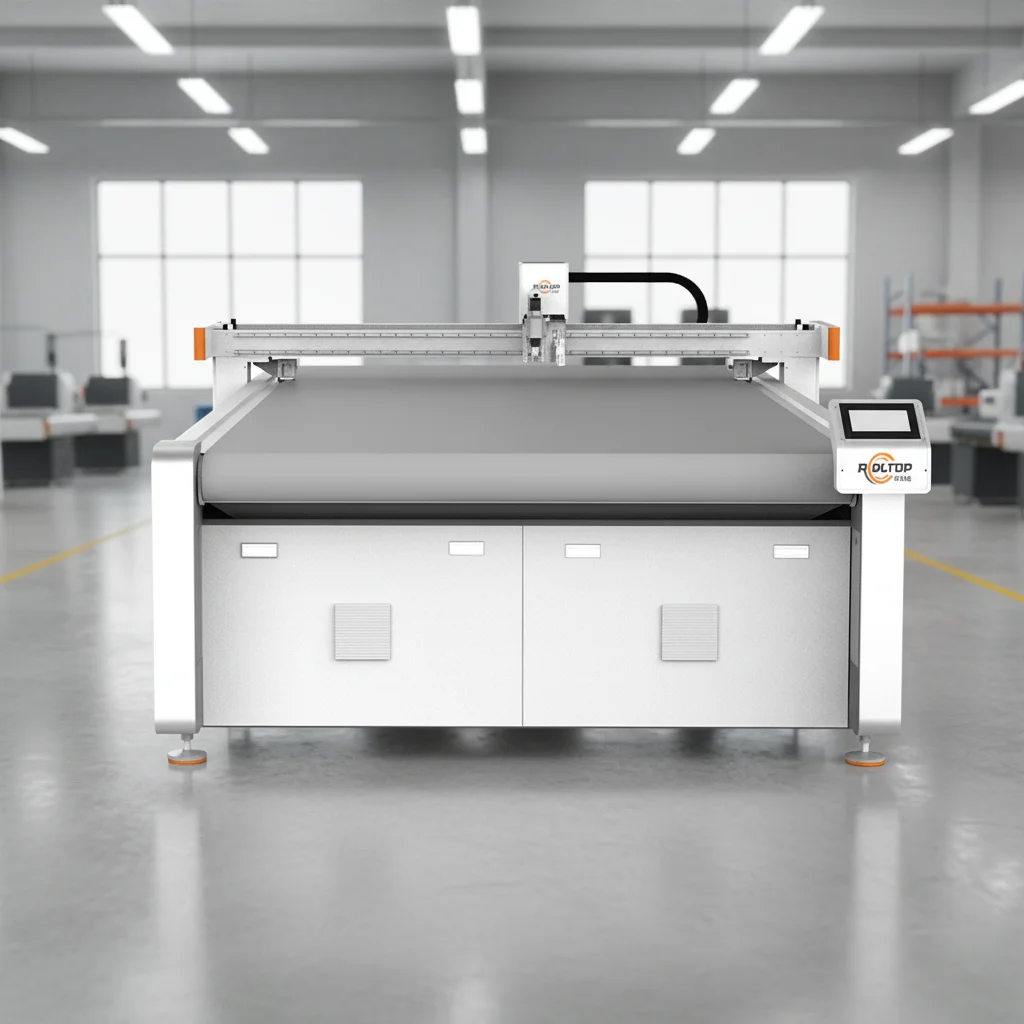
Material-first cutting configuration — tool head and vacuum zoning matched to fabric weight, weave, and stack height rather than forcing one setup across all textile jobs.
Technical Specifications
| Parameter | Value |
|---|---|
| Product Type | CNC Oscillating Knife Cutting Machine |
| Working Area | 1600×2500 mm |
| Tool Head Options | Oscillating knife, Driven rotary knife, Creasing wheel, Kiss cutting tool, Pneumatic knife, Milling tool, V-groove knife |
| Cutting Speed | 0–2000 mm/s |
| Cutting Thickness | ≤30 mm (basis not stated in source — confirm material type and layer configuration) |
| Cutting Accuracy | ±0.1 mm |
| Vacuum Pump Power | 9 kW |
| Vacuum Table Type | Aluminum bellows vacuum table |
| Servo Motor Brands | Panasonic, Delta, Dorna (selectable) |
| Control System | PLC control panel |
| Software File Formats | PLT, DXF, AI, PDF |
| Voltage Options | 110V / 220V / 380V |
| Language Options | English, Russian, Italian, Chinese (custom languages available) |
| Safety Devices | Infrared sensor, Emergency stop |
| Nesting Software | Intelligent nesting with defect avoidance |
| Machine Dimensions (L×W×H) | 3300×2100×1350 mm |
Application Suitability
| Application | Material or Output |
|---|---|
| Garment manufacturing | Woven suits, knitwear, lace, patterned fabrics requiring ply alignment |
| Automotive interiors | Seat fabrics, carpets, PVC floor mats cut to burr-free edge standards |
| Home textiles | Sofa upholstery, curtain panels, rugs with pattern matching across plies |
| Composite processing | Carbon fiber prepreg, aramid, and specialty technical fabrics |
Why the Wrong Knife Head Ruins More Fabric Than You Think
Edge quality starts at the tool head, not the blade sharpness.
A buyer once sent us a roll of stretch-blend knitwear. We ran it on an oscillating knife at our standard stroke rate and the edges came out frayed within the first meter. The elastic fibers in the weave were catching on each upstroke. Switching to a driven rotary knife at a matched feed rate cleaned the edge immediately. That kind of mismatch between tool head and fabric construction is the most common cause of rejected cuts in textile production [NEED_CITE: common cutting defects in elastic and blended fabrics].
The CNC Oscillating Knife Cutting Machine for fabric production addresses this by offering seven interchangeable tool heads on one platform. The oscillating knife handles rigid woven fabrics and multi-layer lays where a straight reciprocating stroke produces a clean shear. The driven rotary knife suits knits and stretch materials where continuous rotation prevents fiber pull. Kiss cutting tools score without penetrating the backing for appliqué and label work. Selecting the correct head before the first production run avoids material waste that no amount of blade replacement can fix.
How Fabric Construction Dictates the Tool Head Choice
Woven fabrics with tight thread counts respond well to oscillating knife action because the rigid structure holds each ply in place during the reciprocating stroke. Knits and jerseys, however, have looped fibers that stretch and recover with each blade pass — an oscillating knife will pull and distort these loops, leaving a visibly uneven edge. For these materials, a driven rotary knife rolls through the lay without interrupting fiber continuity.
Plush, fleece, and high-pile fabrics introduce a third variable: pile direction. If the blade enters against the nap, the surface fibers get dragged under the cut line and emerge on the wrong side of the seam allowance. A pneumatic knife with adjustable downforce and a shallow entry angle resolves this. Matching tool head to fabric construction is not optional — it determines whether the cut pieces go straight to sewing or require rework [NEED_CITE: textile cutting tool selection by fabric weave and pile type].
Vacuum Zoning and What Happens When It Falls Short
The aluminum bellows vacuum table on this system pairs with a 9 kW pump to generate full-surface adsorption across the 1600×2500 mm working area. In multi-layer fabric cutting, the vacuum must hold every ply flat against the table surface so that the bottom layer does not shift independently from the top. When small pattern pieces — like collar stays, pocket flaps, or gusset panels — are nested near the edges of a lay, uneven vacuum distribution allows those pieces to lift during the knife pass.
Zoning the vacuum table into independently controlled sections lets the operator concentrate suction under the active cutting zone. This is particularly relevant for mixed nests where large body panels sit alongside small trim pieces. Without proper zoning, the small parts drift by a millimeter or two — enough to throw off seam alignment downstream in the sewing department.
Reading the Specs That Actually Matter on the Shop Floor
The ±0.1 mm cutting accuracy figure matters most when cutting patterned fabrics where stripe or plaid alignment must match across adjacent pieces. At that tolerance, nested pieces maintain registration across the full 1600×2500 mm bed, so a jacket front and its corresponding facing panel stay matched regardless of where they sit on the table.
The 9 kW vacuum pump rating should be read alongside the table construction. Aluminum bellows tables distribute suction through a perforated surface sealed by the material itself — the pump power determines how quickly vacuum recovers after each knife penetration breaks the seal momentarily. A weaker pump would allow the vacuum to lag behind the cutting head during high-speed passes, particularly on porous woven fabrics where air bleeds through the weave.
Servo motor selection across Panasonic, Delta, and Dorna gives the buyer a choice between cost and response characteristics. Higher-tier servos maintain positional accuracy during rapid direction changes — the kind that occur when cutting tight curves on collar and cuff patterns. The PLC control panel with multi-language support means operators on the floor can run the machine without relying on translated paper manuals [NEED_CITE: servo motor selection criteria for CNC cutting tables].
The Cost of Skipping the Sample Cut
We had a buyer specify the machine based solely on working area and cutting speed, assuming any fabric within the thickness range would cut cleanly. When their actual production material — a bonded three-layer automotive seat fabric with a foam interlayer — arrived for testing, the oscillating knife compressed the foam rather than shearing it, leaving a crushed edge that would not accept a topstitch. Running a sample cut on the buyer’s exact material before order confirmation catches these mismatches while changes still cost nothing.
Skipping this step means discovering the problem during installation, when the machine is already on the factory floor and production deadlines are pressing. At that point, the fix involves shipping a different tool head internationally and re-running operator training — delays that compound through the entire supply chain [NEED_CITE: cost of post-installation configuration changes in CNC equipment].
What Distinguishes This Platform for Textile Production
In-house design covering both knife and laser cutting means the cutting method is chosen to match the fabric rather than forcing a single technology across all materials. Synthetic fabrics that benefit from sealed edges can move to a laser platform, while natural fibers and multi-layer lays stay on the knife table.
Tool head and table configuration is specified per material and production volume, not pulled from a standard catalog page. CCD camera positioning for printed contour work is available where registration to printed marks is required. Software compatibility with the buyer’s existing PLT, DXF, AI, or PDF files is confirmed before order. Voltage, control language, and plug type are locked in writing before production begins. Sample cutting on the buyer’s own fabric at full production thickness validates edge quality and throughput before commitment.
Documentation & Verification
- Machine specification sheet listing selected tool heads and vacuum zone layout
- Electrical schematic with confirmed voltage, frequency, and plug type for destination market
- Tool head and table configuration list matched to buyer’s fabric type and ply count
- Sample cutting report on buyer’s own material at production lay height
- CE declaration covering the configured machine and selected safety devices
- Software licence and file format compatibility note for nesting workflow integration
Installation, Commissioning & Support
- Floor space allocation for 3300×2100×1350 mm machine footprint plus material feed and offload clearance
- Dedicated electrical circuit matching confirmed 110V, 220V, or 380V supply with correct frequency
- Assembly of aluminum bellows vacuum table sections and 9 kW pump connection on site
- First-run parameter setting for selected tool head against buyer’s fabric at target ply height
- Operator training on PLC control panel in confirmed language with nesting software workflow
- Spare oscillating and rotary knife blades plus vacuum seal consumables supplied at delivery
What We Need to Configure Your Machine
To recommend the correct tool head and vacuum zoning, send us a representative sample of your fabric along with the lay height you run in production. Include your standard nesting files so we can verify software import and confirm that the intelligent nesting system handles your pattern geometry. Let us know your local voltage and frequency so the electrical package is correct before the machine leaves the factory.
Frequently Asked Questions
Q: Which tool head should I use for stretch knit fabric versus rigid woven?
A: Stretch knits with elastic fibers require a driven rotary knife to avoid fraying caused by the reciprocating stroke of an oscillating knife. Rigid wovens with tight thread counts cut cleanly with an oscillating knife, which shears through multi-layer lays efficiently. We run sample cuts on your actual fabric to confirm the selection before the machine ships.
Q: How do you verify the cutting thickness capacity for my material?
A: The stated capacity of up to 30 mm depends on material density and whether you cut single ply or stacked lays. We test your exact fabric at your production lay height and document edge quality, cutting speed, and vacuum hold-down performance in a sample cutting report before you commit to the order.
Q: Will the vacuum table hold small pattern pieces without shifting?
A: The aluminum bellows table is divided into zones with independent suction control, concentrating vacuum under the active cutting area. This prevents small pieces like collar stays and pocket flaps from lifting during high-speed knife passes. Zone configuration is matched to your typical nest layout during setup.
Q: Can the nesting software import my existing CAD files?
A: The intelligent nesting system accepts PLT, DXF, AI, and PDF formats directly. Before order confirmation, we test import of your actual production files to verify compatibility with your existing workflow, including defect avoidance logic. Any format gaps are identified and resolved before shipment.
Q: How are voltage and control language confirmed before delivery?
A: We document the required voltage, frequency, plug type, and PLC control language in writing before production begins. Options include 110V, 220V, and 380V supplies with control interfaces available in English, Russian, Italian, Chinese, or a custom language specified by the buyer.





商品评价
Clear filtersThere are no reviews yet.