


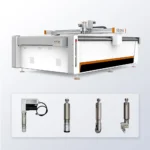

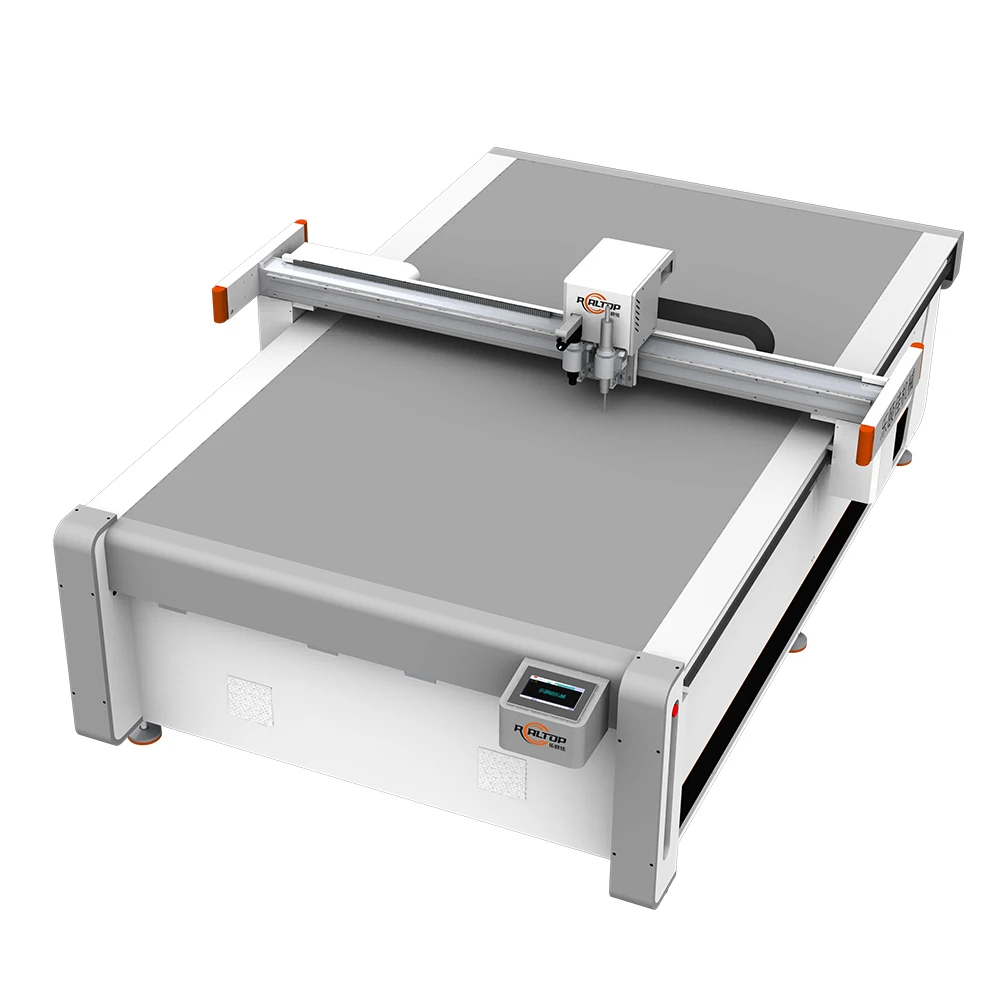


Vacuum Zoning by Part Size — table zones mapped to the actual footprint of your carton samples, not a generic grid.
Technical Specifications
| Parameter | Value |
|---|---|
| Product Type | CNC Oscillating Knife Cutting Machine |
| Working Area | 1600 × 2500 mm |
| Tool Head Options | Oscillating knife, Driven rotary knife, Creasing wheel, Kiss cutting tool, Pneumatic knife, Milling tool, V-groove knife |
| Applicable Materials | Cardboard, Carton, Corrugated board, Greyboard, Art paper, Fabric, PVC, EVA, Leather, Foam, PTFE, Rubber |
| Cutting Speed | 0–1500 mm/s |
| Maximum Cutting Thickness | ≤ 40 mm |
| Cutting Accuracy | ±0.1 mm |
| Vacuum Pump | 9 kW |
| Voltage Options | 110V / 220V / 380V |
| Profile Format Compatibility | PLT, DXF, AI, PDF |
| Safety Features | Infrared sensor device, Emergency stop |
| Machine Dimensions | 3300 × 2100 × 1350 mm |
| Control System | PLC control panel (specific brand to be confirmed) |
| Servo Motor Options | Panasonic, Delta, Dorna (subject to manufacturer catalog verification) |
| Interface Languages | English, Russian, Italian, Chinese (custom languages available) |
Application Suitability
| Application | Material or Output |
|---|---|
| Carton sample prototyping | Corrugated board (E-flute, B-flute, BC-flute), greyboard, cardstock |
| Short-run packaging production | Art paper, adhesive-backed laminates, thin plastic sheets (PVC, PET) |
| Protective insert fabrication | EVA, EPE, PU foam contour-cut to product shape |
| Inner lining and gasket cutting | Velvet, fleece, non-woven fabric, rubber mats |
| Rigid box structural sampling | Greyboard and composite boards with V-groove scoring |
Why Board Weight Matters More Than Table Size
A machine specified only on working area often fails when the first corrugated sheet hits the table — a CNC oscillating knife cutting machine for packaging production workflow must be configured around your heaviest flute and smallest offcut, not just the bed dimensions.
I once set up a flatbed cutter for a carton plant based on the coated stock thickness they quoted. The vacuum zones were mapped for large sheets, and the knife pressure was dialed for single-ply board. On day one they ran triple-wall corrugated for a protective packaging trial. Small tabs lifted off the table mid-cut, the oscillating knife caught the leading edge, and an entire batch of samples was ruined before the operator could stop the head. The problem was never the machine itself; it was the gap between what the specification sheet assumed and what the production floor actually ran [NEED_CITE: common causes of material lift on flatbed digital cutters]. That gap is where most packaging cutting failures start.
Tool Head Sequencing for Corrugated and Foam
Corrugated carton rarely needs just one tool in a single job. A crease line followed by a through-cut on B-flute board demands that the creasing wheel and the oscillating knife share the same tool carriage and reference the same registration points. When the CNC oscillating knife cutting machine for packaging switches between scoring and cutting without losing datum, fold lines land exactly where the structural engineer placed them in the CAD file. For EVA and EPE foam inserts, the oscillating knife holds a vertical wall through 40 mm of density without crushing the cell structure at the bottom of the cut — something a drag knife simply cannot do on closed-cell foam.
Vacuum Table Zoning and Small-Part Hold-Down
The 9 kW vacuum pump on this flatbed is sized for full-surface adsorption across the 1600 × 2500 mm aluminum bed, but raw suction is not the issue. The issue is zone segmentation. When you cut a carton sample with twelve small glue tabs, each tab needs its own vacuum zone to stay flat under the knife head at 1500 mm/s traverse speed [NEED_CITE: vacuum zoning strategies for nested packaging parts]. A table with only four large zones will hold a full sheet perfectly yet let a 30 mm tab flutter free the moment the knife exits the cut. Zone layout must be specified against the smallest part in your typical nesting job, not the largest sheet you plan to buy.
Reading the Specs Beyond the Headline Numbers
Cutting speed rated at 1500 mm/s is the maximum traverse rate on straight vector paths; actual throughput on a corrugated carton sample with multiple crease lines and tight-radius corners depends on acceleration curves and the tool change sequence. The ±0.1 mm accuracy figure matters most on kiss-cut applications where the blade must score an adhesive laminate without cutting through the release liner — any drift past that tolerance and the liner is breached, rendering the part scrap. Voltage configurability across 110V, 220V and 380V is not a cosmetic option; packaging plants in North America run 220V single-phase or 480V three-phase (transformed), while most Asian and Middle Eastern facilities are on 380V three-phase at 50 Hz, and mismatched supply will burn out the 9 kW vacuum pump motor before the first shift ends. File format support for PLT, DXF, AI and PDF means your existing packaging box structure design software output imports directly, but compatibility must be tested on your actual files before the purchase order is signed, not assumed from a format list on a brochure.
The Cost of Skipping the Material Trial
Every carton plant runs a different mix of flute profiles, board weights and laminate constructions, and no specification sheet captures that mix accurately. When a buyer approves a tool head list based on generic material categories — "cardboard" or "foam" — without a physical sample cut on their own stock, the first production run reveals what the quote left out: ragged edges on coated art paper because the wrong oscillation frequency was selected, crushed flutes at fold lines because the creasing wheel diameter was too narrow for BC-flute, or adhesive build-up on the kiss-cut blade because the tool material was not specified for coated stocks [NEED_CITE: tool wear patterns on adhesive-backed packaging materials]. These are not warranty issues. They are configuration errors, and they cost days of production time to diagnose and correct on the factory floor.
Why Procurement Starts Here
Our in-house design team covers both knife cutting and creasing tool engineering under one roof, so the tool carriage is built around your job sequence rather than adapted from a generic router platform. Every machine leaves the Jinan facility with a sample cutting report run on the buyer’s own board stock and flute type — edge quality, crease integrity and tab hold-down are documented before the crate is closed. The electrical schematic and voltage confirmation are matched to your facility supply and signed off before the servo drives are energized. Software compatibility is verified by importing your actual PLT, DXF, AI or PDF design files and running a nesting test, not by checking a format list. The CE declaration and factory test record ship with the machine, and the spare parts list reflects the exact tool heads and wear items on your configuration, not a generic catalogue page.
Documentation & Verification
- Sample cutting report on your corrugated flute type and board weight
- Electrical schematic matched to your facility voltage and phase
- Tool head and vacuum zone configuration list specific to your carton sizes
- Software licence and file format compatibility note for your design workflow
- Factory test record with dimensional accuracy check before dispatch
- CE declaration for machinery directive compliance
Installation, Commissioning & Support
- Floor space allocation for 3300 × 2100 mm footprint plus operator clearance
- Dedicated circuit for 9 kW vacuum pump separate from PLC control supply
- Machine arrives on skid base requiring fork-lift positioning and leveling
- First-run parameter setting for your specific board weight and flute profile
- Operator training on tool change sequence between creasing wheel and oscillating knife
- Wear parts inventory matched to your quoted tool head configuration
What We Need From You to Build a Quote
Send us the exact board specifications you run most often — flute type, board weight in GSM, maximum sheet size and the smallest part dimension in your typical nesting layout. Tell us your facility voltage and phase, the language your operators need on the PLC interface, and which packaging design software generates your production files. If you want to see edge quality and crease integrity before committing, ship us a stack of your own material and we will return a sample cutting report with the tool configuration that produced it.
Frequently Asked Questions
Q: How is cutting throughput verified for my specific corrugated board and flute type?
A: We run your actual board stock on the machine at our Jinan facility before shipment. The sample cutting report documents traverse speed, edge quality and crease line integrity for your exact flute profile and board weight. Maximum rated speed of 1500 mm/s applies to straight vector paths; real throughput on nested carton samples depends on corner radii and tool change frequency, both measured during the trial.
Q: Which tool heads are configured for corrugated carton with crease lines?
A: A typical corrugated carton setup pairs the oscillating knife for through-cuts with the creasing wheel for fold lines, both mounted on the same carriage. The wheel diameter and pressure are selected to match your specific flute — E-flute requires a different wheel profile than BC-flute. Kiss cutting tools are added if your job includes adhesive-backed laminate windows or labels.
Q: Does the software import my existing packaging design files without rework?
A: The system accepts PLT, DXF, AI and PDF formats, but file import must be tested on your actual design output before the order is confirmed. We take your production files, run them through the nesting software and verify that cut paths, crease lines and registration marks translate without manual redrawing. Any conversion issues are resolved before the machine ships.
Q: How is vacuum zoning set up to prevent small carton tabs from lifting?
A: The aluminum vacuum table is segmented into zones, and the active zones are matched to the smallest part in your nesting layout. A generic four-zone setup will hold a full sheet but release a 30 mm glue tab at high speed. We specify zone segmentation based on your actual part dimensions and verify hold-down during the sample cutting trial on your board stock.
Q: What voltage and control language are confirmed before shipment?
A: Voltage is confirmed against your facility supply — 110V, 220V or 380V — and documented on the electrical schematic before assembly. The PLC control panel language is set to your operator preference from available options including English, Russian, Italian and Chinese, with custom languages available on request. Plug type and cable specification match your local standard.



商品评价
Clear filtersThere are no reviews yet.