




Tooling matched to material — the cutting head, stroke and vacuum layout are set after sample trials on the buyer’s fabric, not picked from a catalog page.
Technical Specifications
| Parameter | Value |
|---|---|
| Model | 1625 |
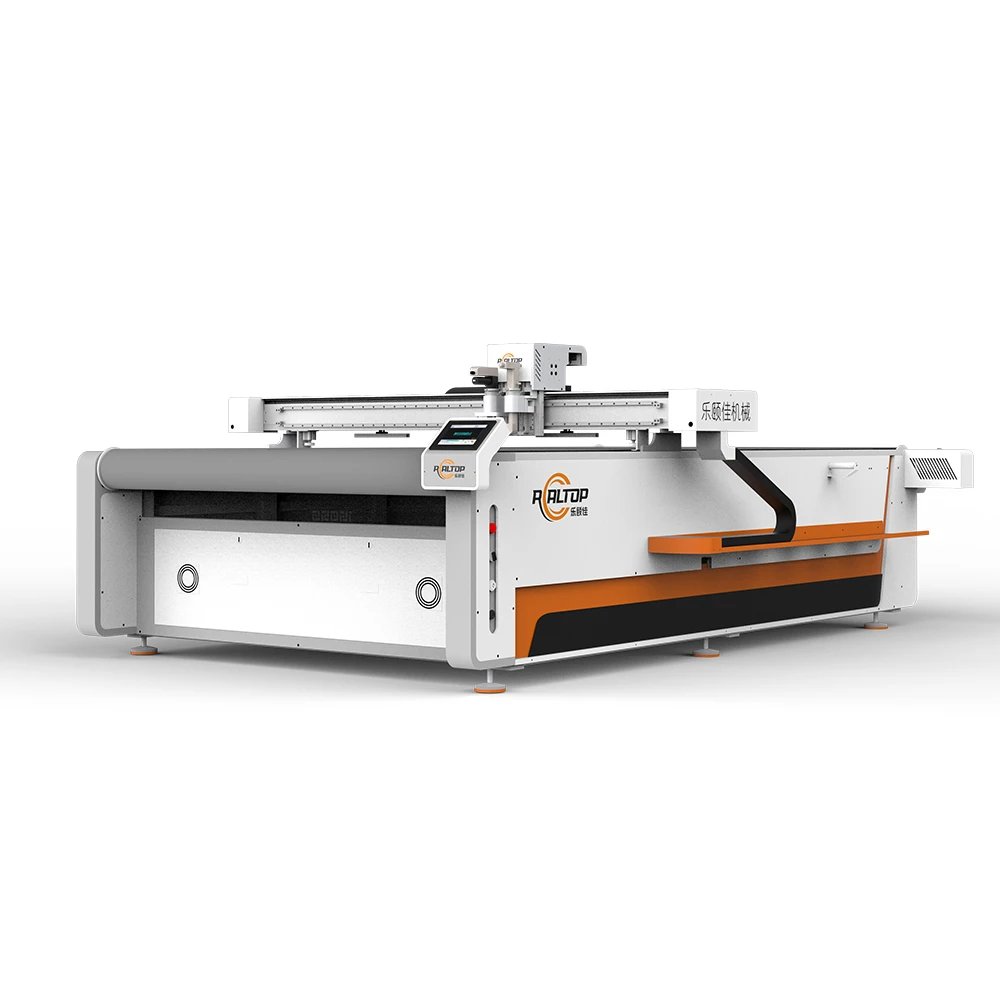
| Product Type | CNC Oscillating Knife Cutting Machine |
| Working Area | 1600×2500 mm |
| Tool Head Options | Oscillating knife, Driven rotary knife, Creasing wheel, Kiss cutting tool, Pneumatic knife, Milling tool, V groove knife |
| Applicable Materials | Fabric, Cardboard, Carton, Mats, PVC, EVA, Leather, Acrylic, Foam, PTFE, Rubber |
| Cutting Speed | 0–2000 mm/s |
| Cutting Thickness | ≤30 mm (basis to be confirmed by material type and ply count) |
| Positioning / Cutting Accuracy | ±0.1 mm |
| Vacuum Pump | 9 kW |
| Vacuum Table | Full-surface aluminum bellows vacuum table |
| Voltage Options | 110V, 220V, 380V |
| Control System | PLC control panel |
| Software & File Formats | PLT, DXF, AI, PDF; dedicated packaging box structure design software |
| Nesting | Intelligent nesting system |
| Safety Devices | Infrared sensor device, emergency stop device |
| Machine Size | 3300×2100×1350 mm |
| Drive / Servo Options | Panasonic, Delta, Dorna |
| Language Options | English, Russian, Italian, Chinese; special languages customizable |
| Certification | CE |
Application Suitability
| Application | Material or Output |
|---|---|
| Apparel manufacturing | Suits, knitwear, lace, complex fabrics with pattern-matching layouts |
| Automotive interiors | Seat fabrics, carpets, PVC mats requiring burr-free edges |
| Home textiles | Sofa fabrics, curtains, rugs, multi-layer cutting |
| Composite material processing | Carbon fiber prepreg, aramid, specialty materials |
| Flexible material fabrication | Shoes, bags, clothing, cartons in garment, automotive and home furnishing sectors |
What "Working Area Only" Specifications Leave Out on a CNC Fabric Cutting Machine Production Line
The table size tells you nothing about whether the machine will actually hold, cut and track your specific fabric lay at sustained production pace.
I have walked into workshops where a machine was chosen purely on working area, then the team discovered the vacuum zoning could not grip small pattern pieces, the oscillating knife struggled through their multi-layer composite, and the software refused to import their nesting files. Each of those mismatches surfaces only after the machine arrives and the first lay goes down. A CNC fabric cutting machine production line must be specified around the material mix, ply count and daily workflow — not the footprint on the floor [NEED_CITE:].
Tool Head Selection Determines Edge Quality Across Fabric Types
Different fabrics demand fundamentally different cutting actions. A woven suit cloth cuts cleanly under a high-frequency oscillating knife, while a knit lace requires a driven rotary knife to avoid pulling and distortion. The 1625 supports seven tool head options, allowing the configuration to match the dominant material rather than forcing every fabric through a single blade. When a production line handles both heavy automotive carpet and delicate lining fabric, switching tool heads between jobs preserves edge quality across both.
Vacuum Zoning and Ply Stability in Multi-Layer Cutting
Holding multi-layer fabric flat during high-speed cutting requires vacuum distributed across the full work surface. The 9 kW pump paired with a full-surface aluminum bellows table maintains suction on small pattern pieces that would otherwise lift at the edges as the knife exits a cut path. This matters most in home textile and automotive applications where lays combine several plies of varying weight — the CNC fabric cutting machine production line must grip the bottom ply as firmly as the top one.
Reading the Specs Through Actual Production Conditions
The ±0.1 mm positioning accuracy holds practical meaning when pattern-matching striped or checked fabric for suits and upholstery, where a fraction of a millimeter drift across a long panel accumulates into visible misalignment. Cutting speed rated at 0–2000 mm/s defines the kinematic ceiling; real throughput depends on corner density, fabric friction between plies, and whether the nesting software groups pieces to minimize head travel [NEED_CITE:]. The PLC control panel accepts DXF, PLT, AI and PDF files, which covers the vast majority of pattern outputs from mainstream apparel CAD systems without intermediate conversion steps. Drive options across Panasonic, Delta and Dorna servos let the buyer align servo brand preference with local service availability.
The Hidden Cost of Skipping a Material Trial
When a buyer commits to a configuration without seeing their own fabric cut under production conditions, the first sign of trouble appears during installation. Ragged edges on technical composites, crushed foam cores, or pattern pieces that shift on the vacuum table all trace back to a tool head or zoning choice made without physical evidence. I watched a customer lose weeks reconfiguring their line after the original oscillating knife could not cleanly shear through a six-layer automotive seat lay — a trial before order would have surfaced that mismatch in an afternoon [NEED_CITE:].
Why Source This CNC Fabric Cutting Machine Production Line Here
In-house design covers both knife and laser cutting methods, so the cutting technology is selected to fit the material instead of forcing every job through one approach. Tool head and table configurations are specified per fabric type, ply count and daily volume with written documentation of every choice. CCD camera positioning is available for printed contour work where registration marks must be tracked at production speed. Software compatibility is confirmed against the buyer’s existing file formats before the order is placed, not discovered during commissioning. Voltage, plug type and control panel language are locked in during specification review so the machine arrives ready to connect [NEED_CITE:].
Documentation & Verification
- Machine specification sheet listing every selected tool head and vacuum zone layout
- Electrical schematic and voltage confirmation matched to your facility’s supply standard
- Sample cutting report on your actual fabric, ply count and lay height
- Software licence and file format compatibility note for your CAD output
- Factory test record run on your material before crating and dispatch
- Spare parts list covering blades, vacuum seals and wearable drive components
Installation, Commissioning & Support
- Floor space planning around the 3300×2100×1350 mm frame with access clearance for material feed
- Dedicated circuit provision for the 9 kW vacuum pump and selected servo drive package
- Reassembly and leveling of the aluminum bellows vacuum table at the installation site
- First-run parameter tuning on your fabric type including knife stroke, vacuum zone mapping and speed profile
- Operator training covering tool head changeover, nesting import and emergency stop procedures
- Scheduled maintenance intervals for blade replacement, vacuum seal inspection and drive belt tension checks
Before You Send an Inquiry
Share the fabric types you cut most often, the typical ply count and lay height, and your target daily output so the tool head and vacuum configuration can be matched to real conditions. Confirm your facility voltage, frequency and preferred control panel language to avoid rewiring after arrival. If you run an existing nesting workflow, send a sample DXF or PLT file so software compatibility is verified before the order is finalized.
Frequently Asked Questions
Q: How is cutting capacity verified for my specific fabric type and lay thickness?
A: Your actual fabric is test-cut at the intended ply count and lay height before order commitment. The sample cutting report documents edge quality, cutting speed achieved and any tool head adjustment required. This removes guesswork and ensures the configuration sustains your production scenario rather than a generic benchmark.
Q: How do we choose the right tool head for mixed-material production?
A: Each fabric type responds differently to cutting action — oscillating knives suit woven and dense materials, rotary knives handle knits and lace, pneumatic knives address heavy composites. The tool head is selected based on your dominant material mix, and additional heads can be specified if your line runs varied jobs across shifts.
Q: How are voltage and control language confirmed before shipment?
A: Voltage options span 110V, 220V and 380V. Your target market supply standard is confirmed during specification review along with plug type and control panel language. The electrical schematic is issued for approval before production begins, preventing mismatched wiring on arrival.
Q: How does the software integrate with our existing nesting workflow?
A: The system imports PLT, DXF, AI and PDF formats directly. If you use a specific CAD package, a sample file exchange before order confirms that nesting output transfers without manual re-drawing. The intelligent nesting system can also supplement your existing workflow where material yield optimization is needed.




商品评价
Clear filtersThere are no reviews yet.