


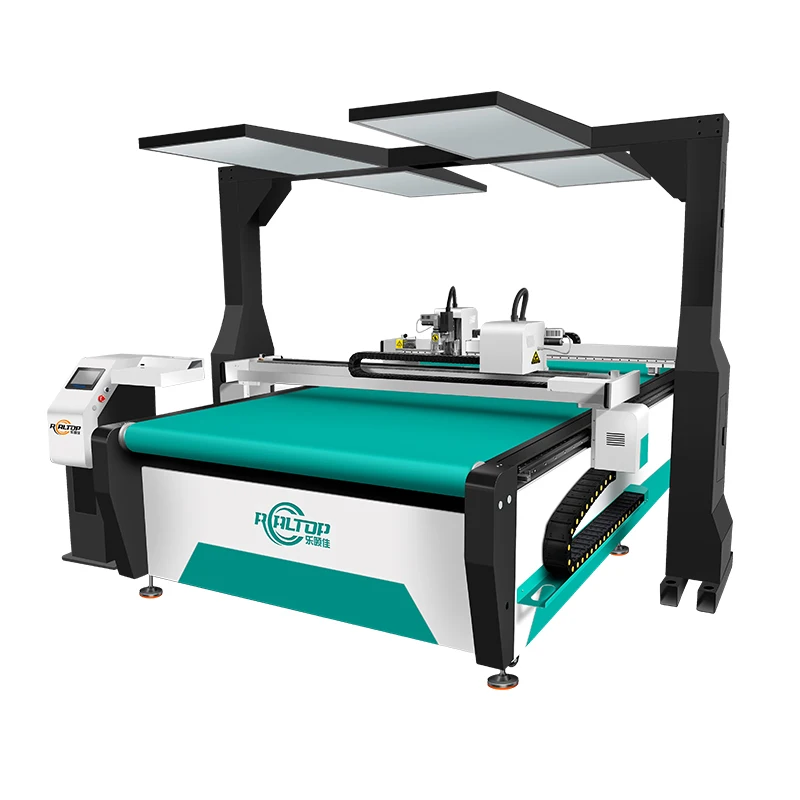
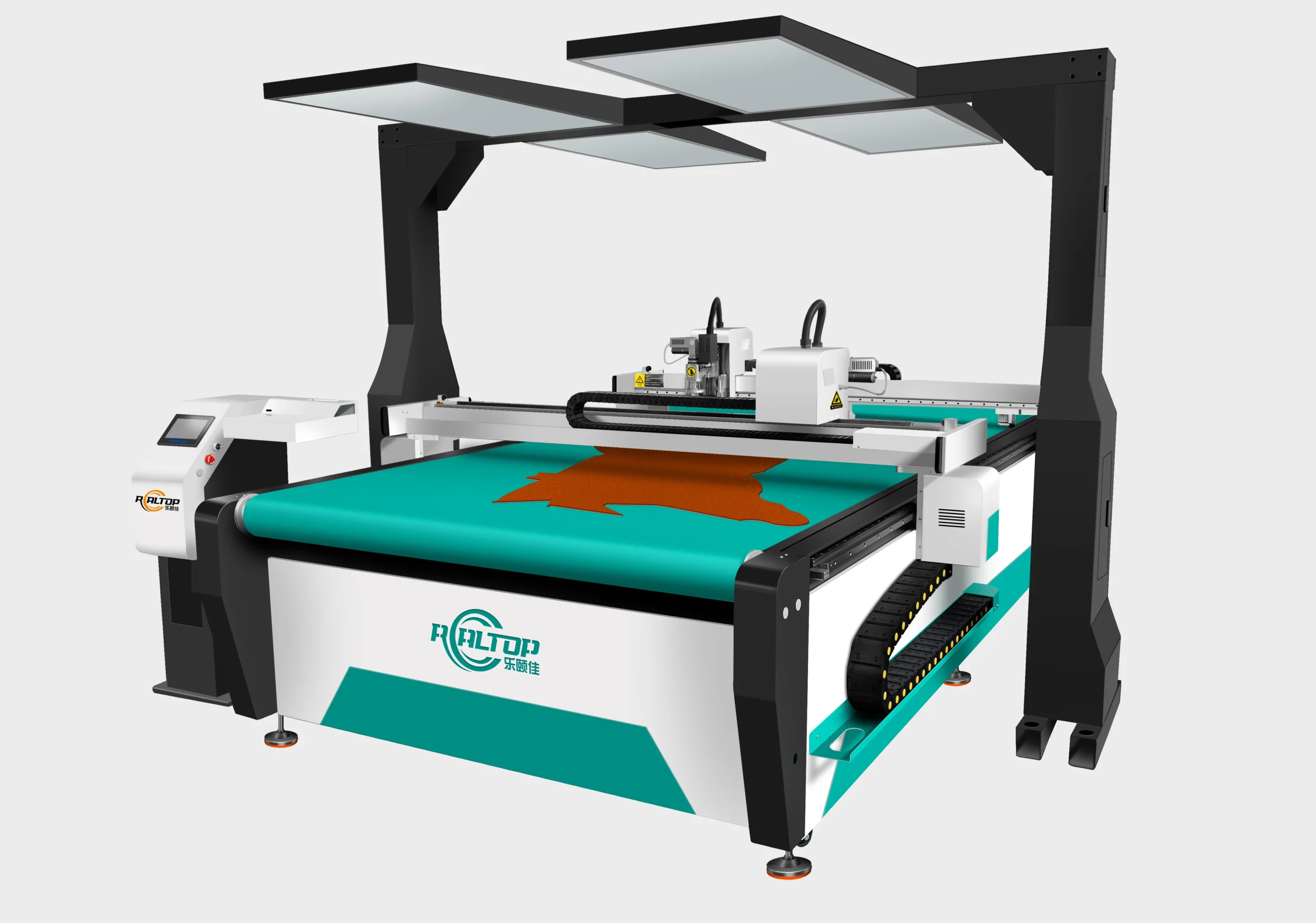
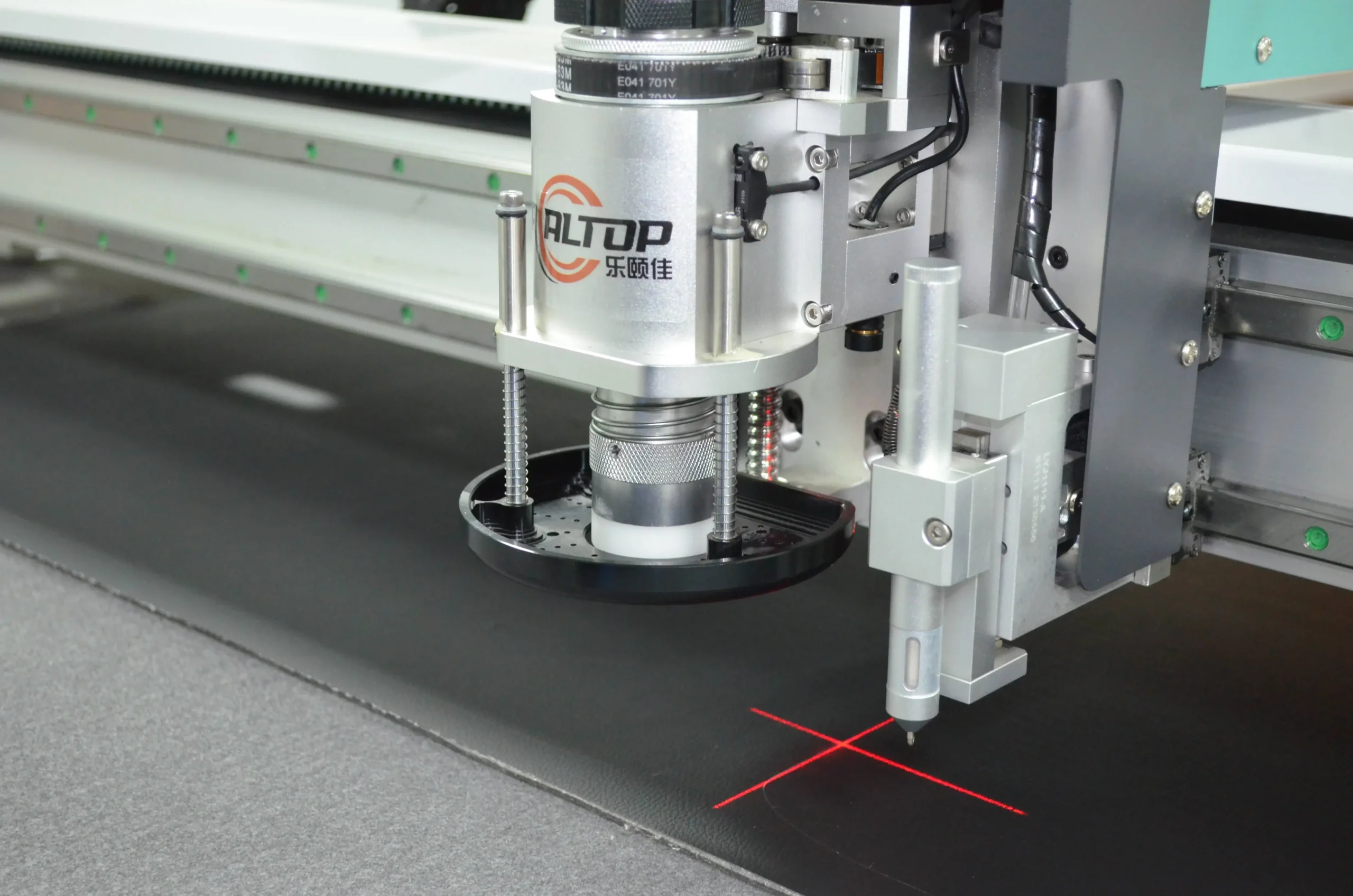
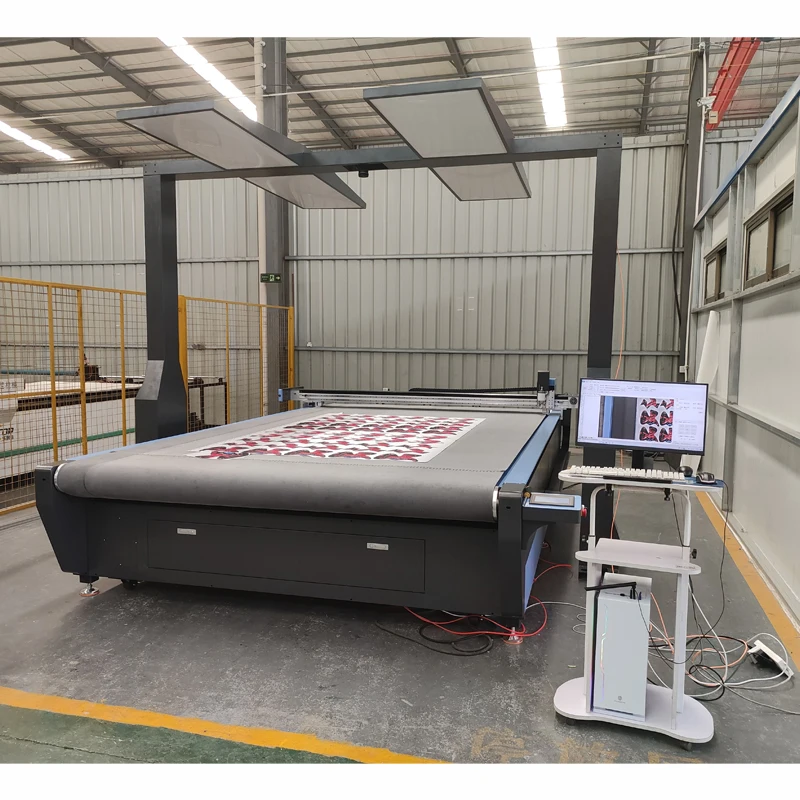

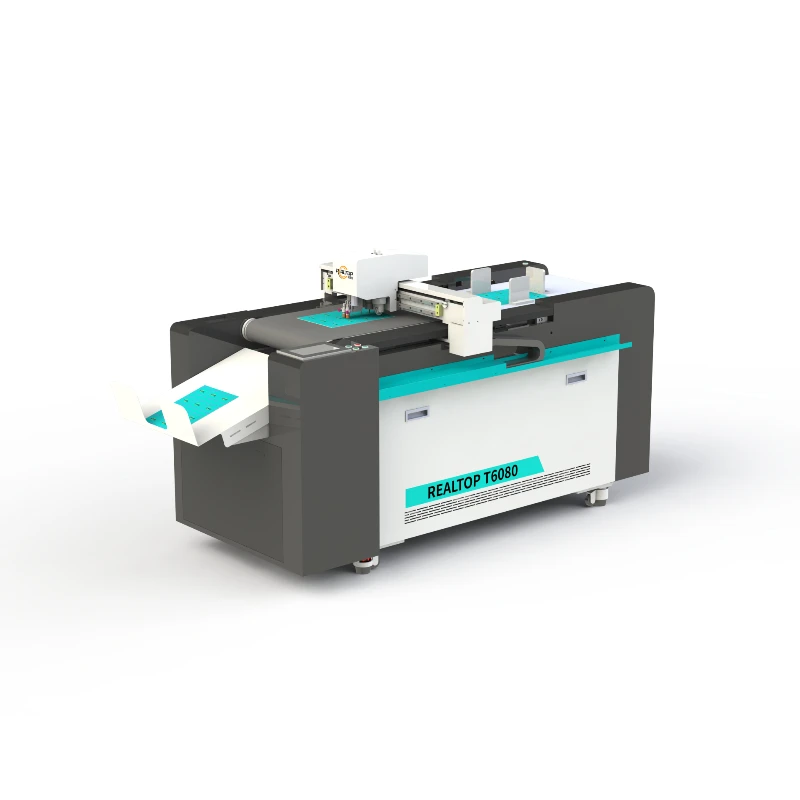
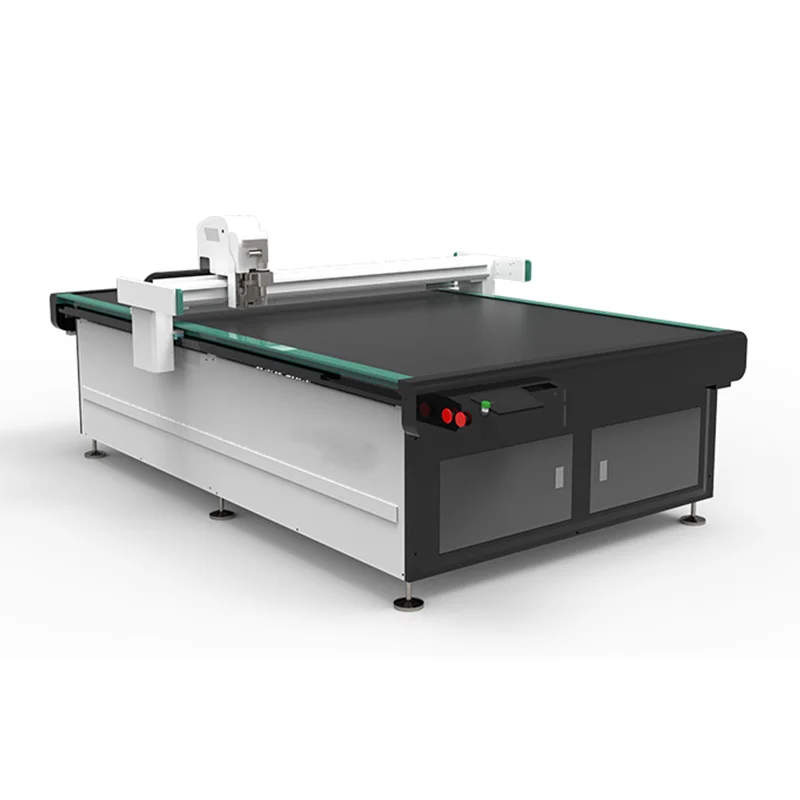
In-house knife and laser design — the RT-D2516 and RT-S2516 oscillating knife cutters are engineered by a single team controlling everything from tool head geometry to vacuum zoning, so material-specific configurations are resolved at the drawing board rather than patched on the shop floor.
Technical Specifications
| Parameter | Value |
|---|---|
| Model | RT-D2516 / RT-S2516 |
| Product Type | CNC Oscillating Knife Cutting Machine |
| Working Area | 1600 × 2500 mm |
| Machine Size (L×W×H) | 3450 × 2300 × 1250 mm |
| Rated Power | 9 kW |
| Table Type | Flat working table with aluminum alloy vacuum adsorption |
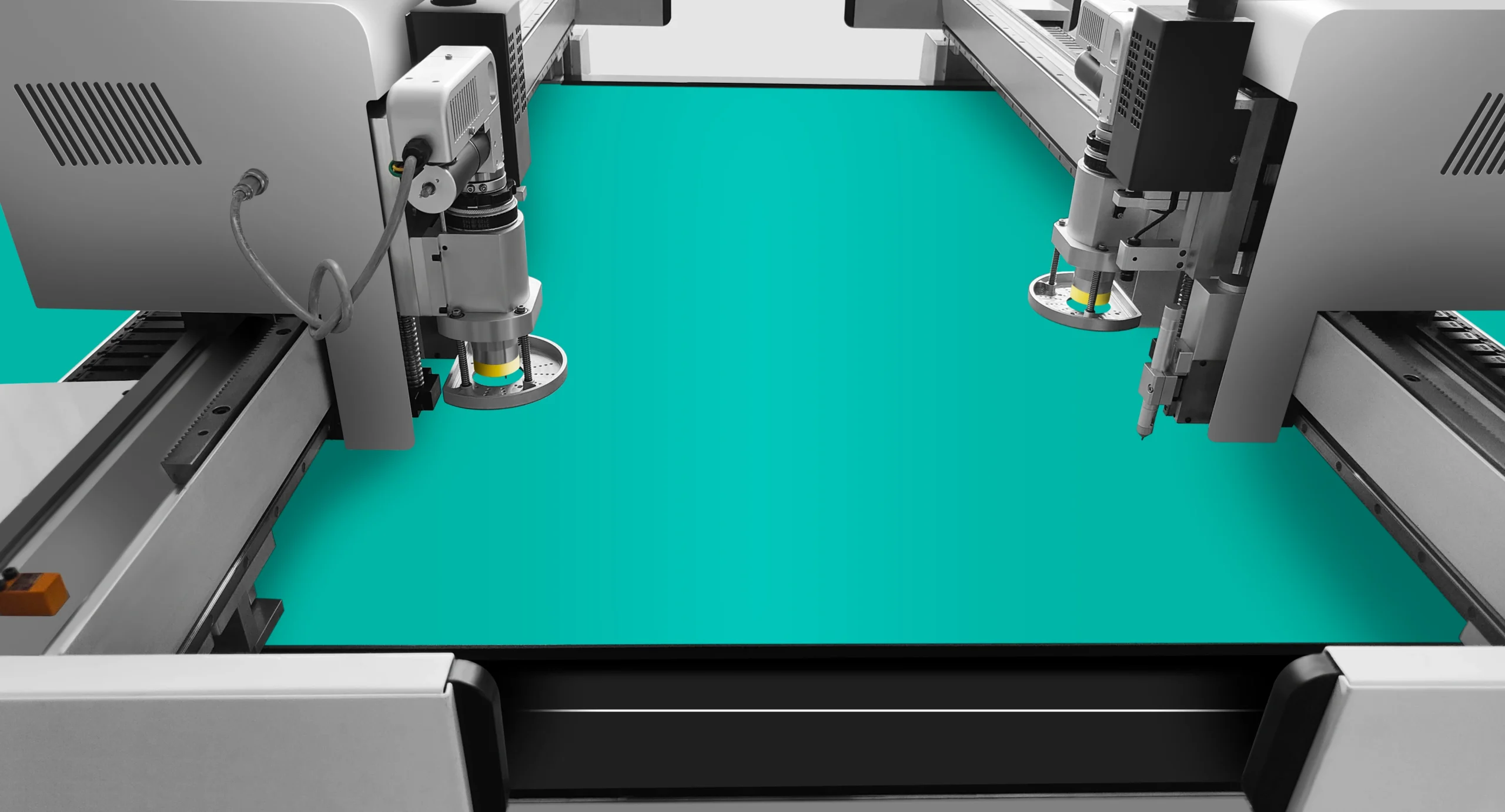
| Multifunctional Head | Swiss imported knife (vibration full cutting, vibration half cutting, cursor location); optional pneumatic knife, high-power vibrating knife, circular knife, V-cutting knife, drag knife, creasing wheel, dotted-line knife, punching tool, brush |
| Safety Device | Infrared sensors |
| Translational Velocity | 800–1200 mm/s |
| Cutting Thickness | 20–80 mm (basis not stated in source — confirm material type and density) |
| Repeatability | ≤ 0.1 mm |
| Transmission System | Digital servo motor (Delta), linear guide (Taiwan Hiwin rail), synchronous belt, ball screw |
| Vision / Positioning | Small CCD camera mark-point positioning, panoramic camera recognition, projection positioning (optional) |
| Instruction Format | HP-GL compatible |
| Voltage | 380 V ±10% |
| Vacuum Pump | 7.5 kW |
| Auto Feeding | Germany imported conveyor belt with auto feeding system |
| Software Language Options | English, Russian, Italian, Chinese; special languages customizable |
| Warranty | 1 year (lifetime technical support stated) |
Application Suitability
| Application | Material or Output |
|---|---|
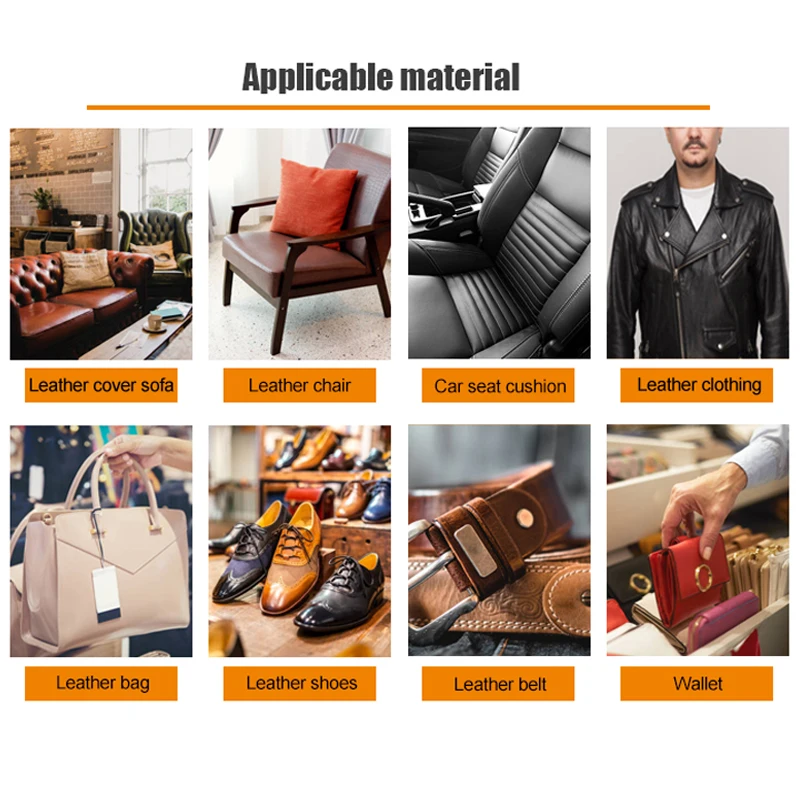
| Footwear and leather goods cutting | Natural and synthetic leather, sponge composite leather, shoe material |
| Automotive interior and gasket production | PU, EVA, XPE, sponge composite leather, multi-layer composites |
| Garment and textile nesting | Clothing flexible material, non-woven fabric, cloth |
| Packaging sample making and carton prototyping | Cardboard, corrugated cardboard, plastic box |
| Soft signage and graphic advertising | PVC, soft glass, sticker, film |
| Sealing gasket fabrication | Rubber, PTFE, ETFE, gasket material |
Why Working Area Alone Is a Dangerous Specification for a CNC Oscillating Knife Cutting Machine
A cutting table sized to your sheet is useless if the tool head cannot hold the material down long enough to finish the cut.
I have watched a machine arrive at a customer’s floor with the right footprint but the wrong vacuum zoning. The buyer’s leather hide was cut into small automotive interior pieces, and every time the blade finished a contour, the offcut lifted, caught the knife, and ruined the surrounding nest. The problem was not the oscillating knife cutting machine itself — it was the gap between the specification sheet and the actual production job. Thickness, density, and part geometry all decide how the vacuum table must be zoned, which tool head goes into the spindle, and whether auto-feeding can keep up with shift volume [NEED_CITE: vacuum hold-down requirements for small-part digital cutting].
Vacuum Zoning and Small-Part Retention on the Shop Floor
When the RT-D2516 or RT-S2516 runs a full hide of automotive seat-cover leather, the 1600 × 2500 mm vacuum table provides broad adsorption. The real test comes once the first contour is cut and a small armrest pattern sits next to an open slit. Multi-zone vacuum control lets the operator keep suction active under uncut areas while releasing zones where parts have already been cleared, so the remaining nest stays flat and the knife maintains consistent depth through the full sheet.
One-Pass, Multi-Tool Nests for Footwear and Leather Goods
The multifunctional head on this CNC oscillating knife cutting machine supports quick-change tooling including a drag knife, creasing wheel, and punching tool. For a footwear factory cutting shoe uppers with fold lines and ventilation holes, a single nest file can drive the oscillating blade for the outer contour, switch to the creasing wheel for the fold score, and fire the punching tool for eyelet holes — all without moving the material or re-zeroing the sheet.
Matching Camera Recognition to Production Cadence
Three vision options are available: small CCD mark-point positioning, panoramic camera recognition, and optional projection positioning. For printed textiles or pre-marked leather hides, the CCD camera reads registration marks before each cut cycle. The key question for a production manager is whether mark recognition keeps pace with translational speeds up to 1200 mm/s on the specific print contrast used in their material [NEED_CITE: CCD camera mark tracking speed versus conveyor feed rate].
Specification Details That Determine Actual Cutting Performance
Cutting thickness is listed at 20–80 mm, but that range depends entirely on material density. A 50 mm slab of low-density PU foam cuts cleanly with a standard oscillating blade, while 30 mm of compressed sponge composite leather may require the high-power vibrating knife option and a slower feed rate. The 7.5 kW vacuum pump is sized to pull air through the aluminum alloy table surface and the felt conveyor belt simultaneously, which matters when auto-feeding is running continuous roll stock. Delta digital servo motors paired with Hiwin linear rails hold repeatability to 0.1 mm, so nested patterns that share a cut line do not accumulate positional error across a full sheet. HP-GL compatible instruction format means the machine accepts output from most industry nesting software, and the software language can be set to English, Russian, Italian, Chinese, or a custom language before the control panel is configured.
What Happens When Tool Head Selection Is Skipped
A buyer who specifies a machine on working area and price, then ships it without a sample cut on their actual production material, is taking a risk that shows up on day one. I dealt with an automotive interior case last year where the customer sent a soft sample swatch for testing, but their production runs used a multi-layer composite leather several grades harder. The standard oscillating blade could not penetrate at production speed, and we spent two days on-site swapping blade types and adjusting oscillation frequency before the line ran acceptably. Wrong tool head selection produces ragged edges on leather, crushed cells on foam, or delamination on composite stacks — defects that only appear when the machine meets the real material [NEED_CITE: material hardness variation in composite leather production].
Why Buyers Source This CNC Oscillating Knife Cutting Machine Here
The design team and core factory operate under one roof, meaning knife-cutting configurations are developed in-house rather than sourced from a third-party integrator. Tool head and table configurations are specified per material and production volume, not offered as a generic package. CCD camera positioning for printed contour work is tested on the buyer’s actual file before the order is finalized. Software compatibility is confirmed against the buyer’s existing CAD output and nesting workflow. Voltage, plug type, control language, and specification details are locked in before production begins. Sample cutting on the buyer’s own material is standard procedure, not an optional extra — and I insist on it because I have seen what happens when it is skipped.
Documentation & Verification
- Machine specification sheet listing confirmed tool head and vacuum zone configuration for your material stack
- Electrical schematic with voltage and frequency matched to your facility supply before assembly
- Sample cutting report produced on your production material at target thickness and shift volume
- Software licence and file format compatibility note covering your existing nesting CAD output
- Factory test record documenting repeatability and cut quality on your specific pattern nest
- Spare parts list identifying blades, felt belt sections, and vacuum cups with replacement intervals
Installation, Commissioning & Support
- Floor space requires minimum 3450 × 2300 mm clear footprint plus material staging area around the 1600 × 2500 mm table
- Dedicated 380 V ±10% circuit with 9 kW capacity and verified frequency before the control cabinet is energized
- Machine ships fully assembled; rigging plan needed for door clearance given 2300 mm transport width
- First power-on includes vacuum zone mapping to your part geometry and servo calibration on Hiwin rails
- Operator training covers HP-GL file import, tool head changeover, and CCD mark-point calibration workflow
- Consumable stock includes Swiss oscillating blades, creasing wheels, and felt belt sections sized for your sheet width
Before You Request a Quote
To configure this machine for your line, share the material type, actual production thickness, and the largest sheet or roll width you run. Confirm your local voltage and frequency, the control language your operators need, and whether your nesting software exports in HP-GL. If your material is a multi-layer composite or a hide with natural irregularities, send a production sample so we can run a cutting test at target volume before the order is placed.
Frequently Asked Questions
Q: How do you choose the right tool head for my material stack?
A: We run your production material through the machine using multiple blade and tool options — oscillating, drag, creasing, or punching — and document which combination delivers clean edges at your target feed rate. The configuration list in the contract reflects that test, not a generic catalog selection.
Q: How is daily throughput verified before I commit to the order?
A: Throughput depends on your specific sheet size, material thickness, and nesting complexity. We benchmark a full nest cycle on your material during the sample cutting stage and record the cycle time, so the expected output reflects your actual production pattern rather than a generic speed rating.
Q: How does the auto-feeding system integrate with my existing line?
A: The Germany imported conveyor belt and 7.5 kW vacuum pump are set up to feed continuous roll or sheet stock onto the working table. We confirm belt speed, vacuum hold-down timing, and downstream part removal against your current workflow during commissioning.
Q: Can I arrange a factory visit to see the machine run my material?
A: Yes. We schedule a factory acceptance test using your supplied production material and your pattern files. You observe the cutting cycle, inspect edge quality, and approve the test record before the machine is prepared for shipment.
Q: What consumables should I stock, and how are replacements sourced?
A: Standard consumables include oscillating knife blades, drag knife tips, creasing wheels, felt belt sections, and vacuum cups. The spare parts list in your documentation specifies part numbers and recommended stock quantities based on your shift volume and material abrasiveness.




商品评价
Clear filtersThere are no reviews yet.