




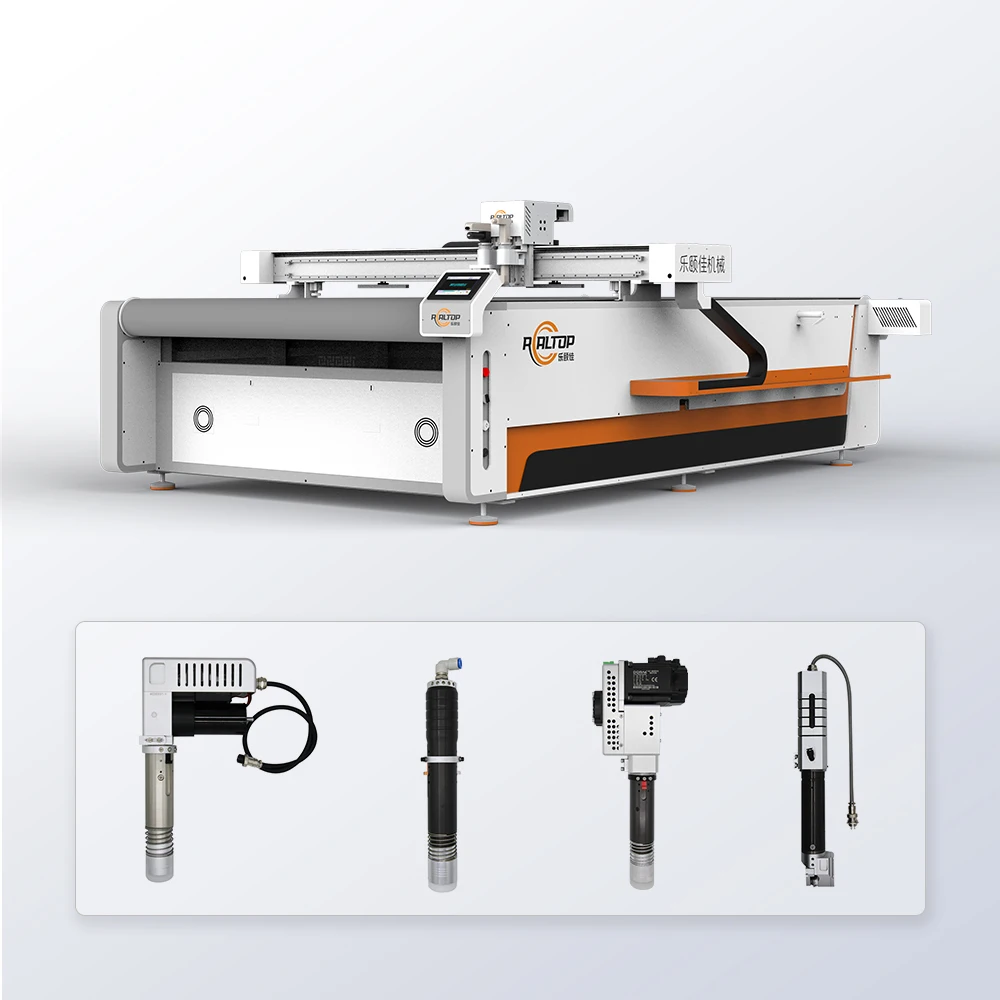
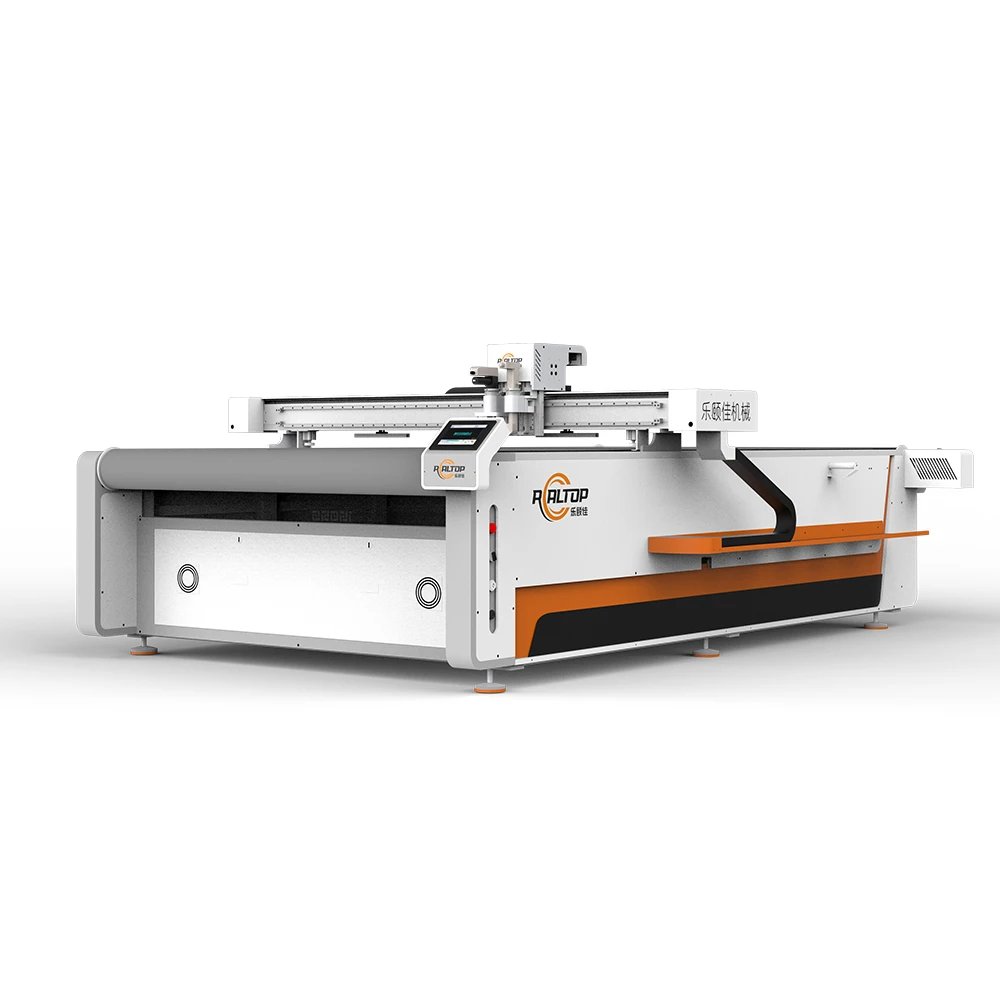
Roll-to-Cut Automation — the RT-D2516/RT-S2516 integrates a German imported conveyor belt and multi-zone vacuum table to keep continuous fabric feeding aligned with high-speed oscillating knife cutting.
Technical Specifications
| Parameter | Value |
|---|---|
| Product Type | CNC Oscillating Knife Cutting Machine |
| Model | RT-D2516/RT-S2516 |
| Working Area | 1600 × 2500 mm |
| Machine Size | 3450 × 2300 × 1250 mm |
| Rated Power | 9 kW |
| Translational Velocity | 800–1200 mm/s |
| Cutting Thickness | 20–80 mm (varies by material density and layer count) |
| Repeated Accuracy | ≤0.1 mm |
| Transmission System | Digital servo motor, linear guide, synchronous belt, ball screw |
| Vacuum Pump | 7.5 kW |
| Voltage | 380V ±10% |
| Tool Head Options | Oscillating knife, pneumatic knife, high-power vibrating knife, circular knife, V-cutting knife, drag knife, creasing wheel, dotted line knife, punching, brush |
| Visual Positioning Options | Small CCD camera mark point positioning, panoramic camera recognition, projection positioning |
| Instruction Format | HP-GL compatible |
| Table Configuration | Flat working table with conveyor belt and auto-feeding system |
Application Suitability
| Application | Material or Output |
|---|---|
| Garment and apparel cutting | Woven fabric, knit textile, non-woven fabric, clothing cloth |
| Automotive interior trimming | Seat cover leather, headliner textile, carpet, sponge composite materials |
| Soft home furnishings | Upholstery fabric, curtain textile, composite cushion foam |
| Footwear and luggage production | Shoe material, PU, EVA, luggage fabric, composite leather |
| Sports and outdoor goods | Technical textile, XPE foam, composite padding |
| Sealing and gasket fabrication | Rubber, PTFE, ETFE, gasket material |
Why Small Fabric Parts Lift During High-Speed Cutting
Multi-zone vacuum configuration determines whether your nesting layout holds flat or shifts mid-cut.
Many production managers specify a cloth CNC cutting machine production line by working area and knife speed alone, only to discover that small pattern pieces lift off the table when the blade exits a cut. The vacuum table on this system is driven by a 7.5 kW pump and divided into independently controlled zones. When cutting irregular garment panels or automotive headliner shapes, the operator activates only the zones beneath the active cutting path, concentrating suction where the material needs it most. This matters especially on porous textiles and loosely woven fabrics where full-table suction would bleed pressure across unused areas. [NEED_CITE: vacuum hold-down requirements for porous textile materials]
Continuous Feeding for Roll-Based Textile Workflows
The German imported conveyor belt paired with the auto-feeding mechanism turns the RT-D2516/RT-S2516 into a cloth CNC cutting machine production line suited to roll-to-cut operations. Fabric advances from the roll across the flat working table, the knife completes the nested pattern, and the conveyor moves the cut section forward for sorting while fresh material feeds in behind it. This continuous cycle reduces the manual handling that typically interrupts flatbed cutting workflows.
Contour Accuracy on Printed Fabrics
For garment manufacturers working with pre-printed textiles or sublimation-transfer fabric, the optional CCD camera positioning systems address registration drift. The small CCD camera targets printed mark points, while the panoramic camera option recognizes the full printed contour across the working area. This lets the cloth CNC cutting machine production line follow printed outlines rather than relying solely on the digital file, correcting for stretch or skew introduced during printing or feeding.
What the Specs Mean on the Cutting Table
The 1600 × 2500 mm working area accommodates standard textile roll widths while leaving margin for nested pattern layouts. Translational velocity of 800–1200 mm/s governs how fast the head moves between cuts; actual cutting speed depends on material density, layer count, and the selected tool head. The Swiss imported oscillating knife delivers a vibrating full cut and half cut, which matters when processing composite materials like sponge-backed leather — a clean through-cut on the face fabric without scoring the backing requires precise depth control. Repeated accuracy at ≤0.1 mm ensures that nested pieces cut from the same layout match dimensional tolerances needed for downstream sewing or bonding operations. The Delta servo motor and Taiwan Hiwin linear guide maintain positional accuracy across the full travel range, preventing cumulative drift that would otherwise compound over a long cutting run. [NEED_CITE: positional accuracy standards for automated garment cutting]
When the Wrong Tool Head Costs You a Production Day
Selecting a drag knife for thick composite foam or a circular knife for tightly nested garment panels produces ragged edges and crushed material cores. I flew to an Indonesian workshop where the customer had switched from lightweight lining fabric to a heavily coated composite textile without changing the tool head configuration — two days of production lost to frayed edges and recuts. The RT-D2516/RT-S2516 offers oscillating, pneumatic, vibrating, circular, V-cutting, and drag knife heads precisely because no single blade geometry handles the full range of textiles and composites a typical workshop processes. Matching the tool head to your specific material stack before the machine ships prevents the kind of on-site troubleshooting that halts a production line. [NEED_CITE: tool head selection criteria for textile composite materials]
Why Procurement Starts with Material, Not Machine Size
The design and production team covers both knife and laser technologies under one roof, so the cutting method is matched to your material rather than forced into a single technology. Every RT-D2516/RT-S2516 configuration is specified against the buyer’s actual fabric type, thickness, and daily volume before a quotation is finalized. The in-house design team adjusts vacuum table zoning, tool head selection, and feeding mechanism parameters based on the production mix you provide. Software file format compatibility is confirmed before order placement, so your existing nesting workflow connects to the machine without intermediate conversion steps. Voltage, control language, and plug configuration are locked in before production begins, not discovered at commissioning.
Documentation & Verification
- Machine specification sheet listing configured tool heads and table zoning layout
- Electrical schematic confirming 380V ±10% supply and circuit protection ratings
- Sample cutting report on your specific fabric type and thickness before shipment
- Factory test record documenting cutting speed and edge quality on your material
- Software licence and HP-GL file format compatibility confirmation note
- Spare parts list matched to your selected tool head configuration
Installation, Commissioning & Support
- Flat foundation required for the 3450 × 2300 × 1250 mm machine footprint with conveyor clearance
- Dedicated 380V ±10% circuit rated for the 9 kW total load including the 7.5 kW vacuum pump
- Assembled frame delivery with conveyor belt tensioning and vacuum zone commissioning on site
- First-run parameter tuning on your actual fabric, adjusting oscillation frequency and cutting depth
- Operator training covering tool head changeover, zone activation, and CCD camera calibration
- Scheduled maintenance intervals for linear guide lubrication and knife blade replacement
What We Need to Configure Your Line
To recommend the right cloth CNC cutting machine production line setup, share the fabric types you process, typical material thickness and layer count, and your daily cutting volume. Include your roll width, nesting software format, and workshop voltage so we can confirm feeding mechanism compatibility and electrical configuration before quoting. If your materials include coated composites or multi-layer laminates, send physical samples so we can run cutting trials and document edge quality before you commit.
Frequently Asked Questions
Q: How should I configure vacuum zones for mixed garment part sizes?
A: The multi-zone vacuum table on the RT-D2516/RT-S2516 lets you activate suction only beneath the active cutting area. For layouts mixing large panels with small collar or cuff pieces, zoning concentrates the 7.5 kW pump output where material needs to stay flat. We map your typical nesting pattern during specification and recommend zone boundaries that match your production mix.
Q: How does the auto-feeding system integrate with upstream spreading equipment?
A: The German imported conveyor belt and auto-feeding mechanism on this cloth CNC cutting machine production line accepts fabric directly from a spreader or roll stand. The feeding rate synchronizes with the cutting cycle so the conveyor advances only after the knife completes the current nested section. We confirm the interface with your existing spreading equipment during the configuration stage.
Q: How is cutting throughput verified before the machine ships?
A: Throughput depends on your fabric thickness, layer count, and pattern complexity. We cut your actual material samples at production speed on the RT-D2516/RT-S2516 during the factory test, then document cycle times and edge quality in a sample cutting report. This gives you verified output expectations rather than generic speed ratings.
Q: Will my existing nesting files run on this machine without conversion?
A: The system accepts HP-GL compatible format, which covers most textile nesting software outputs. Before order confirmation, we test your actual CAD files on the cloth CNC cutting machine production line controller to verify import, tool path generation, and execution. Any format gaps are resolved before the machine enters production.
Q: What does the factory sample cutting protocol cover?
A: Send us representative fabric samples including your thickest composite material and your most tightly nested pattern. We run the RT-D2516/RT-S2516 with the recommended tool head, document cutting speed, edge quality, and dimensional accuracy, then send you the sample cutting report for approval before shipment authorization.




商品评价
Clear filtersThere are no reviews yet.