




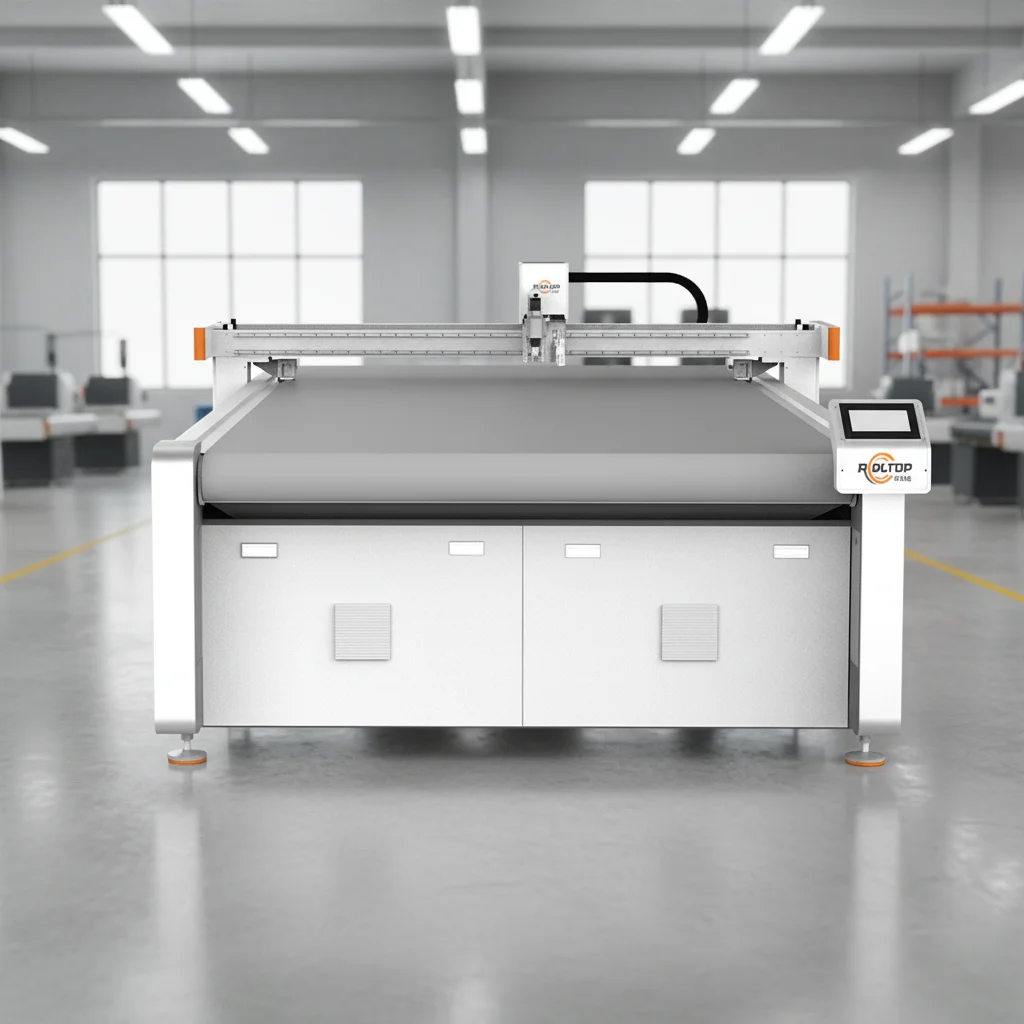
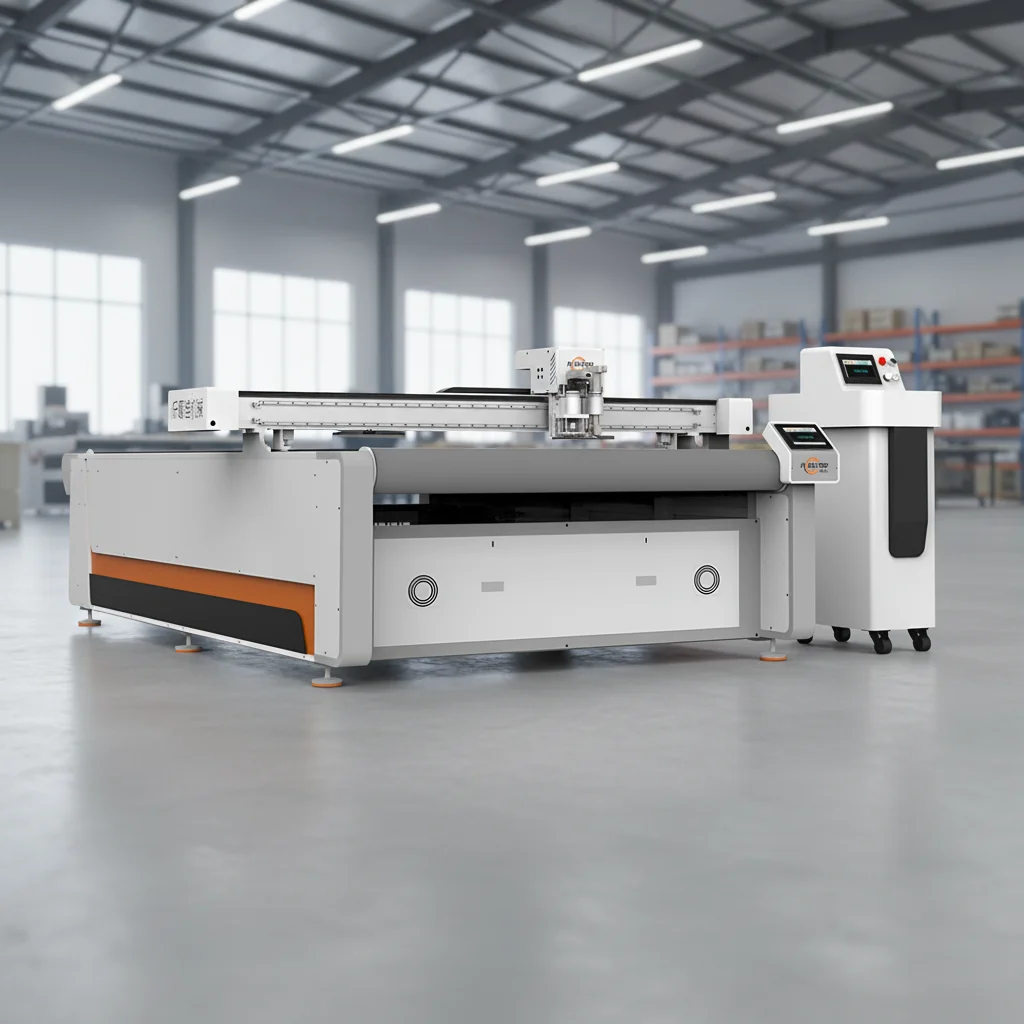
Precision Tooling Match — We specify the oscillating knife, vacuum zoning, and nesting workflow against your actual fabric roll before any Cloth CNC Cutting Machine production line leaves our floor.
Technical Specifications
| Parameter | Value |
|---|---|
| Product Type | CNC Oscillating Knife Cutting Machine |
| Working Area | 1700×2000mm / 1900×2000mm / 2300×3300mm configurations |
| Max Operating Speed | 80m/min |
| Average Cutting Speed | 12m/min |
| Cutting Thickness | Up to 70mm after vacuum adsorption |
| Voltage | 380V/50Hz |
| Max Power | 26kW |
| Air Flow Volume | 160L/min |
| Blade Grinding Method | Double rotary sharpener |
| Control System | PLC control panel |
| Vacuum Table | Aluminum bellows vacuum table |
| Servo Motors | Options including Panasonic, Delta, Dorna |
| Software | Packaging box structure design software; DXF/PLT/AI/PDF import |
| Language Options | English, Russian, Italian, Chinese; custom languages available |
| Assembly State | Fully assembled |
| Standards | CE |
Application Suitability
| Application | Material or Output |
|---|---|
| Apparel manufacturing | Suits, knitwear, lace, and complex pattern-matching fabrics |
| Home textile production | Multi-layer sofa fabrics, curtains, and heavy rugs |
| Medical textile cutting | Surgical drapes from woven and non-woven rolls |
| Flexible composite processing | Knits, wovens, and plush materials from 0.1mm to 70mm |
Why "Up to 70mm" Depends Entirely on Your Fabric Roll
Vacuum adsorption capacity shifts dramatically depending on textile density, weave, and coating.
When buyers see a 70mm cutting thickness on a Cloth CNC Cutting Machine production line, they often assume it applies universally across all their materials. In reality, a 70mm stack of loose-weave surgical nonwoven compresses differently under vacuum than a 70mm stack of coated upholstery composite. I once specified a high-speed auto-feeding knife cutter for surgical drapes; the sample ran clean on plain nonwoven, but the client’s actual coated composite caused the oscillating blade to drag, fraying edges and scrapping a full batch. [NEED_CITE: material compression behavior under vacuum adsorption]
Material Compression and Vacuum Hold-Down
The aluminum bellows vacuum table on this system is designed to compress and secure multi-layer textile stacks. However, the effectiveness of that hold-down depends on the air permeability of your specific fabric. Tightly woven technical textiles or coated medical composites restrict airflow through the stack, reducing the effective suction on the lower layers. This is why we require the buyer’s actual production roll for sample cutting before configuration is finalized.
Blade Selection for Coated and Layered Textiles
Not every oscillating knife handles coated or composite fabrics identically. A standard blade may slice cleanly through plain woven cotton but tear through a polyurethane-coated layer, leaving ragged edges that fail quality inspection on surgical drapes or automotive interiors. The double rotary sharpener maintains edge consistency across long runs, but the initial blade geometry must match the material. A Cloth CNC Cutting Machine production line configured without testing on your exact roll risks producing scrap from the first shift. [NEED_CITE: oscillating knife blade geometry for coated textiles]
Reading the Speed and Power Specifications
The 80m/min maximum operating speed and 12m/min average cutting speed are achieved under specific conditions—typically single-layer or low-ply materials with simple geometries. When cutting 50-layer stacks of dense upholstery fabric, the effective speed will be lower as the knife must traverse the full compressed depth. The 26kW maximum power rating covers the servo drives, vacuum pump, and spindle simultaneously. For facilities running three shifts, understanding the continuous draw versus peak rating matters for electrical infrastructure planning. The 160L/min air flow volume must be matched against your compressor capacity to maintain consistent vacuum pressure across the working area.
The Cost of Skipping Material Verification
When a buyer specifies a cutting system based on working area alone, the consequences surface on the production floor. Wrong blade geometry produces frayed edges on coated composites, forcing operators to slow the feed rate or accept reject rates that erode margins. Inadequate vacuum zoning for small garment pieces allows material lift during cutting, shifting pattern alignment and producing mismatched panels. These problems do not appear in the quotation stage—they appear after installation, when the machine is cutting your real material at your real volume. [NEED_CITE: vacuum table zoning requirements for small textile parts]
Why Sourcing Through This Facility Works
The design team builds both knife and laser cutting systems in-house, so the recommendation is driven by your material rather than by forcing one technology onto every application. Tool head and table configurations are specified per fabric type and production volume, not selected from a default menu. The PLC control panel supports DXF, PLT, AI, and PDF file imports, and software compatibility is confirmed against your existing nesting workflow before the order is placed. Voltage, control language, and plug type are documented and verified against your destination facility standards. Sample cutting on your actual fabric roll—documenting edge quality, layer count, and cutting speed—is completed before the machine ships.
Documentation & Verification
- Machine specification sheet listing confirmed working area and servo motor selection
- Electrical schematic with voltage and frequency matched to your facility
- Tool head and vacuum table zoning configuration matched to your part sizes
- Sample cutting report on your fabric roll showing edge quality and layer count
- CE declaration where applicable for European market entry
- Software license and file format compatibility confirmation for your nesting workflow
Installation, Commissioning & Support
- Floor space assessment for 2300×3300mm maximum footprint plus material handling clearance
- Dedicated 380V/50Hz circuit rated for 26kW continuous draw with proper grounding
- Machine arrives fully assembled; positioning and leveling verified on your floor
- PLC control panel parameters set and tested with your production files during commissioning
- Operator training on tool head changes, blade replacement, and nesting software workflow
- Spare parts list including oscillating blades and vacuum seals provided at handover
What We Need to Specify Your Line
To configure a Cloth CNC Cutting Machine production line that handles your material without edge degradation or lift, we need your fabric type, weight per square meter, and typical layer count. Provide your standard sheet or roll width, daily cutting volume, and the file formats your design team currently uses. Confirm the voltage and frequency at your facility, along with the preferred control panel language. If your material includes coatings or composite layers, ship a sample roll so we can run cutting tests before final configuration.
Frequently Asked Questions
Q: How is the 70mm cutting thickness verified for my specific fabric?
A: The 70mm capacity is measured after vacuum adsorption, which compresses the stack. Actual cutting depth depends on your fabric density, weave, and coating. We run sample cuts on your production roll at your target layer count and document edge quality and cutting speed before confirming the configuration.
Q: Which tool head is specified for coated or composite textiles?
A: Tool head selection depends on your material structure. Coated composites require specific oscillating knife geometry to prevent coating delamination. We test your actual roll on our floor and specify the blade type, oscillation frequency, and sharpening interval that produces clean edges on your material.
Q: Does the nesting software accept my existing DXF and AI files?
A: The included software imports DXF, PLT, AI, and PDF formats. We verify compatibility with your specific file versions and nesting workflow before order placement. If your production relies on specific layer naming or marker conventions, we confirm the import preserves those structures.
Q: How is vacuum zoning configured for small garment pieces?
A: The aluminum bellows vacuum table is zoned to match your typical part sizes. Small pattern pieces require concentrated suction zones to prevent material lift during cutting. We specify the zoning layout based on your garment panel dimensions and confirm hold-down performance during sample cutting.
Q: What voltage and language options are available for my facility?
A: The system is configurable for your local voltage and frequency. Control panel languages include English, Russian, Italian, and Chinese, with special languages available on request. Electrical schematics are provided in your voltage configuration, and all settings are verified before shipment.



商品评价
Clear filtersThere are no reviews yet.