




Precision-Configured Textile Cutting — Every tool head and vacuum zone specified against your actual fabric roll, ply count, and daily output rather than a generic catalogue page.
Technical Specifications
| Parameter | Value |
|---|---|
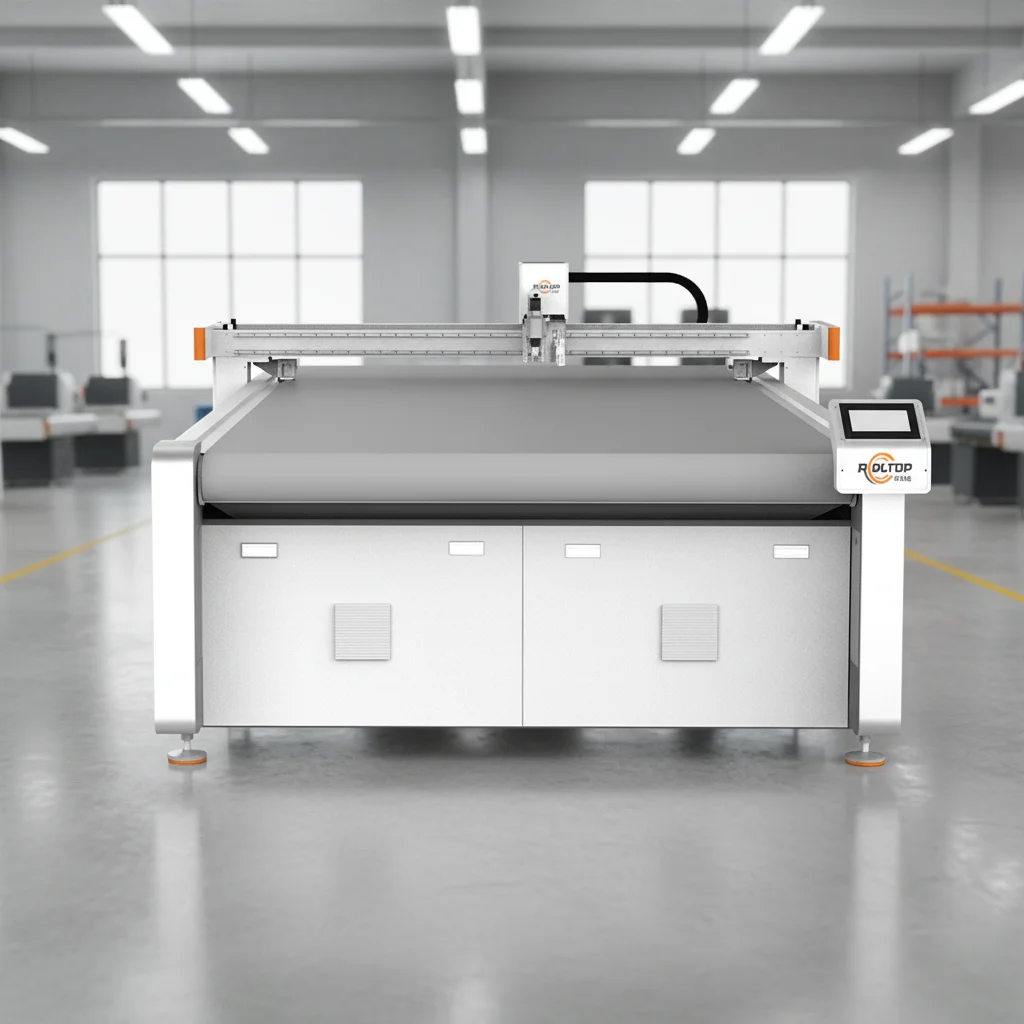
| Product Type | CNC Oscillating Knife Cutting Machine for Textile |
| Working Area | 1600 × 2500 mm |
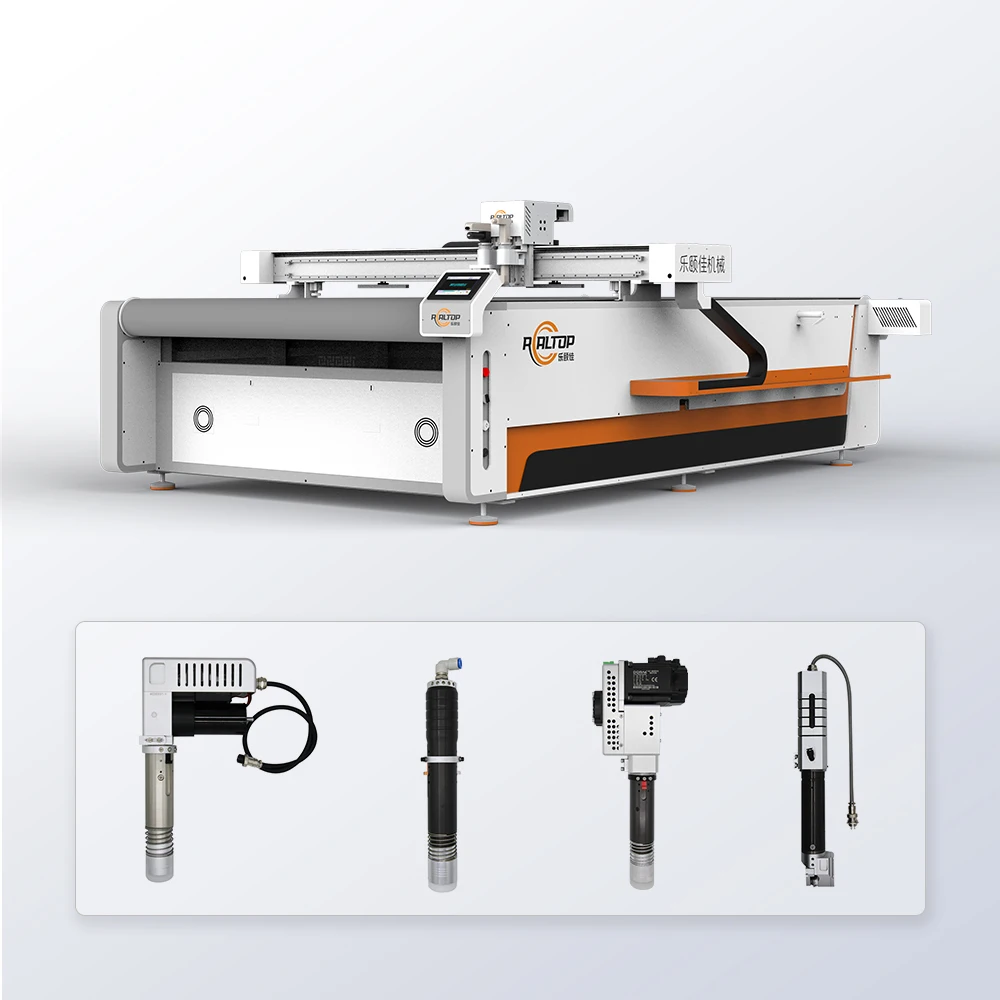
| Tool Head Options | Oscillating knife, Driven rotary knife, Creasing wheel, Kiss cutting tool, Pneumatic knife, Milling tool, V groove knife |
| Cutting Speed Range | 0 – 2000 mm/s |
| Cutting Thickness Capacity | Up to 30 mm (basis not stated in source — confirm fabric type and layer count) |
| Cutting Accuracy | ±0.1 mm |
| Vacuum Pump Power | 9 kW |
| Vacuum Table Construction | Aluminum bellows vacuum table |
| Control System | PLC control panel |
| Servo Motor Options | Panasonic, Delta, Dorna |
| Voltage Options | 110 V, 220 V, 380 V |
| Supported File Formats | PLT, DXF, AI, PDF |
| Language Options | English, Russian, Italian, Chinese; special languages customizable |
| Safety Devices | Infrared sensor device, emergency stop device |
| Overall Dimensions | 3300 × 2100 × 1350 mm |
| Certification | CE |
Application Suitability
| Application | Material or Output |
|---|---|
| Suit and knitwear batch cutting | Worsted wool, cotton blends, and interlinings laid up in multi-ply spreads |
| Lace and patterned fabric production | Delicate open-weave lace and printed textiles requiring contour alignment |
| Automotive seat and carpet trimming | Automotive-grade seat fabrics, needle-punch carpets, and PVC floor mats |
| Home textile manufacturing | Upholstery-weight sofa fabrics, curtain panels, and woven rugs |
| Composite material processing | Carbon fiber prepreg, aramid weaves, and specialty coated technical textiles |
What "Five Times Manual Output" Actually Depends On
A Cloth CNC Cutting Machine production line only reaches its rated throughput when fabric type, ply height, and nesting layout are defined before the machine is built.
Sales brochures in this sector routinely quote a multiplier against hand cutting, yet that figure shifts dramatically once you swap lightweight cotton for coated polyester or tighten the nesting gap for small pattern pieces. I have watched garment workshops in the Gulf region sign for machines based on a demo run on plain weave, only to find the feed system slipping on the slippery longrobe fabrics they cut every day. The vacuum hold-down, tool head selection, and blade oscillation frequency all need to match the specific fabric weight and surface finish [NEED_CITE: textile cutting throughput variables by fabric construction]. Without that match, the promised cycle time stays on the brochure.
Tool Head Selection Dictates Edge Quality on Coated and Woven Fabrics
An oscillating knife handles most mid-weight woven and knitted fabrics, vibrating at high frequency to shear fibers cleanly without fraying the cut edge. For heavier upholstery or tightly woven technical textiles, a pneumatic knife delivers greater downward force and a deeper single-pass stroke. Driven rotary knives excel on continuous single-ply or low-ply spreads where speed matters more than absolute edge precision. The Cloth CNC Cutting Machine production line ships with interchangeable heads so a workshop cutting suit wool on Monday and PVC-coated automotive fabric on Wednesday can switch tooling without running the wrong blade geometry on the wrong material.
Vacuum Hold-Down Across the Full 1600 × 2500 mm Bed
Multi-layer textile cutting fails the moment the bottom ply shifts. The aluminum bellows vacuum table on this system pairs with a 9 kW pump to pull air through the entire working surface, pinning porous fabrics and non-porous coated materials alike. On a spread of sixty plies of shirting cotton, edge-to-edge suction prevents the stack from creeping during high-speed directional changes [NEED_CITE: vacuum adsorption requirements for multi-ply fabric cutting]. Smaller pattern pieces — collar stands, cuff facings, pocket flaps — demand uniform suction right to the bed perimeter, which is where zoned vacuum channels prove their worth.
Reading the Specification Sheet Against Your Shop Floor Reality
The ±0.1 mm cutting accuracy figure matters most when pattern-matched layouts demand that a stripe or check aligns across front and back panels after sewing; any drift compounds over dozens of plies. The 0 – 2000 mm/s speed range is the head travel envelope, but actual cutting speed on a given fabric will be set lower to maintain edge integrity on curves and tight radii. File format support for PLT, DXF, AI, and PDF means patterns exported from common apparel CAD systems — Lectra, Gerber, Optitex — arrive without conversion steps, while the intelligent nesting module arranges pieces to minimise off-cut waste. Servo options from Panasonic, Delta, or Dorna let buyers balance positioning response and local service availability.
When the Wrong Specification Reaches the Loading Dock
Choosing a vacuum pump sized for single-ply sampling and then asking it to hold sixty plies of slippery lining fabric results in ply shift, recuts, and fabric waste that erodes any machine investment [NEED_CITE: consequences of undersized vacuum in textile cutting operations]. Specifying an oscillating knife alone when the production schedule also includes dense carpet or PVC matting forces the blade to deflect, leaving ragged edges that the downstream sewing line rejects. Voltage mismatches discovered after arrival mean rewiring the entire workshop panel or running an undersized transformer that starves the servo drives. These are not warranty conversations — they are specification failures that trace back to the inquiry stage.
Why Buyers Source This Configuration Here
In-house design covers both knife cutting and laser cutting technologies, so the cutting method is matched to the fabric rather than forced through one approach. Tool head and table configuration are specified per material and daily volume before the order is confirmed. CCD camera positioning is available for printed contour work where registration marks must be tracked at production speed. Software compatibility with the buyer’s existing CAD and nesting workflow is verified before shipment. Sample cutting on the buyer’s own fabric at the intended ply count confirms edge quality and cycle time before commitment. Voltage, plug type, and control language are locked in to match the destination facility.
Documentation & Verification
- Machine specification sheet listing confirmed tool head and vacuum zone layout
- Electrical schematic with voltage and frequency matched to your facility supply
- Sample cutting report produced on your fabric at your specified ply count
- CE declaration file for customs clearance and local compliance registration
- Software licence and file format compatibility note for your CAD system
Installation, Commissioning & Support
- Floor flatness within tolerance across the 3300 × 2100 mm footprint to prevent bed twist
- Dedicated circuit sized for the 9 kW vacuum pump plus servo and PLC load
- Machine arrives in shipping configuration requiring on-site gantry and table assembly
- First-run parameter tuning against your fabric type, ply height, and nesting layout
- Operator training on tool head changeover, blade replacement, and vacuum zone settings
- Spare blade and oscillating knife consumables list provided with recommended stock levels
Before You Request a Quotation
Send the fabric composition, weight per square metre, and maximum ply height you plan to cut, along with the typical pattern piece size range. Confirm the voltage and frequency at your facility and the control language your operators need. If your current workflow uses a specific CAD or nesting platform, share a sample file so format compatibility is validated before the machine is built.
Frequently Asked Questions
Q: How is cutting throughput actually verified before shipment?
A: Throughput is measured during a factory sample run using your fabric at your specified ply count and nesting layout. The resulting cycle time and edge quality report accompanies the machine. Without your material on the table, any quoted output figure remains a generic estimate rather than a confirmed production rate.
Q: Which tool head suits my specific fabric weight and weave?
A: Oscillating knives handle most mid-weight wovens and knits, pneumatic knives suit heavier coated or technical textiles, and driven rotary knives work best on low-ply continuous spreads. We confirm the correct tool head after reviewing your fabric samples and production mix before finalising the configuration.
Q: Will the vacuum table hold small pattern pieces without shifting?
A: The aluminum bellows table and 9 kW pump are designed to maintain suction across the full 1600 × 2500 mm area. For very small pieces or low-porosity coated fabrics, we review your typical part geometry and may adjust zone configuration to ensure adequate hold-down at the bed perimeter.
Q: Can the software integrate with my existing pattern and nesting workflow?
A: The system accepts PLT, DXF, AI, and PDF files and includes intelligent nesting with automatic path generation. We verify compatibility with your specific CAD output before order confirmation and can test a sample file from your current production library during the pre-sale evaluation.
Q: What are the installation requirements at my facility?
A: The machine occupies approximately 3300 × 2100 mm and requires a level industrial floor, a dedicated electrical circuit matching the confirmed voltage and the combined load of the vacuum pump and servo drives, and adequate ceiling clearance for gantry assembly during commissioning.




商品评价
Clear filtersThere are no reviews yet.