


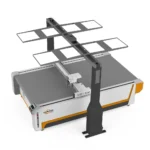
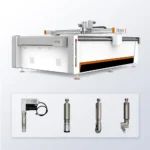
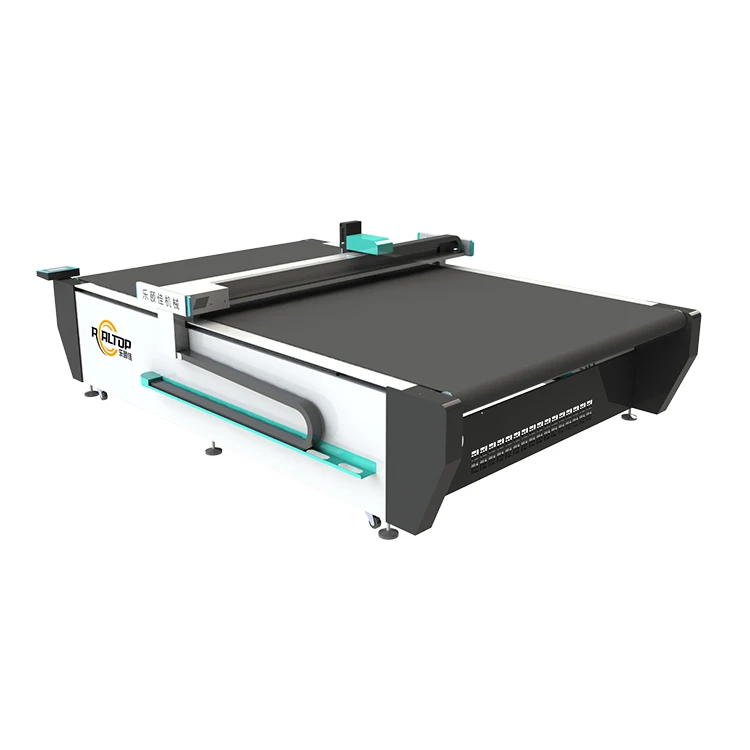
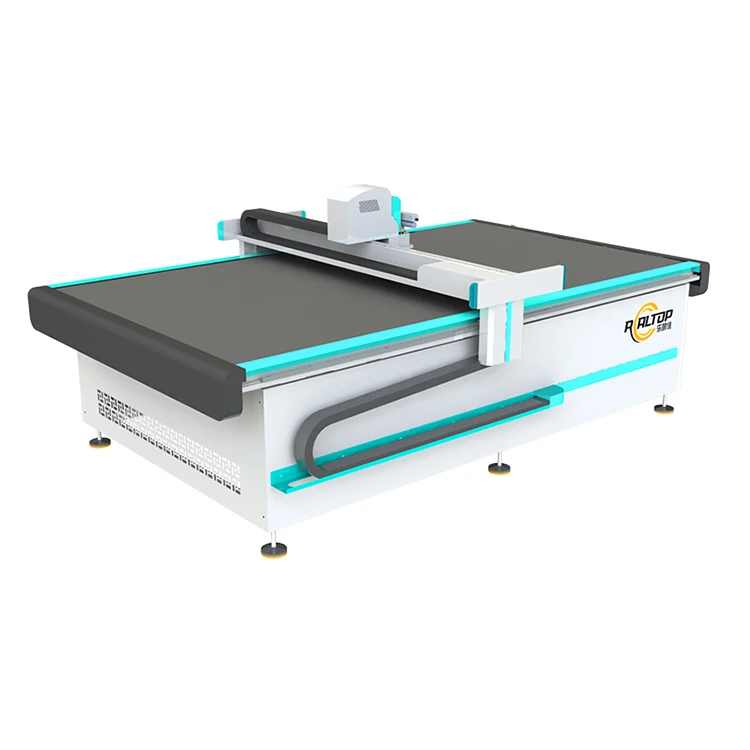
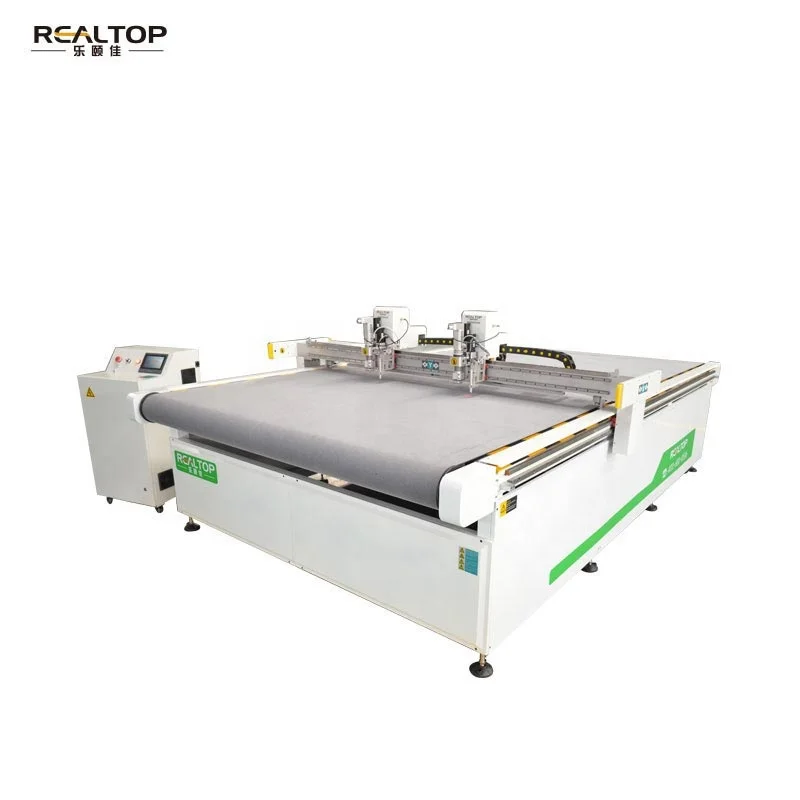
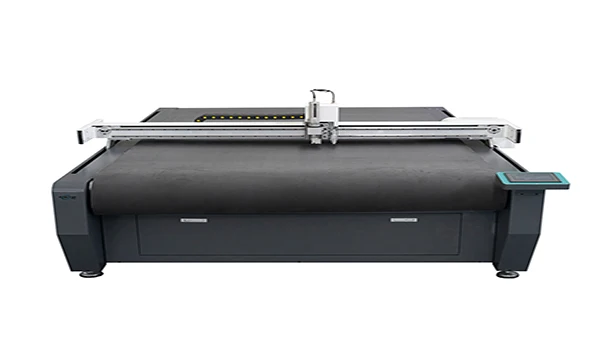
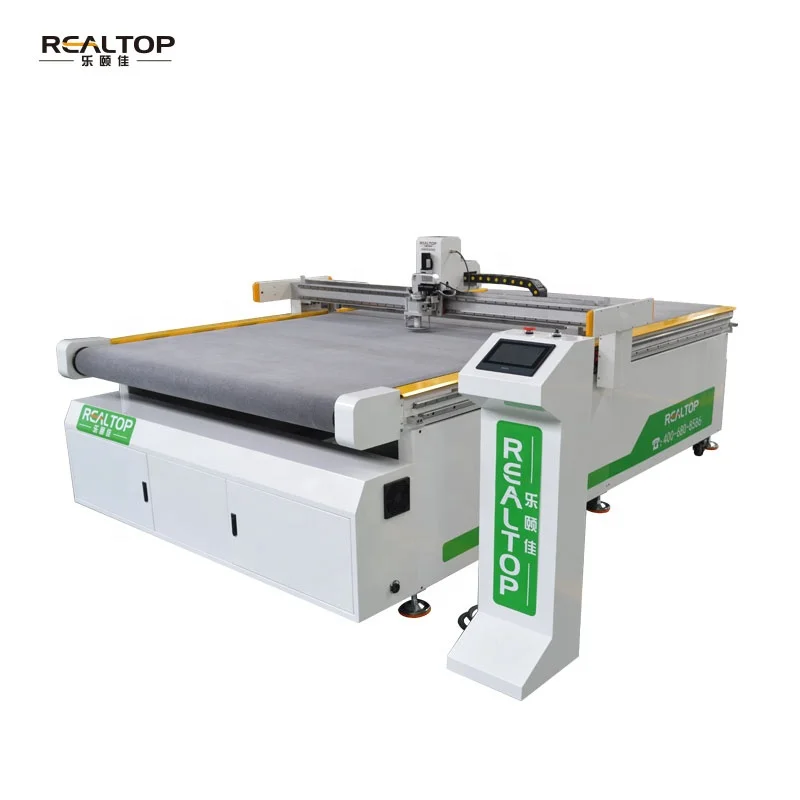
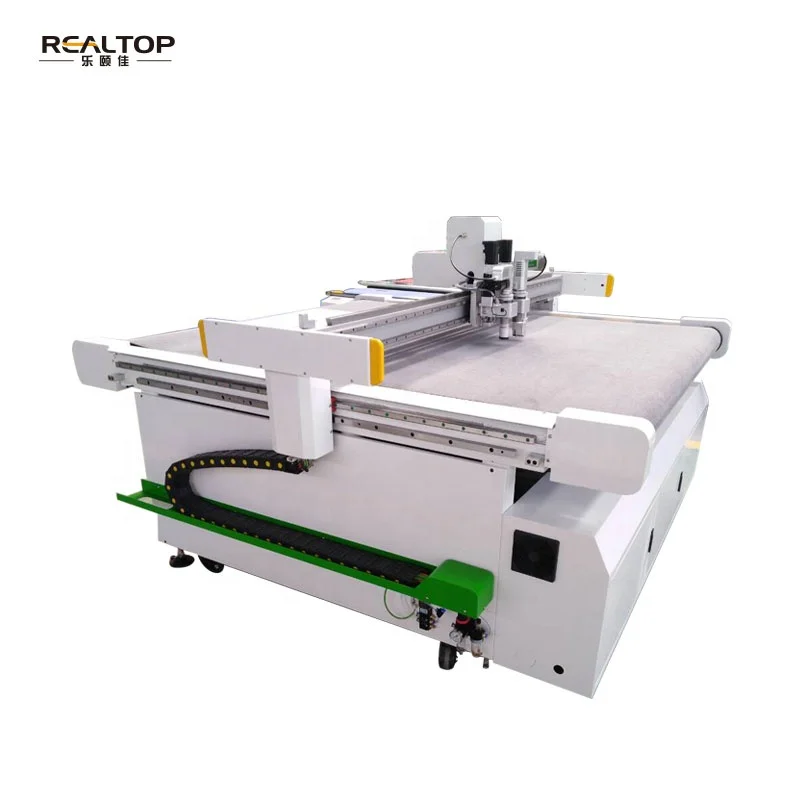

Precision Tooling Match — Every RT-D2516/RT-S2516 leaves our Jinan facility configured for the buyer’s actual leather stock, validated by sample cutting before shipment.
Technical Specifications
| Parameter | Value |
|---|---|
| Model | RT-D2516 / RT-S2516 |
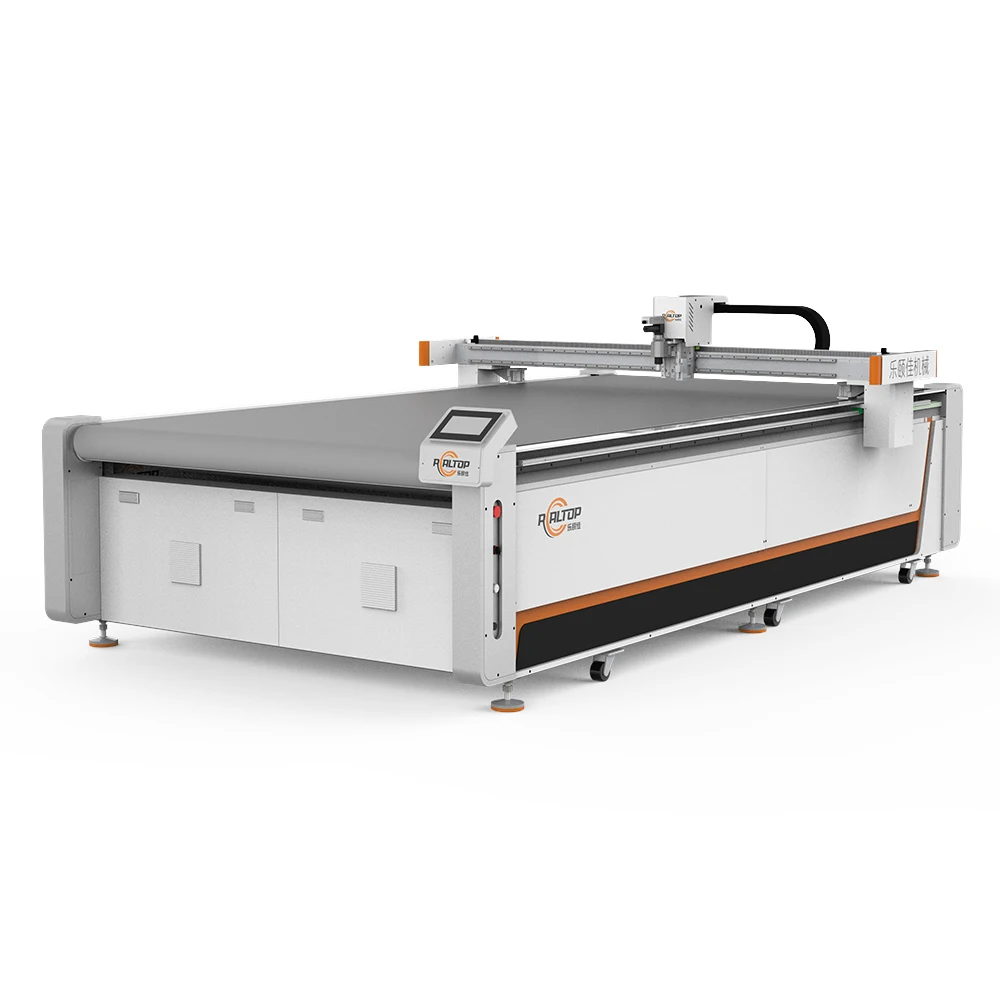
| Product Type | CNC Oscillating Knife Leather Cutting Machine |
| Working Area | 1600 × 2500 mm |
| Overall Dimensions (L×W×H) | 3450 × 2300 × 1250 mm |
| Rated Power | 11 kW |
| Vacuum Pump | 7.5 kW |
| Tool Head | Swiss imported oscillating knife (full cut, half cut, cursor location) |
| Translational Speed | 800 – 1200 mm/s |
| Cutting Speed | 200 – 800 mm/s (basis not stated in source — confirm material type / thickness) |
| Repeatability | ≤0.1 mm |
| Transmission System | Digital servo motor, linear guide, synchronous belt, ball screw |
| Servo Motor | Japanese Yaskawa |
| Linear Guide | Taiwan Hiwin rail |
| Conveyor Belt | Germany imported |
| Table Type | Flat working table with vacuum and auto-feeding conveyor |
| Safety Device | Infrared sensors |
| Instruction System | HP-GL compatible format |
| Voltage | 380V ±10% |
| Key Features | Auto-feeding conveyor, vacuum hold-down, Swiss oscillating knife head, Yaskawa servo drive |
Application Suitability
| Application | Material or Output |
|---|---|
| Footwear upper cutting | Genuine leather, PU leather, synthetic splits |
| Bag and small leather goods | Multi-layer leather, sponge composite panels |
| Automotive interior trim | Sponge composite leather, soft PVC, upholstery fabrics |
| Flexible garment production | Woven and non-woven textile layers, silicon sheet |
| Gasket and seal fabrication | Rubber sheet, soft silicon, flexible PVC |
Why the Cutting Speed Number Means Nothing Without Your Material
The only cutting speed that matters is the one measured on your specific leather grade and thickness.
I have watched buyers compare two machines purely on the 800 mm/s figure printed in a brochure, then discover during commissioning that their 3 mm coated PU synthetic requires a completely different oscillation frequency and blade angle than the vegetable-tanned sample used for the demo. The result is ragged edges, crushed foam layers, and thousands of ruined pieces before anyone adjusts the parameters. A CNC Oscillating Knife Leather Cutting Machine production line workflow depends on matching the tool head behavior to the actual stock, not to a generic test coupon. [NEED_CITE: oscillation frequency and blade angle effects on synthetic leather edge quality]
Oscillation Frequency and Blade Geometry by Leather Type
Genuine full-grain leather and coated PU synthetic react differently to the same blade stroke. The Swiss imported oscillating knife head on the RT-D2516/RT-S2516 supports adjustable vibration full cutting and half cutting modes, which lets the operator tune the stroke for dense hides versus softer composite materials. Cursor location capability assists with pattern alignment when working from marked hide sections. A CNC Oscillating Knife Leather Cutting Machine production line workflow built around this tool head reduces the trial-and-error that typically consumes the first days of a new installation.
Vacuum Zoning for Small Piece Stability
Footwear uppers and small leather goods generate nesting layouts packed with irregular shapes, leaving minimal surface area for vacuum adhesion. The 7.5 kW vacuum pump on this system supports zoned table sections, though the exact zoning configuration should be confirmed against your typical nesting patterns before the machine ships. When cutting narrow belt blanks or shoe tongue pieces, insufficient vacuum pull allows the leather to lift during the knife stroke, producing dimensional drift that exceeds the ≤0.1 mm repeatability specification. [NEED_CITE: vacuum table zoning requirements for small leather component nesting]
Drive Components and Their Effect on Cut Consistency
The combination of Japanese Yaskawa digital servo motors and Taiwan Hiwin linear guide rails governs how accurately the knife head follows complex contour paths at the stated 800–1200 mm/s translational speed. In leather cutting, the critical moment is direction change at tight inside corners — any servo lag or rail play translates into overcut at the corner apex. The synchronous belt and ball screw transmission maintains positional discipline across the full 1600 × 2500 mm working area, which matters when a single hide layout contains both large upholstery panels and small hardware-reinforcement pieces that demand different path geometries.
The Cost of Skipping a Material-Specific Sample Cut
The most common failure I see on commissioning visits traces back to a purchase decision made on working area alone. A buyer specifies a 1600 × 2500 mm table, signs the order, and then discovers that their 5 mm sponge composite leather — used for automotive armrest panels — requires a blade depth and oscillation setting the machine was never configured to deliver. Edge crushing and delamination appear at production speed, and the material waste during adjustment can consume an entire shipment of stock. Requesting a sample cutting report on your own leather before committing eliminates this risk entirely. [NEED_CITE: material-specific sample cutting as pre-purchase validation practice]
Why Source This Machine From the Builder
In-house design covering both knife and laser cutting technology means the cutting method is selected to suit the leather type rather than forced into a single option. Tool head and table configuration are specified per your material stack and daily volume, not pulled from a standard catalog page. Software compatibility — HP-GL file import and nesting workflow — is confirmed before order placement. Voltage and control language customization is documented before the machine enters production. Sample cutting on your actual leather stock is standard procedure, not an optional extra.
Documentation & Verification
- Machine specification sheet listing confirmed tool head and table configuration for your leather type
- Electrical schematic with voltage and frequency matched to your facility supply
- Sample cutting report produced on your supplied leather material before dispatch
- Factory test record documenting repeatability and edge quality at agreed cutting speed
- Software licence and file format compatibility note for your existing nesting workflow
- Spare parts list including oscillating knife blades and vacuum table seals
Installation, Commissioning & Support
- Foundation must support the 3450 × 2300 × 1250 mm footprint plus conveyor infeed and outfeed clearance
- Dedicated 380V ±10% circuit with capacity for the combined 11 kW machine and 7.5 kW vacuum pump load
- Machine ships with table and frame assembled; conveyor belt and tool head require on-site alignment
- First-run parameter tuning for your leather grade, including oscillation frequency and vacuum zone mapping
- Operator training covers blade replacement intervals, nesting import, and HP-GL file handling
- Consumable blade stock and vacuum seal spares recommended for the first production quarter
What to Include With Your Inquiry
Send samples of the leather or composite material you actually run in production — include the thickest and thinnest grades, plus any sponge-laminated stock. Specify your local voltage and frequency, the control panel language your operators need, and whether your existing nesting software outputs HP-GL or another format. If you have a target daily piece count, describe the average nesting layout and piece mix so the cutting speed can be quoted against a realistic baseline rather than a generic coupon.
Frequently Asked Questions
Q: How do cutting speed and thickness relate across different leather types?
A: The 200–800 mm/s cutting speed range applies differently depending on material density and thickness. Dense full-grain leather at 3 mm requires a slower stroke with higher oscillation frequency than a 2 mm PU synthetic. The basis for any quoted throughput figure must reference your specific material, which is why we run a sample cutting report on your stock before finalizing the configuration.
Q: Will the vacuum table hold small footwear pieces during high-speed contour cutting?
A: Small pieces like shoe tongue blanks and reinforcement panels have limited surface area for vacuum adhesion. The 7.5 kW pump provides substantial hold-down force, but the zoning layout must match your typical nesting pattern. We confirm the vacuum zone configuration against your actual layout files before the table is built, preventing lift-related dimensional errors during production.
Q: Can printed or embossed leather patterns be aligned during cutting?
A: Cursor location capability on the Swiss oscillating knife head supports basic registration marks. For full printed contour recognition at production speed, CCD camera integration may be required — confirm this need during the specification stage so the appropriate positioning system is included in the machine build and tested with your printed material.
Q: Will my existing nesting files work with this system?
A: The instruction system accepts HP-GL compatible format. If your current nesting software exports DXF, PLT, or another vector format, we verify import compatibility and file translation accuracy before order confirmation. Software licence details and a file format compatibility note are included in the documentation package delivered with the machine.
Q: How are blade changes and daily maintenance handled?
A: The Swiss oscillating knife uses replaceable blades with intervals that depend on your material abrasiveness — dense genuine leather wears blades faster than PU synthetic. Operator training covers the blade change procedure and the daily checks for vacuum table seal integrity and linear guide condition. A recommended spare parts list is provided with the machine documentation.




商品评价
Clear filtersThere are no reviews yet.