


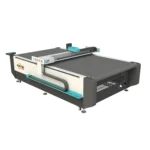
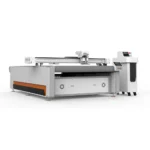
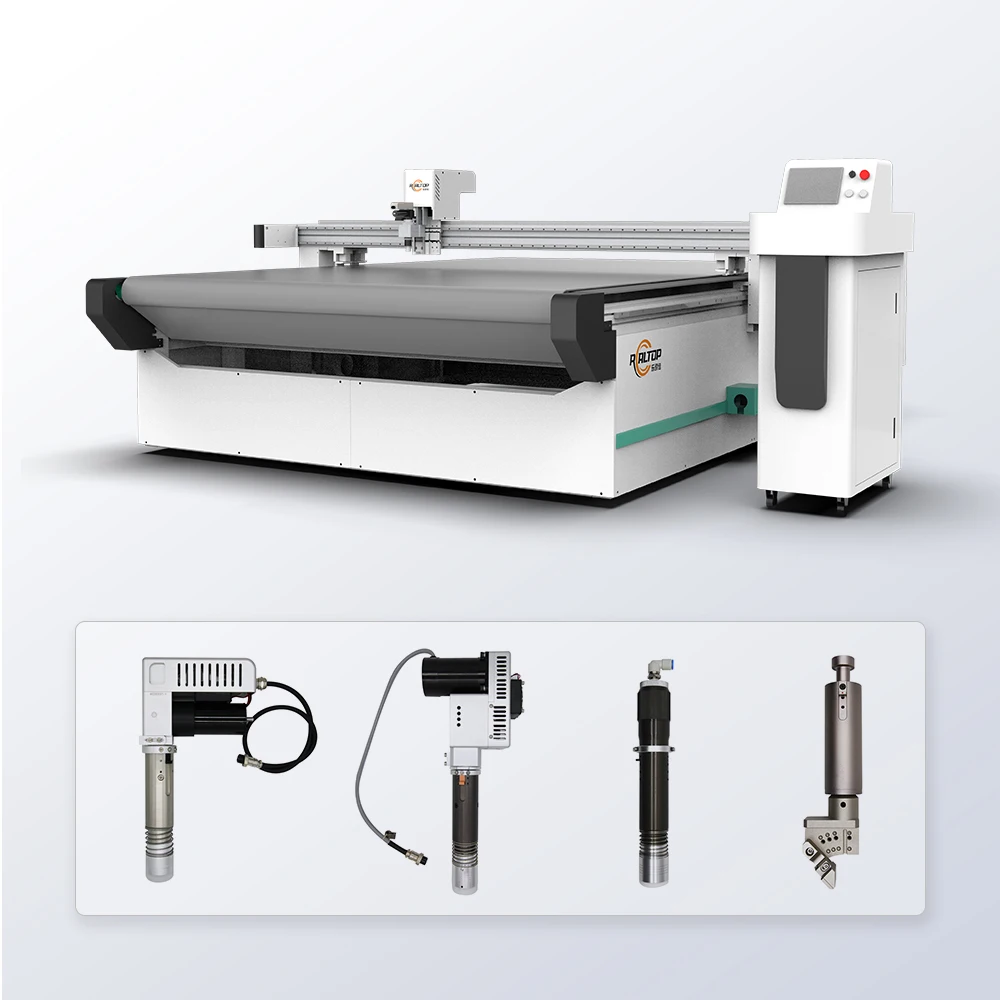
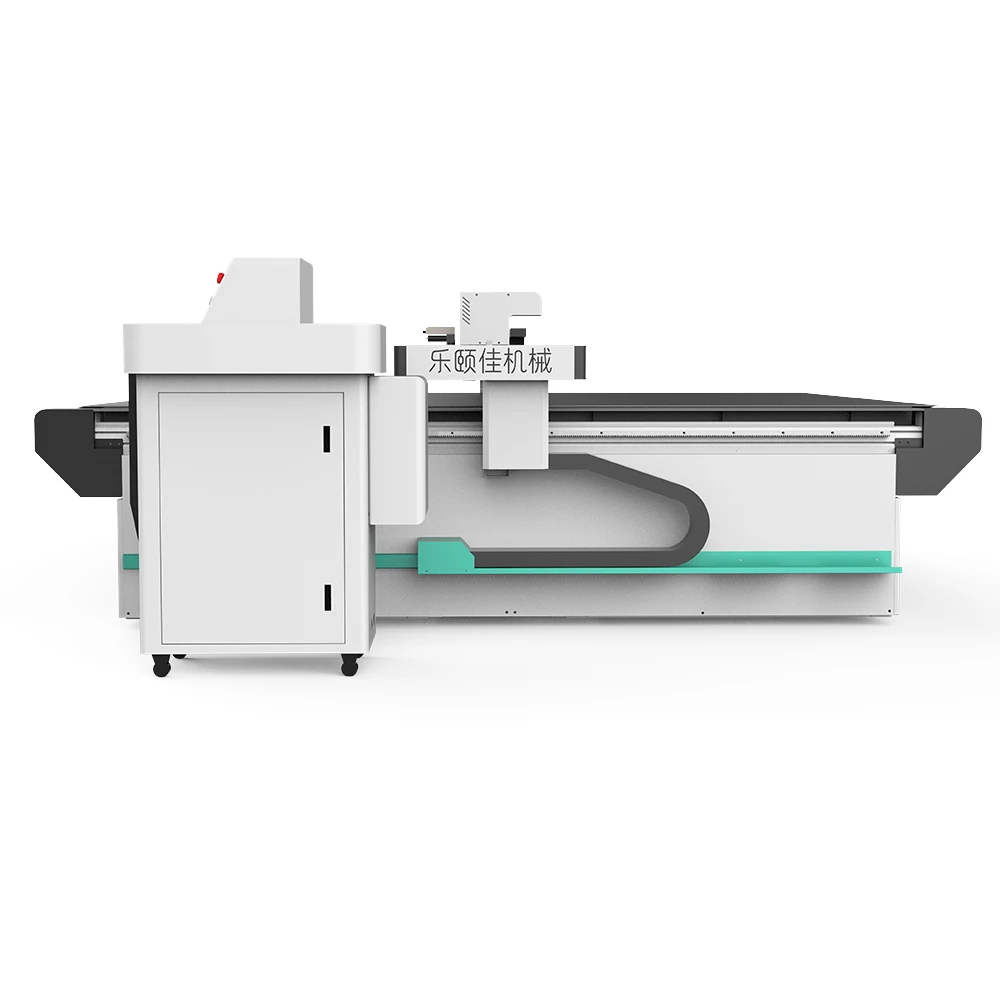
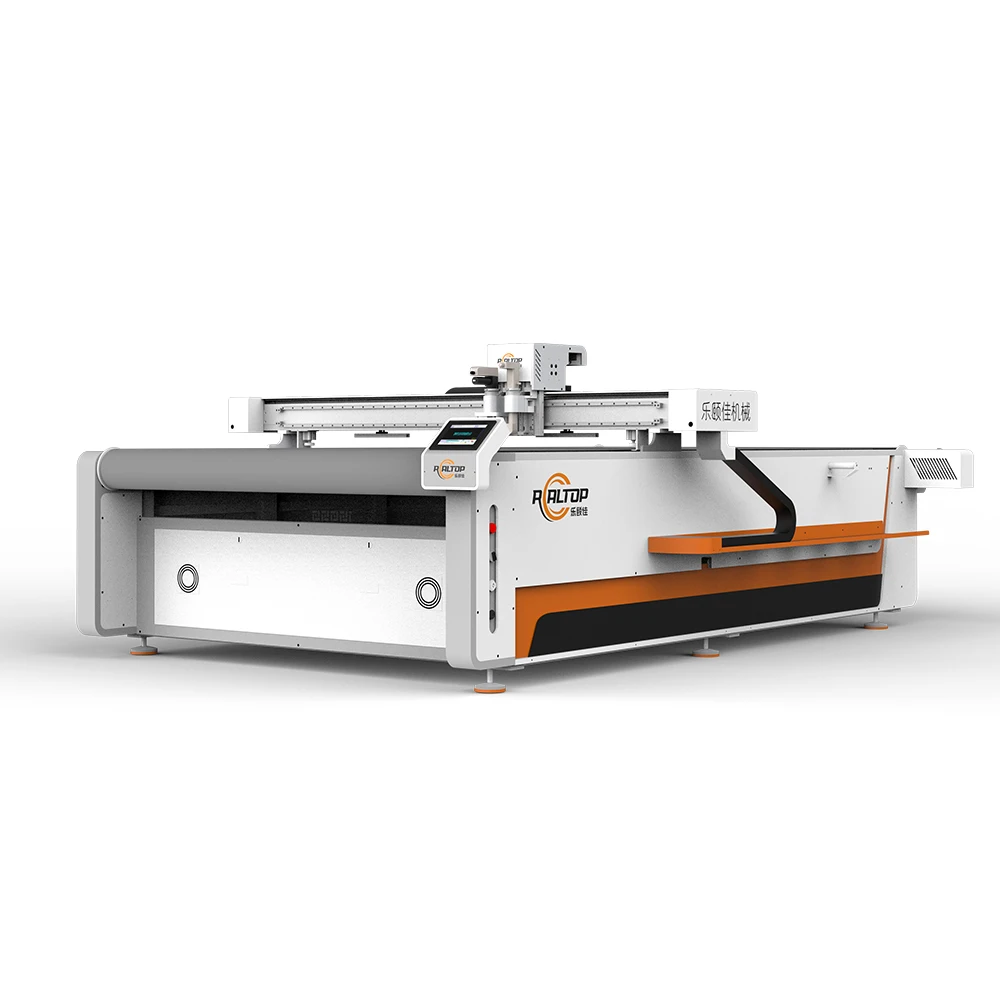
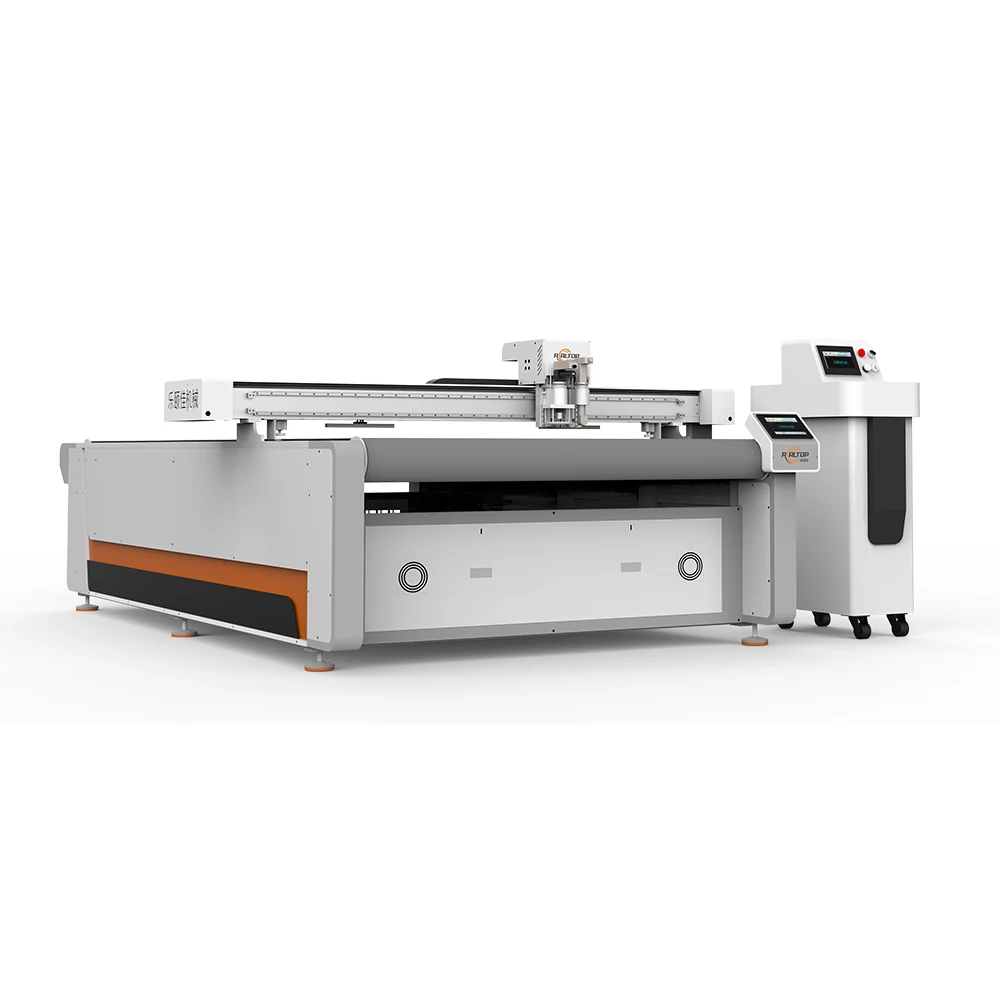
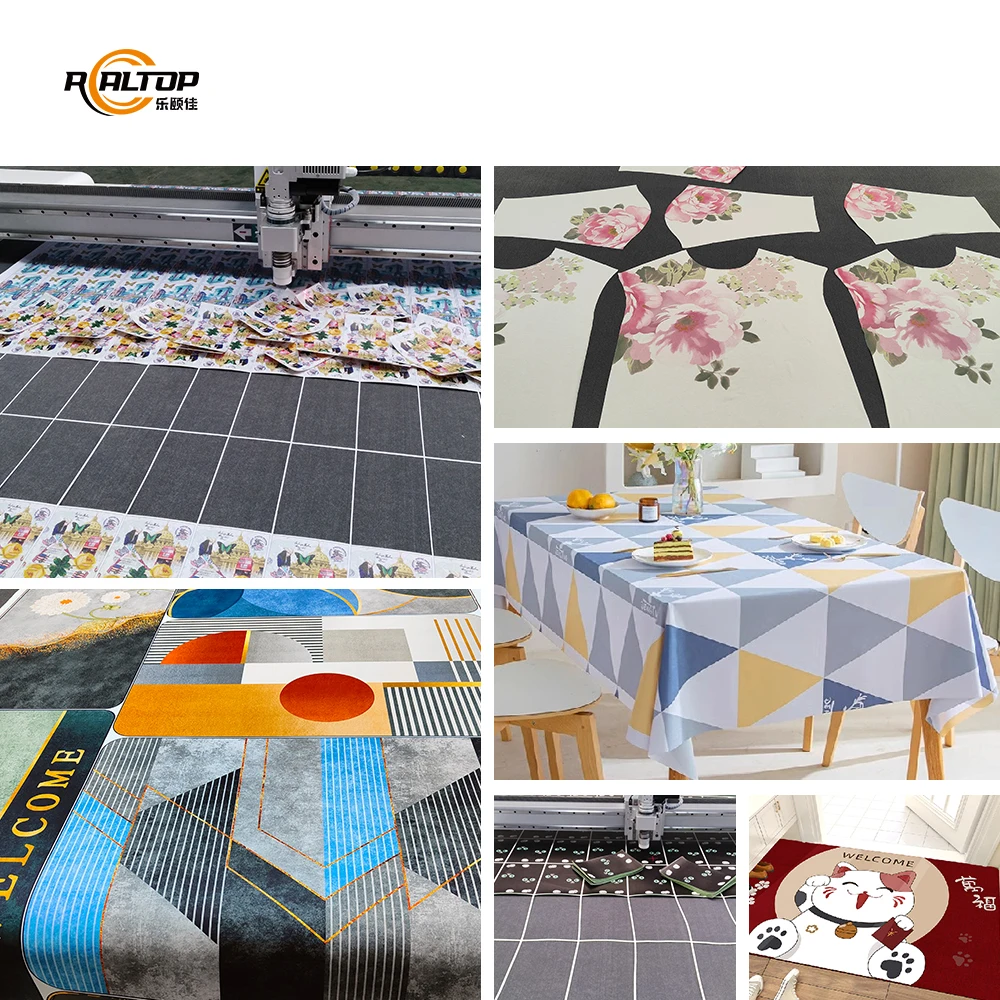

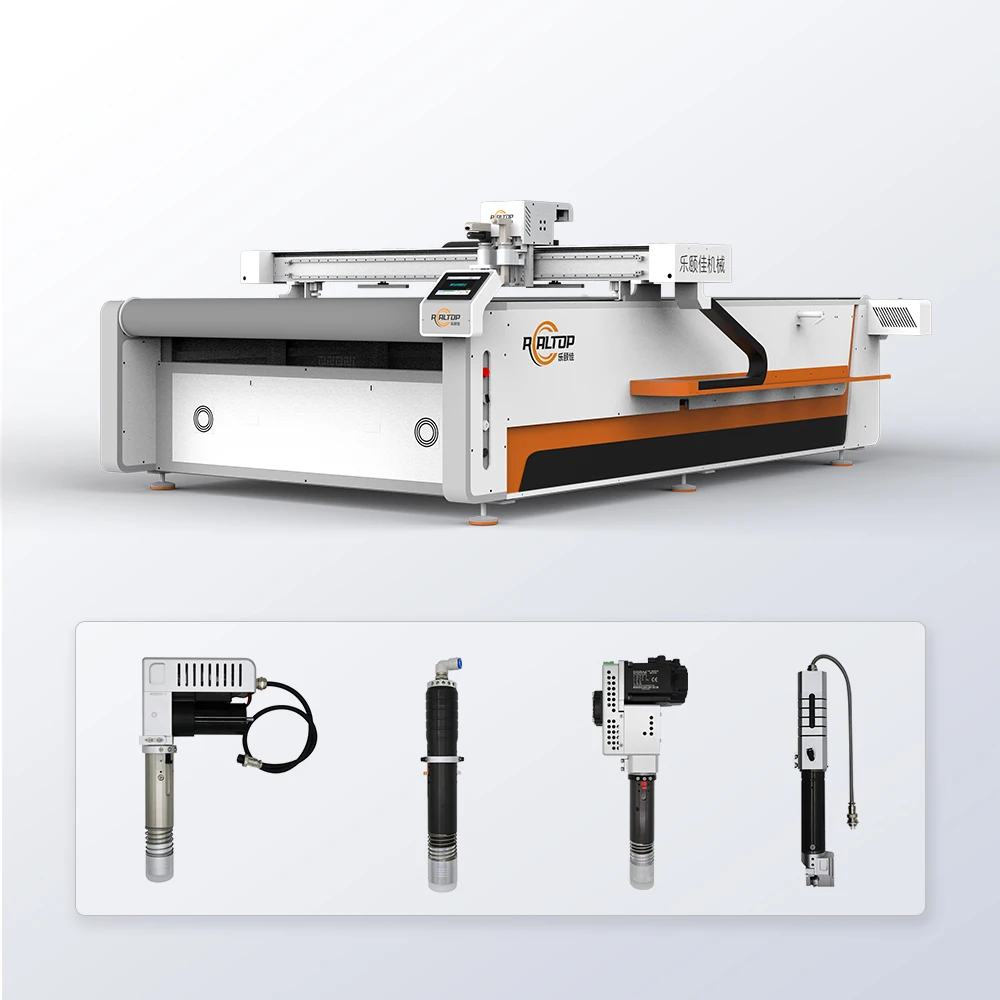
Tool head matched to material — Our oscillating knife and drag knife options are selected against the buyer’s actual fabric density and ply count, not a generic default head.
Technical Specifications
| Parameter | Value |
|---|---|
| Product Type | CNC Oscillating Knife Cutting Machine |
| Model | RT-D2516/RT-S2516 |
| Working Area | 1600 × 2500 mm |
| Machine Size | 3450 × 2300 × 1250 mm |
| Rated Power | 9 kW |
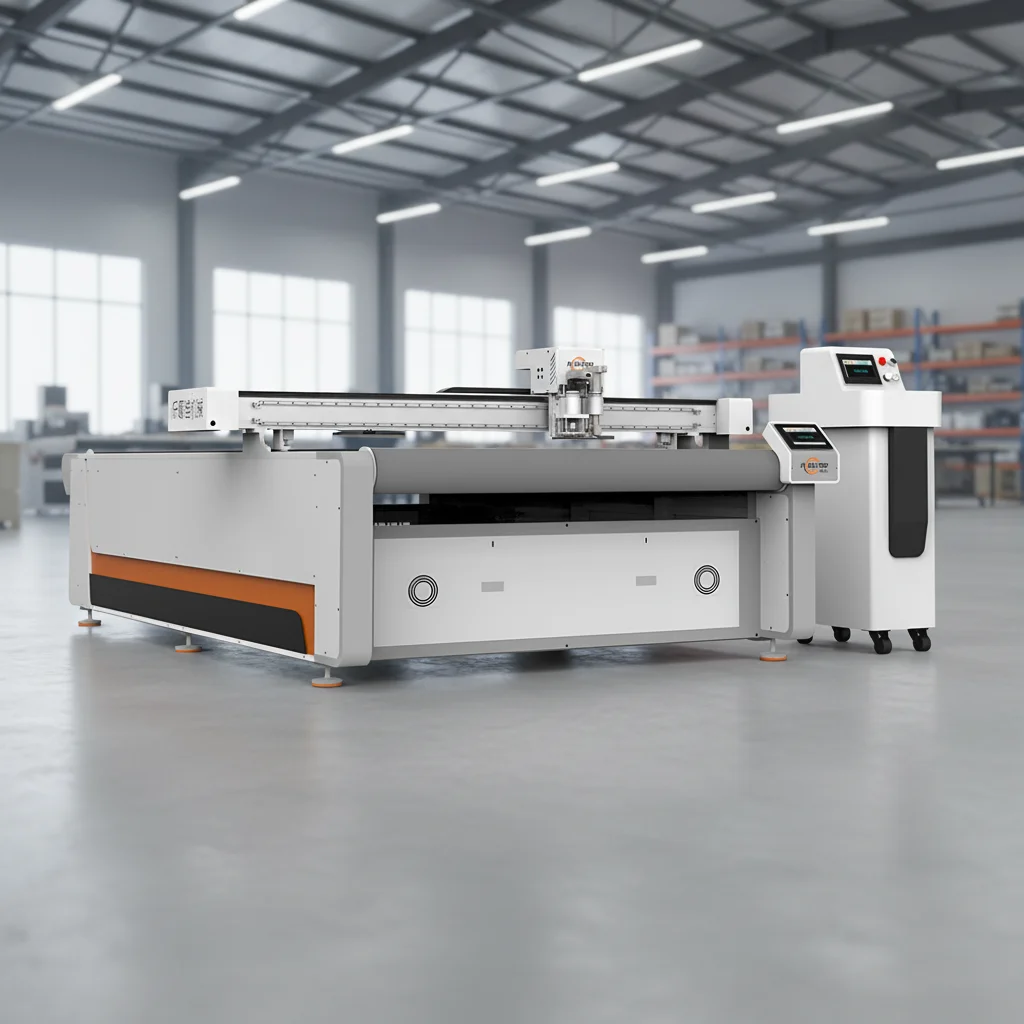
| Table Type | Flat working table; auto-feeding conveyor table available |
| Multifunctional Head | Swiss-imported oscillating knife (full cut, half cut, cursor location) |
| Translational Velocity | 800–2000 mm/s |
| Cutting Speed | 200–800 mm/s (basis not stated in source — confirm material and ply count) |
| Cutting Thickness | Up to 100 mm (varies with material density and tool selection) |
| Repeated Accuracy | ≤0.1 mm |
| Transmission System | Digital servo motor, linear guide, synchronous belt, imported ball screw |
| Servo Motor Options | Delta (China) or Panasonic (Japan) |
| Vacuum Pump | 7.5 kW, aviation aluminum shell with built-in silencer |
| Vacuum Table | Magnesium-aluminum alloy, fluorocarbon PVDF coating, anodic oxidation |
| Visual Positioning Options | Small CCD mark-point, panoramic camera recognition, projection positioning |
| Software Compatibility | PLT, DXF, AI import; auto typesetting |
| Voltage | 380 V ± 10 % |
| Control Panel | Touch screen; English, Russian, Italian, Chinese, or custom language |
| Safety Devices | Infrared sensors, anti-collision, emergency stop |
| Instruction Format | HP-GL compatible |
| Standards | CE declaration applicable |
Application Suitability
| Application | Material or Output |
|---|---|
| Surgical gown and medical textile cutting | Non-woven fabric, SMS, hemp-blend technical textiles in single or multi-ply |
| Garment and apparel production | Woven, knit, and stretch fabrics; fleece and lining materials |
| Automotive interior trimming | Seat cover leather, synthetic suede, headliner textiles, floor mat composites |
| Footwear and luggage uppers | Natural leather, PU synthetic leather, textile uppers, reinforcement layers |
| Carpet and floor mat processing | Tufted carpet, woven mats, rubber-backed flooring rolls |
| Sports and outdoor gear | Ripstop nylon, neoprene, laminated waterproof membranes |
| Composite and gasket fabrication | PTFE, ETFE, rubber sheet, fiberglass, XPE and EVA foam |
What "Up to 100 mm Cutting Depth" Does Not Guarantee for Your Fabric
A thickness rating alone never tells you whether the knife will hold a clean edge through a hemp-linen blend at six plies.
The cutting depth figure on a spec sheet is typically measured on a uniform, low-density material under controlled conditions. When the machine meets a tightly woven hemp fabric or a laminated composite with an adhesive interlayer, the blade encounters varying resistance within a single stroke. Oscillation frequency, downward pressure, and vacuum zone distribution all shift the real-world result. Buyers who specify working area and thickness without confirming tool head and vacuum zoning often receive a machine that struggles on their exact roll stock [NEED_CITE: vacuum hold-down requirements for multi-ply textile cutting]. The CNC Oscillating Knife Cutting Machine production line must be configured against actual material samples, not brochure values.
Conveyor Feeding and Continuous Roll-to-Cut Workflow
The auto-feeding table uses a Germany-imported belt that advances material from a roll directly into the cutting zone. This eliminates the manual lay-up step for high-volume garment and medical textile runs, where operators would otherwise unroll, align, and smooth each ply. The feeding cycle synchronizes with the cutting head path so that the fabric remains stationary during the cut, then indexes forward for the next nest. For materials like non-woven SMS used in surgical gowns, continuous feeding maintains consistent tension and prevents edge drift across long production runs.
Vacuum Zoning and Small Pattern Piece Stability
Garment pattern pieces — collar tabs, cuff panels, pocket flaps — often measure only a few centimeters across. A single large vacuum chamber leaves these small parts vulnerable to lift when the oscillating knife exits the cut. The magnesium-aluminum alloy table is divided into independently controlled zones so that suction concentrates under the active cutting area. The 7.5 kW pump with aviation aluminum housing delivers the static pressure needed to hold lightweight non-wovens flat. When cutting printed textiles with contour alignment, stable material position directly determines whether the CCD camera can track registration marks at production speed [NEED_CITE: CCD contour recognition accuracy on moving textile substrates].
Interpreting the Drive and Motion Specifications
The imported ball screw and linear guide combination controls the cutting head’s X-Y travel with a repeated accuracy of ≤0.1 mm, which matters when nesting dozens of pattern pieces with tight kerf allowances. The digital servo motor choice — Delta or Panasonic — affects how quickly the head decelerates at direction changes; tighter deceleration profiles leave fewer witness marks on delicate knits. Translational velocity of 800–2000 mm/s governs non-cutting travel between pieces, while actual cutting speed of 200–800 mm/s depends on fabric density and ply count. A thick hemp canvas will demand the lower end of that range, whereas single-ply polyester lining can run near the upper boundary. The Swiss-imported oscillating knife tool delivers high-frequency vertical strokes that shear rather than tear fibers, critical for materials that fray easily.
When the Wrong Tool Head Ruins the Edge
A drag knife dragged through a dense hemp weave will crush fibers rather than sever them, leaving a fuzzy edge that frays further during sewing. An oscillating knife set to the wrong frequency on thin silk will chatter and produce micro-tears visible under garment inspection lighting. The consequence is not just scrap — it is re-cutting time, delayed shipment, and eroded margin on contracts where fabric cost dominates the bill of materials [NEED_CITE: tool head selection criteria for natural versus synthetic textile fibers]. Buyers who skip the sample cutting step often discover this mismatch during their first production run.
Why Sourcing This Machine Here Makes Sense for Textile Producers
The in-house design team covers both knife and laser cutting technologies, meaning the cutting method is matched to your material rather than forced into a single-method machine. Tool head and table zoning are specified against your production volume and part geometry before the order is confirmed. Software file format compatibility — PLT, DXF, AI — is verified against your existing CAD and nesting workflow so that no conversion step slows the pattern-to-cut chain. Voltage, plug type, and control panel language are customized per destination market and documented in the electrical schematic before shipment. Sample cutting on your actual roll stock produces a report showing edge quality, ply separation, and dimensional accuracy, giving you data rather than promises before commitment.
Documentation & Verification
- Machine specification sheet listing tool head and table zoning matched to your fabric type
- Electrical schematic confirming voltage, plug, and control language for your facility
- Sample cutting report on your own hemp or non-woven material showing edge and tolerance data
- Software license and file format compatibility note for your CAD nesting workflow
- Factory test record documenting motion accuracy and vacuum pressure before crating
- Operation and maintenance manual in your chosen control language with spare parts list
Installation, Commissioning & Support
- Foundation must support the 3450 × 2300 mm footprint and 9 kW total power draw on a dedicated circuit
- 380 V ± 10 % three-phase supply verified at panel before the servo drives are energized
- Machine ships in modular sections; reassembly includes conveyor belt tensioning and vacuum hose routing
- First-run commissioning includes cutting your sample material to confirm knife frequency and zone suction
- Operator training covers nesting software import, CCD camera calibration, and tool change procedures
- Spare oscillating knife blades and vacuum seals included; reorder intervals depend on fabric abrasiveness
What to Share Before Requesting a Quote
Send your fabric type, weight per square meter, and the number of plies you cut per lay. Specify your daily output target in pieces or linear meters and your existing CAD file format. Confirm the local voltage and frequency at your plant, the preferred control panel language, and whether you need the auto-feeding conveyor or flat table configuration.
Frequently Asked Questions
Q: How can I verify cutting speed claims for my specific fabric weight and ply count?
A: Cutting speed of 200–800 mm/s is measured under conditions that may differ from your production material. Request a sample cutting report run on your exact fabric at your intended ply count. The report documents actual speed, edge quality, and dimensional deviation, giving you a realistic throughput baseline rather than a catalog figure.
Q: What vacuum zone layout do I need for small garment pattern pieces?
A: Small pieces like collar tabs and pocket flaps require concentrated suction to prevent lift during the knife exit stroke. The magnesium-aluminum table is divided into zones that can be activated independently. Your part nesting layout determines which zones must remain active; the configuration list provided before order confirmation maps zones to your typical nest pattern.
Q: How does CCD positioning maintain accuracy at production speed on printed textiles?
A: The CCD camera reads registration marks printed on the fabric edge and adjusts the cut path in real time. Accuracy depends on mark contrast, print-to-cut registration tolerance, and the vacuum table holding the material flat between camera scan and knife pass. Sample cutting with your printed fabric confirms the system tracks at your target feed rate.
Q: Can the nesting software integrate with my existing CAD workflow?
A: The software imports PLT, DXF, and AI formats and runs automatic typesetting to optimize material yield. Before order, provide your current CAD export file for a compatibility test. If your workflow uses a proprietary format, a conversion step or intermediate export may be needed, which the compatibility note documents.
Q: How does the auto-feeding conveyor synchronize with the cutting cycle?
A: The conveyor belt advances the fabric roll into the cutting zone, pauses for the cutting head to complete the nest, then indexes forward. The pause-and-cut sequence prevents material shift during blade contact. Synchronization parameters are tuned during commissioning based on your fabric’s friction coefficient and roll weight.





商品评价
Clear filtersThere are no reviews yet.