




Precision Tooling Matched to Material — cutting configuration specified per gasket density and composite layup rather than assuming a single blade fits all sealing materials.
Technical Specifications
| Parameter | Value |
|---|---|
| Product Type | CNC Oscillating Knife Cutting Machine |
| Effective Cutting Area | 2500×1600mm / 2500×2200mm / 3000×2200mm |
| Maximum Travel Speed | 2000mm/s |
| Reset Accuracy | ±0.1mm |
| Cutting Thickness Capacity | ≤40mm (basis not stated in source — confirm material type and density) |
| Table Configuration | Automatic conveyor feeding system |
| Tool Head Options | Oscillating knife, pneumatic knife, servo vibrating knife, circular knife, round knife, drag knife, marking pen |
| Positioning System | Panoramic visual CCD camera |
| Data Format Compatibility | dxf, plt, ai, pdf |
| Control System | REALTOP customized high-speed controller |
| Bed Construction | Quenched treatment for stress elimination |
| Industrial Belt | Glass fiber tension cord, high-temperature and corrosion resistant |
| Wiring | Oxygen-free copper shielded cable |
| Voltage | 380V / 220V (frequency to be confirmed per destination) |
| Safety Devices | Infrared blocking stop, anti-collision protection |
Application Suitability
| Application | Material or Output |
|---|---|
| Automotive gasket and sealing component cutting | Aramid fiber composites, compressed asbestos-free sheet, cork-rubber blends |
| Multi-layer automotive interior trimming | Nonwoven acoustic insulation foam, polyester batting, synthetic leather |
| Industrial flange gasket production | PTFE sheets, graphite-filled laminates, nitrile rubber |
| HVAC and plumbing seal fabrication | Closed-cell EPDM foam, neoprene, fiber-reinforced elastomers |
| Printed contour trimming | Pre-printed gasket outlines on composite sheets using CCD tracking |
What Gasket Producers Overlook When Specifying a Cutting Table
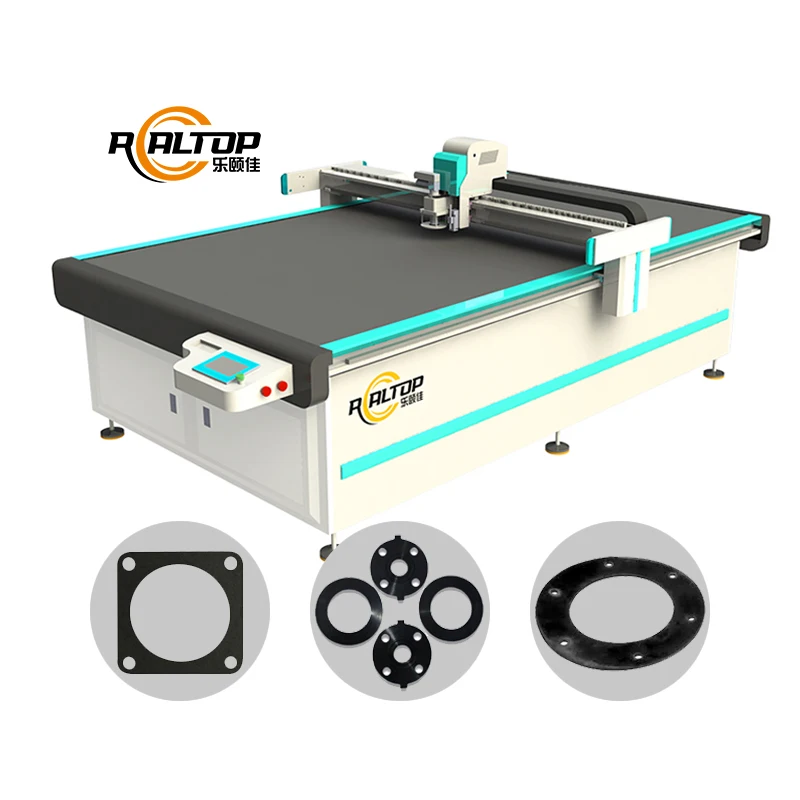
A Gasket Cutting Machine selected only by working area and maximum speed will fail the moment your material changes from compressed fiber to aramid composite or soft cork-rubber.
In the sealing industry, the wrong oscillating frequency or blade geometry does not just slow production down — it produces frayed edges that fail pressure testing and crushed foam layers that compromise thermal insulation. I have walked into workshops in Monterrey where an entire batch of head gaskets was scrapped because the knife head was configured for rigid asbestos-free board while the operator was running a softer, multi-layer aramid layup. The machine physically cut the shape, but the edge delamination rendered every piece unusable. [NEED_CITE: edge delamination failure modes in multi-layer gasket materials]
Matching the Blade to the Sealing Material
The oscillating knife, pneumatic knife, and servo vibrating knife each serve distinct material families within gasket production. Dense compressed fiber sheets demand high-frequency, short-stroke oscillation with a pointed tungsten blade to fracture the resin binder cleanly. Softer elastomeric foams, by contrast, require a lower-frequency, longer-stroke action with a smooth-edged blade to avoid tearing the cell structure. This Gasket Cutting Machine production line approach means the tool head is selected after a material sample test, not assumed from a generic catalog entry.
Why CCD Positioning Matters for Contour Work
Many gasket designs are printed onto large composite sheets with registration marks, especially in automotive interior and HVAC sealing where nesting software optimizes material yield. The panoramic visual positioning system reads these printed contours and adjusts the cutting path in real time. Without this capability, any sheet distortion during printing or feeding introduces a registration error that accumulates across the nest, leaving the final pieces out of tolerance. [NEED_CITE: CCD contour tracking accuracy in high-speed digital cutting]
Reading the Specification Sheet Beyond the Headlines
The 2000mm/s maximum travel speed is the unloaded axis velocity; actual cutting speed through 6mm aramid fiber composite will be a fraction of that figure depending on contour complexity and corner density. The ±0.1mm reset accuracy defines repeatability after a homing cycle, which directly determines whether consecutive gaskets from the same nest will pass a go/no-go gauge check. The quenched bed construction eliminates residual welding stress, preventing the frame from warping over months of continuous operation and maintaining flatness across the full 3000×2200mm working area. Conveyor feeding with a glass fiber tension belt prevents the belt from stretching under heat or chemical exposure common in gasket workshops.
The Cost of Skipping the Material Test
A buyer who specifies a Gasket Cutting Machine turnkey system based solely on table size and voltage often discovers after delivery that the standard oscillating knife produces ragged edges on their specific PTFE-filled laminate. Retrofitting a pneumatic knife head and reprogramming the toolpath parameters adds downtime and freight cost. In some cases, the vacuum zoning on the conveyor table is configured for large gasket panels, leaving small flange seals lifting during cutting and ruining the edge finish. [NEED_CITE: vacuum table zoning requirements for small sealing components]
Why Source This Equipment from the Builder
The manufacturer operates an in-house design team covering both knife and laser cutting technologies, so the cutting method is matched to the sealing material rather than forced into a single process. Tool head and conveyor table configurations are specified after reviewing your material data sheet and daily volume. CCD camera contour recognition is validated on your printed sheets before the order is finalized. Voltage, control language, and software file format compatibility are confirmed during the quotation stage, not left to the shipping department. Sample cutting on your actual aramid, cork-rubber, or foam stock is performed and documented before the machine enters production.
Documentation & Verification
- Sample cutting report on your gasket material confirming edge quality and thickness capability
- Tool head and conveyor configuration list matched to your sealing material and daily volume
- Electrical schematic with confirmed voltage, frequency, and phase for your facility
- Software license and file format compatibility note for your existing nesting workflow
- Factory test record demonstrating cutting accuracy on your material before dispatch
- Packing photographs showing machine securing and tool head protection for transit
Installation, Commissioning & Support
- Level foundation required across the full 3000×2200mm bed footprint to maintain frame geometry
- Dedicated 380V or 220V circuit with confirmed frequency for the REALTOP high-speed controller
- Machine arrives with tool heads pre-mounted; conveyor belt tension verified during commissioning
- First-run parameter tuning on your gasket material, including oscillation frequency and vacuum zoning
- Operator training covering CCD mark recognition, nest file import, and blade change procedures
- Spare blade and belt wear parts list provided with recommended replacement intervals
Before You Request a Quote
Provide your gasket material type, thickness range, and whether the sheets are pre-printed with contour marks. Confirm your daily cutting volume, the largest sheet dimension you receive from your supplier, and the voltage and frequency at your facility. Let us know which file format your nesting software exports so we can verify compatibility before the machine is built.
Frequently Asked Questions
Q: How is cutting thickness capacity determined for different gasket materials?
A: The 40mm figure is a general reference; actual capability depends on your material density, fiber orientation, and compressibility. Aramid composite at 3mm thickness cuts differently from closed-cell EPDM foam at 15mm. We run your specific material sample to confirm achievable thickness and edge quality before finalizing the tool head configuration.
Q: Can the control system and interface be adapted to our local language?
A: Yes. The REALTOP controller supports language customization confirmed before shipment. We also verify that your local voltage and frequency match the electrical system specification, including phase configuration, to avoid on-site transformer issues during installation.
Q: What determines actual throughput on gasket contour cutting?
A: Throughput depends on material hardness, sheet thickness, contour complexity, and the number of internal cutouts per gasket. The 2000mm/s axis speed is an unloaded maximum. We calculate realistic cycle time from your actual nest layout and cutting path during the sample test phase.
Q: How does the conveyor system integrate with upstream and downstream equipment?
A: The automatic feeding conveyor accepts rolls or pre-cut sheets from your material storage area. Downstream, cut gaskets can be collected manually or transferred to a sorting station. Integration with existing printing or stacking systems depends on your line layout and is discussed during the configuration stage.





商品评价
Clear filtersThere are no reviews yet.