

Blog
Can You Lease a Cutter Plotter Instead of Buying It Outright?

Can You Lease a Cutter Plotter Instead of Buying It Outright?
Yes. We offer leasing options for our cutter plotters. This means you can use the machine right away without paying the full price upfront. The monthly payment depends on the model you choose, how long you need it, and your order situation.
Leasing lets you start production now while spreading the cost over time.1 Our customers include startups with limited launch budgets, traders managing seasonal order volumes, and manufacturers needing multiple machines but facing budget cycles. You pay monthly instead of all at once, which helps when you want the equipment but cash flow timing is tight.
We started offering leasing after hearing the same concern from different buyers: "We need the machine, but not right now because of the budget." That phrase kept coming up. It was not about the equipment being wrong. It was about timing and cash availability. So we created payment flexibility to match how our customers actually plan their spending.
Who Actually Asks About Payment Flexibility?
Over the past few years, we noticed three types of buyers ask about installment or leasing options. Each group has a different reason, but the core issue is the same—they want the cutter plotter, they just cannot or prefer not to pay everything upfront.
Startups launching new product lines have tight budgets. They need the machine to fulfill orders, but they are also paying for materials, labor, marketing, and sometimes renting workspace. One customer told us directly: "We have the orders, we just cannot tie up all our cash in equipment right away." They were not questioning the machine quality. They were managing multiple expenses at once.
Traders with unstable order volumes are another group. Their business depends on incoming contracts. Some months are busy, others are slow. They do not want the machine sitting idle after paying full price. Leasing turns a fixed cost into a variable one that aligns better with their revenue pattern.2 One trader explained: "If orders drop for two months, I still have cash to handle it. The machine payment is predictable and smaller."
Mid-sized manufacturers needing multiple units face budget cycle constraints. They might need three or four machines, but their annual budget only covers one or two at full price. Leasing allows them to deploy all units now and spread payments across fiscal periods. We have seen this with automotive interior suppliers who got bulk orders but could not wait another year to expand capacity.
Common Concerns That Stop Buyers From Asking
Many buyers assume leasing always costs more than buying outright. That is partially true if you only compare total payments. But it ignores what you do with the cash you keep. If you use that money to buy materials, hire staff, or take on more orders, the revenue from those actions can exceed the extra leasing cost.3 It depends on your situation, not a universal rule.
Another misconception is that leased equipment is refurbished or used. Our leasing option uses new machines from our production line. The warranty and technical support are identical to purchased units. We do not offer used equipment under any payment plan. This confusion comes from rental companies in other industries, but as a manufacturer, we only provide equipment we built.
Some buyers do not realize they have options after the lease ends. You can buy out the machine at a predetermined price, renew the lease if you still need it, or return it if your production needs changed. These terms are part of the agreement from the start, not surprises at the end. We outline them during the initial discussion so you can plan ahead.
| Concern | Reality | What It Means For You |
|---|---|---|
| Leasing always costs more | Total payments are higher, but keeping cash can generate revenue that offsets the difference | Compare payment amount to what you earn by using that cash elsewhere |
| Leased machines are used | We provide new equipment from our factory with full warranty | Same quality and support as purchased units |
| No flexibility after lease ends | You can buy, renew, or return based on agreed terms | Terms are set upfront, not decided later |
| Only certain models qualify | Most of our cutter plotters are available for leasing | Check with us about your specific model requirements |
How Do Leasing Terms Actually Work?
Leasing terms are not standardized. We adjust them based on your order size, production stability, and growth timeline. The main factors include lease duration, monthly payment amount, initial deposit, and buyout price at the end. Each of these can be negotiated.
Lease duration typically ranges from 12 to 36 months.4 Longer terms mean lower monthly payments but higher total cost.5 Shorter terms are the opposite. The right choice depends on how long you expect to use the machine and whether you plan to buy it out. We help you calculate different scenarios so you can see the trade-offs clearly.
Monthly payment amounts depend on the machine model, lease duration, and your deposit. A higher deposit reduces monthly costs.6 Some customers prefer minimal deposit to preserve cash, others put down more to lower ongoing expenses. We structure payments to fit your cash flow cycle. If your revenue peaks in certain months, we can adjust payment schedules to match.
What Happens During and After the Lease?
During the lease period, you are responsible for routine maintenance like blade replacement and machine cleaning.7 We provide remote technical support and can send parts if something breaks. Major repairs covered under warranty are handled the same way as purchased machines.8 You own the production output, not the machine itself, until the lease ends.
At the end of the lease, you decide the next step. Most customers choose one of three options: buy out the machine at the agreed price, extend the lease with adjusted terms, or return the equipment and lease a newer model. The buyout price is set when you sign the initial agreement, so you know exactly what you will pay if you keep it.
Some customers ask if they can upgrade mid-lease if their production needs change. We evaluate this case by case. If you need a higher-capacity model, we calculate the remaining lease balance and apply it toward a new agreement for the upgraded machine. This is not automatic, but we try to accommodate growth situations.
Leasing vs. Buying: What Actually Matters?
The comparison is not just about money. It is about timing, cash availability, and risk. Buying outright means you own the machine immediately, no ongoing payments, and full control. But it requires significant upfront capital. If that cash could be used to take on more orders, hire staff, or expand production, you need to weigh the potential return against the leasing cost.
Leasing reduces initial expense and spreads risk. If your order volume drops, you are not stuck with a fully paid machine sitting idle.9 If technology improves significantly, you can upgrade at lease end without selling used equipment.10 But total payments exceed the purchase price, and you do not own the machine until buyout.11
Many customers find leasing helps them start production sooner. A packaging supplier told us: "We had orders but needed the machine in two weeks. We did not have time to wait for budget approval for the full amount. Leasing let us deliver on time, and we bought it out after six months when cash flow improved." That scenario plays out more often than people expect.
| Factor | Buying Outright | Leasing |
|---|---|---|
| Initial cost | Full machine price plus shipping | Deposit plus first month payment |
| Ownership | Immediate | After buyout or lease end |
| Cash flow impact | Large one-time expense | Smaller recurring expense |
| Flexibility | Fixed investment, harder to change | Upgrade or return options available |
| Total cost | Lower total payment | Higher total payment over time |
| Risk if orders drop | Machine sits idle, no refund | Smaller sunk cost, easier to adjust |
How to Start a Leasing Discussion With Us
Contact our sales team with your basic information: the cutter plotter model you need, your expected order volume, and how long you plan to use the machine. We ask about your production cycle and budget timeline to propose terms that match your situation. This is not a standard form—we build the agreement around your business.
We do not position ourselves as a financing company. We are a machinery manufacturer offering payment flexibility as part of our sales process. The equipment comes from our factory, warranty and support are the same as purchased units, and we stay involved throughout the lease period.
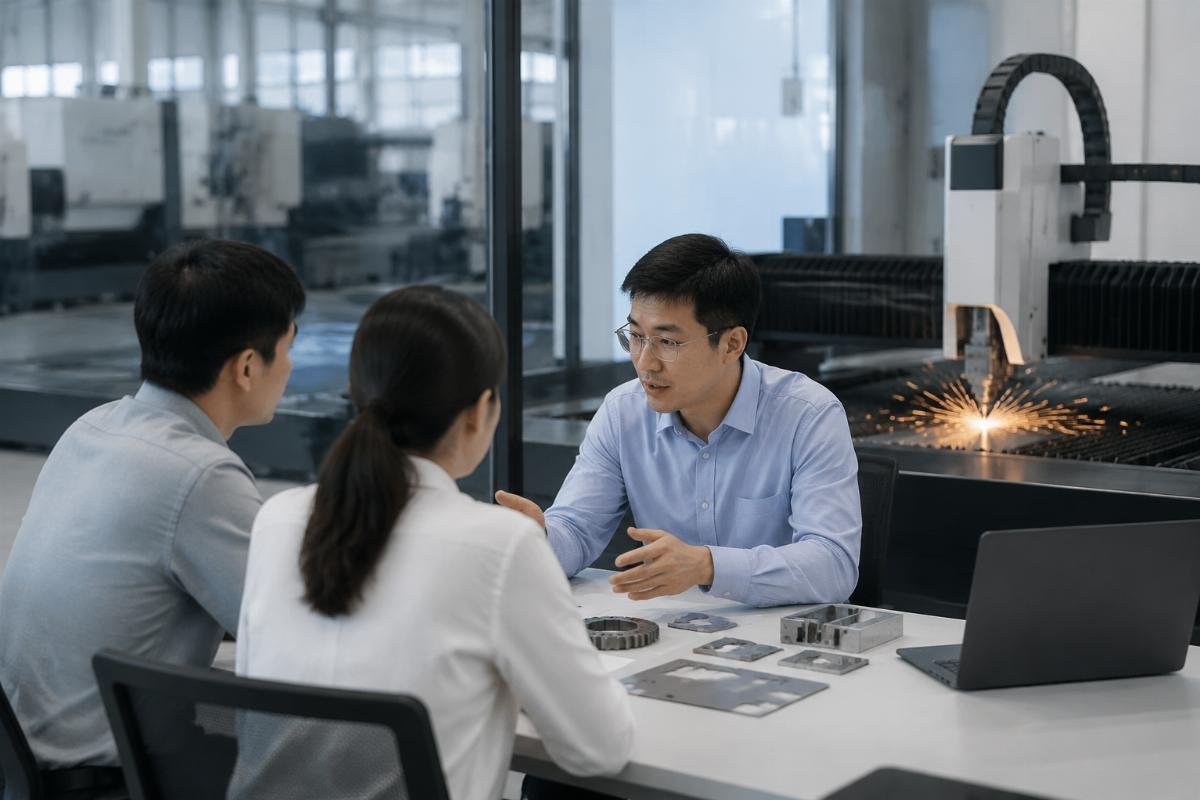
You can request a payment breakdown to compare leasing vs. buying. We show you different lease durations, deposit options, and total cost scenarios. Some customers share their order forecasts with us so we can align payments with expected revenue. Others prefer fixed terms for predictable budgeting. Both work.
After you agree to terms, we prepare the equipment and handle delivery the same way as a regular purchase. Installation support, training, and warranty activation happen on schedule. The lease agreement covers payment dates, maintenance responsibilities, and end-of-term options. Everything is documented before the machine ships.
What If Your Situation Changes Mid-Lease?
We have seen order volumes spike unexpectedly, requiring a second machine. We have also seen customers want to pause production for a few months. We handle these on a case-by-case basis. Pausing payments is rare, but we consider it if you face a genuine slowdown. Adding a second unit usually means starting a new lease agreement with adjusted terms.
If you want to buy out early, we calculate the remaining balance and offer a settlement price. This is lower than the sum of remaining payments because you are eliminating future interest.12 Some customers do this when they receive a large contract and want full ownership to secure financing from their bank.
Does Leasing Make Sense for Your Business Right Now?
It depends on your specific situation. If you have the full purchase price available and no better use for that cash, buying outright is simpler. If you are managing tight cash flow, uncertain order volume, or need multiple machines, leasing removes the upfront barrier. The question is not "Is leasing cheaper?" but "Does spreading the cost help me start production sooner or manage risk better?"
We offer leasing because our customers asked for it. We do not push it as the default option. Some buyers need it, others do not. Our role is to explain how it works, show you the numbers, and let you decide based on your business priorities.
We are Realtop Machinery, and we build cutter plotters for flexible materials processing. We started offering leasing after hearing buyers say "We need the machine, just not right now." That sentence came up enough that we realized timing and payment structure matter as much as equipment specifications. Leasing is our way of removing that obstacle.
Conclusion
Leasing a cutter plotter spreads the cost over time and reduces upfront expense, which helps when you need the machine but cash flow timing is tight. We offer flexible terms based on your order volume, production cycle, and growth plans. Contact us to discuss options that match your situation.
"To buy or to lease: The advantages and costs of leasing ... - PMC - NIH", https://pmc.ncbi.nlm.nih.gov/articles/PMC7202199/. Equipment leasing is recognized in business finance literature as a method that provides immediate access to capital assets while distributing payment obligations across the lease term, thereby reducing initial capital requirements. Evidence role: general_support; source type: education. Supports: Equipment leasing enables immediate asset use while spreading payments over time. Scope note: General business finance principle; specific benefits vary by industry, equipment type, and individual business circumstances. ↩
"[PDF] Operating Lease Expenses - NYU Stern", https://pages.stern.nyu.edu/~adamodar/pdfiles/papers/oplev.pdf. In managerial accounting, operating leases are classified as period costs rather than capital expenditures, creating a payment structure that can be aligned with operational cycles and revenue patterns. Evidence role: mechanism; source type: education. Supports: Leasing arrangements can convert capital expenditures into operating expenses with periodic payment structures. Scope note: Accounting treatment depends on lease structure and applicable accounting standards; not all leases qualify as operating expenses. ↩
"Lease versus Purchase | EME 460 - EMS Online Courses", https://courses.ems.psu.edu/eme460/node/767. Financial economics recognizes that capital allocation decisions should account for opportunity costs, where funds preserved through leasing arrangements may generate returns in alternative applications that offset financing premiums. Evidence role: mechanism; source type: education. Supports: Opportunity cost analysis in capital budgeting considers alternative uses of capital when evaluating financing decisions. Scope note: Actual returns depend on specific investment opportunities available to each business; opportunity cost benefits are not guaranteed. ↩
"Machinery Leasing - Is It for You? | Ag Decision Maker", https://www.extension.iastate.edu/agdm/crops/html/a3-35.html. Equipment leasing industry data indicates that lease terms for manufacturing equipment commonly range from one to five years, with shorter terms of 12-36 months frequently used for technology-sensitive or specialized equipment. Evidence role: statistic; source type: institution. Supports: Common equipment lease terms in the manufacturing sector. Scope note: Industry averages vary by equipment type, value, and sector; specific terms are negotiated based on individual circumstances. ↩
"Amortizing Loan Calculator - Office of Financial Readiness", https://finred.usalearning.gov/ToolsAndAddRes/Calculators/Loan/calculator/Amortizing-Loan. In amortization mathematics, extending the repayment period reduces periodic payment amounts through distribution across more periods, while simultaneously increasing total interest paid due to longer exposure to interest accrual. Evidence role: mechanism; source type: education. Supports: The mathematical relationship between loan term, periodic payment, and total interest cost. Scope note: Assumes fixed interest rate; actual relationship may vary with variable rates or different fee structures. ↩
"How to decide how much to spend on your down payment", https://www.consumerfinance.gov/about-us/blog/how-decide-how-much-spend-your-down-payment/. In lease and loan amortization, a larger initial deposit reduces the principal amount requiring financing, which proportionally decreases the periodic payment needed to amortize the remaining balance over the term. Evidence role: mechanism; source type: education. Supports: The effect of initial payment on financed principal and subsequent periodic payments. Scope note: Direct mathematical relationship; actual payment reduction depends on specific calculation method and fee structure used. ↩
"Operating system - Wikipedia", https://en.wikipedia.org/wiki/Operating_system. In equipment leasing practice, operating leases commonly assign routine maintenance and operational care responsibilities to the lessee, while structural repairs and major component failures may remain with the lessor depending on contract terms. Evidence role: general_support; source type: education. Supports: Standard allocation of maintenance responsibilities in equipment leasing agreements. Scope note: Maintenance allocation varies by lease type and specific contract terms; not a universal standard across all leasing arrangements. ↩
"Businessperson's Guide to Federal Warranty Law", https://www.ftc.gov/business-guidance/resources/businesspersons-guide-federal-warranty-law. Under consumer protection and warranty law in most jurisdictions, manufacturer warranties typically run with the equipment rather than the purchaser, meaning warranty coverage applies to leased equipment during the warranty period regardless of ownership status. Evidence role: general_support; source type: government. Supports: Manufacturer warranty obligations apply regardless of ownership structure. Scope note: Warranty terms and transferability vary by jurisdiction and specific manufacturer policies; some warranties may have restrictions on commercial lease arrangements. ↩
"[PDF] Residual Risk and the Valuation of Leases under Uncertainty and ...", https://www.cmu.edu/ceic/assets/docs/publications/working-papers/ceic-02-02.pdf. Operations and financial management literature identifies equipment leasing as a strategy to manage capacity risk under demand uncertainty, as lease structures can provide exit options or reduced sunk costs compared to capital purchases when utilization falls below expectations. Evidence role: general_support; source type: education. Supports: Leasing as a risk management strategy for demand uncertainty. Scope note: Risk reduction depends on lease terms, including early termination provisions and penalties; leases with buyout obligations may not provide significant risk mitigation. ↩
"What's impacting equipment leasing in 2026 - Abrigo", https://www.abrigo.com/blog/whats-impacting-equipment-leasing-in-2026/. Business finance literature recognizes equipment leasing as a method to mitigate technology obsolescence risk, as lease structures can provide upgrade options or equipment return provisions that eliminate the need to dispose of owned assets when adopting newer technology. Evidence role: general_support; source type: education. Supports: Leasing as a strategy to manage technology obsolescence risk. Scope note: Upgrade flexibility depends on specific lease terms; not all leases include upgrade provisions, and technology advancement rates vary by equipment category. ↩
"FRB: Vehicle Leasing: Leasing vs. Buying: Monthly Payments", https://www.federalreserve.gov/pubs/leasing/resource/different/payments.htm. In equipment financing, lease-to-own and installment purchase arrangements incorporate financing costs (interest, fees, and risk premiums) into the payment structure, resulting in total payments that exceed the cash purchase price by the cost of capital over the term. Evidence role: mechanism; source type: education. Supports: The cost structure of financed acquisitions compared to cash purchases. Scope note: Cost differential varies with interest rates, term length, and creditworthiness; comparison assumes no alternative return on preserved capital. ↩
"Comment for 1026.32 - Requirements for High-Cost Mortgages", https://www.consumerfinance.gov/rules-policy/regulations/1026/Interp-32. In amortized financing, early payoff eliminates future interest accrual periods, and the settlement amount is calculated as the present value of remaining principal rather than the sum of scheduled payments, which include interest charges that would have accrued over the remaining term. Evidence role: mechanism; source type: education. Supports: The mathematical basis for early payoff discounts in financed agreements. Scope note: Actual early buyout terms depend on contract provisions; some agreements include prepayment penalties or use different calculation methods that may reduce or eliminate the discount. ↩