


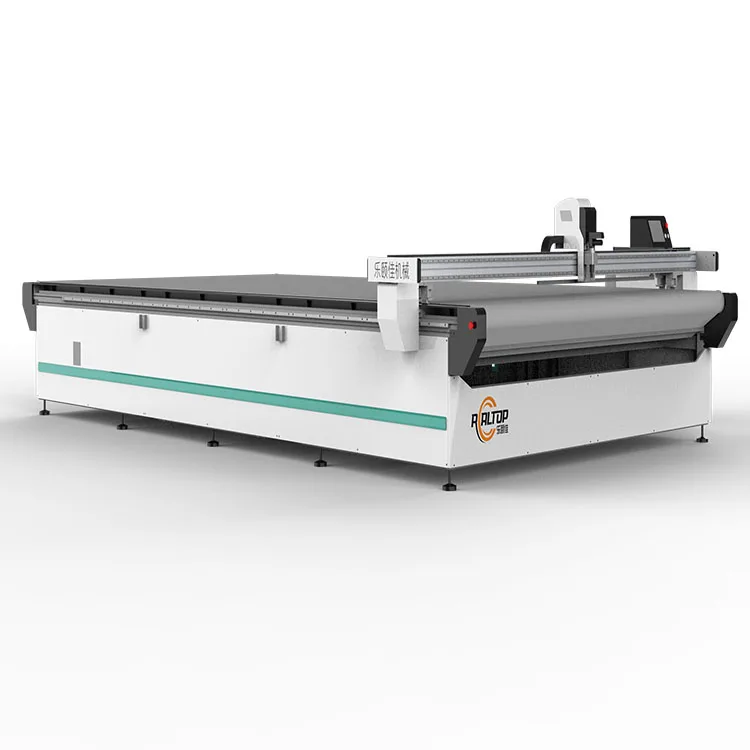
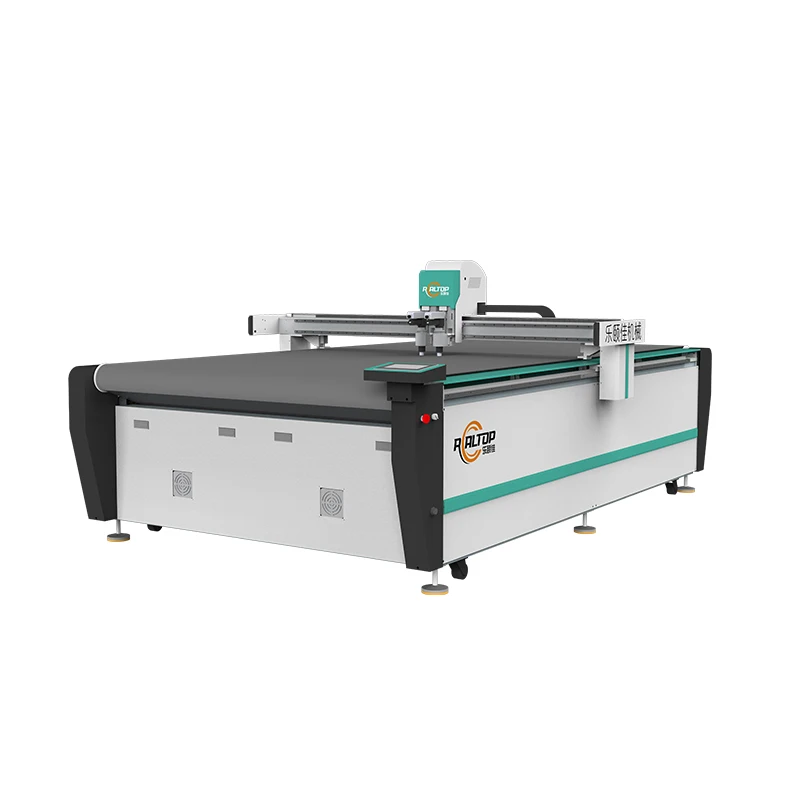
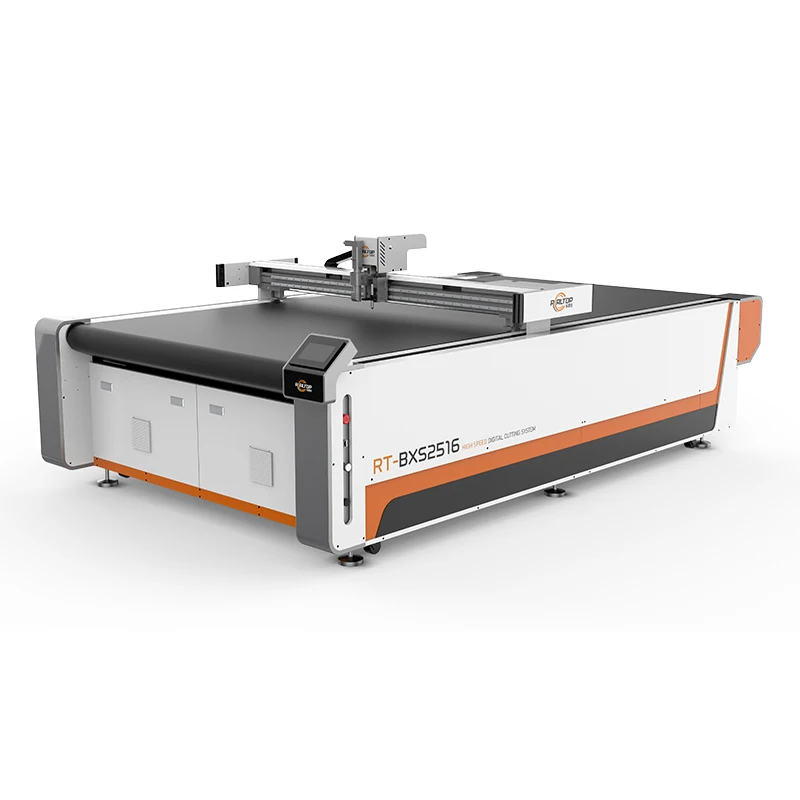
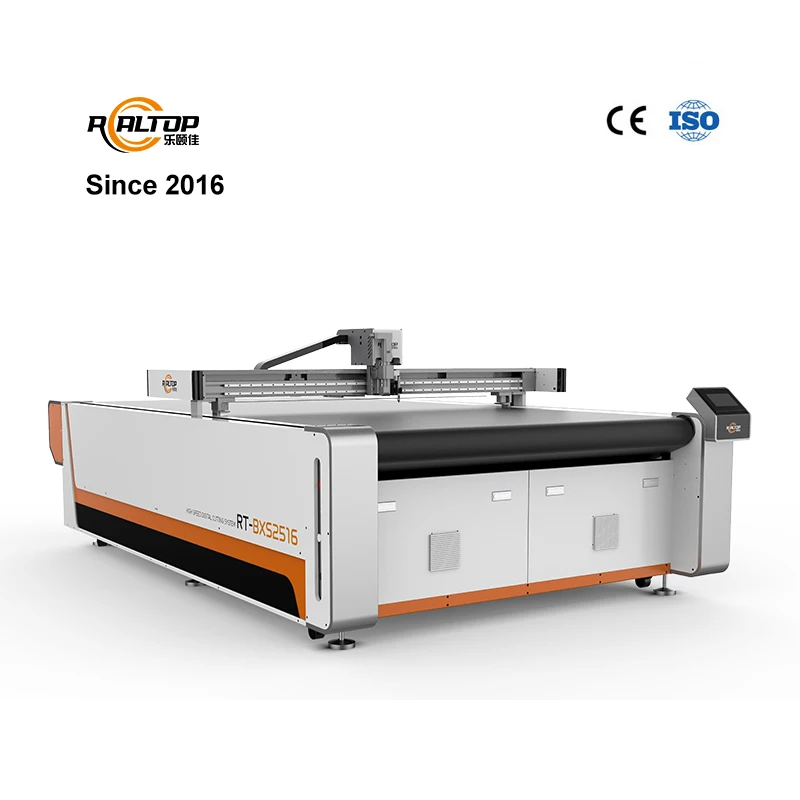
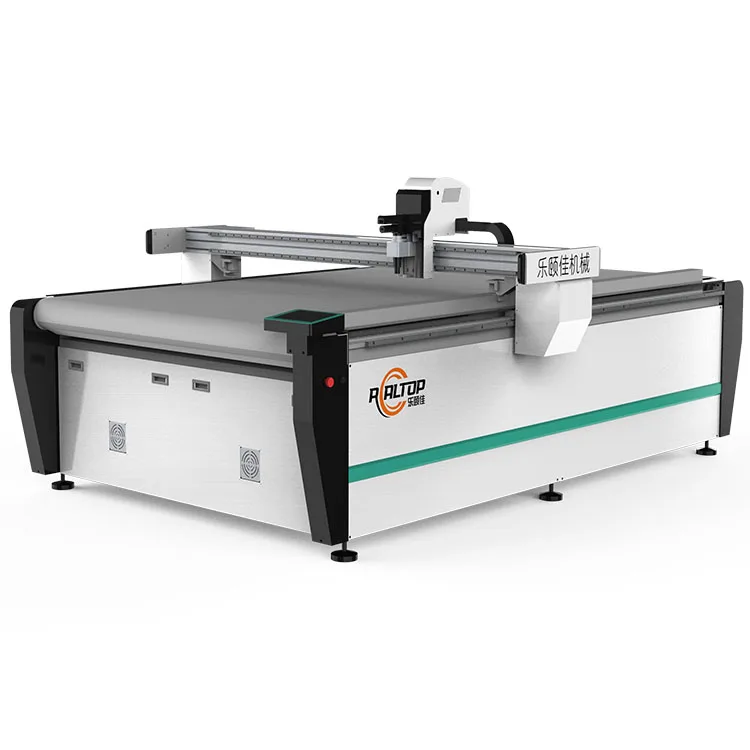
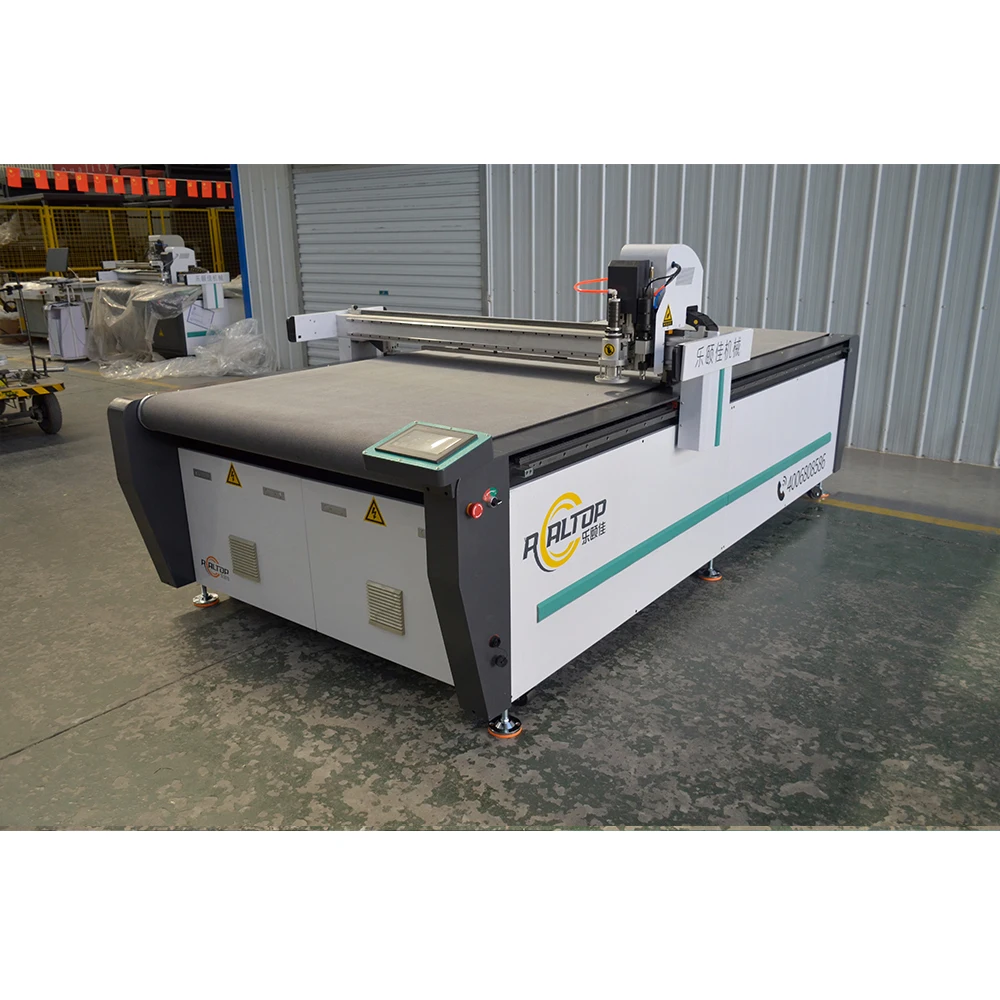

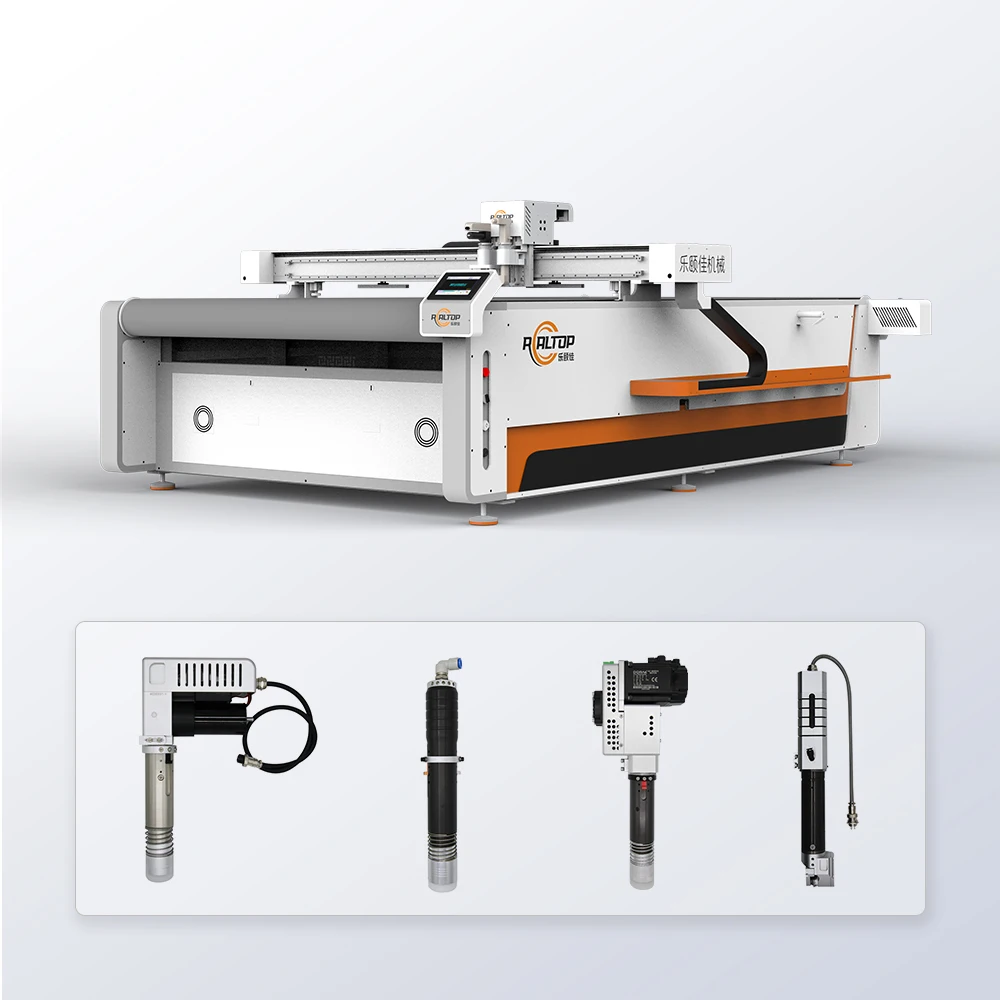
Customized tooling and vacuum zoning — Every RT-D2516/RT-S2516 ships with a knife head and table layout matched to your fabric thickness, verified by a sample cut on your actual roll stock before the order is locked in.
Technical Specifications
| Parameter | Value |
|---|---|
| Model | RT-D2516/RT-S2516 |
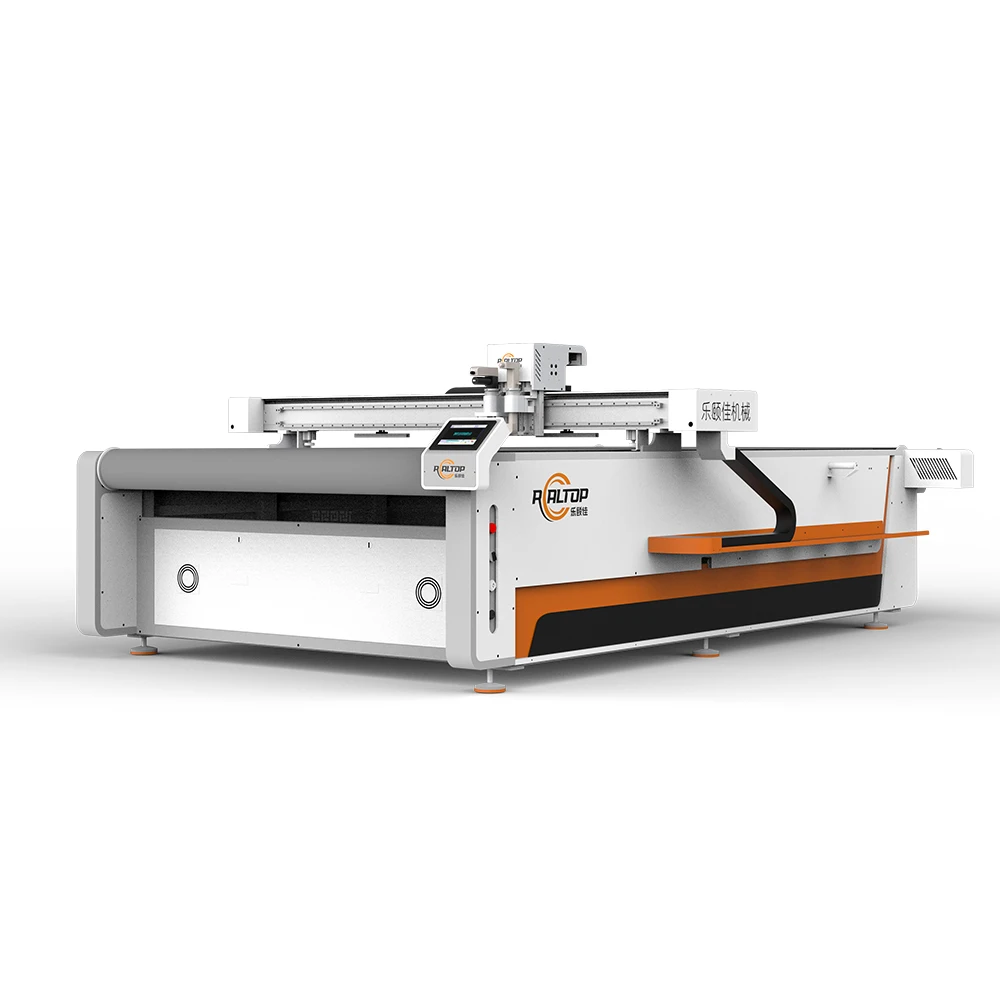
| Product Type | CNC Oscillating Knife Cutting Machine |
| Working Area | 1600 × 2500 mm |
| Machine Size | 3450 × 2300 × 1250 mm |
| Rated Power | 9 kW |
| Voltage | 380V ± 10% |
| Max Cutting Thickness | Up to 100 mm (varies with material density and type) |
| Translational Velocity | 800 – 2000 mm/s |
| Repeated Accuracy | ≤ 0.1 mm |
| Transmission System | Digital servo motor, linear guide, synchronous belt, ball screw |
| Vacuum Table | Aluminum air box platform with integrated zoning; split box supported |
| Multifunctional Head | Swiss imported knife with full cut, half cut and cursor location |
| Safety Device | Infrared sensors, anti-collision and emergency stop |
| Control Panel | Touch screen, multiple language supported |
| Software Compatibility | PLT, DXF, AI and other formats; auto typesetting included |
Application Suitability
| Application | Material or Output |
|---|---|
| Roller blinds and window treatments | Coated blackout fabric, PVC-backed polyester, sunscreen mesh |
| Automotive interior trim | Synthetic leather, nonwoven acoustic felt, foam-backed composites |
| Upholstered furniture and soft furnishings | Velvet, linen, heavy canvas, PU and EVA foam laminates |
| Footwear and luggage production | Natural leather, split leather, textile mesh, nylon webbing |
| Outdoor and sports gear | Ripstop nylon, TPU-coated fabric, XPE foam layers |
| Gasket and seal fabrication | Rubber sheet, silicone, PTFE, composite gasket material |
Why Vacuum Zoning Decides Your Edge Quality on Small Fabric Parts
A high-powered oscillating knife means nothing if the fabric lifts off the table during the final pass.
When cutting small garment panels or intricate blind vane shapes from coated polyester, a single large vacuum zone leaves edges of the material free to curl as the blade exits the cut path. The split-box aluminum platform on the RT-D2516/RT-S2516 allows operators to activate only the zones directly beneath the material footprint, concentrating suction exactly where it counts [NEED_CITE: vacuum table zoning principles for CNC flatbed cutters]. I once saw a production run of roller blind panels scrap nearly a full roll because a generic single-zone table could not hold narrow strips flat at cutting speed, producing frayed edges that forced the entire batch back to the manual cutting table. Configuring a CNC oscillating knife cutting machine for fabric production without first mapping your part geometry to the available vacuum zones is the most common avoidable mistake I encounter on site.
Matching the Knife Head to Coated and Layered Textiles
The Swiss-imported oscillating knife on the RT-D2516/RT-S2516 cycles through a full cut and a programmable half cut, which matters when you are kiss-cutting a coated blackout fabric without slicing through the PVC backing. For heavier composite materials like foam-laminated upholstery fabric, a high-frequency oscillation amplitude keeps the blade passing through without compressing the foam layer. When the material shifts from single-layer garment textiles to multi-ply automotive interior stacks, the tool head can be swapped on the shop floor for a round knife or a pneumatic drag knife, and the CNC oscillating knife cutting machine for fabric production continues running without a change of software profile.
CCD Contour Recognition at Line Speed
Printed roller blinds and digitally printed upholstery panels require the blade to follow contour marks that shift with every roll due to stretch and registration drift during printing. The available CCD camera positioning — offered as a small camera for dot-mark tracking or a full panoramic camera for pattern recognition — reads fiducial marks on the fabric surface and adjusts the cut path in real time [NEED_CITE: CCD camera contour tracking accuracy on flexible substrates]. On a recent job running printed sunscreen mesh for commercial blinds, the panoramic camera held registration within tolerance across a full 2500 mm stroke, whereas a fixed-path file would have drifted off-mark by the time the blade reached the far end of the table.
What the Spec Sheet Numbers Actually Mean on the Shop Floor
A translational velocity range of 800 – 2000 mm/s is not a single speed you set and forget; the usable speed depends entirely on how many corners and curves your nest contains and how thick the material is. At 2000 mm/s the RT-D2516/RT-S2516 handles straight-line cuts on thin woven polyester effectively, but a tight curve on 80 mm EVA foam demands a much lower speed to prevent the oscillating blade from deflecting. The repeated accuracy of ≤ 0.1 mm, delivered through Taiwan Hiwin linear guides and ball screws, ensures that nesting software output translates directly to the cut piece — meaning two identical panels cut hours apart will still align on the assembly bench. The 9 kW rated power covers the servo drives, the oscillating head motor, and the 7.5 kW vacuum pump simultaneously, so the machine does not trip a breaker when the pump ramps to full suction during a heavy cut cycle. Understanding these relationships prevents buyers from specifying a machine on working area alone and discovering the speed or power envelope does not match their daily volume.
The Hidden Cost of Skipping the Sample Cut
Every coated fabric behaves differently under an oscillating blade: a PVC-backed blackout cloth may cut cleanly at one oscillation frequency while a silicone-coated fiberglass mesh frays at the same setting. Without running the buyer’s actual roll stock through a sample cut before the machine configuration is finalized, the delivered CNC oscillating knife cutting machine for fabric production may require weeks of parameter re-tuning on site [NEED_CITE: material-specific knife cutting parameter development]. I learned this the hard way when a standard polyester test run looked perfect, yet the customer’s real coated sunscreen fabric produced ragged edges that demanded a complete blade and speed overhaul. That is why the process here always starts with your material, not our assumptions.
Why Source This Machine Through a Manufacturer That Builds Both Knife and Laser Lines
Realtop operates in-house design and production across both oscillating knife and laser cutting platforms, which means a buyer processing both woven fabric and acrylic signage can match each material to the correct cutting method rather than forcing one technology to cover everything. The tool head and vacuum table configuration on the RT-D2516/RT-S2516 is specified per material and per production volume, not selected from a default catalog page. CCD camera positioning is verified against the buyer’s actual print registration marks before the order is confirmed. Voltage, plug format, and control panel language are locked in during the specification stage, so a 380V machine does not arrive in a 415V facility without the correct transformer. Software file format compatibility — PLT, DXF, AI — is tested with the buyer’s existing nesting files before shipment.
Documentation & Verification
- Machine specification sheet listing every configured tool head and table zone
- Electrical schematic and voltage confirmation matched to your facility supply
- Sample cutting report produced on your exact fabric roll stock
- Factory test record showing repeated accuracy and cut edge quality
- Software licence and file format compatibility note for your nesting workflow
- CE declaration documentation where applicable to your import market
Installation, Commissioning & Support
- Machine footprint of 3450 × 2300 mm requires a level floor with clearance for roll loading on the auto-feeding side
- 380V ± 10% dedicated circuit required; confirm local frequency and plug type before dispatch
- 7.5 kW vacuum pump generates significant noise; plan extraction or acoustic enclosure accordingly
- First commissioning includes vacuum zone mapping against your standard nest layouts
- Operator training covers tool head changeover, CCD calibration and software nesting import
- Spare parts list and one-year warranty provided for domestic and international installations
What to Prepare Before Requesting a Quotation
Send your material data sheet or a physical sample roll identifying fabric type, coating composition, thickness and standard roll width. Confirm your daily cutting volume, the average number of distinct part shapes per nest, and your current nesting software and file formats. Specify the local voltage, frequency, and the control panel language your operators require.
Frequently Asked Questions
Q: How do I choose between an oscillating knife and a drag knife for my fabric?
A: Oscillating knives cut through layered or dense textiles by vibrating the blade at high frequency, which prevents compression of foam-backed materials. Drag knives suit thin, single-layer woven fabrics and vinyl where a smooth continuous cut is sufficient. The RT-D2516/RT-S2516 supports both heads, and the correct choice depends on your thickest and most demanding material.
Q: Can the CCD camera track printed marks reliably at full cutting speed?
A: The panoramic and dot-mark CCD options adjust the cut path dynamically as the camera reads fiducial marks on the moving fabric. Reliability depends on mark contrast, size and spacing, which is why we verify tracking performance on your printed material before confirming the camera specification for your order.
Q: How does vacuum table zoning prevent small fabric parts from lifting?
A: The split-box aluminum platform lets operators activate only the zones beneath the material, concentrating suction on the actual cutting area. This prevents small garment panels or narrow blind vane strips from lifting at the edges during high-speed cuts, which is critical for maintaining edge quality on intricate shapes.
Q: Will the software accept my existing PLT, DXF or AI files?
A: The included auto typesetting software imports PLT, DXF, AI and other standard formats. Before the order is finalized, we test your actual production files on the machine software to confirm layer recognition, nesting compatibility and that no geometry is lost during import, avoiding workflow disruption after delivery.
Q: How are voltage and control language confirmed before shipment?
A: During the specification stage we document your facility voltage, frequency and plug type, then cross-check against the machine electrical schematic. Control panel language — English, Russian, Italian, Chinese or a custom option — is programmed and verified at factory test so operators can use the machine from day one.



商品评价
Clear filtersThere are no reviews yet.